
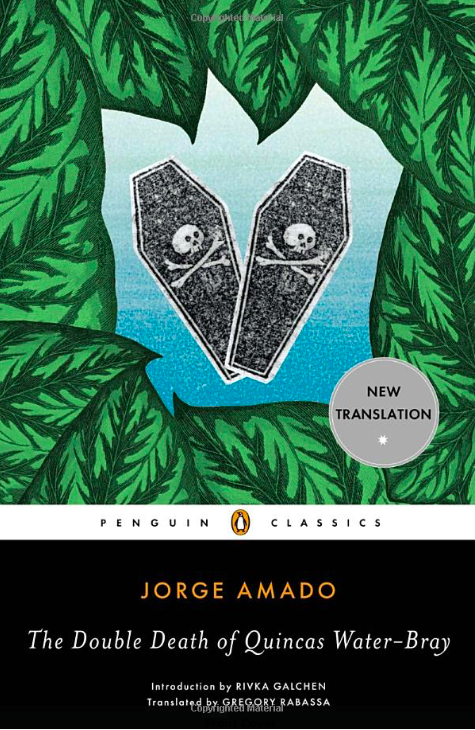
Why this book: Recommended by Janar in my literature reading group. Janar lives in Brazil, and Jorge Amado is very well known author in Brazil, but not in the US. This novella – only about 70 pages – is a well regarded book of his, so we added it as an additional option to another book we were reading.
Summary in 4 Sentences: A well established respectable, church going family man suddenly up and leaves his family, and not only joins the ranks of carousers, partyers, and deplorables in Bahia, Brazil, he becomes a leader and hero to those whose lives revolve around the bars, the red-light district, the docks, and the lower class speak-easys. His family is appalled and embarrassed, choose to pretend that he doesn’t exist, don’t speak about him to their friends or around the children, until they are told that he was found dead in his cheap and dirty cold water flat, and now they have to claim the body and bury him. Meanwhile his many admiring friends and fellow carousers want to appropriately mourn the passing of the chief partyer, much to the chagrin of his family. It is a hilarious story of the clash of cultures between the world of strict adherence to conventional morality, and the world of those who don’t care a whit for conventional morality, preferring to live for today’s more immediate pleasures and friendships.
My Impressions: Very clever, well written and well translated. Worthy of Steinbeck or Hemingway – both of whom would have very much enjoyed this book, as did I. We only get to know our protagonist after he is dead, from the sad recollections of his very conventional daughter, and the happy recollections of his friends and fellow carousers. He is dead, but is he really? He had been a model upper middle class bureaucrat in the town of Bahia, Brazil, respectable in every way: Joaquim Soares de Cunha, a husband, a father, with a nice home, nice family, church going, doing well in his civil servant career, well-liked and well-respected among respectable people in the community. Then, at one point, one day, something snapped.
He got up from his chair, called his wife and daughters “vipers,” and walked out, and joined the ranks of the carousing dispossessed in the barrios of Bahia, Brazil, consorting with those who respectable society preferred to pretend didn’t exist. He reinvented himself as Quincas Water-Bray and became a well-loved and well-respected member of a different community – one that didn’t have nearly so strict (if any) rules of propriety – beyond fun, friendship and taking care of each other. When after 10 or so years he died, the papers referred to him as the “boozer in chief of Salvador,” the “tatterdemalion philosopher of the market dock,” the “senator of honky-tonks,” “tramp par excellence.”
HIs wife, daughter, family and friends were horrified and scandalized, and of course, embarrassed by his leaving and his behavior afterward. For them, the husband/father upstanding member of the community they had known was dead. His name was not spoken around the grand children, nor among each other. When they did speak of him, it was in the past tense, and they lived in constant fear of being associated with the scandalous tramp whose name occasionally appeared in the papers as part of some drunken act of debauchery that shamed the family. Leaving his family was of course, his first death – symbolically speaking – the death of Joaquim Soares de Cunha
But now Quincas Water-Bray is lying cold with a smile on his face in a filthy room in a poor part of town. This creates an embarrassing dilemma for his daughter and family. It forced them to acknowledge their connection to him, and to undertake the appropriate rituals for claiming their family relative and arranging a funeral that would be “appropriate” for people of their class – but they insisted on honoring the man he had been before, with a proper Catholic funeral that a good family would sponsor to grieve the passing of respectable member of the community. BUT they and everyone knew, that is not who he’d been for years. And in every decision, how much it would cost was always an important factor – from the clothes he’d be buried in, to the coffin, to the limousines that would drive people to the cemetery.
The family’s desires for a proper Catholic burial did not involve his more recent friends – those of the community to which he’d escaped their more uncompromising standards of propriety. It is customary in that part of the world for someone in the family to sit up with the corpse all night, before the burial, but the family members were tired, it was not in a good part of town to be in at night, so late that night, Quincas’s brother chose to leave the corpse in the care of several of Quincas’s friends, who were grieving with them, so that he could go home and get some sleep.
Quincas’s friends had been drinking much of the day, drowning their sorrows while celebrating Quincas’s life in the way they celebrated everything. The drinking and story telling led to the the ingenious idea to take the celebration outside the room and into the community where Quincas had been so happy, AND TAKE QUINCAS WITH THEM to celebrate with and say goodbye to his friends and members of his community. They noted that Quincas was so drunk, he couldn’t stand up or walk on his own, so they held him up and went into town.
We are thereby introduced to the rogues gallery of Quincas’s life, the ladies of the night, including Quincas’s favorite Quiteria Goggle-Eye, and his many other friends with whom he had partied and associated. There follows a revery which is reminiscent of Weekend at Bernies or Waking Ned Devine. It is a slapstick scene but well done, as Quincas’s corpse has a smile on its face and the author has him making (imagined?) comments to those around him. It is not overdone, and one can’t help but celebrate along with his friends, and even think to oneself “this is how I’d like to go.” Finally, they find a conclusion for Quincas on this earth which he would find much more to his liking than a proper Catholic burial.
The Double Death of Quincas Water-Bray is a fun novella that highlights the hypocrisy of the respectable middle-class through the life and death of one who rejected their values and goes over to the other side and joins with those who celebrate life and each other, and thumb their noses at death. In this book we are given a humorous but insightful story of a clash of cultures..


 Bob's Books