
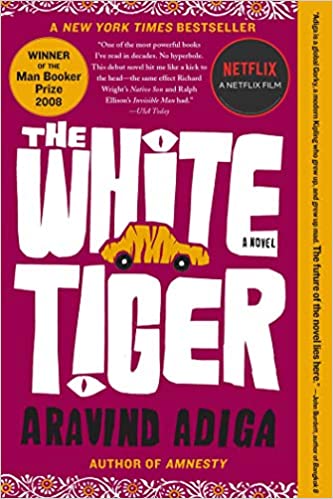
Why this book: Recommended to me by my son Brad, who told me that if I liked Shantaram (which he knows is one of my top 5 favorite novels) I would like The White Tiger – which is also written in a first person narrative, takes place in India, and provides a unique perspective on Indian culture.
Summary in 3 Sentences: A life story with an edge, from the perspective of a person from a lower class in India, writing a long letter to the Premier of the Peoples Republic of China about the reality of his life in India, to tell the “truth” and undermine the Public Relations white-washing that the Premier would certainly get on his up-coming visit to India. Our narrator describes his life and his difficult path from being the son of an impoverished rickshaw driver to becoming a successful business man and entrepreneur. But this is NOT a Horatio Alger story; rather it is a description of the corruption and sense of entitlement of the wealthier classes, their indifference to the suffering and indignities of those in the lower classes, and we see that our narrator’s success seemed to demand compromising basic human values that he believed those in power use to keep the lower classes in their place.
My impressions: Powerful, engaging, fascinating, and a fun quick read. It is told from the perspective of a smart, ambitious young man from one of the lower classes in India – the Halwai caste of sweet makers – observing, describing, and then breaking into the entrenched system in India which he argues keeps the poor poor, and the rich rich. It provides great insight into a level of poverty that is hard for most westerners to imagine. We see how a stratified caste-culture like India’s, demands a subservience of those in one caste to those in another that is difficult to for us in the West to contemplate, but which I suspect people of color might say has had its analogues in America.
The only voice we get from our narrator is in the letters he writes to “His Excellence Wen Jiabao, Premier of the Freedom Loving Peoples of China” in a long letter, composed over seven nights – promising that his life story will give the Premier a more accurate impression of life in India. His supposed intent is unveil the truth behind the public relations images of India as a free, capitalist, democratic country that Premier Jiabao will certainly be presented during his forthcoming visit to India. By his last letter he is addressing his letter simple to “Mr Jiabao.”
Our narrator was named “Boy” when born – his parents too busy to give him a proper name. Later he gave himself the name Balram Halwai, but adopted as his identity what an inspector of his school said about him, that he was “an intelligent, honest, vivacious fellow in this crowd of thugs and idiots… a creature that comes along only once in a generation…The White Tiger.” He says up front that his life’s story ought to be called “the autobiography of a half-baked Indian.” (Which sounded to me very familiar to The Absolute Diary of a Part-Time Indian, told from the perspective of an outlier Native-American Indian, which I just read!)
Balram and his family grew up living in what he referred to as “the Darkness” in a country village far from the centers of power, learning how to “faithfully serve your masters with absolute fidelity, love, and deviation.” Unlike most born in his situation, who simply accept or surrender to their lot in life, Balram is relentlessly curious, always seeking a way to learn the ropes, to ingratiate himself with those who can help him rise above his poverty, and cunningly seeking an advantage that will help him get ahead.
Balram describes what he calls “The Great Indian Rooster Coop” noting that the trustworthiness of servants is the basis of the entire Indian economy – the sense of loyalty and servitude to masters that holds India together. The “Rooster Coop” analogy refers to roosters who sit in their cages, calmly watching their brothers beheaded and chopped up to feed their masters, knowing they will be next, but doing nothing. He notes that to break out of the Rooster Coop, one has to be prepared to see one’s family destroyed – literally killed – for upsetting the social order. “Servants have to keep other servants from becoming innovators, experimenters, or entrepreneurs. The coop is guarded from the inside.” p166
Initially, Balram is conflicted between the family values of the village he came from, and what he needed to do to get ahead. As Balram moves away from his village, the simple values of his village, his grandmother’s exhortations, and “the Rooster Coop” held sway, but they eventually lost their pull on him as he realized that those with power and the money play by very different rules. Balram becomes a driver for a wealthy group of coal magnates and eavesdrops on their conversations, as he drives them to their various meetings to pay off politicians or to engage in their expensive debauchery. And though some treat him with respect and dignity, he eventually comes to realize that they will throw him under the bus in a heartbeat to protect their wealth and status.
We get to know not only the cruel and vicious magnates, but also those liberal idealists who profess to be concerned for the inequities in the system, but don’t have either the backbone or the power, or are unwilling to make the sacrifices necessary to make any real difference. And Balram meanwhile sits and listens, is ignored as a non-entity, and his attitudes begin to change.
He not only begins to resent the power of his masters, and their indifference to those like him, but he also directly experiences their self-serving corruption. And he also desperately wants to rise up to be someone others envy – and he realizes that to do this, he must become more like them.
It is indeed a revolutionary book – told with an engaging personal style, bitter irony, and with a working class sensibility and smug humor. He pokes fun at a political leader to whom he refers as “The Great Socialist,” who has duped the lower classes into thinking he is their defender against the greed and power of the wealthy, but indeed is in league with them, and just as corrupt as they are. The Great Socialist, like so much else he sees is a sham meant to placate the poor, to keep them in their place, and protect the power of the elites.
We also get to know the subculture of the drivers for the rich – how they carve out their own pleasures and satisfactions within the system, without threatening their own relatively privileged positions. They refer to the idealistic Balram from a remote rural village as “country mouse.”
Balram is an interesting and complex character. We admire his curiosity to learn, his unwillingness to surrender to the corruption and the fate of so many millions in his situation. We admire his cleverness, his initiative and ambition to learn and grow. And he routinely makes reference to the wisdom of the great poets – noting an understanding for a perspective that he seems to appreciate, but his very practical nature doesn’t internalize. Several times he quotes poets and icons of wisdom such as his quote of the Islamic poet Iqbal that ”The moment you recognize what is beautiful in this world, you stop being a slave.” 236
Is he noting how he is straying from their wisdom, or Is he merely mocking them?
But I couldn’t help but also be repelled by the “entrepreneurial” actions he takes – by necessity, he would argue – to get ahead and become the entrepreneur he is proud to have become. We know throughout his long letter to Premier Jiabao that Balram has indeed found success as an entrepreneur. What he had to do to achieve it is an important message of this book.
The Netlix Movie based on the book is quite a good representation of the book, its story and message. As usual, I recommend reading the book first – it’s short – then watch the movie.
My own “meta” view: The White Tiger describes a phenomenon that can be seen in many parts of the world. It is an example of what happens when leaders try to transpose a system and philosophy of human rights, human dignity, freedom and capitalism that has evolved over centuries in the UK, Europe and eventually the US, onto cultures with very different histories, values and social structures, that have evolved over millennia. The shoe doesn’t always fit.
Below are some quotes I found interesting and which give a sense for the style of The White Tiger.
The one infallible law of life in the Darkness is that good news becomes bad news – and soon. 30
To break the law of this land – to turn bad news into good news – is the entrepreneur’s prerogative. 32
I don’t keep a cell phone, for obvious reasons -they corrode a man’s brains, shrink his balls, and dry up his semen, as all of us know. 33
In the old days there were one thousand castes and destinies in India. These days, there are just two castles: Men with Big Belies and Men with Small Bellies. And only two destinies: eat – or get eaten up. 54
Is there any hatred on earth like the hatred of the number two servant for the number one? 66
Like eunuchs discussing the Kama Sutra, the voters discuss the elections in Laxmangarh. 82
Do we loathe our masters behind a facade of love – or do we love them behind a facade of loathing? We are made mysteries to ourselves by the Rooster Coop we are locked in. 162
The rest of today’s narrative will deal mainly with the sorrowful tale of how I was corrupted from a sweet, innocent village fool into a citified fellow, full of debauchery, depravity and wickedness.” 167
Standing around books, many books in a foreign language, you feel a kind of electricity buzzing up toward you, Your Excellency. It just happens, the way you get erect around girls wearing tight jeans. Except here what happens, is that your brain starts to hum. 175
The poor dream all their lives lof getting enough to eat and looking like the rich. And what do the rich dream of? Losing weight and looking like the poor. 191
Referring to the Red Light District: “An hour here would clear all the evil thoughts out of my head. When you retain semen in your lower body, it leads to evil movements in the fluids of your upper body. In the Darkness we know this to be a fact. 213
Delhi is the capital of not one but two countries – two Indias. The Light and the Darkness both flow into Delhi. 215
The history of the world is the history of a ten thousand year war of brains between the rich and the poor. Each side is eternally trying to hoodwink the other side: and it has been this way since the start of time. 217


 Bob's Books