
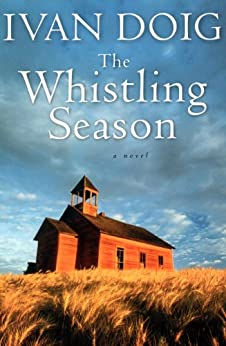
Why this book: I had been reading primarily non-fiction and was looking for a novel to balance my reading. My friend Francine told me she’d just read this one. I had read 5 other books by Doig, one of the pre-eminent authors of the 20th Century American West, centered in Montana. I really like his writing, have very much liked all I’ve read by him, so I bought it on audible and listened to it. Really glad I did.
Summary in 4 sentences: The story is told as a retrospective by the Superintendent of Schools in Montana in the mid-late 1950s, looking back on his youth about 50 years earlier in the early 1900s when his widower father was a homesteader in Marias Coolie, Montana and he and his brothers rode horse back to a one-room school house. The story begins with his father answering an add from a woman in Minnesota offering to work as a housekeeper, since he needed help taking care of their home while the boys were in school and he was working the farm. Responding to the add, an attractive woman arrives on the train from Minneapolis with her brother, and between the adjustments required in the family and the household, and the various day-to-day dramas at school, the story twists and turns as we get to know the world of small town Montana homesteaders. Our narrator goes back forth between his voice as a young teenager in Marias Coolie, to his voice as a middle aged man looking back on his youth while dealing with the challenges of running a school system in the age of Sputnik.
My Impressions: A.wonderful story beautifully written, that allows the reader to experience the charm and frustrations of frontier life in the early 20th century, as the narrator tells his stories from his life growing up in a very small town in Montana. There are a number of intermingled mini-dramas that take place throughout the story and Doig weaves them seamlessly into his narrative about the main character’s experiences coming of age in this world that once was, but is no more.
The story begins with the changes wrought by bringing an energetic and charming woman into a household of all men and boys and how they have to adapt. That brings drama at school as the boys are ribbed at school and the constant gossip about an attractive single woman working for their widowed father. We get to know the other kids in the one-room school house and a bit about their families, and there is the inevitable bad boy who bullies the other boys, who himself is bullied at home by his brutal father. Boys get beat up, kids get in trouble, or fall in love, relatives die, the weather is always an issue for farmers, people come and go, and the town changes and evolves, as life happens and Doig fascinates the reader with his descriptions of people, places, events that deserve to be appreciated and savored, but are truly normal.
Key characters in the book are the book’s narrator and protagonist, Paul Milliron, unusually precocious and gifted student in the one-room school house, responsible and mature beyond his years, but rather timid, cautious and practical in his approach to most problems and life. Paul’s younger brother Damon is bold, aggressive and adventurous, a sports nut, always willing to assume risk and take on a challenge. Their youngest brother Toby is affectionate, emotional, innocent and extraverted. And father Oliver, who is hard working, intelligent, sensitive and practical – kind of a Ward Cleaver in overalls.
We also get to know Paul a bit as a 60 something middle aged man, telling the story as he looks back, but also as he confronts his challenge as Montana School’s Superintendent under pressure to close all one-room school houses.
Into young Paul Milliron’s family comes Rose Llewelllyn, practical, bold, hard-working and ambitious, but mysteriously, she arrives dressed in satins, but with no money. She brings a new, positive feminine energy into the household and all three boys are captivated by her, and Oliver keeps his practical distance but remains the head of the household. Rose’s brother Morrie escorts her from Minnesota and plans to stay – he too is another enigmatic and interesting character, extremely well educated, articulate in the way of a Harvard professor, who knows a little bit about everything, is wise in the ways of the civilized world, but not in the practical skills of the frontier.
The story evolves as various challenges arise in the school and community – for example, we get to know Aunt Eunice, a caricature of a judgmental, guardian-of-social-propriety aunt, Eddie Turley the school’s big, strong, dumb bully, Ms Trent, the school house’s one teacher, who elopes with a revivalist preacher, leaving the school without a teacher, and more. Throughout the book we are treated with different stories of the three brothers, of various dramas at school, stories of Rose and Morrie, and Oliver Milliron. As the community deals with various mini-dramas, we get to know the all these characters and the community better – all through the eyes of our precocious narrator, Paul Millirone.
Eventually Rose and her brother move onto center stage as Rose takes initiatives that change not only life in the Milliron family but in the community. Her brother Morrie steps in to fill the teacher vacancy and he transforms the school house and the learning environment. Through Paul, his prize pupil, we get to know him as a fascinating character. And eventually the mysterious backgrounds of Rose and Morrie are revealed to Paul – and this become something of a crisis and a fork in the road for the key players in this story.
The magic of the book is in the writing and the language. Doig injects the sophisticated language of the narrator, as well as the almost classically refined language of Rose’s brother Morrie, into the simple western world of homesteaders in Montana. The juxtaposition is striking and entertaining. The language itself is a prism through which we see the contrast between two different worlds – but Doig’s style does not in any way belittle the hardworking homesteaders of Montana.
The New York Times reviewer Sven Birkerts wrote in his excellent review of this book, that: “Doig’s writerly ambition is less in plotting than evoking, and it is his obvious pleasure to recreate from the ground up — or the sky down — a prior world, a prior way of being.”
I think that puts it pretty well. I really enjoyed this book and was again, impressed with Ivan Doig, one of my favorite novelists.


 Bob's Books
Bob, I loved your review! You captured the book so very well and I’m so glad you enjoyed it as much as I did! I read the next book, Work Song, as it carries on with Morrie, but it paled in comparison to this one. Francine
Pingback: My Antonia, by Willa Cather | Bob's Books