
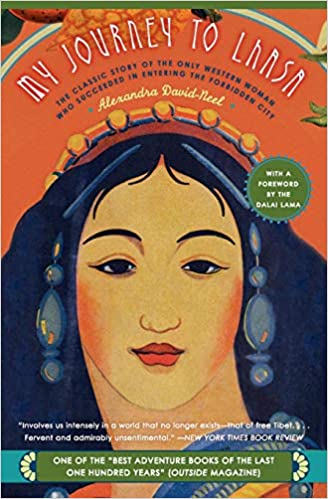
Why this book: I heard first about Alexandra David-Neel in James Nestor’s book Breath, in which he described how she kept herself warm while traveling in the Himalayas in Tibet by a special type of breathing. I looked her up and she must be one of the most amazing women of the 20th century.
Summary in 4 Sentences: This is Alexandra David-Neel’s personal account of her trip on foot through the Himalayas to become the first western woman to visit Lhasa, the capital of Tibet. She had spent years living in Tibet, spoke the language fluently and had several times tried to visit Lhasa, but had been turned back each time because it was off limits to foreign women. At age 55, in 1923, she decided to give it another bold attempt (in winter!), and this is her account of her several-months-long pilgrimage disguised as a peasant woman, with her adopted son, a Tibetan llama from a well respected sect, and their many close calls, struggles, hardships and adventures along the way to finally achieving her lifelong dream.
My impressions: This is an amazing story told in the first person by a most intrepid woman who, already very well versed in the history and culture of Tibet, chose to undertake a very risky and challenging trip through lawless and uncharted mountains of the Himalayas in winter to fulfill her dream of visiting Lhasa. Accompanying her was only her adopted son Yongden – a Tibetan llama with whom she’d already traveled through much of Tibet, India and China. I was amazed at her physical and mental hardiness and stamina as she and Yongden powered through a series of stunning trials and tribulations, challenges with snow, extreme weather, robbers, a very limited diet and sometimes days without any food between remote villages, with only what they carried on their backs, sleeping outside on the ground much of the time, eating very little, and having few creature comforts.
They were both extremely cautious and scrupulous about not doing anything that would draw attention to themselves or appear to be anything other than what they presented themselves to be – a penniless lama with his old peasant mother on a spiritual pilgrimage to Lhasa. This required her to eschew all western comforts, to quietly accept the humiliations of poverty, to humbly beg for food and shelter, and when that was not forthcoming, to do without, sometimes for days, as she and Yongden hiked through often trackless and snow covered mountain passes and forests with no maps, no protection from wild animals or brigands, sometimes unable to find water, and often not sure where they were. It took them several months, and they had quite a few adventures and close calls along the way.
Alexandra David-Neel was born in Belgium in the late 1860s, had had a fascination with Buddhism since she was young, and eventually found her way to the Far East where she studied Tibetan language, culture religion, mythology for decades and became well known to other literati well versed in these esoteric fields, including elite Tibetans themselves. But as a westerner, and as a woman, she was restricted in what she could do. With her force of personality and her intellect she broke through some of these barriers, but Lhasa was off limits. This trip was her most ambitious ordeal and most audacious initiative.
Her story is not simply about the challenges of her travel. She enjoys telling stories of her interactions with the people she encountered along the way in the remote mountain villages of Tibet. The farther she got into Tibet, the less likely she felt that people would suspect her of being a foreigner. But she was always very careful. She darkened her skin with dirt and soot, she blackened her hair with dye, and had a braid of black yak hair braided into her otherwise short hair – all to make her look like a common old peasant woman. For shelter on their journey they sought old animal shelters, caves, or protected areas in the forest. In the villages they begged for and often got shelter from villagers, sometimes with the animals, sometimes sleeping with the family on the floor in the kitchen. The living conditions in the remote villages in the Himalayas was quite austere for those who lived there – it was especially austere for someone accustomed to Western comforts and hygiene begging for whatever these villagers were willing to give them And often times they were turned away, sometimes had dogs sicked on them.
She noted how western senses of privacy were unknown among the villagers she stayed with – there was very little of it, even for the most private matters of personal hygiene, to which she had to accommodate herself to appear accustomed to these living patterns. Yongden was usually the star guest as he belonged to a Tibetan sect which was well known for having a sixth sense connecting him to the occult, magic and prophecies. Wherever they went, he was asked to provide insights and answers to dilemmas, while Alexandra quietly sat and observed. His talent and clever use of this skill got them out of many a tight situation, and allowed our narrator to sit quietly and inconspicuously in the shadows, and watch and listen .
Throughout the book she instructs the reader through her own experiences about the culture of Tibet and of Tibetan Buddhism. We learn about how the poor villagers live, about various sects of Buddhism and how lamas are viewed. She shares her perspectives on the faults and strengths of the culture and the people. She also regularly shared her inspiration from the beauty of the world through which she was travelling, describing breathtaking mountains and valleys that took her breath, and her fatigue away.
Eventually she and Yongden arrived in Lhasa, and her narrative changes tone. She spent two months there, still very concerned about being found out and evicted – so she continued to play the dumb, poor old peasant woman. She and Yongden stayed in a ramshackle stable with some other poor pilgrims on the outskirts of Lhasa, and the stories she tells of the drunken quarreling of their stable-mates reminded me of Chaucer. She loved what she found in Lhasa, having studied it for years, and her joy at being there for the new year in January, was palpable – she was able to participate with the other pilgrims in all the new years ceremonies, parades and festivities.
After two months there, she headed back, a shorter route, and she didn’t have to be as concerned about being found out – if an official found out who she was, he couldn’t take her visit to Lhasa away from her. So she allowed herself a bit more comfort on the way out, and enjoyed sharing stories of Tibetan superstitions, myths and strange encounters she’d had with a variety of people in that remote part of the world, so different from the West.
Two things would have made this book better and easier to follow – she uses a lot of Tibetan words that don’t have English equivalents, and though they are defined and explained in the footnotes, they are only explained once, but used again later. It would have been useful to have had a glossary to refer to of all the words that were defined in footnotes – since a number of them appeared repeatedly, with the assumption that the reader remembered what they meant. Also there is but one very indistinct and small map in the front of the book. The book would have been greatly improved with maps of different portions of their journey, with the various rivers, villages, monasteries and other place-names identified.
I found the book and the woman fascinating. I learned so much about a world and culture completely foreign to me – the Tibet of a hundred years ago. That world is certainly different now – the introduction to the book provides a painful litany of atrocities, and a description of the cultural genocide that China has inflicted on Tibet in the last 50 years to bring it under Communist Chinese control. And it continues – I just read an article in the WSJ (July 2021) about current Chinese government efforts to undermine key Tibetan cultural practices in order to make Tibet culturally more Chinese. But I was fascinated with Alexandra David Neel herself and how she describes this short snippet of her life. I have ordered a biography of her life – I’m very interested in learning more about the rest of her story.
Some quotes from the paper back book that will give you a sense for her style and her voice:
What a change from that ovenlike kitchen to the cold air of a frosty night, with a blizzard raging, at fifteen or sixteen thousand feet above sea level! It was not the first time that I had experienced this kind of hospitality. More than once villagers had invited us, treated us to a good supper, and then sent us on the roof or into the courtyard. Nobody apparently thought much of it in Tibet. p115
For miles we proceeded under cover of gloomy, silent, and mysterious forests. Then, an unexpected clearing suddenly revealed, behind the dark line of tall fir trees, extraordinary landscapes of shining snow-clad mountains, towering high in the blue sky, frozen torrents and glittering waterfalls hanging like gigantic and immaculate curtains from the rugged rocks. We looked at them, speechless and enraptured, wondering if we had not reached the confines of the human world and were confronted with the abode of some genii.p198
We did not always spend the night in the forest. On reaching hamlets, isolated farms, or monasteries, we often begged hospitality. Sometimes it happened that we were forbidden to enter. More than once we had to defend ourselves against dogs left loose to keep us away…p 198
In Tibet, amongst country folk, the farm always includes a number of rooms, but none of them has a really special purpose. Wool, grain, provisions, ploughs, and so on fill the different parts of the house, and for the most part, the family’s general living and sleeping room is the kitchen. p 213
Tibetans have lost much in parting with China . Their sham independence profits only a clique of court officials. Most of those who rebelled against the far-off and relaxed Chinese rule regret it nowadays, when taxes, statute labor, and the arrogant plundering of the national soldiery greatly exceed the extortion of their former masters. p262 (note: this was in 1923 only a few years after Tibet broke from China who had treated her as a remote colony, with benign neglect.)
The religious communities in Tibet form little states within the state, of which they are almost entirely independent. All are possessed of lands and cattle. As a rule, they carry on commerce of some kind. p281
Life vows do not exist among Buddhists, who believe in the fundamental impermanence of all things, and these children may, therefore, return later on to the world and live as laymen without carrying the dis-esteem of their compatriots. Some of them do so, but many, not feeling sufficiently courageous to apprentice themselves to any other career, maintain the habit of the Order without respecting it as they should. As a rule, these drones of lama-ism, somewhat lazy and gossiping, a trifle too gluttonous and especially too greedy of gain, are charitable and hospitable folks in spite of their faults. 282-3
(on leaving Lhasa) Under the blue luminous sky and the powerful sun of central Asia the intensified colors of the yellow and red procession, the variegated bright hues of the crowd’s dresses, the distant hills shining white, and Lhasa lying on the plain at the food of the huge Potala capped with glittering gold- all these seemed filled with light and ready to burst into flames. Unforgettable spectacle which alone repaid me for my every fatigue and the myriad dangers that I had faced to behold it! p303
Her story of practicing Thumo reskiang – the practice of creating body heat through a breathing practice is briefly described on p134.


 Bob's Books
Pingback: The Secret Lives of Alexandra David-Neel, by Barbara and Michael Foster | Bob's Books