
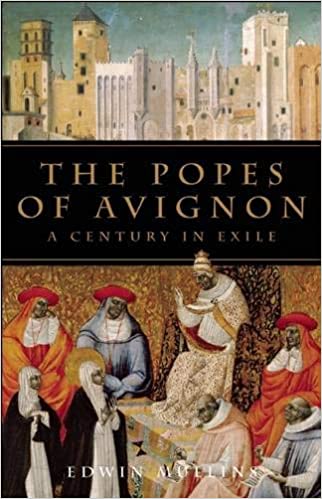
Why this book: I was preparing to do a bike ride in Provence starting and finishing in Avignon, and riding for 8 days in the environs. This book came strongly recommended to provide a historical perspective on the world we would be biking through, by Francine, who with her husband Jeff, organized the trip.
Summary in 3 Sentences: In the early 14th century, violence, anarchy, brigandage, and warlordism around Rome threatened the center of Christianity, so the then Pope Clement V decided to move the papacy and his court to one of the papal-owned regions of what is now France. This book walks through the reigns of the 7 popes who led the Catholic church through the nearly 7 decades that Avignon hosted the Pope and his retinue, their challenges, successes, failures and their relationship to the Holy Roman Empire, France and other temporal powers in the region. We learn of the widely varied personalities and approaches to papal leadership exhibited by the seven popes, the political intrigue involved in selecting and then supporting the popes, how the papacy mimicked autocratic and self-indulgent leadership styles that were standard and expected of temporal kings and princes in Europe at the time, how the popes themselves, their cardinals and bishops succumbed to the temptations of power, wealth, and pleasure that were freely available to them.
My impressions: An enjoyable lay-person’s history of the period during which the Papacy moved from Rome to Avignon. It is also naturally a look at the history of Avignon, why it was selected as an alternate location for the center of Christianity at the time, the impact that the Papacy had on what was previously the small town of Avignon and the region, and then what happened after the papacy returned to Rome.
The book is divided into chapters the first of which address each of the seven Popes who resided in Avignon. The book begins with a look a the environment and the events that led Pope Clement V’s decision to move the papal court to Avignon in 1309 where it remained until 1378 when Pope Gregory XII returned the papacy to Rome and then shortly afterward died. His death left the door open for a power struggle between the French and Italian cardinals. The book concludes with the Papal Schism, a rather confusing era of about 30 years when the Italian and French cardinals selected two competing popes – one in Avignon and one in Rome until this awkward situation was finally resolved in 1414 and the Papacy remained in Rome.
The Papacy moved from Rome to Avignon in response to two key factors:
- First, Italy at that time was a collection of independent principalities, each led by a King many of whom were ambitious, gathered their own money to hire mercenaries to intimidate or defeat his rivals to gain more power and resources assume regional ascendancy – and Rome was a wealthy target. When it appeared that Rome and the Papacy were most vulnerable to threats, intimidation or being conquered militarily, Pope Clement V decided to move to a safer locale in France.
- Second, that “safer” locale was under the protection of the King of France – but that protection came at a price. The King of France, Philip the Fair (“Fair” not being “just,” instead meaning handsome) contributed to convincing Clement V to move the papacy after which he essentially became a vassal of the King of France, . Eventually the Popes, cardinals and Bishops became primarily French which kept much of the wealth the Papacy spent in France – which created a momentum for keeping the Papacy in France.
The popes of Avignon were very different. Some were self-effacing introverts, others extravagant and bold. The most interesting to me was Pope Clement VI, (1342-1352) a charismatic and extravagant leader who was well known for his celebrations and parades, his generosity in giving money away to his supporters as well as to the poor. Clement VI was a boisterous partier and reputedly had several mistresses. He was not afraid to take on the Holy Roman Emperor, raised armies to protect papal property in Italy, and during his 10 years he built out the papal palace in Avignon to be one of the grandest in Europe. He also had the challenge of leading the Church during the worst of the Black Plague in Europe. When he died, he left the papal treasury almost empty.
Typically the Cardinals selected a new pope to offset any excesses excesses of the previous pope. When Clement VI died, the cardinals selected Pope Innocent VI who could hardly have been more different, coming from a tradition of hermits and ascetics, and naturally, he sought to reform many of the excesses of Clement VI. Innocent VI’s successor was Urban V, one of the most highly respected of the popes of that era, one who more closely than most, abided by today’s standards for Christian behavior and leadership. It was Urban V who initiated the return of the papacy to Rome, but it was his successor Pope Gregory XI who finally succeeded in moving the papacy to Rome, and then soon after reestablishing himself in Rome, died. When the Italian Cardinals elected an Italian Pope, and the French Cardinals wouldn’t accept him, that initiated the Great Schism referred to above, which continued for nearly 40 years until it was finally and not very gracefully resolved in 1418.
The Papacy was very much about power and patronage and protecting the resources of the Catholic church from rapacious Kings, warlords and marauding bandits who looked with great envy upon the land and wealth of the Church. The popes behaved as kings in a kingdom and this was expected since then even more so than today, it was generally accepted that power and wealth had their privileges and which included not having to follow the rules that apply to everyone else.
One interesting character who appears through much of this book is Petrarch, a well known poet and an open critic of the papacy for its hypocrisy and self-indulgence. Petrarch was pretty vicious in his criticism of the popes, cardinals and bishops, but the popes never seemed threatened by him – in fact they often patronized him.
When I was in Avignon, I visited the papal palace and walked the gardens. Avignon is surrounded by it’s famous ramparts – a 2 mile circumference of thick and high walls, still maintained, intact and impressive. These walls were begun by Innocent VI and completed by Urban V to protect the city from being sacked by out-of-work mercenaries who formed up private armies that preyed upon castles, towns and citizens throughout France, during periods of peace between England and France. Avignon itself, its wealthy cardinals and merchants, and the wealth of the papacy were lucrative targets to these armed bands of former soldiers. Eventually Urban had to pay protection money to preserve Avignon from the ravages of these “companies.”
The Popes of Avignon inspired me to revisit a wonderful book I read about 40 years ago about France in the 14th century The Distant Mirror, by Barbara Tuchman, which gave a fascinating look at how people lived, the culture, the times, the challenges of life in medieval France – which included the papacy in Avignon.
I would echo Francine’s recommendation to read The Popes of Avignon before visiting Avignon and Provence, or to anyone interested in the history of the papacy, or southern France in the 14th century.


 Bob's Books