
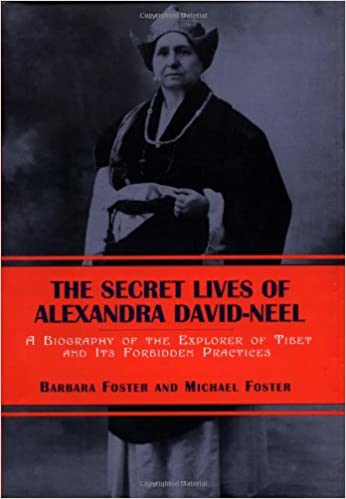
Why this book: After reading My Journey to Lhasa in which she describes how she became the first Western woman to visit Lhasa (and which I review here), I felt inclined to learn the rest of the story of the life of this remarkable woman.
Summary in 3 Sentences: This thoroughly researched biography of Alexandra David-Neel begins with what little is known of her childhood and early years in Europe, and fairly quickly moves to the main events of her life exploring and living in Asia. The “meat” of the book describes her many and multi-faceted experiences for 40 years in India, Tibet, China and other Asian countries, including a couple of chapters which provide some different insights into her remarkable trip to Lhasa. It concludes with the last third of her life, as her physical health deteriorated, but her cognitive skills remained intact – though as for anyone who reaches that age, life was not easy for her at the end.
My Impressions: This is a fascinating biography of what has to be one of the most amazingly intrepid women of the 20th century. She grew up in the Victorian era in Belgium became fascinated with Buddhism early – showing signs at a young age of rebelling against the standard paths for young girls at that time. As a teenager, she ran away from home, got involved in Madam Blavatsky’s circle of mystics and clairvoyants in London, then found her way into operatic singing and show business, before heading to India and the East to pursue her passion for studying Eastern religion and cultures.
This biography offers what little is known of her youth before getting into the main act of her life as a trail blazing woman student and scholar of Tibetan religion, religious practices and philosophy at the very beginning of the 20th century. Very few Westerners, and no other Western women were aggressively pursuing knowledge and experience of Tibetan practices at that time, and given her intelligence, charm, and ambition, she came to the attention of the 13th Dalai Lama and the Panchen Lama (second to the Dalai Lama in the Tibetan Buddhist hierarchy) as well as becoming well known and respected in the broader circle of other senior members of the sect. She also became well known, and not completely trusted by British authorities who still controlled much of that part of the world.
This biography outlines her extensive travels through India Nepal and China in search of knowledge and direct experience of the cultures she was studying, at a time when travel was primitive and dangerous. David-Neel was often short of cash – relying on funds wired to her from her husband in Algeria, or what she earn, beg, or borrow on her own, and was often nearly destitute, putting to the test her incredible resourcefulness and adaptability. She had adopted a Tibetan son who was her travelling companion and essentially aide-de-camp during these often difficult times, and who stayed with her for the rest of his life. Travelling with caravans, walking, on horseback, or in carriages through remote areas on the borders of Tibet and China, she anticipated being subjected to the vagaries of civil war, brigands and highway robbers and other dangers – but she was undeterred and usually lucky. All of this prepared her for her most famous adventure – her months long hike in winter through the Himalayas avoiding government authorities to sneak into Lhasa, which was absolutely forbidden of Western women.
Because of the discretion expected of Victorian-age woman in their public and private correspondences, and because she was married, she was not forthcoming in her letters and other correspondences on matters that may have touched on the romantic or the erotic. The authors however believe that she probably had an affair with a Maharajah of Sikkim during this period, and they have indicators that her explorations of Tantric sexual practices were more than merely academic. In her study of Tibetan Buddhist practices, she was typically unwilling to take information or wisdom on authority – she always wanted to experience things directly and personally. For example, in order to better understand the Tibetan Buddhist tradition of isolating and meditating under the tutelage of a yogi, she spent nearly 3 years living alone under great austerity in what was essentially a cave high in the Himalayas, with regular visits to her Tibetan yogi mentor.
Eventually, she decided that to truly understand Tibetan Buddhism, she needed to visit Lhasa, the capital of Tibet and and the Vatican of Tibetan Buddhism. But Lhasa was off-limits to Western women, by order of the Dalai Lama and Tibetan authorities. Respecting the desires of the Tibetans, the British, who controlled much of the Far East at the time, also actively opposed her efforts to visit. Not one to simply give in to authority, she found a way, which she describes in her book My Journey to Lhasa which I review separately.
In this biography we learn about the nearly 20 years she spent learning the Tibetan language, experiencing the culture and becoming strong and resilient enough to successfully and convincingly disguised herself for months as a Tibetan peasant woman hiking through the Himalayas in winter with her adopted son to Lhasa. This biography goes beyond that specific journey to provide additional stories about what she experienced in Lhasa and some of the aftermath of her visit, her challenges with funds, with her husband, with various bureaucratic officials who didn’t trust her, nor know quite what to make of her.
Over her lifetime, Alexandra David-Neel wrote nearly 30 books on Tibet and Buddhism, and is credited by the 14th (the current) Dalai Lama with having introduced Tibet to the West, through her writings, her adventures and her love of Tibet.
Alexandra David-Neel as a person was not only an impressive and interesting woman, she could also be difficult. She was clearly a powerful and brilliant woman with amazing strengths, but she also had her own character flaws and contradictions. She was on the one hand intellectually curious, compassionate and respectful toward those at the lower end of the social scale, bold and self-confident in taking on great challenges, tough and resilient, and almost un-intimidatable. She could also be imperious, egotistical, ambitious for fame and recognition, entitled and arrogant. Crafting and maintaining a certain persona and image were important to her to help ensure she could pursue her projects and ambitions. She was often deceitful and manipulative toward her husband, in order to keep his funds flowing to support her ambitions.
In this biography, the authors, while clearly admiring her, were not shy about exposing these some of these less savory aspects of her character. Toward the end of her life, she had her caregiver burn many of her letters that she believed might challenge the image she wanted history to have of her. That’s too bad, since the whole picture of the woman would be much more interesting than the air-brushed version she hoped to leave.
She lived to be 101 years old, living the final 30+ years of her life in Southern France, continuing to write, to lecture and to host and entertain other scholars of Tibet and Tibetan Buddhism.
This biography is 1998 update of an earlier biography the two authors had written: Journey: The LIfe of Alexandra David-Neel published in 1989. They felt this update was necessary after discovering important new material that came to light after publishing the first book. They also indicate that there is much more material on her life that remains to be released – so those of us interested should stand by. The authors are clearly conversant in Buddhist philosophy and religion and were sympathetic to David-Neel’s desire to study it and uncover its truths, and I felt did a good job of explaining some of the more esoteric aspects of Tibetan Buddhism to me a lay reader.
Some of the key take-aways and insights I had from this book, apart from being fascinated by the life of an amazing, bold and ambitious woman:
- How much different the world of India, China, Tibet in which she spent much of her life was from the West at the early part of the 20th century, before globalization brought so many of civilizations comforts, corruptions and distractions into that part of the world. Her travels on foot, in caravans, by train, ship, and plane, disguised as a beggar, a religious figure, scholar, she lived in and traveled through a world of brigands, warlords, European expats that today seems exotic and probably no longer exists.
- I learned much about Tibetan Buddhism and Tibetan culture, which was the primary focus of her learning and exploration. I hope to read her book Magic and Mystery in Tibet (still in print and easily available, also in audio and pdf format) which is considered a classic on how Tibetan Buddhism incorporated local superstitions and more “Pagan” beliefs, along with some of the amazing things she observed and experienced that are inexplicable by modern western science. She herself was a skeptic about mystical powers associated with Tibetan Buddhism, but she also routinely observed and experienced phenomena that challenged that skepticism.
- The multifaceted aspects of her character fascinated me – her fearless and relentless pursuit of her ambitions, her ability to draw on Buddhist serenity when she needed it, while also manifesting very un-Buddhist like ambition, egotism and focus on achievement.
- The early part of the 20th century – prior to WW1 and in the inter-war years, was a period of great power competition for influence in Asia, between the British, the Russians, the Japanese, the Nationalist and Maoist Chinese, and at every turn, these larger political forces impacted the life and goals of Alexandra David-Neel. She became an internationally known figure – considered by many to be a spy, by others a nuisance, and by still others a threat.
- The authors are clear in how the Chinese are actively seeking to destroy Tibetan culture and homogenize it with Chinese Communist culture. In the introduction and in the epilogue, they provide shocking statistics of the number of Tibetan monks who have been murdered, monasteries destroyed, and legislative and legal steps taken by the Chinese to put pressure on traditional Tibetan religion and culture. This process is brutal, and continues unabated.
- The epilogue discusses the impact Alexandra David-Neel has had. Her books on TIbet are still read and studied. Her intrepid life and courage continue to inspire, especially women who are fascinated with learning more about Tibet and Buddhism. And as noted, the current Dalai Lama gives her a lot of credit for publicizing Tibet, Tibetan Buddhism and its many appealing aspects to much of the West.


 Bob's Books