
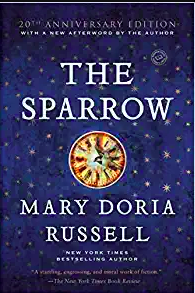
Why this book: I had read this book about 12 years ago in my literature reading group. It resulted in one of the richest discussions we’d had after reading a book. All of us who were in the group at that time agreed we’d like to read it again, so we prevailed upon the newer members of our group to selected it to read.
Summary in 3 sentences: A group of Jesuit Americans embark on an expedition to a nearby galaxy to explore the source of spiritual sounding music coming from a planet in that galaxy. They prepare in early 21st century and make the journey and connect with sentient intelligent beings on that planet, learn their language, live with them and learn their culture. But something goes terribly wrong, and only one member of the expedition returns, but is so traumatized he struggles to confront and recount and explain his experiences.
My Impressions. An incredible story, powerful, well-written by a well-educated, thoughtful and articulate author. Mary Doria Russell is a paleo-anthropologist and her extensive background in the science of humanity is evident in this, her first novel. The story itself is imaginative, but the story serves primarily as a framework on which the author hangs powerful themes of good and evil, faith and disillusionment, love and friendship, and more. It is a search for spiritual meaning and understanding man’s place in the universe wrapped in a science fiction novel. I found the characters in the book rich, multi-dimensional and believable – I could relate to them, though it took some imagination to relate to the unique circumstances in which the author develops them.
There are two stories going on simultaneously in The Sparrow, and the two stories come together at the end of the novel. The first story is about an eclectic group of astro-scientists who detect haunting and spiritual music coming from the Alpha Centauri Galaxy – one of the closest galaxies to our own. The Jesuit branch of the Catholic church then feels compelled to finance and sponsor an expedition to explore the source of the music, in an effort to connect with other spiritual and sentient beings in the Universe.
In this part of the story, we get to know the main characters of the novel, and follow their preparations and ultimately their voyage to beyond our galaxy to find the source of this music. During this part of the novel, we get to know each of the six or so main characters of the expedition, and that is interesting and enjoyable. The author makes some effort to make this travel to a different galaxy at least superficially scientifically believable. The team explores and attacks the types of problems that would be associated with such travel, such as food, fuel, time relativity, navigation, communications and more. In this part of the story, our team leaves earth, leaves our Milky Way, finds and is able to land on the obscure planet of Rakhat. The story follows their adaptation to that world, and the symbiotic relationship they develop with the sentient creatures they encounter on that planet. They learn and adapt to their language and culture, and eventually see a way to connect with the source of the music.
The second and parallel story on-going in The Sparrow is taking place some 40 years later and is the investigation into what happened on the expedition. Father Emilio Sandoz is the only one of the original team to survive and return to earth, and he is severely traumatized. He was the most spiritual of the Jesuits who went on the mission, and upon his return, is unwilling to confront nor discuss what happened, what traumatized him so, and how and why he has lost his faith. In this part of the story we get to know a separate set of characters – those conducting the investigation and the interrogation of Father Sandoz. Father Vincent Giuliani, the Father Superior of the Jesuits insists on coaxing the story out of Sandoz, while trying to be sensitive to Sandoz’s obvious suffering from severe post -traumatic stress.
These two parallel stories in The Sparrow are told in alternating chapters. We share in the excitement of the expedition members as they prepare for the expedition, become a high functioning team, and get on with one of the human race’s greatest adventures. There is much joy and camaraderie in the first part of mission, and it is easy to like and relate to the characters Russell creates, and how they connect in powerful ways. The author permits a bit of bawdy humor and very human connection among this group of religious space pioneers, as they bond and build a solid team dynamic. They deal with mistakes, disappointments, tragedies and the team holds up – they take care of each other and their mission
In the separate and alternating chapters we come to understand that somehow it all went terribly wrong, as we struggle with Emilio Sandoz’s efforts to deal with the tragedy of what happened – though we don’t yet know what that tragedy was. But we know it wasn’t good.
Emilio Sandoz is interrogated, sometimes accused, often with little finesse or sympathy, and is slowly nursed back to health 40 years after the expedition had departed earth. We are kept in suspense to learn what ultimately happened to the expedition after such a promising beginning, until the last 30 or so pages of the book.
Wrapped in a fasincaitng science fiction novel, The Sparrow addresses faith in God in the face of pain, evil, suffering and tragic disappointment. In the voices of the characters in the book, Russell makes strong cases both for faith, and for loss of faith and atheism.
In the interview at the conclusion of the paperback edition of the book, Russell says she was inspired to write this book during the celebration of the 500th anniversary of Columbus discovering America – when she asked herself what it might be like today to leave all that we know, and arrive in an alien land and confront a completely different culture. She also clearly drew inspiration from the suffering and privations of Jesuit missionaries who sought to educate and convert Native Americans to Christianity – Isaac Jogues in particular, as well as the Jesuits known as the Canadian martyrs.
It was also interesting to note that Russel was raised a Catholic, left the church and declared herself an atheist, and then in her 30s had a child, returned to belief in God, but as a Jew. As a converted Jew she learned of how the Jews experience God during and in spite of centuries of pogroms and genocide, and the Holocaust, suffering on a scale most Christians have difficulty imagining.
I couldn’t help but see this story as a modern day version of the book of Job. How could a loving God let this happen? I also saw parallels with Chinua Achebe’s book Things Fall Apart about how well-meaning missionaries appalled at what they perceived as barbarian native practices, intervened to upset a delicate balance in an African native village. Coincidentally, after finishing The Sparrow, I re-read Viktor Frankl’s Man’s Search for Meaning for another book club – It could be a companion piece to The Sparrow, and Frankl, a Jew, would have a lot to say to Emilio Sandoz.
I highly recommend The Sparrow to thoughtful readers. But if at the end you may be a bit confused about the message, read the interview with the author at the conclusion of the paperback edition – it is very enlightening.


 Bob's Books