

Why this book; I had read it some 45 years ago, and then, listening to Yuval Harari’s 21 lessons for the 21st Century recently, he noted that Brave New World is more relevant today than when it was written and is continuing to increase in relevance. That intrigued me and inspired me to read it again, and to convince some of my friends to join me.
Summary in 4 sentences: This is a science fiction novel published in 1932 with the story taking place many centuries into the future in the “ideal” society that Huxley saw many in Western culture striving to attain. The story begins with a tour of an incubation facility for artificially inseminating harvested female eggs, and then describing a process for creating multiple versions of the same genetic identity, and then how they provide the growing fetuses with more or less of critical nutrients to create various levels of motivation and intelligence – a test-tubed-created class structure and a happy and stable society. Afterwards the story involves two individuals who are somehow dissatisfied living in a world designed and structured to make everyone happy and satisfied, always. Then into this ideal society enters the disruption of a more primal Savage.
My impressions: Very thought provoking. Not great literature, and the satire is perhaps a bit corny by today’s standards, but amazingly prescient and original, given that it was first published in 1932. Though I believe Huxley was creating a parody of the ideal world to which Soviet and western Communists in the 20s and 30s aspired, these same general ideals are insidiously creeping into the ideals of Western democracies today. Which is in part of why Yuval Harari noted that this book is of ever-increasing relevance.
Huxley describes a world that seeks to homogenize differences in people, by taking out genetic variables through test-tube fertilization and testing, and eliminating the variable of how children are raised by different parents – no parenting is involved in procreation, nor in education. It is all done to standard – by the state. Genetics are managed, education and personal development is standardized, and people live by a prescribed set of cliches, proverbs and principles that are piped into their brains as they sleep, in what are called “hypnopaedic proverbs,” from childhood through and into adulthood. People are in fact strongly discouraged from thinking about values, choices, priorities – it is all taken care of for them – by the state and the structure of their society.
The “brave new world,” is a phrase taken from Shakespeare’s The Tempest.* It is a world designed and structured to have the state guarantee stability, comfort and happiness as primary goods and inalienable rights of all people. Scientific truth, progress, wisdom, or individual desires should never take precedence over stability or group happiness. This means mitigating or eliminating stress, personal conflict, disappointment, anger, striving, etc as sources of instability, anxiety, and unhappiness. This is the world built on the one goal of happiness and the first part of the book introduces us to it.
To create contrast and tension in the novel, one of our protagonists is permitted to take his girlfriend to visit a “Reservation,” a tribe of Zuni Indians living in the traditional Zuni manner in the Southwest of the US. The trip is intended to reinforce the wonders of their own world. There they witness ancient Zuni rituals, and the primitive state in which people live; our visitors are amazed and appalled by what they see. They also meet a woman from their own world who was stuck there on a visit a generation ago, and the woman had been unable to adapt well to Zuni culture (the Brave New World is not strong on developing resilience.) She longs to bring her son out of the primitive world and into the paradise she remembers from her younger years in the Brave New World. Our protagonist succeeds in getting permission for the woman and her son to return with him.
Upon return, the woman chooses to enter a drug induced ecstasy from which she never returns. The young adult son on the other hand, had been brought up by the Zunis to believe that manhood requires overcoming challenge and suffering, developing strength and courage, and an ability to know oneself in solitude. He finds that these are alien concepts in the Brave New World, and the young man rebels and refuses to adapt. Accordingly, he is seen as a curiosity, a freak and a savage. His attempt to understand this new world becomes the confrontation between more primal human values of striving, courage, competition and understanding, and a civilization that has sought to eliminate all sources of tension, discomfort, pain, disappointment, and unhappiness.
The Grand Inquisitor. There is a key conversation near the conclusion when The Controller – the leader of a large part of the Brave New World, has a conversation with the Savage, in which he attempts to describe and explain his world. The Controller is in on the deal – he has read literature and philosophy that is forbidden to others, has a broad and rather deep understanding of human nature, and is a key architect and caretaker of this Brave New World, which he notes, fulfills the dreams of countless generations of men and women. He is like the Grand Inquisitor in Dostoyevsky’s Brothers Karamazov. He explains to the Savage the how and the why, the logic and the goodness of the functioning of the system. He acknowledges that yes, there are sacrifices, but argues that they are worth it – they are the price of stability. The Savage won’t buy it. He wants challenge and adversity. He states he’d rather live in a world with the right to be unhappy. The Controller asks if he indeed wants the right “to grow old and ugly and impotent; the right to have syphilis and cancer; the right to have too little to eat; the right to be lousy; the right to live in constant apprehension of what may happen tomorrow; the right to catch typhoid; the right to be tortured by unspeakable pains of every kind?” “I claim them all,” the Savage replies.
The Brave New World. These are some aspects of the world Huxley describes in his novel.
Political Correctness. In Huxley’s Brave New World, any disruptions to prescribed codes or managed stability are treated as apostasy and punished. This is a picture of “political correctness” run to its extreme – what we saw in the Soviet Union, or see in China today. Divergent views are either “corrected” or the person expressing these views is ostracized and exiled. Divergent views are not tolerated, nor even allowed to be expressed.
Henry Ford They worshipped Henry Ford as the founder of the idea of efficiency above individualism. He is regarded as civilization’s savior. “Oh, Lord” becomes “Oh Ford.” And they borrow from Catholicism as well; the sign of the cross as a reverential symbol becomes the sign of the “T” – in reference to the Model T.
Soma – People were given prescribed doses of Soma – a drug which calms the nerves, eliminates fear or anxiety, makes one happy and generous and good natured, and in various doses can go beyond calming to putting one in an ecstatic trance. It is always available – and those in the lower classes are given an allotment – to ensure that they continue to do their work. “Anybody can be virtuous now. You can carry at least half your mortality about in a bottle. Christianity without tears – that’s what soma is.” p238
Sex is not to be a source of tension or unhappiness. Monogamous relationships are strongly discouraged, since “everyone belongs to everyone else” and exclusivity can result in jealousy – a source of tension. Promiscuity is not only encouraged, it is a cultural value. Sex is recreational and fun – why limit it? There are no pregnancies nor STDs to inhibit us. And everyone is biologically healthy until it is time to die, and so the sex drive in men and women remains a source of pleasure and distraction well beyond youth. “You can’t have a lasting civilization without plenty of pleasant vices.” p237
Class and Caste – people are born into a caste – Alpha’s being the highest, Epsilons the lowest, and this is determined by how the fetuses are nourished, with nutrients and oxygen adjusted to make the resulting child more or less intelligent, motivated, capable. A person is assigned work in life according to his/her caste and their work fits their capabilities – no stress. People accept their place in society – there is no class tension. This is the ideal outcome of “from each according to his ability, to each according to his needs.” The strict class/caste structure is a fundamental source of stability.
Solitude and thinking are dangerous. Literature and philosophy are banned because they can be sources of confusion and alienation. Shakespeare is banned. Our Savage had (somehow) had access to Shakespeare and quotes his works extensively in his response to what he saw in the Brave New World. When he fell in love, his reference point was Romeo and Juliet, with predictably unhappy consequences.
Continuous Vitality – “We give transfusions of young blood. We keep their metabolism permanently stimulated…Youth almost unimpaired till sixty, then, crack! the end.” p111 “The mere suggestion of illness or wounds was to him not only horrifying, but even repulsive and rather disgusting.” p138
Death Children undergo “death conditioning” at a young age – exposing them to death and dying in a positive way, to pre-empt fear of death. There is a scene in which children are sent to play in a hospital with terminal patients, all on soma and smiling blissfully. Nobody is visiting them. Though the novel doesn’t deal with this theme in any depth, it appears that the key to dealing with death is the same as the key to dealing with anything with which might make one uncomfortable or anxious – take more soma and look the other way.
Change/Progress “Every change is a menace to stability…Every discovery in pure science is potentially subversive; even science must sometimes be treated as a possible enemy…It isn’t only art that’s incompatible with happiness; it’s also science….we have to keep it most carefully chained and muzzled. p225
Everyone is beautiful – The genetic engineering revolution has created a race of beautiful people, “pneumatic” women, and mostly handsome men. And yet with the exception of a couple of the protagonists in this novel, these beautiful people are mostly vapid and superficial. The best example is Lenina (her name is noteworthy,) a stunningly beautiful woman, desired by every man who meets her, and she is quite generous with her favors. But her character is about an inch deep. She is certainly a caricature of beautiful women whose primary concerns are their appearance, their toys, their comfort and their own amusement.
Freedom: “Don’t you want to be free Lenina?” Lenina responds: “I don’t know what you mean. I am free. Free to have the most wonderful time. Everybody’s happy nowadays.” p91
Nobility – “In a properly organized society like ours, nobody has any opportunities for being noble or heroic. Conditions have got to be thoroughly unstable before the occasion can arise. P237
Some hypnopaedic proverbs to live by, that people in the Brave New World grow up hearing repeated to them, again and again, while they’re asleep, while they’re awake.
- Everybody’s happy now.
- Everyone belongs to everyone else.
- Everyone works for everyone else.
- We can’t do without anyone.
- Never put off till tomorrow the fun you can have today.
- When the individual feels, the community reels.
- I take a gram and only am. (a gram of soma)
- Hug me till you drug me, honey.
On the other hand….
There are aspects of what I read in Brave New World that have some appeal to me, and I believe are worth considering, if not taken to the extremes that Huxley takes them in his novel. For example:
- Hypnopedia – Let’s not dismiss the idea of a few basic principles of living well and good social behavior that we might engrave into most people’s consciousness as default values. How about: “Patience is often a virtue.” Or “Do unto others as you would have them do unto you.” Or “Be Kind.” Or “Act as if your action were to become a law for all mankind.” (Kant’s Categorical Imperative).
- Choosing Virtue – in the Brave New World, the Controller states that his goal is for people to make the right choices because they desire the right things, that is what they have been taught to want. That in fact, was Aristotle’s goal when he promoted “habituation” as a primary tool in his virtue ethics – to train oneself to want to do the virtuous thing. The difference is, that in our (and Aristotle’s) world, that is the project of a lifetime. In the Brave New World, virtue is built in, and comes with no effort and no sacrifice – no character required.
- Continuous Vitality – with currently on-going improvements in health and wellness, and knowledge of how we age, we are rapidly getting to where 60 is the new 40, and lifespan and wellness are increasing dramatically for those who pay attention to certain rules. Who can argue against extending youth, vitality, and wellness by several decades? What is different in the Brave New World, is their abhorrence of physical deterioration, and an unwillingness to look death in the face. As well as – there is no effort involved.
- Sexual liberation – The sexual revolution of the 60s and beyond has taken us more than halfway to the promiscuity described in Huxley’s Brave New World. Remember that Brave New World was written in the UK at the tail end of the Victorian era. There has certainly been value in bringing sex out into the open, though I believe Huxley’s world has taken it to an extreme, and we are seeing some tendencies toward Brave New World promiscuity in some circles today. Emotional intimacy that can be deepened and enhanced through sexual connection is eschewed in the Brave New World, but (I believe) emotional intimacy has increased in importance and value in today’s world, in the wake of so much exposure to purely physical arousal and the act of intercourse. Most would agree with overthrowing the severe restraint (and hypocrisy) that Victorian morality put on sexual activity, limiting it to only those specific conditions endorsed by the Church. But most would also disagree with trivializing it to be as casual as a cup of coffee between friends. Clearly, attitudes toward sexuality are very much culture driven – the mullahs in Saudi Arabia probably view sex in the West now as we might view Huxley’s Brave New World.
- Greatest Good for the Greatest Number The Brave New World may indeed be a better place for most, than one filled with pain, suffering, hunger loneliness, deprivation, and quiet desperation, which may indeed characterize the lives of a large percentage of the world’s population. For people living in dire circumstance, the comfort and happiness of the Brave New World probably look pretty good. Does the Brave New World only look hellish to those of us privileged enough to have most of our needs at the bottom of Maslow’s hierarchy met?
But then John Stuart Mill, the popularizer of the Utilitarian philosophy prioritized pleasures of the mind over those of the body, and famously said that he’d rather be Socrates dissatisfied, than a pig satisfied. But I wonder what percentage of the world would prefer the Brave New World to the one they live in. And I’m curious about what life was like on Iceland where Bernard Marx and Helmholtz would be exiled. That may have been the question Huxley was answering when he wrote Island 30 years later, which described his idea of a utopian counterpoint to his Brave New World. Below is a comparison of themes in Island to Brave New World, out of Wikipedia.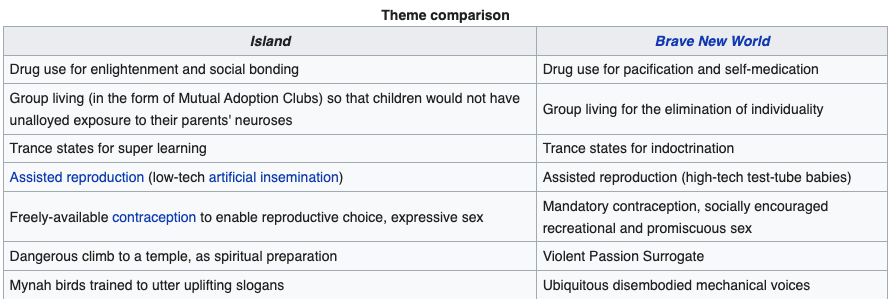
*In Shakespeare’s The Tempest, Miranda says, “How beauteous mankind is! O brave new world / That has such people in’t!” (5.1. 186-187).


 Bob's Books