
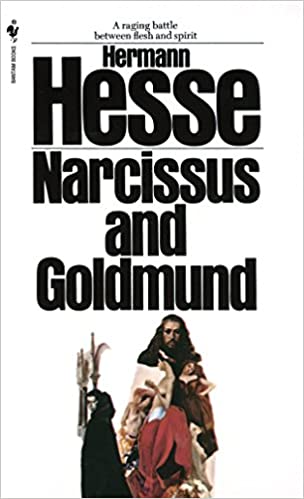
Why this book: Selected by my literature reading group for our bi-monthly selection – something different. I’d read Hesse’s Siddhartha, Steppenwolf, and The Glass Bead Game before, but not this one. Considered by some to be his masterpiece.
Summary in 4 sentences: Set in 14th century Germany, two young men meet as residents of a monastery, share much with each other and become very close friends. Narcissus is a teacher under instruction, and Goldmund a new student, and while Narcissus serves as a somewhat older mentor to Goldmund, he encourages Goldmund to pursue his life in the world outside the monastery. Goldmund has an epiphany, does indeed leave the monastery, and as a vagabond has many adventures for many years, roaming the countryside, meeting and seducing women, encountering various interesting characters, training as an artist and sculptor and finding himself in the middle of the devastation caused by the Black Plague in Europe. After many years and many hardships, he eventually returns to the monastery to find that his old mentor is now the Abbott, they reconnect on a new level with each admiring and envying the other.
My Impressions: An interesting story, an adventure story of the soul, with two characters who represent two important aspects of human nature who pursue two very different paths in their lives. Their lives begin together, then they separate, and then come back together again to resolve the tension between the different paths they’d chosen. The book includes a lot of Goldmund’s internal dialogue and soul searching, and his efforts to understand the world he wandered through. We don’t get inside Narcissus’s mind until the end of the book after their reunion, some 20 years after separating. Goldmund and his “adventures” and efforts to find himself and understand where he fits in the world comprise the majority of the book.
Narcissus and Goldmund represent two approaches to life: Narcissus represents the life of the mind, of thinking, of dedication to the spirit, almost in denial of the body and one’s primal instincts. He is extremely intelligent, perceptive and disciplined, and he commits fully to becoming the best priest and teacher he can be in the monastery. While Goldmund was a very promising and intelligent student, Narcissus sensed that he had other work to do in the world, that the religious/spiritual path was not where he would find fulfillment, and recommended that he indeed leave the monastery to find out who he really was meant to be.
Goldmund is young, energetic, attractive and charming and these qualities help win him the favors of many of the women he meets. He has many casual and pleasant sexual encounters but also falls in love several times, but for various reasons, one of which being that Goldmund was not ready, these love affairs do not lead to marriage or a long term commitment. But these love affairs each leave an indelible impression on Goldmund as he goes through life with an Epicure’s delight in the joys of love, food, and pleasure, while also undergoing hardship and tragedy with a Stoic’s resilience. All the while, as we accompany Goldmund on his wanderings, we are inside his head as he considers and tries to find meaning and significance in the things he’s seeing and experiencing.
At one point, looking back on his experiences, he sensed, “Something remained, something inexpressibly horrible but also precious, something drowned and yet unforgettable, an experience, a taste on the tongue, a ring around the heart. In less than two years he had learned all the joys and sorrows of homeless life: loneliness, freedom, the sounds of forests and beasts, wandering, faithless loving, bitter deathly want. ” p 139
DEATH: Goldmund sees much death on his journeys, including the mass dying that was the Black Plague in Europe in the 14th century. He also nearly loses his life several times and gives much thought to death, and considers it thoughtfully, in contrast to the joys of living. Death and the transitory experience of life is a theme throughout the book until the very end. His personality is alternately animated, optimistic and joyful in experiencing the simple ordinary things in life, and withdrawn, contemplating the ephemeral nature of our experiences, of joy, of happiness, of life, recognizing that it will all be over, sooner or later, for all of us. A couple of quotes:
- He thought that fear of death was perhaps the root of all art, perhaps also of all things of the mind. We fear death, we shudder at life’s instability, we grieve to see the flowers wilt again and again, and the leave fall, and in our hearts we know that we, too, are transitory and will soon disappear. p 155
- To others death might be a warrior, a judge or hangman, a stern father. To him death was also a mother and mistress; its call was a mating call, it’s touch a shudder of love. p221
ART Narcissus pegged Goldmund early on as an “artist,” though at the time Goldmund did little more than draw sketches. But Narcissus saw in him an artist’s personality type, and indeed Goldmund eventually found something to which he could commit himself, when he saw a statue of the Madonna that shook him to his core – how could someone create something that so spoke to him of the mystery of woman, of the mother figure, of life? He’d found his passion, and with some effort, committed himself to become an assistant to the artist who’d created that sculpture. Goldmund discovered that he indeed had the talent to take an images he held passionately in his mind and make it real. A couple of quotes on art.
- Goldmund: (Art) was the overcoming of the transitory. I saw that something remained of the fools’ play, the death dance of human life, something lasting: works of art. They too will probably perish some day; they’ll burn or crumble or be destroyed. Still they outlast many human lives; they form a silent empire of images and relics beyond the fleeting moment. p268
- Goldmund: The basic image of a good work of art is not a real, living figure, although it may inspire it. The basic image is not flesh and blood; it is mind. It is an image that has its home in the artist’s soul. p 269
- Goldmund: I have often been extremely happy. And I was also fortunate enough in my experiences to learn that sensuality can be given a soul. Of it, art is born. p 307
While Death and Art are two major sub themes in the book, Hesse gives us examples of an honorable sensualist and an honorable ascetic – how their lives differed – each with a different calling. Narcissus did not hold it against Goldmund that he was not called to the priesthood – in fact encouraged him to go out into the world. Nor did Goldmund negatively judge Narcissus for choosing to live a life circumscribed by the walls of the monastery and his duties as a priest and eventually, Abbott. To take an epigram from Lucretius “Live life fully, if not perfectly,” we see Goldmund indeed following his heart to “live fully,” and he went wherever he could to learn and grow. Narcissus, one might say, chose to live life perfectly, if not fully, choosing the path of the mind, duty and discipline.
Nietzsche argued that to live fully, one must balance our Apollonian natures (representing rationality and order) with our Dionysian natures (disorder, passion, ecstasy) and Nietzsche saw these as always in tension. The great, he argued, seek a fusion of the two. Narcissus and Goldmund is a story of two men who represented each side of this duality, neither finding the full satisfaction of a fusion, though at the end, Goldmund in his art, and Narcissus in his appreciation of Goldmund’s life may have moved closer to that greatness in the middle.


 Bob's Books