
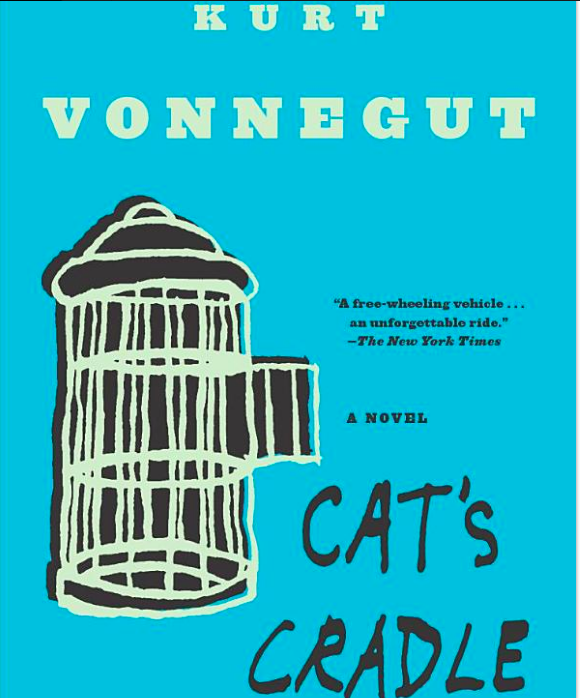
Why this book: Selected by one of the book clubs I’m in, a different karass of mine (see below for “karass.”) I’d read it nearly 50 years ago, it made an impression on me then and I was happy to read it again.
Summary in 4 Sentences: A journalist is writing a book about a now deceased (and fictional) leading scientist and one of the fathers of the atomic bomb and in doing his research, gets pulled into some of the crazy drama of his family’s life. His research takes him to the fictional Caribbean Island of San Lorenzo where one of the scientist’s sons is the general in charge of the island nation’s very small military. The journalist learns that the scientist he was researching had developed a chemical that potentially could put mankind at risk. When he arrives in San Lorenzo, the craziness and absurdity reach new levels, surprises abound, and Vonnegut has a ball with his satire on our human foibles.
My impressions: A clever and at times hilarious satire on the absurdity and hypocrisy of humanity. Fun, funny, crazy, written and published in the early 60s at the height of the Cold War when the destruction of the human race as a result of misunderstandings and/or the selfish and unreasonable behavior of humans was a palpable threat and a real concern.
The novel is written from the first person perspective of a journalist who is doing research to write a book about a recently deceased nuclear scientist whose genius was key to developing the atomic bomb. Our protagonist journalist is investigating who he was, his background and his life, and we learn that this scientist’s genius in science was more than outweighed by his almost complete lack of common sense, or concern for his environment and the world he lived in. He focused on scientific challenges with an intensity that excluded not only the people around him and his family, but also the potential consequences of his work. He would develop solutions to relatively small problems that had the potential of creating much larger problems. Nuclear weapons come to mind.
Our journalist’s investigation takes him to the fictional island of San Lorenzo in the Caribbean, which becomes a caricature for hopelessly impoverished Caribbean islands run by selfish and ignorant dictators. While visiting the island he encounters one absurd situation after another, and we are amused by aspects of life and the national narrative on the island which they considered completely normal and unremarkable.
Our journalist protagonist uncovers that his “mad scientist” had developed a product to help Marines better march through mud, which he called “Ice-9.” Ice-9 would immediately freeze and solidify any liquid it contacted, and this would make it easier for Marines to negotiate muddy terrain. But if a little piece of Ice-9 would somehow find its way into the ocean, it would unleash a chain reaction that would freeze and solidify all the oceans of the world, including all the waterways that flowed into them. In other words, kill almost all living things and make earth uninhabitable. Our journalist learned that the scientist’s adult children, who had grown up in his dysfunctional family and inherited their father’s lack of common sense, each had a piece of Ice-9.
San Lorenzo had a native philosopher, an elderly reclusive black man named Bokonon who had written a philosophy which offered a very cynical and non-heroic (realistic?) description of how human beings behave. His philosophy strives for human happiness, rather than human perfection, and accommodates conscious and unconscious hypocrisy, child-like credibility and the primary desire for comfort and pleasure of most humans. His philosophy doesn’t preach nor try to make humans better; rather it intends to make people content by accepting their very human, self-centered, and unheroic characteristics. And in the end, when Bokonon himself lies down to die, he thumbs his nose at God – for having created a world with so much suffering, weakness and stupidity.
Bokonon’s philosophy is detailed in the fictional “Books of Bokonon” which is regularly quoted and creates a humorous sub-theme to the second half of the book. It is Vonnegut’s clever description of how people actually behave, what they actually believe, and how they routinely deceive themselves. On San Lorenzo, Bokonon himself is state criminal number one, wanted, dead or alive, and it was forbidden to own the Books of Bokonon, though it was commonly accepted as the underground state religion. To be caught practicing Bokonism’s rituals such as boko-maru, was punishable by death. All this of course ensured that Bokonism would be enthusiastically, but secretely embraced by the people of San Lorenzo, and one of the most devoted secret observers of Bokonism was the dictator himself, “Papa” Monzano – the enforcer of the laws against Bokonon and Bokonism.
Cat’s Cradle gives names to concepts and practices from the underground holy texts of The Books of Bokonon. Some of those concepts that I found most insightful, and enjoyable:
- karass– A group of people linked in a cosmically significant manner, even when superficial linkages are not evident.
- duprass– a karass of only two people, who almost always die within a week of each other. The typical example is a loving couple whose lives focus almost entirely on each other.
- granfalloon – a false karass; i.e., a group of people who imagine they have a connection that does not really exist. An example is “Hoosiers.” Hoosiers are people from Indiana, and Hoosiers have no true spiritual destiny in common. They really share little more than a name. It can also include members of the same family.
- wampeter– the central theme or purpose of a karass. Each karass has two wampeters at any given time, one waxing and one waning.
- sin-wat– a person who wants all of somebody’s love for themself
- pool-pah– shit storm, but in some contexts: wrath of God
- boko-maru–an intimate act of Bokonists consisting of prolonged physical contact between the naked soles of the feet of two persons
- zah-mah-ki-bo– Inevitable destiny, fate.
Boko maru, helped people feel connected to each other and they found this practice to be as pleasurable as sex. But it was punishable by death – again ensuring that it would widely practiced, the risk and thrill associated with the danger intensifying the pleasure, and providing a cheap pleasurable distraction from their otherwise desolate and impoverished lives. I’m reminded of a line from Huxley’s Brave New World, spoken by their Grand Controller: “You can’t have a lasting civilization without plenty of pleasant vices.”
Vonnegut’s satire of people’s unconscious hypocrisy and absurd behavior I find particularly relevant today, in view of widespread virtue signaling, and the quasi-religious adherence of those on the left to woke “ideals,” and those on the right to a mythological vision of America. Vonnegut died in 2007 but his cynicism pointing to the weakness and fallibility of humans is timeless, and certainly resonates – from our slave-owning founding fathers promoting life, liberty and the pursuit of happiness, to the sexual abuses of our celibate priestly class, to hundreds of leaders in their private jets flying to Glasgow to promote measures for reducing CO2 emissions and slowing climate change.
The crazy humor and satire in this book will not appeal to all. But I had great fun reading it again.


 Bob's Books