
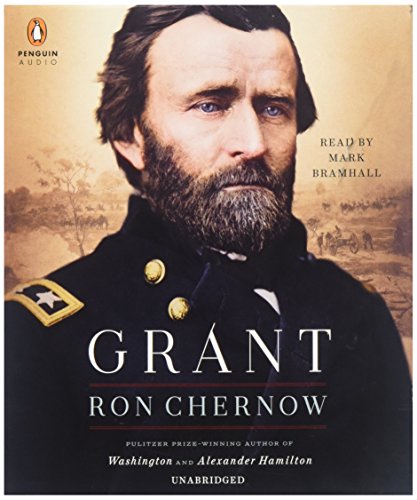
Why this book: I watched the PBS documentary special on Grant, was fascinated and wanted to know more. I had heard many good things about this book, but suspected I wouldn’t get around to reading it – so I picked it up on audible and listened to it – in the car, on my bike, whenever and wherever I could. The narrated version is excellent, but one doesn’t get footnotes, nor pictures, nor the opportunity to highlight, underline, make marginalia to return to.
Summary in 4 sentences: This thorough biography takes Grant from his boyhood growing up, to his appointment to West Point, to his service in the Mexican War, to then a series failures and disappointments after leaving the Army, then his meteoric rise from Cpt to LtGen of the Army in 4 years during the Civil War. Extremely well researched, but more importantly told in a non-academic narrative style that kept me coming back. So much I didn’t know about the Civil War, and even more surprising, about reconstruction and the battle Grant had as President to implement Lincoln’s and his vision for a united country with civil rights for all. This is the story of Grant’s life as a lens through which to look at this hugely important time in American history – HIGHLY recommended
My Impressions: This is an amazing biography – long and detailed, but a fascinating look at a man who was a surprise key player in a defining period of our national history. We learn not only about Grant himself and the circle of those closest to him, but we learn also about America in the middle 50 years of the 19th century, we learn about the Civil War, and about well known and more obscure players in that great drama – and we get to know them as human beings.
Chernow’s research was impressive. He must have read the autobiographies and biographies of dozens of those with and against whom Grant fought. He has Grant’s perspective from Grant’s excellent memoir, and he has Mrs Grant’s autobiography as well, but he balances that with what other players in the drama of his life said about him, and with that broader, almost 360 degree perspective, he provides us with a more accurate picture of Grant and events in Grant’s life. Chernow is a not only a superb historian, he is also a superb writer. His narrative carried me along like a novel – though I knew the ending, I couldn’t stop listening.
I finished listening to this book a couple of months ago. The audible version is excellent – but I got a hard copy from the library to view the photographs and compare the reading with the listening experience. Both excellent. But without a hardcopy on which I could highlight key passages or write notes, I’ll just list in this review some of the many things I recall being surprised by in Chernow’s biography of Grant. I’ll also note that the PBS documentary on Grant, available on Amazon, is an outstanding companion piece to this book and this 7 minute interview with Chernow about the book is a great introduction to the book.
Here are the highlights of what I remember about Grant’s life from listening to the book a couple of months ago.
- Childhood. I knew that Grant had had a tough childhood and an unpleasant experience in his early years in the Army. I didn’t realize that his father despaired of him as a failure, rode him hard, constantly reinforcing Grant’s failures to Grant himself and essentially forcing him to go to West Point. At West Point he excelled as a horseman – one of the best – but had an otherwise non-descript performance there. Grant was shy, didn’t want to be there, but was unwilling to leave and deal with his father.
- Mexican American War – his bravery and conscientious adherence to duty stood out. He took chances that others wouldn’t take, and he had a sangfroid in battle and under fire that was remarkable – to others and even himself. This early experience exposed him to the tremendous amount of suffering and death that comes in war, and it moved him.
- Middle Years – after the Mexican American War, in spite of his heroics, Grant was given undesirable positions. The army then was a fraternity and good-ole-boy network into which he didn’t fit. He married Julia Dent but spent very little of their early married years together while he was stationed in remote areas, with little to do, under bosses who didn’t like him. He began to drink out of boredom and loneliness, which led to his leaving the army – he quit before they fired him – establishing a reputation as a drunk that followed him for the rest of his life.
- After the Army – Grant struggled. He had very little business sense, was overly trusting of people and many took advantage of him. He invested in get-rich-quick schemes that went broke, and loaned money to many people who had no intention of paying him back. He was often broke and his family often depended on his in-laws to keep from starving. He was forced to work for his father and depended on the charity of his father in law, who had no respect for him.
- Slavery – Grant never supported slavery, though his father-in-law gave him one slave, who Grant freed. His own family were abolitionists, while his wife’s family were staunchly pro-slavery. This caused tension in his family and for Grant. When the Civil War broke out Grant’s sympathies were with the North and he offered up his services to the Illinois militia, exacerbating the schism in his family, as his wife’s family. But his wife always supported him.
- The beginning of the Civil War. Grant’s offer of his service as an officer with experience in combat was initially ignored, and then he was given assignments that were little more than an insult. He was not adept at playing the political game that was an important part of getting leadership positions in the Army. But whatever unglamorous assignment he got, he performed superbly, eventually garnering the respect of those above him, leading to positions of gradually increased responsibility, and as the war became more serious, and political appointees to military positions failed and were relieved, Grant’s star began to rise.
- Early and middle years in the Civil War in the the Western Theater Grant eventually was promoted to BG but he struggled under the autocratic and arrogant leadership of Major General Henry Halleck, but eventually, even Halleck couldn’t deny that Grant was a talented battlefield commander. Grant was an aggressive, audacious, and creative battlefield commander. He sought found, and exploited the advantage against his enemies. He won key and unexpected victories at Ft Henry and Ft Donelson which got him attention in Washington. Eventually, and somewhat reluctantly, Halleck allowed him to plan and execute the Vicksburg campaign which continues to be studied at military leadership schools around the world. Then after winning the difficult battle to rescue Chattanooga, he was promoted to Lt Gen. Finally when Lincoln was fed up with cautious and incompetent Generals in the East, he fired McClelland and put Grant in charge of all the armies fighting for for the Union.
- Final years of the War. The final year of the war pitted Grant against Lee, who many in both North and South believed to be invincible. Grant was not intimidated and went after him aggressively, which cost the Union many lives, but the Union could afford the losses, the Confederacy couldn’t. Finally Grant took Richmond and won a decisive battle at Petersburg, after which Lee’s forces were decimated, were out of resources and Grant’s armies had cut all their supply lines.
- Grant accused of being a “butcher” – the Battles of Shiloh and the Wilderness. Grant was accused of being a “butcher” for wantonly sacrificing troops for victory. In particular, the battles of Shiloh, and later while chasing Lee in Virginia, the battle of the Wilderness, cost the Union heavily in losses. He was accused of fighting a war of attrition, which had some merit, but other Uion generals had been so cautiously afraid of loses, an audacious Lee was able to regularly defeat numerically superior forces. The Special Operator in me believes Grant could have found less costly ways to win his battles, but given the times and circumstances and his background, Grant’s choices made sense, and they did indeed work.
- Appomattox. Grant accepted Lee’s surrender on generous terms, for which he was criticized by many. Grant believed that for the Union to survive, minimizing bitterness would be key. He paroled all the Confederate men and gave them amnesty, (protecting them against charges of treason) and let men keep their horses. The guarantee of amnesty in particular was a sore point with many who wanted to punish the South. The amnesty guarantee protected Lee and other officers later against charges of treason
GRANT IN THE YEARS IMMEDIATELY AFTER THE CIVIL WAR At the end of the War, Grant was a national hero, seen as savior of the Union and was the most popular and honored man in America – of course primarily in the North, but also by many in the South who appreciated the lenient terms he gave Lee and the Confederate army at Appomattox. He remained in charge of the Army after the war, and Congress voted to create a new position, General of the Army making Grant a 4-star General appointed by Congress. Fully 1/3 of Chernow’s book covers the period following the Civil War.
- Grant, Lincoln, and Johnson Grant and Lincoln had been close, personally, and politically, both believed fully in the cause of freeing the slaves, giving them full citizenship, and preserving the Union. Grant was devastated at Lincoln’s assassination, and in fact he and his wife had been invited by the Lincolns to join them in their box at Ford’s theater, and J.W. Booth had hoped to kill both of them. Grant declined the invitation largely because his wife did not get along w Mary Lincoln. When Andrew Johnson became president, Grant became slowly disillusioned with Johnson’s lack of commitment to Lincoln’s vision. President Johnson tried to undermine the Civil Rights amendments and laws that Congress passed, while Grant was doing all he could to support Reconstruction, and the two feuded. Congress supported Grant in this, and Johnson’s efforts to get rid of or marginalize Grant were in part what led to Johnson’s impeachment, which failed to remove him from office by only one vote.
- Grant’s alcoholism. Grant’s many political enemies and the press throughout his life accused him of regularly becoming irresponsibly drunk and disorderly, and Chernow spends a good bit of time exploring these charges. He concludes that Grant indeed was an alcoholic, could not drink in moderation, and when he occasionally let himself have a drink, he often took it to excess. Both Grant and his wife set up protectors to help Grant avoid drink, and to avoid becoming drunk. Chernow admires Grant’s discipline, but notes that the evidence supports Grant indeed abusing alcohol on inappropriately on occasion, but the accusations against him were personal, political and unfair and did not reflect the reality of his deportment.
- Julia Dent Grant. Grant’s wife plays an important role in Grant’s life and therefore in Chernow’s biography. She wrote her own autobiography after Grant’s death and Chernow quotes from it liberally in sharing her perspective on key events in Grant’s life. Where Grant was uncomfortable socializing, his wife thrived in it. Grant was happy to leave the Presidency; his wife was not – she loved the social life and prestige it gave her. She was always consummately loyal to her husband and he to her, and he counted on and relished her love and support throughout his life. I couldn’t help but find her rather annoying and obsessed with social form and status – which of course Grant tolerated much better than I would have. But she was able to add an important bit of social polish to his public persona which in fact he needed, and balance his quiet introspection.
GRANT AS PRESIDENT 1869-1877 The final half to a third of the book is about Grant’s life after the Civil War to include his tenure as President. During his political career, the level of vitriol and partisan fighting astounded me – and makes today’s squabbles look tame. There is a lot in this part of the book but three things stood out to me:
-
- Overly Trusting. History books accuse Grant of having had an unusually corrupt administration, plagued by scandals. That is in part true, but this was due to Grant’s nature to trust people. He did not make the transition from military leadership to political leadership well. Repeatedly he was let down after trusting people the way he would in the Army; he believed everyone was as honest and conscientiously loyal to principle as he was. Even some of his closest associates, who sold themselves well, turned out to be working primarily for their own personal advantage and gain. He refused to believe warnings about the perfidy of some of his appointees, until the evidence was overwhelming and the damage done. This trusting nature of Grant’s cost his administration much credibility, when a number of his key appointees, whom he had trusted and backed, were revealed as self-serving scoundrels.
- Civil Rights Champion. Grant found it extremely difficult to uphold Lincoln’s and his visions of reintegrating the South with the North and reuniting the country, while also assuring freed slaves their civil rights and integrating them into society. Most of those in power in the South, sought to undermine through local laws and political influence the aims of the war. Blacks were routinely murdered, the Ku Klux Klan flourished and local politicians and law enforcement supported them and refused to prosecute crimes against Blacks. Grant also found that many in the power elite in the North did not object to Southern recalcitrance and did not support the aims of reconstruction. He aggressively went after the Klan and fought un-reconstructed southern leaders who were elected by their white constituents, where blacks were intimidated or murdered when they tried to vote. This was the primary struggle Grant dealt with during his two terms as President. Several times he faced the possible threat of reigniting the civil war when he sent federal troops into certain states to enforce federal laws that the local political leaders and law enforcement officials wouldn’t enforce. He similarly fought for the rights of Native Americans, and in this too, he was opposed and undermined by a population largely wedded to their racist prejudices.
- Under valued President. Grant has been called by many recent historians the most under valued and under appreciated President in American History. His personal integrity and lack of concern for the trappings of success were unusual – he achieved power position because of his performance, not as a result of political maneuvering and personal ambition. He is the most dedicated advocates of civil rights for all, and worked harder for it and sacrificed more for it than any President we’ve had since Lincoln.
FINAL YEARS AFTER THE PRESIDENCY 1877-1885 Grant was asked to run for a third term, which was opposed by many to violate the unofficial two term limit since Washington. Grant was ambivalent – on the one hand had he been drafted, he could have continue to carry out his goals of increasing civil rights, and supporting reconstruction in the South. On the other hand he was exhausted by the social and political demands of the office, which he detested, and was ready for a break. He chose to not actively politic for a third term, and former Union General James Garfield was chosen by the Republican party, and Grant went into retirement. Garfield was not as lucky as Grant had been in avoiding assassination attempts – he was shot by an assassin less than a year into his presidency. The most interesting things I recall about this final period of Grant’s life:
- STILL A HERO. He left the Presidency still regarded as the hero who saved the Union and though many were not impressed with his administration, those who supported the liberal Republican party’s goals of reconstruction still applauded his efforts. He and his wife were feted wherever they went, which she enjoyed more than he did. He was often asked to speak, which he did not particularly enjoy, but because his speeches were short and laconic, he was much appreciated.
- TRIP AROUND THE WORLD. He and his wife Julia with a small coterie of supporters were invited with the support of the US Government to make a tour of the world on board ship. He was still seen as a hero in much of the world and he was received as a representative of the United States and its still nascent experiment with democracy. Wherever he went, he was received not only as a former President but also as a military hero. This part of the book is fascinating for describing his experiences in the 1880s in such places as France, Italy, India, China, Japan – places which then were far more obscure to America than they are today. Chernow rushed through his description of this voyage more than I would have liked – I would have liked more details.
- FINAL YEARS. After returning from his world tour, Grant followed his pattern of trusting the wrong people and invested almost all of his money with a Bernie Madoff-like character, and when the ponzi scheme collapsed, he and his son lost everything. On top of that, due no doubt to years of almost non-stopping cigar smoking, Grant was diagnosed with an extremely painful case of throat cancer. Near destitute, and faced with little time to live and the prospect of dying and leaving his wife with no money, he acquiesced to writing his memoirs, and again trusted the wrong people and made a bad deal. Mark Twain came to his rescue, got him out of the bad deal and got him the advances and support he needed. Grant wrote, dictated, edited his memoirs through the great pain and discomfort of his cancer – an act of almost inhuman will and courage. He finished his memoirs, and died a few days later at the age of 63.. His memoirs continue to be regarded as a classic. Attendance at his funeral in NYC exceeded 1.5 million and he was eulogized in cities around the country as an American Hero on par with Washington and Lincoln. Julia his wife wrote her own autobiography which, with the royalties from Grant’s memoirs, ensured that she would live out her live in comfort


 Bob's Books