
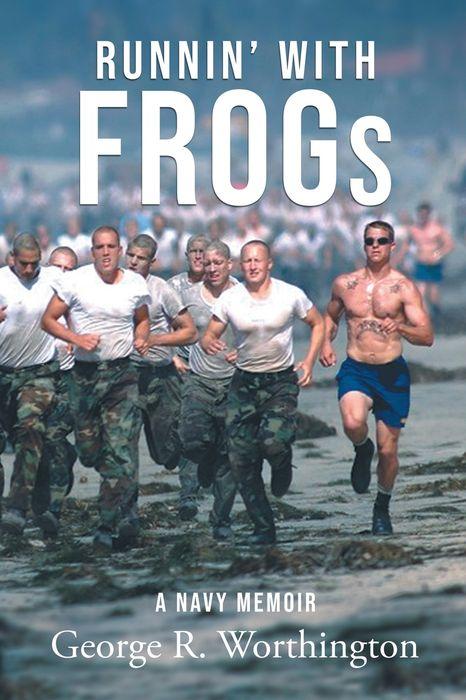
Why this book: George Worthington was one of the senior officers in the Navy SEALs as I was growing up during my career. He was the second Admiral to command Naval Special Warfare Command. He recently died, and I learned of the existence of this memoir only after going on-line to find a brief bio and picture of him to notify the community of Old Frogs and SEALs of his passing. I had not known of this memoir, nor had most of my friends. I bought it and read it.
Summary in 3 Sentences: George is telling his life’s story – beginning with his childhood, schooling, and then after graduating from the Navy, focussing almost entirely on his professional life. He describes the many things he learned as a Surface Warfare Officer driving ships and working for an Admiral in the surface navy before becoming a SEAL, at what was then the very senior rank of Lieutenant. Then he skips pretty quickly through his tours in UDT and SEAL Team One, his time in Vietnam, his command of SEAL Team ONE and eventually Naval Special Warfare Group One. He spends a good part of the book on his 6 years in the Pentagon on the Navy Staff protecting and fighting for the continuance of and support for Naval Special Warfare in a time when the Navy was not convinced we needed SEALs.
My Impressions: This little memoir (205pages) had the potential to be really good – and as it is, with all its flaws, it is still a valuable addition to the history of how the SEALs came to be what they are today (2022.) There are also some great lessons learned for junior officers who plan to make a career of being a Naval Special Warfare (SEALs/Special Boats) officer in the US Navy – and at the bottom of this review, I list a few key lessons from his memoir that occur to me. Each of his chapters covers a window of his life, and most conclude with a paragraph: “What’d I learn?” in which he shares a couple or several of key insights that came from the experiences he describes in the chapter he is concluding.
George Worthington enlisted in the Navy in 1957 and attended the Naval Academy, getting commissioned as an ensign in 1961. He initially served on surface ships and then transitioned to Naval Special Warfare with over 30 years of commissioned service (1961-1992) during a key period of change for the Navy and Naval Special Warfare. He was one of the very few officers in that era (early 60s) who went thru BUD/S as a lieutenant, and was one of the very few Naval Academy graduates allowed to become a frogmen at that time, given that serving in the UDT/SEAL Teams was not considered career enhancing. He graduated from BUD/S so senior that he immediately became the Operations Officer of UDT 11 and then “fleeted up” to become the XO, and deployed with his team to Vietnam. At that time, a tour with a UDT or SEAL TEAM was viewed as a brief hiatus for a naval officer, so after serving as XO of UDT 11, he had to get back to the real Navy, and was sent to Destroyer School and then back to sea as the operations officer of a surface ship. He was clearly good at surface warfare skills and ship driving, and enjoyed this assignment – it was full of engaging challenges and opportunities. When he completed that assignment in 1970, he was sent to Vietnam to a major Navy staff – Naval Forces Vietnam – where among other things, he served and represented SEALs and Special Boats in the Navy’s piece of the fight against the Viet Cong and the NVA.
By the time he concluded his Vietnam assignment, Naval Special Warfare had matured, and offered officers a career path, and Worthington was able to spend the remainder of his career in Naval Special Warfare. He recounts stories and lessons learned from his assignments as Commanding Officer SEAL Team ONE, Commander Naval Inshore Undersea Warfare Group ONE and then later, Naval Special Warfare Group ONE. He also spent 6 years in the Pentagon, and much of his narrative was about the battles he fought and the successes he had defending and resourcing NSW programs in the budgeting and planning processes in Washington DC. During this window, I was a junior officer in NSW, and as new force structure initiatives, new equipment, and new opportunities kept positively affecting my professional life, I had no idea how they came to be, nor of the work and struggles that George Worthington and other SEALs in Washington had undergone in order to achieve these results. This was one of the most enlightening aspects of the book for me.
His first flag assignment was to stand up, and serve as the first and interim Deputy Assistant Secretary of Defense for Special Operations, in 1988-89. From there he was called upon in 1989 to serve as the 2nd Admiral to Command Naval Special Warfare Command which owns and resources all the SEALs and Special Boats in the Navy, and he shares many of his successes and adventures from that time. At the end of that tour in 1992, he retired from the Navy. The last of chapter of his book briefly covers his life and activities after retiring from the Navy. George died from complications from Parkinson’s Disease in December 2021.
Shortcomings of the book: While I found much of the content of this book of great interest to me as a retired Naval Special Warfare Officer, I found a couple of key shortcomings to his book:
- First, it is very poorly edited. The book is full of mis-spellings, typos, cut-off sentences and in some cases redundancies. He may have been deeply into his Parkinson’s when he was ready to self-publish the book and unable to give it the detailed editing it deserves. But it badly needed a good editor to put the excellent content into a more professional form.
- Second, he includes very little about his personal or family life in his memoir. There is no mention of Sydna, his first wife, little about their 3 kids, nor does he mention his divorce from Sydna, or his 30 years spent with his final partner and wife Veronica. Nor does he mention a messy incident or two that I understand hastened his retirement, when he still had plenty to give the Navy and the SEALs.
My impression of George Worthington is that he was an extremely talented and very energetic man who led a full, active, and very engaged life. He was a clearly a gifted naval officer who loved the Navy and was fully committed to serving Naval Special Warfare. George was known as a good shipmate, loyal and generous to his friends, a fun guy to be with whether at a party or in tough circumstances. He was irreverent, funny, and had a biting sense of humor. He could also be vain, irascible, and impulsive, often sharing his views and acting on impulses without due consideration to context or impact. This was a darker side of his positive enthusiasm, intense energy and passion. His final years with Parkinson’s were very difficult for him, as his energy and freedom of action diminished, his athletic abilities and physique withered, and he struggled to maintain his joy and positive energy. By all accounts he faced these difficulties with great courage and humility to the end.
I attended George Worthington’s memorial service and celebration of life on 27 January 2022 in Coronado and it was well attended by members of the Coronado community, and by active and former SEALs who wanted to pay their respects to him, his service and his family. He had led an amazing and full life and contributed enormously to the success and growth of the Navy SEAL community, and he deserved to be so honored. Most impressive at the event was the eulogy that his son Rhodes, now a Chief Petty Officer in SEAL Team SEVEN, gave at the memorial service – about what a great Dad he’d been – compassionate, engaged and loving, always sharing his enthusiasm for trying new things, and embracing the joys of life. At the celebration of life afterward, his daughter Greer, reiterated the points made by her brother Rhodes, and gave examples of how he’d helped her be strong when she was down. Both Sydna, his first wife and mother of their three children, and Veronica who was his partner and then his wife over his last 30 years, were very gracious at his memorial, and celebration of life.
One of the quotes Rhodes shared in his eulogy of his dad is practical and profound: “In life when faced with two choices, the choice that is most personally difficult will never fail you.”
Lessons from Runnin’ with Frogs for aspiring SEAL officers:
- The value of experience outside NSW. He regularly referred to the value of his time in the Surface Navy in his later NSW career, and the contacts he had from that window gave him credibility with the Navy and with key decision makers in the Navy.
- The importance of working in the Pentagon – he made a HUGE impact on NSW by the work he did and the connections and credibility he established in Washington, which translated into increased force structure and money for the Teams. The credibility he earned with the Navy was key to his getting selected for flag.
- Don’t whine. Get to work. He often didn’t get the assignment he wanted or felt he deserved. But by making top performance in the undesired assignments a priority, it led to bigger and better things. He realized that he got what he needed, rather than what he wanted.
- Build bridges with the civilians. He shared how important it was for him to make friends with the civilians and civil servants in the big staffs to get things done. He had sympathy for the reality that they were there for years, while officers like him came and went, full of urgency and impatience to make an impact during the short window of their assignment.
- Learn to play the game. He tells us in the “What’d I learn” section after his Pentagon tours how important it was to not try to end-run the process, have your facts right, and maturely accept what the process gives you, work with and try to modify/improve it, rather than fight it. Have a plan, sell the plan to others, and then refer to your plan as you campaign for the things you want.
- The importance of good staff work. The operators in the field need competent and very engaged staff officers supporting them in higher headquarters, to get the coordination and support they need. Without competent, engaged, and credible representatives fighting for them on the staffs above them, the operators don’t get the intel, equipment, coordination, support they need to succeed.
- Stay active and build your network. He found a way to stay active with his athleticism – swimming, sky diving, etc, even when assigned to remote areas. His involvement with athletics and other outside activities built his network of friends and allies which served him well professionally and personally.


 Bob's Books