
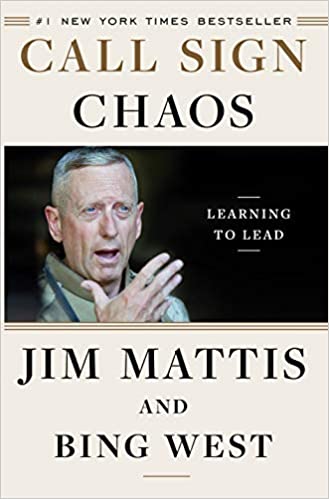
Why this book: Selected by our SEAL reading group. Also, I’ve met General Mattis, seen him speak several times and looked forward to reading his book.
Summary in 3 sentences: Call Sign Chaos is both a memoir and a book about leadership. After a brief chapter on his boyhood, Gen Mattis writes about his time in the Marine Corps – each phase of his career from what he calls “direct leadership” to later in his career where he is called upon to exercise “executive leadership,” and finally toward the end of his career, “strategic leadership.” He tells us stories of what he observed and experienced, decisions he made and the leadership lessons drawn from those experiences.
My impressions: Full of great stories and great leadership insights. A “MUST READ” for anyone in or aspiring to leadership positions in the military, or for anyone outside the military looking for great lessons on leadership from a great military leader sharing insights from the military context that translate well into any context. These are stories from the life and career of a very successful marine officer – arguably the most successful and inspiring marine officer in generations. His ghost writer was Bing West, a former Marine and a good friend of General Mattis. Bing West did an excellent job putting the General’s thoughts into a coherent and articulate book. Bing West is himself an author of several well-respected books on different wars, from Vietnam to Afghanistan.
Call Sign Chaos is written as an autobiography – of his career in service to his country – but it is primarily about leadership based on his own experiences – successes and failures. He breaks his career, his experiences and his lessons learned and insights about leadership into three parts: Direct Leadership, Executive Leadership, and Strategic Leadership. He begins the book with a brief chapter covering his youth and background entitled, “A Carefree Youth joins the Disciplined Marine” and then gets into his life in the Marine Corps and the process and adventure of learning about how to motivate and lead people in difficult, challenging, and sometimes life threatening environments.
Direct Leadership briefly covers his time as a junior officer in the Marine Corps but by page 20 he is already what he calls a totus porcus (whole hog) marine and a battalion commander in Operation Desert Storm. Then, in the inter-war years he offers us a chapter on “broadening” which includes serving as Executive Assistant to Secretaries of Defense Perry, Cohen, and Rumsfeld – what he called “a PhD-level course in running large organizations, witnessing how civilian control of the military actually works.”p49 The section takes him to his promotion to Brigadier General and a full chapter on his operations in the initial phases of our efforts in Afghanistan right after 9-11.
Executive Leadership begins when he is a Division commander leading Marines in Iraq marching toward Baghdad, where he says, “At this stage of executive leadership, I delegated routine chores of management – filling personnel gaps, requesting equipment, etc. – to my chief of staff. I reserved for myself and my subordinate commanders the design of the plan for how we would fight.” p81 Included in this chapter were his experiences and leadership lessons learned as a two star Division Commander and a three star Expeditionary Force commander during three different combat tours in Iraq. He concludes his Executive Leadership section with his insights leading Joint Forces Command as a four star General. In this section, some of his most interesting comments are about the challenges he had trying to keep the NATO partnership working together.
Strategic Leadership began when he was selected to assume command of US Central Command and essentially oversea the US efforts in both Afghanistan and Iraq. Here he was closely integrated into the political process, dealing regularly with ambassadors, congress, the press. “I decided that, while my official job was to coordinate the activities of our U.S. and allied troops across the region, my real role was to fight for a better peace – or what passed for peace – in the region for one more year, one more month, one more day… until diplomats could direct us to a better path.” p195-6 In this role, he concerned himself with the long term goals of the wars in Iraq and Afghanistan, and coordinating with our allies and with our relations with Pakistan and other countries in the middle east to achieve US objectives.
He concludes this section and the book with two short paragraphs about his time as Secretary of Defense. “On a Saturday morning in late January 2017, I walked into the Secertary of Defense’s office, which i had first entered as a colonel on staff twenty years earlier. Using every skill I had learned durin gmy decades as a Marine, I did as well as I could for as long as I could….When my concrete solutions and strategic advice, especially keeping faith with allies, no longer resonated, it was time to resign, despite the limitless joy I felt serving along side our troops in defense of our Constitution.” p244-245
Epilogue Call Sign Chaos concludes with an Epilogue which is a call for civilized discussion and a rebuke of the tribalism he sees in America today. He expresses his faith in our constitutional democracy which he reminds us is still an experiment, and is not to be taken for granted. He concludes with “E pluribus unum.”
Appendices Call Sign Chaos includes appendices A thru G which are different letters from his career, which he felt help make his points. My favorite is Appendix B which is about why professional military personnel should make reading a priority, and he provides us a list of his favorite books.
Footnotes: Extensive and fascinating footnotes follow the appendices, which give additional background to some of the many quotes he provides, as well as some of incidents he describes. The footnotes are also testament to how extensively General Mattis has read about and studied his profession.
Quotes: The book is full of great bumper stickers and one liners that one can remember and apply in so many contexts, as well as other memorable quotes. Here are just a few of the many that I underlined:
- Attitude is a weapon system. p17
- Attitudes are caught, not taught. p81
- In great units, everyone owns the mission. p16
- You can’t have an elite organization if you look the other way when someone craps out on you? p18
- Never advantage yourself at the expense of your comrades. p23
- If you haven’t read hundreds of books, you are functionally illiterate, and you will be incompetent, because your personal experiences alone aren’t broad enough to sustain you. p42
- Developing a culture of operating from commander’s intent demanded a higher level of unit discipline and self discipline than issuing voluminous, detailed instructions. p44
- If the risk takers are punished, then you will retain in your ranks only the risk averse. p45
- At the executive level, your job is to reward initiative in your junior officers and NCOs and facilitate their success. p45
- Doctrine is the last refuge of the unimaginative. p54
- Business management books often stress”centralized planning and decentralized execution.” I believe in centralized vision, coupled with decentralized planning and execution. p59
- My aim was to create a restlessness in my commanders and make the learning environment contagious. p81
- Note to all executives over the age of thirty: always keep close to you youngsters who are smarter than you. p88
- Our campaign’s success was based on not giving the enemy time to react. p90
- As (British Field Marshall) Slim made clear, any general who isn’t connected spiritually to his troops is not a combat leader. p92
- Cynicism too often passes for critical thinking. p94
- Field Marshall Slim wrote in WWII: “As officers you will neither eat, nor drink, nor sleep, nor smoke, nor even sit down until you have personally seen that your men have done those things. If you will do this for them, they will follow you to the end of the world. And if you don’t, I will break you.” p98
- I’ve always tried to be hard on issues, but not on spirits. p104
- (In Iraq, one of his soldiers said) “We’re taking the “fun” out of “fundamentalism.” p127
- (In Iraq, talking to village elders) As the negotiations turned into a kabuki dance, I warned my interlocutors: ” I come in peace. I didn’t bring artillery. But I’m pleading with you, with tears in my eyes: If you fuck with me, I’ll kill you all.” p132
- As Churchill noted, “A lie gets halfway around the world before truth gets its pants on.” In our age, a lie can get a thousand times around the world before the truth gets its pants on. p141
- It was refreshing to listen to a gunnery sergeant or lieutenant verbally spar with his men in the casual but respectful manner that reflected mutual fondness. That told me the lads’ hearts were still in the game. p145
- For me, “player-coach” aptly describes the role of a combat leader, or any real leader. p151
- There’s a profound difference between a mistake and a lack of discipline. p166
- The underlying problem with NATO transformation was…a lack of energy and initiative, resulting from a process-driven culture. Entropy prevailed; process had replaced output. p173
- It’s easy to get into a bureaucratic rut where things are done a certain way because they’re done a certain way. p 175
- Every institution gets the behavior it rewards. p 179
- Powerpoint is the scourge of critical thinking. p182
- I told my one-star admirals and generals: “You’re still low enough in rank to be in touch with your troops, but senior enough to protect our mavericks. That’s your job.” p184
- Secy Gates: “The only thing that allows government to work at the top levels is trusted personal relations.” You can’t achieve this leading by email. p201
- Rules of Engagement are what separate principled militaries from barbarians and terrorists. p211
- We must sustain trust, from the general to the private, as the most effective route to winning battles with the lowest cost to noncombatants. p212
- If a democracy does not trust its troops, then it shouldn’t go to war. p212
- Our military is hardwired with a can-do spirit; otherwise we could not take on what war requires of us. p214
- John Toolan on the challenge of fighting in Afghanistan: “The Muslim religion isn’t the barrier to progress here. The problem is a whole culture that rejects Western concepts of playing by the rules and cooperating with each other.” p219
- After a rebellion, power tends to flow to those most organized, not automatically to the most idealistic. p 222
- When tensions develop between friends, extraordinary effort must be made to keep those friends close. p225
- It is better to have a friend with deep flaws than an adversary with enduring hostility. p227
- On President Obama’s decision not to respond to Assad’s use of chemical weapons. “This was a shot not heard around the world.” p 228
- Acting strategically requires that political leaders make clear what they will stand for and what they will not stand for. p234
- Our military exists to deter wars and to win when we fight. p236
- There’s no substitute for constant study to master one’s craft….there are lots of old solutions to new problems. If you haven’t read hundreds of books, learning from others who went before you, you are functionally illiterate – you can’t coach and you can’t lead. p237
- I stressed to my staff that we had to win only one battle: for the hearts and minds of our subordinates. They will win all the rest – at the risk and cost of their lives. p239
- Trust is the coin of the realm for creating the harmony, speed and teamwork to achieve success at the lowest cost…..Yet it’s not enough to trust your people; you must be able to convey the trust in a manner that subordinates can sense. 240
- I had also found , in Tora Bora’s missed opportunity to prevent Osama bin Laden’s escape, that I had to build awareness and trust above me. This takes significant personal effort, and the information age has not made this easier, or removed the need for face-to-face interaction. p240


 Bob's Books