
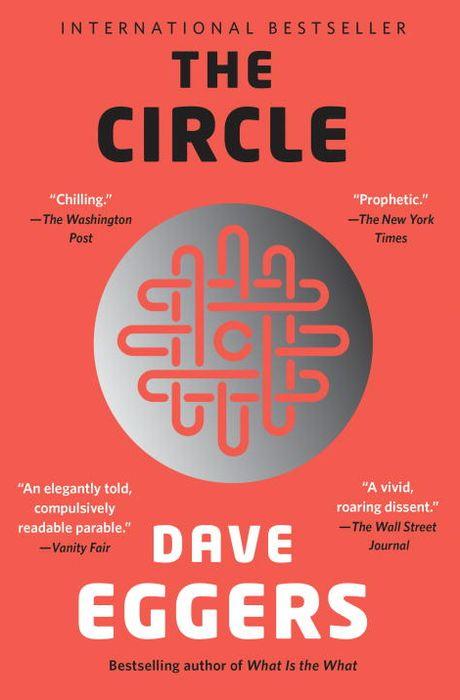
Why this book: I talked some of my friends in my literature reading group into reading this with me when I failed to get the whole group to agree to read it. I was impressed with an interview I’d heard with Dave Eggers, and additionally after listening to Yuval Harari’s 21 Lessons for the 21st Century, warning about the insidious and ever increasing power of the tech world over our lives, I was intrigued by this book.
Summary in 3 sentences: Mae Holland is excited to be hired by the most prestigious tech company in Silicon Valley and as she becomes acquainted with the company, the culture, the perks that come with the job, she feels like she is in heaven. As she works to become integrated into the culture, she sees that its demands of total engagement, total commitment, and total transparency have unexpected impacts on her private life, but she chooses to adapt to their demands in order to earn and deserve her membership in this ideal community. Eventually she begins to rise in the hierarchy of The Circle, and agrees to serve as an example of complete honesty and transparency in her life, which creates new challenges.
My Impressions: Really interesting, fun, easy, thought-provoking read. I actually listened to rather than read The Circle and found the audible version to be an entertaining and acceptable way to experience this book – but it precludes highlighting or taking notes as I listen, so this review is my overall impressions. Though it was published in 2013, the issues surrounding the ever-increasing influence of google, facebook, social and info media are still very much in the news, and this book continues to be very relevant. The concerns Eggers warns us about in The Circle are indeed of greater relevance today than when he wrote the book.
The Circle is the name of a private company which is a thinly disguised version of Google. The protagonist in The Circle is Mae Holland a bright young woman from the Central Valley of California whose close friend Annie had risen to a senior rank in The Circle and was able to get her a job at the world famous, cutting edge company in Silicon Valley. Mae had been bored and uninspired in her previous job working for the municipal government in the small town where she had grown up. Jobs at the Circle were highly sought after, prestigious and offered the best pay and perks in the industry.
Her early days in the company are like a dream – she is ecstatic with the support and the amenities that go with working at The Circle – and indeed it is a very seductive picture – almost too good to be true – the free this, the free that, an extensive employee support infrastructure, the nightly parties on the “campus.” The Circle would be fun, with an engaging social environment, and would take care of her every need. She’d found a family and a fully energetic, young and supportive community.
But there were also different kinds of challenges she had to meet in order to fit in and earn her full membership – challenges that were new and caught her by surprise. She learned that she was expected to be FULLY engaged, not just in her job, but also in the lifestyle and culture that The Circle promotes. She also learned that she was being judged and graded – constantly – on her level of participation and her demonstrated enthusiasm for the lifestyle and culture that The Circle promotes. It seemed like every time she turned around there was a surprising new challenge she had to meet if she was going to stay in good graces with her new “family.” She struggled a bit, but adapted and rose to meet every new challenge. She was expected to post regularly, and the AI algorithm graded her on the number of posts on the company’s social media site, and her grade, which changed daily, even hourly based on her behavior, was available for everyone to see. She was expected to respond to other posts, attend as many functions as possible, support as many philanthropic causes as possible, and share her life and what she was doing on the company’s social media site. She did – and better than most – and in the process, she became widely known, respected and admired in the organization.
Mae was extremely grateful for all that she got from The Circle – great health care for herself and her parents, a sense of purpose and membership in a community of people who were enthusiastic – or at least seemed to act that way – about everything associated with working at The Circle. And Mae was committed to prove herself worthy of being there.
Many of the characters in The Circle are realistic caricatures of techies working in Silicon Valley – young (most in their 20s or early 30s,) many from overseas, extremely idealistic and optimistic all the time – because that was what was expected. She developed a relationship with a young man who’d had a troubled youth, but who found solace in metrics – about everything. He seemed to have no emotional intelligence, and wanted to put a number value on everything he did, including a grade on his interactions with her, to include on his sexual performance. Mae later had another boyfriend who was mysterious, wouldn’t share his name or background with her, and she couldn’t contact him, which put Mae in a bind – because her best friend Annie was suspicious of his intent, kept pressing her for details and Mae felt she had to lie – or at least not tell the whole truth – to protect her relationship with her mysterious partner.
A turning point for Mae came when she borrowed (without permission) a kayak, went into San Francisco Bay with it, but was caught by the now-ubiquitous cameras that The Circle was dispensing, nationally and internationally. Mae was arrested and faced the possibility that this transgression would cost her her job. By apologizing for her poor judgment in front of the whole company and agreeing to become a role model of complete transparency in her personal life, she was given a second chance. This unexpectedly made her an international social media star, and a rising figure within The Circle.
In the end, Mae completely buys into the vision of The Circle, that civilization will only be saved when there is complete transparency in everyone’s lives – that way, each of us would have to be completely accountable for our lives and all our actions to everyone else. That complete accountability would end crime, corruption, deceit, dishonesty and the world would be a better place. And The Circle with all its money, technology, influence and idealism was on a path to to making that happen.
Some of the maxims that The Circle repeats and enforces, meant to promote complete transparency;
-
- Secrets are Lies
- Sharing is Caring
- Privacy is Theft.
- All that Happens must be Known
The Circle through its access to data, information, with its technology and its enormous resources and the political influence that brings, was well on the way to realizing its vision. And when Mae became one of the exemplars of the complete transparency movement, it cost her some of the most important relationships in her life. In the book The Circle we see the utopian idealism of the left, given huge resources and power, using technology to fulfill their vision for the world, in confrontation with the reality of how most humans are trying to live their lives. Eggers is subtle in his satire of this utopian vision – which we come to understand through the voices of the starry-eyed idealists at The Circle.
That said, I recognize a similar, but much less intrusive version of The Circle in the military, where I spent the majority of my adult life. Similarities include an extensive on-boarding process, a forced acculturation, an expectation of complete commitment, a strong culture with specified norms that can be pretty strict, an intolerance of behavior outside those norms which include one’s private life. The military specifically states that one is accountable to one’s service 24/7/365. The Circle similarly rejects the idea of a life bifurcated between private and work. There is also a self-righteous idealism – even arrogance – in both cultures, regarding the superiority and virtue of their values, and a willingness to impose those values on others. As conformist as the military is in minor matters such as haircuts, uniforms, and social behavior, the drive to conformity in The Circle is even greater, indeed becomes cult-like in its pressure to conform – Jeff Jones (just drink the Kool-aide!) or Scientology come to mind.
The Circle is a very clever dystopian look at current trends in American society. It was published in 2013 and so much of what Eggers predicts through the book is indeed coming true – to the horror of many of us, who hate excessive intrusions of self-righteous individuals, the government, and/or the larger society into our private lives. I found The Circle to be a very clever and well-written warning about the dangers of the increasing trend toward using Big Data to build connections between all of us, and the dangers of Silicon Valley tech firms maintaining data bases of information on all of us, with which to manipulate us to buy, behave, and live in ways that fit their vision of America.


 Bob's Books
I enjoyed reading this review! After having recently read The Circle, I totally agree with a lot of your points. True, the book was published in 2013, but I was having this thought that as years go by, this dystopia is possibly getting more and more closer to reality, given the feasibility of the scenarios presented in the novel. Though it was specifically representative of an ‘American dystopian’ setting, I could say for sure that the same is the case in so many countries in the world, including big Asian cities.