
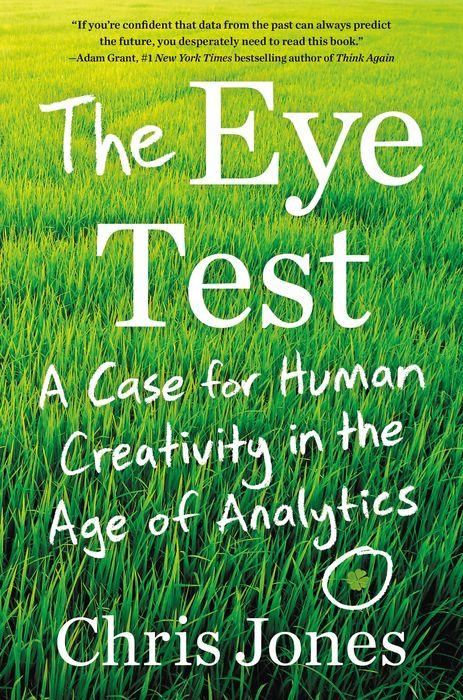
Why this book: Recommended by my friend Jay and by other members of a discussion group we’re in together. I wasn’t going to read this book, until to a person, the others in our group raved about it and said they were using it in their work and were having others they work with read it. Given that the people in this group are very smart and whose judgment I respect enormously, I changed my mind, got the audio and listened to it.
Summary in 3 sentences. Jones is arguing for a slightly skeptical view toward the “unimpeachable authority’ of data and analytics. He is a great story teller, and in the book he tells multiple fascinating stories of how people who believed they were using the unimpeachable authority of analytics and data to make decisions, have gotten results that shocked and disappointed them, or in some cases were tragic. The title “Eye Test” refers to what one sees, senses, intuits based on human experience, and his point is that while using data and analytics is strongly encouraged, our human senses, experience and instincts provide valuable input that one ignores at one’s peril.
My Impressions: The summary above is what I took as the “bottom line” message of this book. His message is NOT against analytics and data – he believes they add an important component to decision making, and sometimes may even be the most important component. But he warns, they should not be the ONLY component, and he makes the case from a variety of perspectives and in a variety of contexts that our basic human experience and instincts should be respected, given due consideration and certainly not ignored, even if they may contradict what the analytics are telling us. The data can miss things.
If you say, “Yeah, I already know that,” it is still very much worth reading the book to see how he makes his point, in worlds as different as entertainment, sports, finance, law enforcement, government and medicine. Chris Jones is a great story teller and he reads his book himself – I listened to the book on audio, and couldn’t wait to get onto my bike or into my car to listen to his stories as I rode or drove, stories that reinforced his point that while analytics should be and an important part of the equation in decision making, they should NOT the whole story or even the most important part, as some would want, and they do not obviate the need for human judgment. He repeatedly makes the point that data, statistics and analytics are not inherently objective – they are the result of human processes which necessarily include – usually unintentionally – bias, prejudice and error, and he gives many examples to make his case.
The Book’s Conclusion – He concludes his book with an impassioned and articulate plea for humility. There is a uniquely human hubris in claiming authority for AI and human created analytics, and he gives multiple examples of questions the answers to which we just don’t or can’t know, and which, while science, AI and analytics may help find some answers, some of the questions he asks are simply a part of the wonder of human existence.
It is a profound book making a simple point eloquently, powerfully and convincingly – at least to me, a right brain guy, who is inherently part of a choir he may be preaching to.


 Bob's Books