
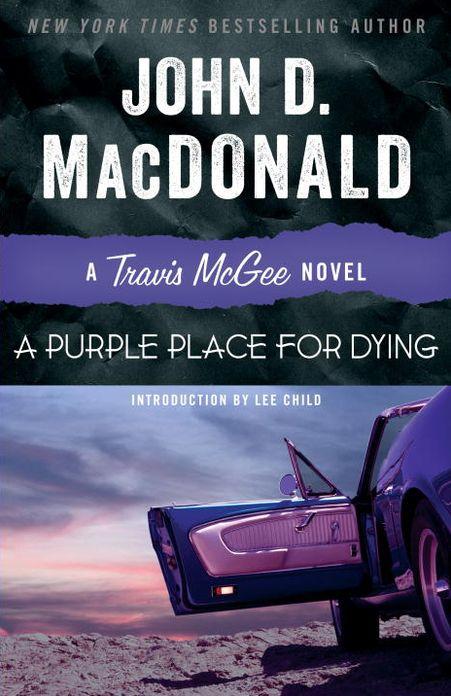
Why this book: In a great podcast interview Tim Ferriss did with Mike Rowe (of Dirty Jobs fame) Mike Rowe strongly recommended the entire John D. MacDonald Travis McGee series. This recommendation was subsequently reinforced by a friend who had read all of MacDonald’s Travis McGee novels and said he envied me the opportunity to read these for the first time. so I picked up and read The Deep Blue Good-bye (my review of it here) and found it a unique pleasure for a mature reader. I was recently looking for something light, fun and distracting to read, so decided to return to MacDonald and picked up A Purple Place for Dying, my second Travis McGee novel. It won’t be my last.
Summary in 3 Sentences: Travis McGee accepts an offer to fly out from his home in Southern Florida to the Southwest (state not specified) to meet with a woman to discuss helping her recoup money that she was convinced her husband had stolen or was hiding from her before she divorced him. McGee was not inclined to accept the work, but before he decides, the woman is murdered. His better judgment tells him to go back home and leave this to local authorities, but his outrage at how it was done, his curiosity, and his sense that he could contribute to finding out how, why, and by whom she was murdered seduced him to stay and look into it, and pretty soon he is VERY involved.
My Impressions: If All the King’s Men, or Angle of Repose are literary gourmet meals, then Travis McGee novels, to include A Purple Place for Dying, represent gourmet Fast Food. A Purple Place for Dying is a who-done-it mystery novel – one of the 21 books in MacDonald’s Travis McGee series, written in the first person voice of Travis McGee. McGee might be described as a cross between Jimmy Buffett and Jim Rockford (the James Garner character in The Rockford Files TV series of a few decades ago.)
Travis McGee is something of a boat bum in his mid/late 30s/early 40s, who lives on a yacht he won in a poker game and which he named “The Busted Flush.” He claims to be enjoying his early retirement in installments. He accepts work when he runs out of cash – and his specialty is helping people recoup money they’ve lost unfairly or through some chicanery. If/when he succeeds, his cut is half of what is left after his expenses.
It’s easy to like Travis McGee. He is un-pretentious, easy-going, un-ambitious, non-materialistic, suffers no fools, is principled and compassionate. He has a good head, a good heart, and the urges of a healthy male in his 30s/early 40s and he is respectful and solicitous of the women he meets. His judgment and decision-making balance these qualities in a way that most men would envy. At least I do.
In A Purple Place for Dying McGee reports the murder of his potential client and is warned by the local sheriff to stay out of this case – since the woman’s husband was a man of significant power, wealth and influence in the region, and the sheriff had political ambitious. But McGee can’t resist – he gets to know the first obvious suspect – the woman’s husband who knew she was having an affair with a local professor. Strangely the murder is set up to create the impression that it didn’t happen – that the woman and her lover simply left and disappeared to live happily ever after (disappearing was easier back then.) That McGee witnessed the murder was clearly not part of the plan. We are with Travis McGee as he goes through his process of determining who might have had a motive to commit this murder and hide it, and we’re along for the ride in his independent sleuthing, in spite of the warning by the local sheriff. Without giving up the story, I’ll just say that his investigation goes down some surprising rabbit holes, introduces us to some interesting characters, and the book concludes with a number of startling turns, a few more murders, and Travis McGee is involved up to his neck. Couldn’t put it down.
A bit about the Travis McGee novels and John MacDonal:
The Travis McGee novels were written in the early sixties, the context is late 1950s/early 1960s, when America was a simpler place than it is today – with most adult men having served in WW2 or the Korean War, no 24 hour news cycle keeping people informed but also enraged, concerned, anxious. The structures and rules of society were simple and well known – not necessarily better, but not as contentious as today. So part of the appeal of the Travis McGee novels is that the context takes the reader back to (at least on the surface) a simpler America. MacDonald writes very well – he is clever and easy to read, and through the voice of Travis McGee, MacDonald shares his keen and (I thought) interesting insights about American culture, men and women, people in general, and how they get along – or don’t.
John D. MacDonald got an MBA from Harvard just prior to WW2, joined the army in 1940 and served throughout WWII, leaving the army at the end of the war as a Lt Col. But rather than jump into the post-war race to join a corporation, develop a career and accumulate wealth, he chose to become an impoverished writer of pulp fiction, who once said about his writing, “They pay me to do this! They don’t realize that I would pay them!” In 1962, he was named Grand Master of the Mystery Writers of America and in 1980 received a National Book Award. He sadly died at the young age of 70 in 1986.
A few quotes that I highlighted while reading the book that may give the reader a sense for MacDonald’s style and perspective. Unless otherwise noted, these are Travis McGee’s thoughts:
When you can keep moving, when you have to keep moving, you can keep a lot of things at arm’s length. But when you stop, they come at you. p 30
Speaking of students he observed at the local college: They all seemed to have an urgency about them, that strained, harried trimester look. It would cram them through sooner, and feed them out into the corporations and tract houses, breeding and hurrying, organized for all the time and money budgets, binary systems, recreation funds, taxi transports, group adjustments , tenure, constructive hobbies. They were being structured to life on the run, and by the time they would become what is now known as senior citizens, they could fit nicely into planned communities where recreation is scheduled on such a tight and competitive basis that they could continue to run, plan organize, until, falling at last into silence, the grief therapist would gather them in, rosy their cheek, close the box and lower them to the only rest they had ever known. p 48-49.
Education is something which should be apart from the necessities of earning a living, not a tool therefor. It needs contemplation, fallow periods, the measured and guided study of the history of man’s reiteration of the most agonizing question of all: Why?……A devoted technician is seldom an educated man. He can be a useful man, a contented man, a busy man. But he has no more sense of the mystery and wonder and paradox of existence than does one of those chickens fattening itself for the mechanical plucking, freezing and packaging. p 49
He had a chauffeur’s hat, a big belly, a damp cigar end, little gray pebbles for eyes, and an air of petty authority. p70
There was a tomcat tension between us, and I had the feeling that if we could each give and take one good smack in the mouth, we might get along fine from then on. p 133
I had one of those strange moments of unreality, that old what -am-I doing-here feeling. p137
Jass Yeoman speaking: “They stood in line for it, boy. They always do. Ring the bell and the suckers come on the run. In this world you either take, or you’re tooken. P143
I had seen him on a hundred corners in a dozen cities, staring at me with a combination of defiance and stupidity, standing with an indolent tomcat grace. p 145
Maybe the entire murder arrangement was like one of those bloody cinema farces the British do so well. Everything goes wrong, and bodies keep falling out of the wrong closets. p 150
Speaking of suicide: This was the monstrous selfishness of self-destruction. Somebody else has to pick up the pieces. p154
I felt an inexplicable depression. This was the foolish end of all the foolish things, in a purple place for dying. p 199


 Bob's Books