
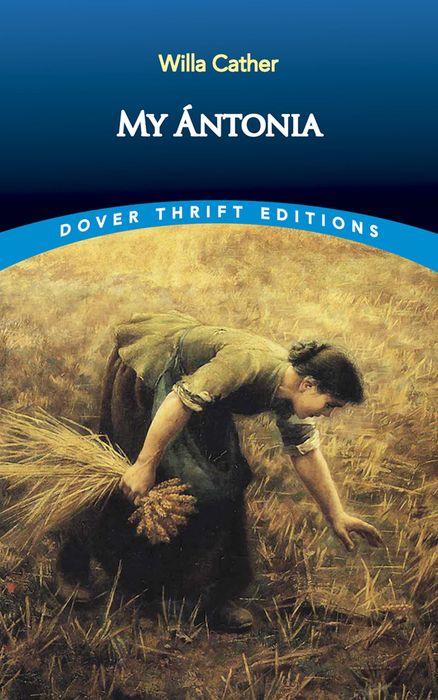
Why this book: I first heard of Willa Cather a few years ago when I was at a conference chatting about books with a woman from Nebraska, who mentioned that when she was in school, everyone had to read Willa Cather. I had never heard of Willa Cather, though I was born in Nebraska and my parents are from Nebraska, so I was intrigued. Then a few years ago, I read Cather’s Pulitzer prize winning One of Ours, and have been wanting to read more of her since.
Summary in 3 Sentences: My Antonia is a novel that takes place mostly on the prairies of Nebraska in the final two decades of the 19th century, and is told as a reflection of a man who had grown up initially on a farm and then in a small town there, looking back on his youth, and in particular at stories surrounding his friend Antonia Shimerda. The book is more about life in rural Nebraska prior to the end of the 19th century, with the focus on the lives, trials and tribulations of our narrator’s close friends and family, and especially Antonia. At the end of the book, the author switches back to the time when he is relating his story, and returns to the town of his youth and shares with us his impressions, his reunions, and his nostalgia.
My Impressions: Wonderful book written in 1918 by a woman who grew up on the prairies of Nebraska, conveying a sense of what life was like in the late 19th century in small rural farming communities on the great plains. My Antonia deserves its reputation as classic of early 20th century literature. It depicts a lifestyle and a time in America long gone – when life was simple, hard, there was a strong social contract in the community, no real social safety net other than what neighbors, relatives, friends would be willing to contribute to help people out. And it is beautifully written.
My Antonia reminded me of the writing of Ivan Doig – a male voice describing life of farmers and ranchers and working class people in rural Montana and Wyoming. In particular his book The Whistling Season comes to mind. I was also reminded of the writing and life of Laura Ingalls Wilder – her Little House books describe a similar setting in time and place, but whereas Wilder’s books are written for children or young adults, My Antonia and Cather’s other books about life on the prairie are written for a more mature reader.
My Antonia begins in the late 1880s and is told in the first person as a retrospective by Jim Burden, a man looking back on his youth. He begins when he was sent by train from Virginia to Nebraska after his parents died, to be raised by his grandparents on their farm. Arriving on the same train that brought him to the fictional town of Black Hawk, Nebraska, is the Shimerda family, a poor family from Bohemia (what is now the western part of the Czech Republic) who speak no English and are arriving to work a farm they had just purchased from a previous immigrant from Bohemia. One of the children in that family is Antonia, a girl just a few years older than Jim, and their farm is not far from the farm where Jim Burden grows up with his grandparents.
Jim tells his story about life on the farm, about his grandparents and his interactions with the much poorer neighboring Shimerda family over the years of his youth. His friendship with the young Antonia gradually grew as they played and interacted as children, but took a leap forward when Antonia’s mother asked Jim to teach her English. Antonia was a good student, energetic, actively, quickly and playfully learning English, and Jim truly enjoys her company, and as he gets older is smitten with her – from a distance. Antonia and her siblings did not go to school – rather they were needed to work on the farm from which the family struggled to make a living.
The book covers the trajectory of Jim’s and Antonia’s lives converging and diverging, as they mature over the years into teenagers and young adults, sometimes going for long periods without seeing each other. But Jim has a strong crush on Antonia who is clearly a remarkable girl, who becomes a remarkable young woman – healthy and strong, resilient in the face of hardship, sensitive in the face of difficulties and tragedy, yet still upbeat, positive, and determined. Additionally we get to know other interesting characters in the small town of Black Hawk, and we experience small-town Nebraskan life, as Jim’s grandparents move off the farm and into town, and Antonia eventually takes a job working as a housekeeper for a well-to-do family in town. We learn of the prejudices that town’s people have toward “country girls” and immigrants in general, and how “hired girls” and immigrants stick together and support each other. Jim describes the country girls who had helped to “break up the wild sod, learned so much from life, from poverty, from their mothers and grandmothers” as much more self-confident and interesting than the coddled and protected girls who had grown up in town.
There are many examples of immigrant families in My Antonia, who responded to the Homestead Act of the 1860s and moved West to get free land in exchange for working it for a number of years. These Swedes, Norwegians, Bohemians, Germans developed their own communities to help each other deal with how difficult life was in these early days on the prairies. We learn of the small town prejudices, the strict and conventional morality, as well as the simple joys and sense of community that people find when there are not many distractions from simply working, eating, sleeping. When things got hard, people had to simply deal them, but neighbors and friends always seemed ready to chip in as best they could to alleviate the worst of suffering.
Eventually, Jim goes off to college and a career that takes him away from Black Hawk, and Antonia and her girl friends also go their separate ways, and the idyllic time of their youth fades as the demands of adulthood take hold. At the conclusion of the book, Jim return to Black Hawk and we learn how the lives of Antonia and other characters in the book have changed and evolved, along with the country they live in. But it is clear in Jim’s narrative that Antonia was the original love of his life, and his story is a nostalgic look at not only his relationship to her, but also at the life they had lived on their farms and in Black Hawk, Nebraska.
My Antonia was published in 1918, and the story ends prior to the advent of WW1.
The Writing and descriptions. Willa Cathers’s descriptions of places and nature have been described as like reading a painting. There are some beautiful evocative passages in her descriptions of the prairie where she grew up. There is a strong Buddhist sense in her descriptions of nature. A few examples:
I kept as still as I could. Nothing happened. I did not expect anything to happen. I was something that lay under the sun and felt it, like the pumpkins, and I did not want to be anything more. I was entirely happy. Perhaps we feel like that when we die and become a part of something entire, whether it is sun and air, or goodness and knowledge. At any rate, that is happiness; to be dissolved into something complete and great. When it come to one, it comes as naturally as sleep. p 12
(At sunset) The blond cornfields were red gold, the haystacks turned rosy and threw long shadows. the whole prairie was like the bush that burned with fire and was not consumed. That hour always had the exultation of victory, of triumphant ending, like a hero’s death – heroes who died young and gloriously. It was a sudden transfiguration, a lifting-up of day. p22
The pale, cold light of the winter sunset did not beautify – it was like the light of truth itself. When the smoky clouds hung low in the west and the red sun went down behind them, leaving a pink flush on the snow roofs and the blue drifts, then the wind sprang up afresh, with a kind of bitter song, as if it said: “This is reality, whether you like it or not. All those frivolities of summer, the light and the shadow, the living mask of green that trembled over everything, they were lies, and this is what was underneath. This is the truth.” It was as if we were being punished for loving the loveliness of summer. p 85
Willa Cather – After reading My Antonia, I listened to several pieces on Youtube about Willa Cather and read what Wikipedia had to say about her. She was a major force in American Literature in the first half of the 20th century and lived a fascinating life. She grew up in Red Cloud, Nebraska, which is represented by the town of Black Hawk in My Antonia. She eventually attended the University of Nebraska in Lincoln, then moved to Pittsburg and then New York City, and became the main editor of McCure’s magazine before she wrote her first novel. My Antonia is one part of what has become known as Cather’s Prairie Trilogy which includes O Pioneers! (1913) and The Song of the Lark (1915.) Her novel One of Ours about a Nebraskan farm boy who goes off to fight in Europe in WW1 was awarded the Pulitzer Prize for fiction in 1922, and she wrote several other highly regarded and successful novels, which are not as well known today as her Prairie Trilogy. She died at age 73 in 1948 of breast cancer and its complications.


 Bob's Books
My Antonia is one of my favorites. My book group will be reading it this year. It seems more timely every year.