
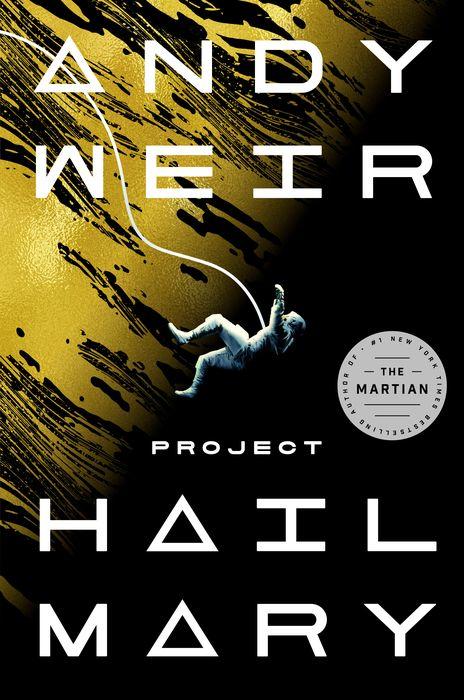
Why this Book: Selected by my SEAL reading group as our June 2022 selection, based on input from several who had read it.
Summary in 3 Sentences: Project Hail Mary begins with our narrator waking up on a gurney, covered with sensors, with numerous tubes attached, and not knowing who he is, where he is, or how he got there. As his memory slowly returns he realizes that he is on a spacecraft, no longer in our solar system, and begins recalling the events that led to his current situation, as well as realizing that he has a crucial tasks to fulfill. The story of the book bounces back and forth between his memories of what was happening in his life on earth that led to finding himself alone on a spaceship, and then forward to being on the spaceship, trying to figure out what he has to do to fulfill his mission, which is critical to the future of planet earth.
My Impressions: Very creative and clever Sci-Fi novel. I listened to it on audible and enjoyed the hypothetical story, the characters, the audible version, and the way it was told. If you liked The Martian and the main character Mark Watney, you’ll like Project Hail Mary and the main character Ryland Grace. They are both avatars of Andy Weir – practical engineers and scientists who systematically and dispassionately look at the most perplexing and seemingly hopeless problems to come up with solutions that I, a decidedly non-scientific thinker, could never imagine. Not having a strong background in science and engineering, I couldn’t judge whether his logic and solutions indeed made sense, but if not, they fooled me.
Project Hail Mary begins with Ryland Grace waking up, not knowing where he is, but slowly realizing that he’s strapped into a bed, alone in a spaceship, with two dead people strapped into beds near him, and he doesn’t know why. The initial part of the book is him slowly getting pieces of his memory back to help him figure out, not only who he is, but what he is doing there, who are these other dead people and what it is he is supposed to be doing. As his memory slowly comes back and he begins piecing things together, we are taken back to his life on planet earth before this strange space ship ride.
The book bounces back and forth between Grace’s emerging memories of events prior to and leading up to finding himself alone on a space ship, and Grace sharing what he’s thinking, seeing, doing and problem solving on the space ship – figuring out how it runs, where it is, where it’s going and why.
Slowly we learn that he has been sent into space on a mission to find what may be a possible solution to the problem of our sun cooling rapidly, due to an infestation of a unique microbial bio-phenomenon called “astrophage.” If the cooling of the sun by astrophage is not reversed, planet earth itself will cool over the next several decades enough to endanger most current life, bring on another ice-age, and perhaps eventual death of all life on earth. So Grace is on a pretty important mission, and as the book is named, he and this mission are a last desperate attempt by a Manhattan Project-like effort to find a solution to this problem.
There are several amazing things that Weir includes in the book. This hypothetical bio-phenomenon offers hints at the potential of fusion as an energy source. Also, astrophage itself is vulnerable to another microbial bio-phenomenon which Grace names taumoeba, for reasons explained in the book. Taumoeba can be and is, both a friend and an enemy, depending on context, and Grace has to figure out and test the properties, strengths and weaknesses of each of these two bio-phenomena, which are key to his mission.
Perhaps most interesting is that Grace, alone in his spaceship trying to figure out his mission and role, finds that he is being approached by another space vehicle, and we are treated to an inter-stellar/extra-terrestrial cross-species communication experience, as Grace and the being in the other space vehicle overcome numerous obstacles and differences in their make-ups to communicate and eventually work together. Grace names the other being Rocky (for reasons he explains in the book) and Grace learns that Rocky is on a similar mission from his planet in a different solar system, also under threat from their star cooling, due to the influence of astrophage.
The collaboration process and the various efforts, solutions, challenges, catastrophes they face together become the focus of the second half of the book, while we continue to regularly revisit Grace’s memories which help him (and us) understand how and why he was put on a space ship and launched on this mission of such importance. It is enjoyable and interesting to read about the international Manhattan project-like effort to save planet earth – and it all sort-of makes sense. Grace himself is an interesting character in this drama – a sort of nerdy everyman – a humble one-time middle-school science teacher – who somehow finds himself in the center of arguably the most important project in the history of the world.
Between these two settings – the leading minds on earth trying to solve the cooling of the sun, and Grace alone on his space-ship with an extra-terrestrial, we are treated to practical example after practical example of the scientific method being used to solve problems, explore possibilities, solve problem, question results, and move on to the next steps. In this, Project Hail Mary is similar to The Martian. But then Weir introduces the extraterrestrial, another intelligent and sentient being, he gives us insights into our own limitations and strengths and unique qualities as human beings.
Rocky is made of different stuff, has 5 legs which also serve as hands, and has many capabilities that we don’t have. As Grace and Rocky connect and get to know each other, they question each other about each other’s worlds, cultures, values etc. And we are introduced to a VERY different versions of sentient creatures which have adapted to a different environment. For example, in Rocky’s culture, one must always be watched and protected when sleeping, because in sleeping Rocky and his species essentially go completely catatonic and inert, and are vulnerable to a whole host of problems. They couldn’t live in our atmosphere, nor we in there’s. Rocky shares with Grace how they get their energy – what we would call calories – very different from us. Rocky and Grace both believe (and I assume this reflects what Weir believes is worth considering) that life in various solar systems, and perhaps galaxies, has evolved from a common source….which Grace and Rocky believe may explain the similarities – as tenuous as they may seem – between how the human and Rocky’s species evolved. And how astrophage and taumoeba have evolved.
Over the course of the book, and especially at the end, we see a transformation in Ryland Grace as he rises to the challenges he finds himself confronting, and truly takes his responsibilities seriously. There is a moral development piece to this book which simmers in the background, until the end. But it is definitely worth mentioning.
Fascinating book – highly recommended as a combination scientist-engineer’s and astrophysicist’s Sci- Fi fantasy which has a fascinating and believable human element.


 Bob's Books