
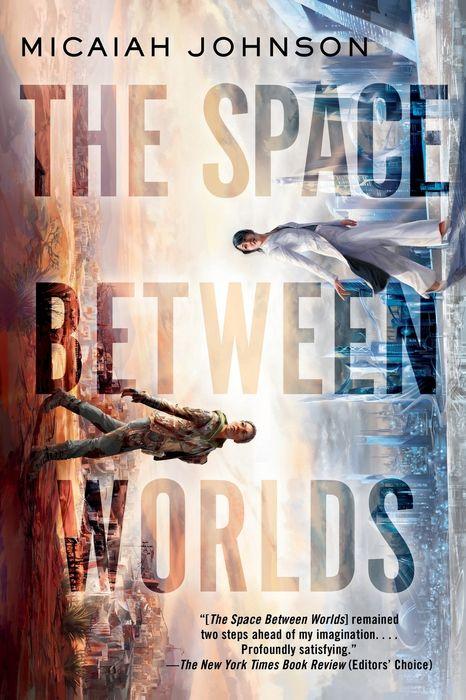
Why this book: When I asked my friend Alison what book in the past few years she’d read that had impacted her, she responded immediately with this book. I mentioned it to my friend Luke, an avid Sci Fi reader who responded “Fantastic book.” Reviews on line are mixed, from very positive, to strong down checks.
Summary in 3 sentences The novel is written from the first person perspective of a paid universe traverser who travels to different versions of Earth that simultaneously exist in parallel, to gather information. We also learn about the version of earth that she lives in, which is a dystopian future vision of the America we live in today. In traversing these multiple realities, our protagonist is learning not only about other versions of our earth in parallel universes, but also about herself and her world of friends, enemies, relations, and trusted confidants, and she and the story evolve from confronting different versions in different realities, of the people she knows in the world from which she is travelling.
My Impressions: Very imaginative book – a Sci Fi novel which includes a lot of different and creative ideas and content. Frankly, I was confused for the first 70 or so pages and considered putting it down – but chose to read on, out of curiosity to see what came next, and with the assumption that somehow, it would all come together. It did, finally. Though especially in the early scene-setting stages, I was more confused than entertained or inspired, the author had a fascinating idea, which became more compelling as I read on, and as more details fell into place, it came together quite well at the end, with a satisfying and morally relevant conclusion that helped me understand why Alison may have found The Space Between Worlds so impactful.
In a future world, a genius has developed a capacity for people in his world to travel to different versions of our reality, BUT with the caveat that, if in the visited parallel reality, there is a version of the travelrser living in that reality, the traverser cannot co-exist in that visited reality with the a different version of themselves. One of them must either be already dead or the traverser will die upon entering it. In this future world, the novel’s protagonist Cara, is hired by the controller of this multi-verse travel mechanism to travel between multiple parallel versions of his reality and gather data about things that have happened, or have been developed that would be of value in the reality from which she is traversing. Her job is to bring valuable data and information that will help the corporation that is paying her for making these trips.
Additionally, and adding a different dimension to this novel, the Earth reality from which and to which our protagonist traverses is a dystopian version of our own – well into the future. “Civilization” has subdivided itself into the “haves” – living in Wiley City – with all the current and future advantages of our civilized welfare state, and the “have nots” – living in “Ashtown” – a primal hell-scape of pollution, gang violence, controlled by a brutal warlord. These two worlds are kept separate with a border which in order to cross it, requires permission and passes. The analogy that occurs to me is San Diego and Tijuana. It also reminds me of the dystopian future sci-fi novel Void Star, by Zachary Mason (my review here.) Cara grew up in Ashtown, and is now living and working in Wiley City and her greatest aspiration is to become one of the Wiley City privileged by acquiring citizenship.
And to add another human dimension to our story, there is a tense and complicated love story between Cara, our protagonist, and Dell, her handler and mentor within the Eldridge corporation that is conducting the research based on the multi-verse travel. Dell is a native and pure Wiley City person, and manages Cara’s schedule of assigned travels and responsibilities.
It took me a while to figure all this out, as slowly throughout the novel, the pieces to the puzzle started falling into place, one piece at a time, answering my questions, and slowly dissipating the confusion I was experiencing.
Why did I struggle with this book? First, I didn’t particularly care for Cara, the book’s protagonist in whose first-person voice the book is written. During much of the book, she is angry, with a chip on her shoulder the size of Idaho (where I finished reading the book.) Having grown up in Ashtown, with a broken, dysfunctional family, mother a sex-worker and addict, she has gotten a job in Wiley City and feels very lucky, but also struggles to adapt. She is VERY keen on fitting in and ultimately gaining citizenship in Wiley City, where all the disadvantages and challenges of poverty and lower-class vulnerability she had experienced growing up in Ashtown are taken care of. She is tough, angry, bitter, and ambitious, but also vulnerable and even a bit paranoid.
As a traverser, Cara travels from Earth Zero which it seems is the baseline reality for the novel, into various versions of Earth-reality that are given different numbers (Earth 22, Earth 175, etc) where her task is to study and report on differences she finds in the versions of the reality she visits, different from where she lives in on Earth Zero. I got confused between characters who appear in multiple versions of Earth reality, but indeed are either somewhat or radically different in each reality – which eventually I realize, is part of the message of the book.
The story is told from Cara’s perspective, and she is the only character who is truly well developed. The other characters are less so, partly because we get to know different versions of each of them in different realities – again, part of the message of the book. We only really get to know Cara’s love interest Dell in Cara’s Earth Zero reality.
As this complex story progresses, there are a number of surprises, twists and turns that keep the reader a bit off-balance. The story culminates in a power struggle between the leaders from Cara’s life in Ashtown and her life in Wiley City – a power struggle with origins not only in their Earth-Zero lives, but also influenced by events and occurrences in other earth realities that Cara has visited – and Cara is a key catalyst in precipitating this power struggle.
If all of this sounds confusing, it is – but as one moves through the novel, the various themes develop and come together: the Wiley City – Ashtown tension, the goals of the Eldridge – the company that controls the multi-verse traversing, the love story between Dell and Cara, the good-vs-evil theme behind the separation of Wiley City and Ashtown, not only in Earth Zero but in the 352 (or so) other Earth realities. And ultimately, and what I found most interesting in the book, all this has an effect on Cara, and we see how from her experiences in multiple dimensions, the evolution of Cara’s character, her goals, dreams and ambitions. And finally through Cara, we gain insight into what all these multiple realities may mean in practical terms, to someone (each of us?) who is living in one of the multitude of realities that may exist.
In The Space Between Worlds, Micaiah Johnson creates a novel which explores the implications of some of the quantum multiple universes theories that theoretical physicists have proposed. It also begs many metaphysical questions about “reality” and whether there is such a “one” thing. If you google “quantum theory multiple universes” you’ll see a multitude of entries discussing this intriguing idea. To the question “Can you live in a parallel Universe?” Google responds: “Those alternate universes are completely separate and unable to intersect, so while there may be uncountable versions of you living a life that’s slightly – or wildly – different from your life in this world, you’d never know it.” In The Space Between Worlds, that assumption is set aside and we play with an imagined future scenario in which it may be possible to get to know a different version of oneself in different situations and contexts, good bad, evil or spiritually transcendent.
Cara: “Maybe I’m not the only one who feels the tugs of my other lives. Maybe they hover over us, steering us, constantly.” p 220
The Space Between Worlds is not a book I’d recommend to most of my friends, few of whom read Sci-Fi. But I found it clever and intriguing, and the conclusions were worth the effort to get there.


 Bob's Books