

Why this Book? Selected by my SEAL Book Club as our Oct 2022 selection. I’d heard about it from others and looked forward to reading it.
Summary in 4 Sentences: The Righteous Mind looks at our human decision making in general, but primarily decision making for issues that we feel have moral content, to include how we vote and where we stand on political issues. The book is written in three parts: PART ONE makes the case that “intuitions come first, strategic reasoning second” -how most of our moral decisions are built upon an emotional, not a rational base, and that we usually use our reason to rationalize responding in accordance with that initial emotional response. PART TWO makes the case that “there’s more to morality than harm and fairness” and he argues for six foundational ethical values that most healthy people share, explains how he came up with them, and explains that our differences are based on differences in the weight we give to those values, since they can often be in tension with each other. In PART THREE, he explains how “morality binds and blinds” – that we are both selfish and groupish, and describes what he calls our “hive mentality” and how this explains our impulse to fulfill ourselves by turning to religion and membership in political parties and movements.
My Impressions: An Extraordinary book about who we are, how we make our key choices and why. He says at the end of the book that he took us “on a tour of human nature and human history.” In the introduction, he says “the take-home message of the book is ancient. It is the realization that we are all self-righteous hypocrites.” He indeed covers a huge amount of territory and does it in language and form that is accessible to most thoughtful readers.
PART ONE: Title: “Intuitions Come First, Strategic Reasoning Second.” Central Metaphor: “The mind is divided, like a rider on an elephant and the rider’s job is to serve the elephant.” As a former Ethics teacher at the USNA and at USD, I was fascinated by his point in Part One, that our ethical intuitions are the drivers of our moral decision making. He argues against Kohlberg, Plato and Kant and others who believed that reason is and should be the primary driver of our moral decisions, noting that he agreed more with David Hume that moral reasoning is more often a servant of moral emotions. He notes that children learn early the difference between social conventions such as what clothes to wear when, what to say under what circumstances, and moral rules that prevent harm and are related to justice, rights, and how people treat each other. He distinguishes between socio-centric cultures which put the needs of the group and institutions first, and individualistic cultures which put individuals and personal freedom at the center, and makes society a servant of the individual. The US is clearly an individualistic culture. He notes that “…we cut ethical corners …when we think we can get away with it, and then we use our moral reasoning to manage our reputations and justify ourselves to others. We believe our post-hoc reasoning so thoroughly that we end up convinced of our own virtue.” p220
He shares his personal experience living in India and contrasts two very different moral codes between the US and India, but notes that though their values were very different from his own, he really liked and appreciated the people he met in India. In India the moral domain includes many behaviors which we in the West would regard as social conventions. He also describes fascinating experiments he’s conducted to explore how people view moral issues, bringing in ideas like disgust and disrespect and where they fit into moral thinking. (Is something that we would find abhorrent that someone does in the privacy of their own home and harms no one, immoral, or merely disgusting?) He says that if morality doesn’t come from Reason, then “that leaves some combination of innateness and social learning as the most likely candidates.” And he shows from the evidence that what we would call effective moral reasoning requires an emotional component.
PART TWO: Title: “There’s More to Morality than Harm and Fairness” Central Metaphor: “The Righteous Mind is like a tongue with six taste receptors.” Here he talks about cultural differences in morality and develops the acronym WEIRD morality – reflecting how a large percentage of psychological research into morality focuses on a rather small sample size – people from cultures that are primarily of what he calls WEIRD people – Western, Educated, Industrialized, Rich, and Democratic. “The WEIRDer you are, the more you see a world full of separate objects, rather than relationships, and whereas most people in the world see things holistically, WEIRD people think more analytically.” (p113) He notes that in non-WEIRD cultures, relationships, context, groups and social conventions are more important than individuals and their “rights.” He notes that you can’t study the mind while ignoring culture, because minds function only once they’ve been filled out by a particular culture. He divides ethics into systems which emphasize three different domains: Autonomy, Community, Divinity.
He also gives us a primer on Deontology, Utilitarianism, which he calls single principle, moralities but makes the case for pluralistic Humean approach which gives priority to naturalist and sentimental (emotion-based) approaches.. He makes the case for six foundational moral principles that are innate in us, but are expressed differently and weighted differently in different cultures. Each has a positive and a negative valence – a virtue is seen as the positive expression of that principle; sin or moral failure in it’s opposite. He goes on to lay out what he believes to be the moral foundations of politics.
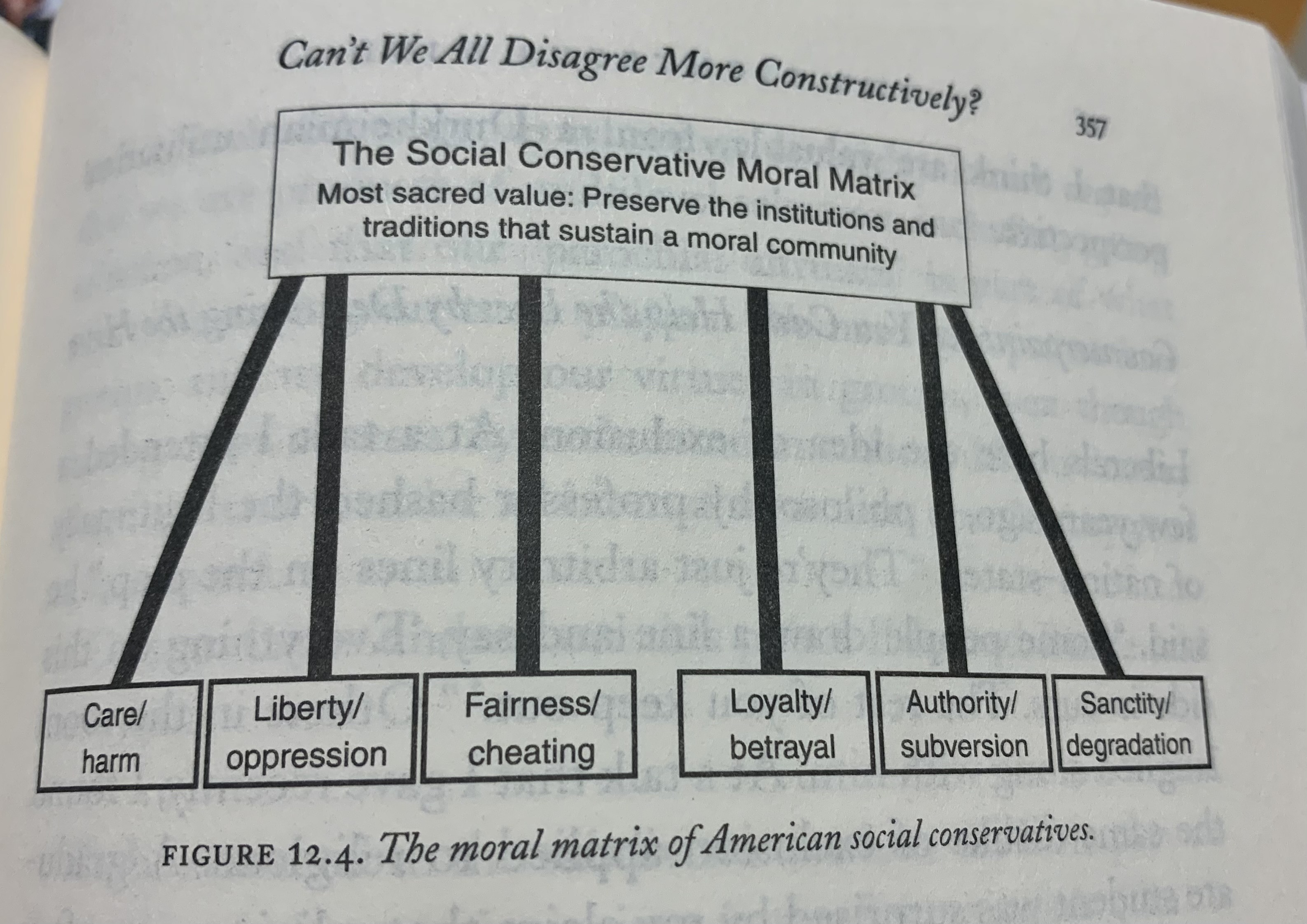
These are the six foundational values that he believes all humans share, and beneath them their negative sides – what the positive is seeking to avoid.
CARE, LIBERTY, FAIRNESS, LOYALTY, AUTHORITY, SANCTITY and their opposites: >Harm, ->Oppression, ->Cheating, ->Betrayal, ->Subversion, ->Degradation.
He argues in this chapter, and elaborates in chapter 12 of Part Three how these foundational values and our relationship to them help explain the differences in political parties and outlooks. In these three figures, the darker the line, the greater priority that political group gives to that value.


PART THREE Title: “Morality Binds and Blinds” Central Metaphor: “We are 90 percent Chimp and 10 Percent Bee.” In this part he argues for why, culturally and genetically, we as a species thrive in groups, and that we have mental mechanisms that drive us to promote not only our individual interests, but also our group’s interests in competition with other groups. “We are not saints, but we are sometimes good team players.” Our social virtues are based on the fact that “people are passionately concerned with ‘the praise and blame of our fellow men.'” Haidt argues convincingly that as humans have evolved, “groupishness helped us transcend selfishness.”
“Man and many animals are social: they live in groups, flocks, or herds. But only a few animals have crossed the threshold and become ultrasocial, which means that hey live in very large groups that have some internal structure, enabling them to reap the benefits of the division of labor.” p 235 Bees, ants, and humans are examples of ultra social groups. Then he argues that natural selection favored species, especially human groups, that have learned to to conform to social norms, and develop what he calls a “vast web of shared intentionality,” with a sense of “we” that extends beyond kinship. He notes that we are “selfish primates who long to be a part of something larger and nobler than ourselves.”
He has a chapter entitled “The Hive Switch” in which he argues that “human beings are conditional hive creatures. We have the ability (under special conditions) to transcend self-interest and lose ourselves (temporarily and ecstatically) in something larger than ourselves.” p258 He goes on to say that “If the hive hypothesis is true, then it has enormous implications for how we should design organizations, study religion, and search for meaning and joy in our lives.” He invokes the work of Peter Durkheim who believed that people have a metaphorical “switch” to go from self-interest, to a group focus, and natural selection favors both impulses – individual self interest can obviously support survival, but those who are members of the most coherent groups will out-compete and out-survive those in less coherent groups.
He identifies three ways in which people transcend their self-focus: 1. Awe in nature; 2. Psychedelics and mind altering drugs; 3. “Raves” – music and other events where people’s consciousnesses seem to ecstatically merge. He also has a section on the biology of the hive switch, including the hormone oxytocin, and the “mirror neuron” which helps people feel each other’s pain and joy “to a much greater degree than any other primates.” His chapter “Religion is a Team Sport” is an extension of his chapter on the Hive Switch – he argues that the impulse to religion and to join religious groups is part of our need for a social group of people we can trust, into which we can subsume ourselves, transcend our personal identity, and which makes moral “everything that is a source of solidarity, everything that forces man to regulate his actions by something other than his own egoism.” He says that “Religion is therefore well suited to be the handmaiden of groupishness, tribalism, and nationalism.”
His final chapter “Can’t We All Disagree more Constructively” revisits the value differences between the three political theories that are listed above – Liberalism, Libertarianism, and Social Conservatives. In fact the pictures I show above are from this chapter. This chapter has what I believe are some great insights about the sources of the polarity we are experiencing in American politics now – regarding both liberal and conservative perspectives. As is seen in the figures above, he argues that we all share common values, but the differences are in the priority and weight we give to those values. He states at the end, “liberals and conservatives are like yin and yang – both are ‘necessary elements of a healthy state of political life,’ as John Stuart Mill put it.”
He has a short chapter entitled “Conclusion” in which he admits that his book covers a lot of territory, and he offers an excellent concise summary of the key points he made in Parts 1, 2, and 3 and the entire book.
This is a fascinating book that has generated great discussion in two of my reading groups that have read it. I strongly recommend reading it with other thoughtful friends, and discussing the three parts, each separately.


 Bob's Books