
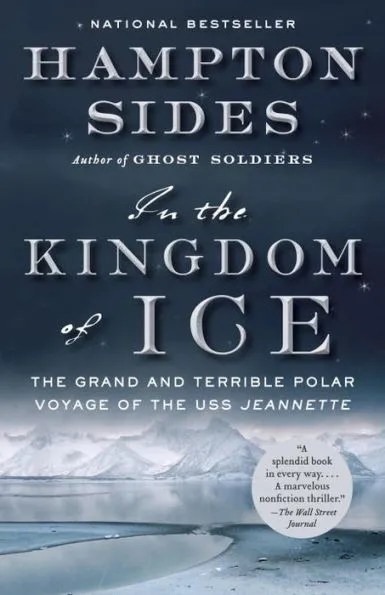
Why this book: Selected by my SEAL book club for our May 2023 session. I had proposed it, having read it maybe 10 years ago – and I was thoroughly engrossed reading it for a second time.
Summary in 3 Sentences: Many of the world’s top scientists believed that there was a navigable passage that connected the Atlantic and Pacific Oceans in the polar regions and the US as well as European nations sponsored exploratory trips to discover it – this is the story of a US effort with a US Navy vessel in the late 19th century. The USS Jeannette headed through the Bering Straits and eventually became icebound and never broke out, and after two years, the crew were forced to abandon ship and head hundreds of miles south over the ice to Siberia. This book covers this voyage from its inception until the surviving crew made contact with Siberian natives.
My Impressions: Powerful story which tells not only a story of heroism and heroic performance under great stress and life-threatening conditions, but also a lens to look at America of the 1870s abnd 80s. It is also a powerful leadership book in that the protagonist, Lt George De Long was pretty close to a model leader as the Commanding Officer of the USS Jeannette making numerous very tough decisions under life and death pressure. If you found the Shackleton story powerful and inspiring, you’ll love this one as well – though it doesn’t have the same fairy tale ending.
For much of the 19th century there was conjecture of a warm water polar region which would permit shipping to travel from Europe to the Far East or to California without having to round the cape. The first quarter of the book outlines how and why some of the best minds believed in a warm-water Polar sea, and how that inspired not only this expedition but previous failed efforts to find a way thru the Arctic to reach the Pacific Ocean. The US government had funded a disastrously failed effort to find that route up the west coast of Greenland, and Hampton Sides opens Kingdom of Ice with a brief account of that effort – in which De Long played a part- leading a bold effort to find and rescue those who had never returned. (That story is well told in the book Trial by Ice, which offers an example that contrasts sharply with both De Long’s and Shackleton’s expeditions.) De Long and the Jeannette would attempt to find that Northwest Passage by going through the Bering Straights and heading to the North Pole.
The book then continues by providing biographical sketches of the two main characters in the book – George De Long and his wife Emma – how they met, courted and married, and then their lives during the 2+ year preparation for beginning the expedition. That included finding, purchasing and refurbishing a ship that would be sturdy enough to withstand the ice and the conditions in the most Northern latitudes, putting together the right crew, lobbying for support and money, though the vast majority of the financial support would come from Gordon Bennett, the mercurial owner and editor of the NY Herald Tribune. Through this period, we see his process in selecting the key players for his expedition and we get to know many of them. Gordon Bennett plays a large part in the beginning of the book, as it was his intent that sponsoring this expedition would provide stories and fame for his newspapers which would increase his own power, wealth and influence.
The expedition got underway from San Francisco Bay in 1879 headed to Alaska stopping at several small ports to replenish coal and supplies before heading to the East Coast of Siberia, making contact with natives and then into the Arctic Sea, where much sooner then they expected, they were frozen into the ice pack and would stay that way for nearly 2 years. Then in June 1881, the ice finally crushed the Jeannette, and De Long and the crew abandoned the ship onto the ice, bringing with them all that they thought they could use. At this point we are about half way through the book.
Hamptons Sides also gave us some insights as to how the rest of the world was waiting for news of the Jeannette’s great mission and adventure. Much of that was in how Emma DeLong was thinking as he quotes some of her many letters, but he also describes several rescue attempts as authorities were concerned at not having heard anything from the Jeannette for two years. One of those rescue attempts included John Muir, the famous naturalist and founder of the Sierra Club, who wrote a book about his experience in the far north looking for the Jeannette.
The second half of the book is divided into two parts: First the efforts and incidents of Jeannette’s crew to cover the 500+ miles from where they abandoned ship, over the ice and freezing water to reach the northern coast of Siberia, where they hoped to contact civilization. This experience compares well with Shackleton’s experience on the ice pack after abandoning the Endurance. The final quarter of the book is about the experience of those who made it to the northern coast of Siberia just as winter was setting in, and their efforts to connect with natives and eventually civilization to rescue them.
De Long kept a thorough personal journal as well as ship’s log, and Emma De Long also kept her many letters which she described as “letters to nowhere” since she had no idea whether they would reach her husband. Hampton Sides had access to all of this in painting a powerful picture of heroism, determination, suffering, privation, rising above and defeating the most inauspicious bad luck. Each of the chapters began with excerpts from a letter written by Emma to her husband, reminding us that while the men on the Jeannette were suffering, their families likewise suffered, not knowing anything of the fate of their husbands, sons, friends.
The suffering and perseverance of those who reached Siberia was intense. Spoiler alert: not all of them survived but some did, barely, and they then did all they could to rescue or find those who had not turned up. Those who did survive, made it very small subsistence villages in the farthest north regions of Siberia – and they had to contend with communication and culture gaps to convince the natives to head back into the regions where no one lived during the winter, to search for survivors of an American Navy ship.
This book was worth reading twice, especially for an aficionado of survival stories by the toughest of men in the most austere and demanding of circumstances. A classic of the trials and tribulations of Arctic exploration in the 19th century.


 Bob's Books
Pingback: Wide Wide Wide Sea – Fateful Final Voyage of Capt James Cook, by Hampton Sides | Bob's Books