
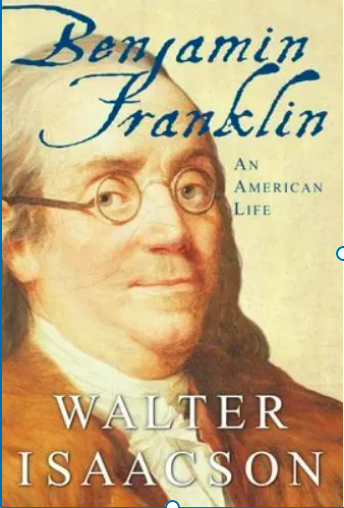
Why this book: I’ve had this book on my shelf for years, had never gotten around to reading it, but have always been fascinated by Benjamin Franklin. So I decided to listen to it on audible. I find biographies easy and enjoyable to listen to on long bike rides or car trips. But listening doesn’t allow me to underline nor make notes in the margins, so I have to rely on my memory and impressions to write a review.
Summary in 3 Sentences: This is the story of Benjamin Franklin’s life from his birth in 1706 to his death in 1790. It is also a fascinating lens through which to look at the founding of not only the American experiment in government, but also a key period in the formation of American culture and values. We learn in this biography not only the facts of Franklin’s life, but also what shaped his character, his strengths and weaknesses, and the great impact he had on the forming of the American government and American culture.
My Impressions: A great biography of a fascinating man, which deserves its reputation as one of the best. This book confirms what I had always heard and understood – that Franklin was one the most fascinating of our founding fathers. A thoroughly enjoyable personality and a fascinating life described in a bio that is beautifully written by a Pulitzer prize winning biographer.
Isaacson’s bio begins with Franklin’s family ancestors living in England. His father emigrated to the Colonies where Benjamin was born in 1706 as the 15th of 17 children his father Josiah had by two wives. The book roughly outlines his childhood and development as a young man. From early on Franklin was a gifted communicator – writer, essayist and satirist. As 15 or 16 year old teenager, he began writing his first newspapaer columns as letters to the editor from the perspective of a middle class, middle-aged widow under the pseudonym of “Silence Dogood” commenting on issues of the day, and concerns of normal middle class people, based largely on his own personal perspectives and what he’d heard from friends and neighbors. These letters were well received, and were cleverly enough written that few suspected that they were from the pen of a teenaged boy. He stayed in the newspaper printing business for much of his life, writing satirical social commentary and political criticism under various pseudonyms, eventually graduating to writing the still popular Poor Richard’s Almanack.
As a young man Franklin was resourceful, charming and always seemed to land on his feet. He made people comfortable and people liked him – except when they were competing with him, and found that his cleverness and ability to charm others and make friends easily made him a formidable opponent. When work became hard to find in the colonies, at the age of 18 he found his way to England where he lived and worked as a typesetter and printer for 3 years before returning to the colonies and becoming a successful printer and newspaper publisher.
This bio covers what Isaacson believed were not only those things that developed his character, but also so much that revealed his character as well. He was a natural organizer and a subtle leader; he was able to take a stand on controversial issues without alienating too many people in the process, including those who disagreed with him. He frequently found himself serving as a bridge between competing factions as he grew up, and which eventually led him into that role as the colonies grew apart from Mother England and tensions mounted. He loved England and English culture, while also loving America and the middle class culture that was blossoming in the colonies. He had a lot of influence with reasonable people on both sides of the tension between the colonies and England, but was not trusted by the most extreme advocates of either side. In fact Franklin initially opposed separation from England – he wanted to maintain a relationship akin to what England eventually developed with its commonwealth partners.
As tensions mounted, Franklin spent a number of years representing the colonies in England, but failed to soften Parliament’s over-bearing attitude toward the colonies – and his moderating influence and position cost him credibility with both the English aristocracy, as well as the colonial firebrands. During the Revolutionary War, he represented the colonies to France and played a key role in winning their support which was crucial to the eventual success in the War of Independence.
Throughout Franklin’s story Isaacson describes his love for but neglect of his wife, Deborah who refused to travel and join him in England where he spent much of his life while married to her, or in France during the Revolutionary War. But Deborah remained loyal to him and effectively managed his home and affairs in Philadelphia while he was gone. We learn of Franklin’s many platonic romances – which Isaacson believes remained mostly Platonic – though that’s hard to say. If they were consummated, this would have been difficult to determine in this pre-Victorian age, as discretion was one of Franklin’s strong points. But many hundreds of Franklin’s letters survive – those he wrote and those he received, including from the many women he was close to, including his wife Deborah, and they are quoted from liberally in this biography.
While still single, Franklin had an illegitimate son William by a woman who is still unknown, but believed to have been a “woman of the street,” who gave the child up to Franklin and later, he and Deborah raised him as their own. Franklin and Deborah had a son who died of small pox, and then later a daughter. Franklin gave his son William all the advantages of being the son of a famous father, but they were later estranged when William, having became the Royal Governor of New Jersey, sided with the British during the Revolutionary War. William was imprisoned during the revolution by the colonial government, and after being released in a prisoner exchange, moved to England. Even after the war, Franklin and William never reconciled.
We also get to know Franklin the scientist. Though lacking formal education, he was one of the best known practical scientists in the world; his groundbreaking work with electricity made him famous throughout Europe and whenever he travelled, he was feted by the great minds and scientists of his day. Electricity was only one of his many scientific interests – his natural curiosity and his desire to understand the natural world inspired experiments that broke ground in ocean currents and refrigeration, and other natural phenomena. He invented the lightening rod, the Franklin stove, bifocal glasses, among other things. He was granted an honorary doctorate in 1762 by Oxford University and afterwards was often addressed or referred to as Doctor Franklin
Franklin always saw himself as a member of and advocate for the middle class. He felt himself a part of what he called “the leather apron crowd” – those who worked with their hands to produce something. He signed his papers “Benjamin Franklin, printer.” He had little time for those who put on airs of elitism, and aristocracy – he had great faith in the wisdom and values of working people – whose interests and values he felt it his calling to represent.
Franklin possessed what we would today call “practical wisdom” – he was not a theoretical philosopher, rather was a thinker who sought what worked – an early American pragmatist, and his Poor Richard’s Almanack was full of practical wisdom and insights that were meant to be useful in living a successful and happy life – for most people of modest means. Isaacson at the conclusion of the book relates how such “practical wisdom” was looked down upon by many elites, who saw his insights as small minded advice for small minded people – how to save money, save time, be more efficient in simple day-to-day living. Franklin’s virtues compare well to Aristotle’s “virtues “- seeking the Golden Mean as a means to succeed in a social world – the Greek word is Phronesis -“a type of wisdom or intelligence relevant to practical action in particular situations. It implies both good judgment and excellence of character and habits.” (wikipeida).
After serving as an elder statesman in the writing of the Declaration of Independence, Franklin spent most of the revolutionary war in France representing the interests of the colonies to the French government, and cultivated and gladly played the role of the wise and charming backwoodsman to the effete aristocracy of pre-revolutionary France. He was respected and adored by much of the French aristocracy, but despised by some of his fellow Americans – especially John Adams – who saw him as lazy and self-indulgent. Adams’ intensity and self-righteousness on the other hand alienated many of the French and made Franklin their much preferred interlocutor. His successful efforts to win the affection and support of the French Crown and parliament for the colonial cause were arguably essential to the colonies’ eventual success at winning their independence.
By the end of the war, Franklin was into his late 70s and returned to a new America where he was nearly as well known as George Washington as one of the heroes of the new country. But by now his health and energy were beginning to fail. He reluctantly accepted a key leadership role in the Constitutional Convention of 1787, struggling with gout and other ailments, but again, his ability to build bridges between parties on contentious issues played a key role in bringing that effort to fruition. He was a much admired mentor of Thomas Jefferson who was one of the last people outside his family to communicate with him. He died at home in Philadelphia in 1790 at age 84, fortunately before learning of the atrocities of the French Revolution in his beloved France.
Isaacson’s biography concludes with interesting comments on Franklin’s legacy. He includes critiques of his life, character, and philosophy by notable figures over the last two centuries, based on what Isaacson implies are rather elitist condescension toward his espousing of middle class values, his willingness to compromise to find solutions, and his advocacy for practical rather than the theoretical ideals.
In reading this book, I became an even greater admirer of Franklin than I was before. He had a perennially positive attitude, sought and played to the good, rather than the angry or selfish in people, and created a life and a philosophy which were his own and unique to his time. These qualities have led to him being called by some the first “real” American. He disdained fanaticism of any kind, uncompromising religious belief and values, and narrow views of right and wrong as taught by conventional thinkers. He believed in and lived by his own spiritual beliefs without demeaning Christian or other more conventional religious values and beliefs. He was a practical utilitarian in that he indeed sought the path which created the greatest good for the greatest number, which usually meant compromising with the ideals of opposing sides. He was his own man who sought and effectively did improve the lives of his community and society. He did not take personally the often vicious criticism from his critics.
One can read the key facts of Franklin’s life in Wikipedia’s article on him, but Walter Isaacson’s biography does a superb job of creating a sense of the man himself, his strengths and flaws, and the times in which he not only lived, but thrived and also made a long term positive impact.


 Bob's Books
Pingback: Benjamin Franklin by Walter Isaacson book review – bookishinsights.com
Pingback: Benjamin Franklin by Walter Isaacson book review – bookishinsights.com