
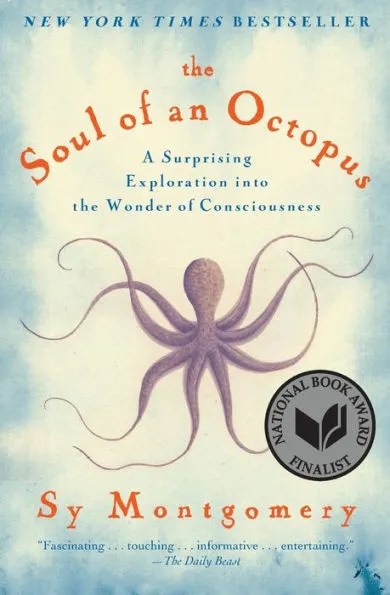
Why this book: I loved An Immense World which gives a lot of attention to the octopus, and I had really enjoyed the Netflix documentary My Octopus Teacher. My wife had read The Soul of an Octopus twice and highly recommended it. The author has written several successful and highly regarded books on the natural world.
Summary in 3 Sentences: This book is Sy Montgomery’s personal exploration into how octopuses live, behave and have many human-like abilities and emotions. She writes in the first person, full of fascination and energy as she tells of her experiences and in fact relationships with several octopuses in the New England aquarium, as well as digressing to describe research and the experiences of many others who’ve made octopus research their life’s passion.
My Impressions: What a fun and fascinating book, full of joy, new insights, the wonder of learning about a species so very different from humans, but with abilities that in some cases put us to shame. A large source of her information and experience comes from becoming a part of the Octopus team at the New England Aquarium in Boston, and we get to know the various members of that “team” of octopus followers and how their relationships with different octopuses have affected them.
Additionally, she visits and spends time at other aquariums that have octopus tanks. and shares what she learns from them that adds to what she experiences in Boston. And finally, she learns how to SCUBA dive, a process which didn’t come easy to her, but which she also describes. As then as a certified SCUBA diver, she takes us on diving expeditions to other parts of the world with researchers in octopus behavior and biology and she shares those experiences with us.
A few things about the octopus that people may not know:
- They recognize individual people and can be affectionate and playful
- Every octopus has a different personality -some are reserved, others outgoing and social, others aggressive.
- They display emotions in their behavior as well as in how their coloring changes.
- They have 3 central brains, but each of their tentacle receptors also has neurological decision making, brain-like abilities. The central brain(s) is more like a federal governor.
- Different species of octopus which live in different parts of the world can behave very differently. Fore example most octopuses are solitary creatures, but there are species which live and work together.
- When octopuses mate and lay their eggs, they have fulfilled their biological function and (in most octopus species) when male octopuses mate, they die soon after. When a female octopus lays its egg, she protects them until they hatch and then dies soon after.
Montgomery concludes her book with a chapter entitled ‘Consciousness’ and raises the question of whether octopuses have self-consciousness and to what degree can we compare their consciousness with ours.
She writes, “But what is the soul? Some say it is the self, the ‘I’ that inhabits the body…..Others say that soul is our innermost being…..One calls soul ‘the indwelling consciousness that watches the mind come and go, that watches the world pass.’ Perhaps none of these definitions is true. Perhaps all of them are. But I am certain of one thing as I sit in my pew: If I have a soul – and I think I do – an octopus has a soul, too.” (p 227-8)
This is not only a fascinating book, it is a fun read as we explore this very different world – not only of the octopus but also other marine life in the world in which they live – from the joyful and fascinating perspective of a woman who is in love with her subject. It is uplifting and enlightening. The big message one takes from this book is that the world of marine life is much more complex and fascinating than most of us realize, and the octopus is a prime example of that. It is humbling. There is SO much we don’t know, understand, or appreciate in the world, and especially in marine life.


 Bob's Books
Pingback: Remarkably Bright Creatures, by Shelby van Pelt | Bob's Books