
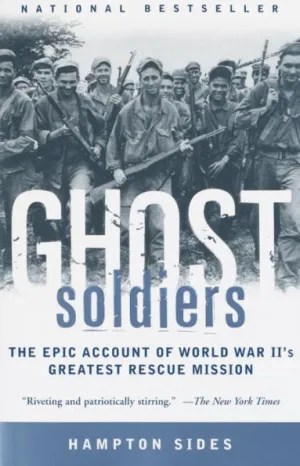
Why this book: Selected by the SEAL Reading group I’m a part of. Our second Hampton Sides book – the first was Kingdom of Ice. People who’d read Ghost Soldiers spoke highly of it.
Summary in 3 Sentences: When Bataan and Corregidor surrendered to the Japanese, those soldiers were marched to Cabanatuan in what became known as the Bataan death march. The book goes aback and forth between the experiences of the prisoners in Cabanatuan over the3+ years they were there, and the training, preparation and conduct of the Army Ranger operation to rescue them. The book concludes with the aftermath – the tense exfiltration after raiding the PoW camp, and then what happened after return to friendly lines and ultimately to the United States.
My Impressions: Another great Hampton Sides historical narrative. He writes two parallel stories in alternate chapters – First, about the Rangers and how they prepared for and executed the raid; Second the story of the PoWs – what led to them all being captured, the infamous Bataan Death March, and the gruesome story of life in the PoW camp at Cabanatuan. In the last part of the book, the two stories converge with the raid itself, and its aftermath. He includes a fascinating Epilogue in which he shares what happened to most of the key characters in this historic drama from nearly 80 years ago.
The Rangers were a relatively new group and were not well established in the Army at that time, but LT General Walter Krueger kept them on standby for any special mission that might come up that conventional forces may not be ready for. The Rangers’ leader was Col Henry Mucci – an energetic and charismatic leader who the men loved and trusted. He trained them to a level that (by standards of the day) was well beyond that of normal infantry. The Rangers were certainly highly motivated, but had hardly been used. As the US Army was fulfilling the primary strategic objective of the campaign – driving the Japanese out of the Philippines – rescuing the PoWs at Cabanatuan was not part of the campaign plan. But the decision was made to try to rescue these PoWs, on a not-to-interfere basis with the larger campaign. And so finally the Rangers got the job they were looking for.
The disparity between what the PoWs were experiencing over the several years that they were captives, and the experience of the Rangers preparing for and conducting the raid was striking. So many of the PoW’s had either been killed mercilessly or died from wounds, disease, malnutrition and other environmental hazards to their existence. The PoW population changed as the Japanese shipped many of the healthiest of the prisoners to Japan to work in their factories and other places where they needed labor. Ghost Soldiers describes their perilous journey by land and under horrific conditions on Japanese ships. Several times they were bombed by allied air and many US prisoners were killed. But some did survive and survived the war, and thus were able to give Sides the stories of their travails.
There was a lot of evil and horrific treatment by the Japanese of US prisoners. But Sides avoids completely dehumanizing the Japanese and does provides some of their perspective, of course without justifying their cruelty. In addition to the often sadistic treatment, Sides notes that some of the guards and leaders treated the POWs humanely. Additionally, the Japanese General in charge of the Japanese Army invading the Philippines, Generals Masaharu Homma had insisted on humane treatment of PoWs but his guidance went largely unheeded, and he didn’t enforce it – for which he was hanged at the end of the war. Part of the Japanese cruelty came from their honor culture that made surrender and being a prisoner a sign of weakness and dishonor, not deserving humane consideration. Also, after the siege of Corregidor and the US surrender, the Japanese were not prepared to receive, feed, transport, care for thousands of prisoners, many of whom were already weak and malnourished from months of being isolated and under seige. There were Japanese military leaders for whom the American PoWs were a mere nuisance and they would just as soon have killed them all. And more than once, atrocities were ordered by superiors and carried out without question.
Japanese cruelties and atrocities were known by the Americans still fighting the Japanese. This raid was conducted in order pre-empt all prisoners being slaughtered as the Japanese were driven out of the area of Cabanatuan City as the Americans were retaking the Philippines. The prisoners themselves expected to be slaughtered and the US Army knew they had limited time to rescue them.
The raid itself was indeed well done, supported by Philippine guerillas who had been fighting the Japanese since the beginning of the war. Also the local civilian population hated the Japanese, loved the Americans and provided indispensable support. As the Rangers stealthily approached Cabanatuan they had to change their plan as new information became available. They knew that surprise was essential and it is actually surprising that they weren’t discovered or betrayed. When it came time to attack, they were not just good, but lucky. Col Mucci was overall in charge, but left the actual raid planning to Ranger Cpt Robert Prince. Based on input from the rangers who were still living, Sides is able to provide a captivating description of the success and tactical details of the raid.
The book details how the raid was conducted, and the 2 day march of the soldiers and the 500 plus walking wounded and sick PoWs back to American lines. A few died along the way. Then the book concludes with how the raid was received and perceived back in the states, the homecoming of the PoWs and what happened to many of them after the war.
Ghost Soldiers describes not only the raid, but also the horrific circumstances in the Japanese PoW camp, and belongs with King Rat, The Narrow Road to the Deep North and The Bridge over the River Kwai as chronicles of Japanese treatment of prisoners during WW2. This book also serves as a valuable look at the origins of the US Army Rangers. Hampton Sides writes a great historical narrative based on his personal contact with many of the survivors who were still alive in the 1990s while he was researching and writing this book.


 Bob's Books
Pingback: Wide Wide Wide Sea – Fateful Final Voyage of Capt James Cook, by Hampton Sides | Bob's Books