
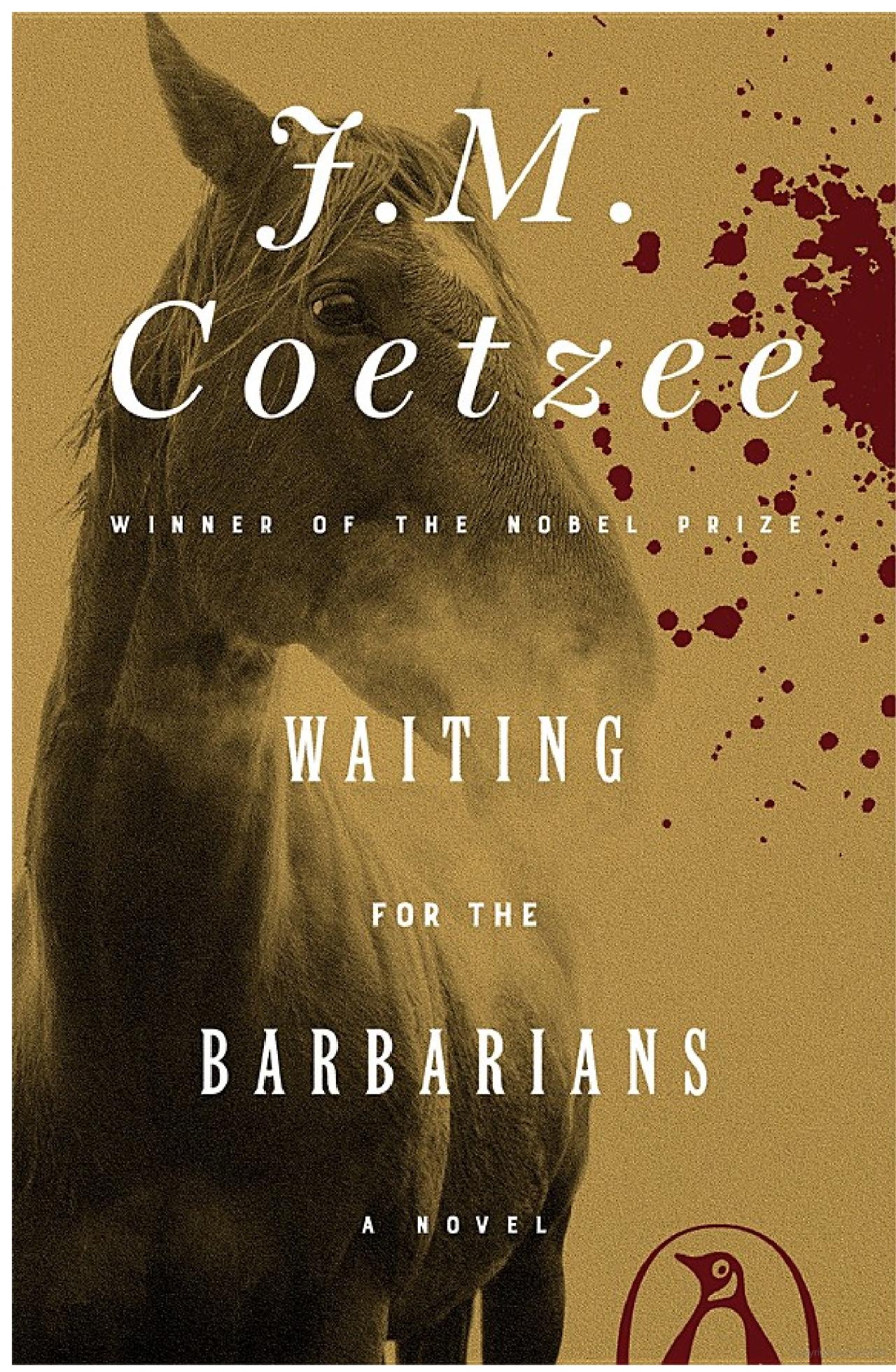
Why this book: Selected by my litrature reading group. Coetzee is a Nobel Prize winning author and the only author to win the Booker Prize twice.
Summary in 3 Sentences: Set in an unnamed “empire”, presumaly in the 19th century, that is fighting a primitive culture on it’s borders, it is in a first-person voice of the magistrate of one of the border towns near where the “barbarians” have lived for centuries. The magistrate is distressed by how the police and army sent from the capital of the Empire are brutally suppressing the natives of the area where he serves as magistrate, He is caught between his duties as magistrate and his sense of duty to the people who he saw being tortured and abused unjustly. He becomes involved with one of the “barbarian” women, and in seeking to challenge and soften the army’s campaign against the barbarian natives, he becomes himself a victim of the Empire’s campaign.
My Impressions: An interesting and powerful book. Not a quick or easy read, and at the beginning, rather difficult – as it begins with graphic descriptions of the torture of the army’s captives in their efforts to subdue the barbarians. We are never given the name of the “Empire” though it is easy to assum that it is Russia – perhaps soon after the Bolshevik revolution, seeking to extend their influence in the far east over Mongols or eskimos or other nomadic tribes.
Written in the first person of a late middle aged magistrate, we experience his anger and frustration at how the representatives of the power of the Empire come into his territory and seek to apply blunt power to achieve their goals. He shares his own sense of his decreasing power and helplessness to stop them, as an aging middle aged man and as a remote, relatively low level functionary of the Empire. He is very self conscious in his internal struggle and I was reminded a bit of Dostoyevsky’s Notes from the Underground – in the self-absorbed but also very self-aware way in which the narrator describes his internal struggles and conflicts.
Our magistrate encounters a young woman from the barbarians who had been captured on a recent raid begging on the streets in his town, who had been tortured and nearly blinded by the army. Begging was illegal in his jurisdiction, but he feels he owes her his assistance after being mistreated by the army, and offers her room and board to come into his household to help with cooking and chores. He also seeks to take care of her injuries and gradually his care and continues to caress and care for her. but he obsesses over his relationship with her, and his care for her takes on an erotic element. Though they sleep together, he claims not to be attracted to her and doesn’t consummate his relationship with her,
We are “treated” to his internal dialogue about his ambivalence about his relationship with this woman, and eventually decides that his duty is to return her to her people, the barbarians, who live in distant mountains. He recruits some men to help him return the girl to her people, and during their arduous journey, at her initiative, they do consumate their relationship, though it is purely a physical response. He describes their very difficult and painful journey to the barbarians’ winter pastures, where he succeeds in returning the girl to her tribe. Upon his return, he is accused of treason and consorting with the enemy and is subjected to the same torture and abuse that the army imposed on the captured barbarians. Interestingly, though he is tortured and is confined to a squalid cell, he is relieved to no longer be a tool of the cruel Empire that is persecuting his town, and torturing the “barbarians” they capture.
During this portion of the book we see how torture and isolation can reduce an intelligent and sensitive man to a cringing animal. He struggles to hold on to his values, and we have to admire his courage.
Eventually the army of the Empire is reinforced and deploys into the mountains to finally subdue and destroy the barbarians, but the army doesn’t return. The people left in the town begin to realize that the army was decimated, and there is fear that the barbarians will ravage the town as well, and many of the citizans leave. The magistrate is released and without the army’s officers there, he re-assumes his position of leadership. Finally, the head of the army returns from the mountains defeated, his remaining soldiers plunder the town before heading back to the capital of the empire. Our magistrate remains in the town, with the few people left, to continue trying to survive, with no further connect-in to the Empire.
Though this would seem to be a story about Russia, the author is South African and it perhaps could be South Africa – the empire representing the Dutch or English, or it could be the US Army seeking to subdue the native Americans. Or it could be almost anywhere that Europeans have gone to spread Chistianity and Western values in conquering indigenous peoples. This story is about the dilemma of a conscientious and humane man, caught in the middle, his conscience, his struggles and ultimately his courageous decisions. And about the suffering of not only the indigenous peoples, but also of the soldiers and the inhabitants of the towns on the frontier, caught in the middle of the Empire’s imperialistic objectives..


 Bob's Books