
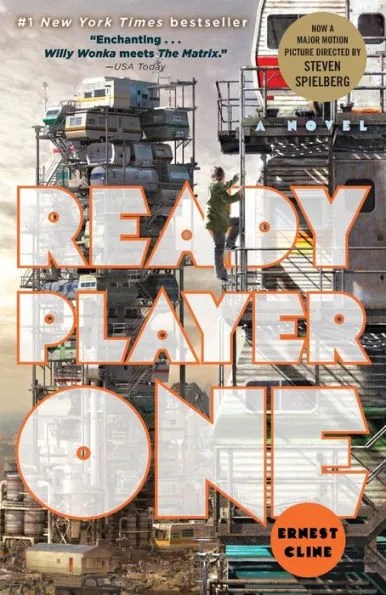
Why this book: Selected by my Science Fiction Book Club – as one of the classics which anticipates the future development of a Metaverse.
Summary in 4 Sentences: The time frame is the 2040s and a Metaverse-like virtual world has been developed by a computer-virtual-reality-gaming genius who has a romantic and nostalgic view of the 1980’s, when he had become fully immersed in the very early stages of the computer gaming world. He dies, leaving in his will that the winner of a game he had created will inherit his company and all that he has developed – worth billions of dollars. The virtual world has become so popular because the real world has devolved into a chaotic dystopia. The book is told from the 1st person perspective of a teenage reclusive, socially awkward computer geek who has lived most of his life in this virtual world – and who is determined to defeat millions of other computer gaming geeks and win the game. He competes with and ultimately collaborates with friends from the virtual world to defeat an “evil” business internet company that wants to control and profit from controlling this virtual world.
My Impresssions: A fun and imaginative book – which is regarded as one of the predictors and shapers of the coming Metaverse – and it is an excellent follow up to Snow Crash and Do Androids Dream of Electric Sheep as one of the seminal sci-fi books that have shaped the vision that continues to drive the evolution of the Metaverse. At only about 380 pages it goes quickly. As literature, it won’t win any prizes, but for imagination, it is a winner. It is written in an easy to read 1st person narrative form from the perspective of Wade Watts, a teenager obsessed with popular US culture of the 1980s – because that was the obsession of James Hallliday his hero and inspiration, and the creator of the game that Wade is trying to win.
Before he died, Halliday had created the intricate and extremely demanding and complex computer game that gamers had been unsuccessfully trying to solve for several years – in order to win the big prize that Halliday had left to the winner in his will – ownership and control over the “OASIS”. Halliday had named his virtual Metaverse (the word “metaverse” however does not appear in the book) the OASIS – which stands for the Ontologically Anthroporcentric Sensory Immersive Simulation. Halliday saturates the OASIS with direct and obscure references to 80’s culture, and because of this, Ready Player One is a nostalgic journey back to the 80’s in America for any reader who was fully engaged in popular culture during that window – TV programs, computer games, music, literature – all are referenced heavily throughout the book. The goal of the game is to find the “Easter Egg” that Halliday has hidden in the OASIS. S/he who finds the Easter Egg wins the big prize.
Because the stakes are so high, millions of gamers around the world are trying to solve it and competition is fierce. Those searching for the Easter Egg are known as “Gunters’ short for Egg Hunters, and Wade Watts is one of millions of Gunters around the world trying to solve the riddles that will help them find the Easter Egg.
That’s the setting. The book includes Wade’s experience in school – which largely takes place in the OASIS, as well as the author’s dystopian descriptions of the world of 2045 America, which drives many people to find happiness and fulfillment in the virtual world of the OASIS. Wade’s avatar in the OASIS is called Parzival – an alternate spelling for one of King Arthur’s Knights ‘Percival’, and suggests he will be defending good from evil throughout his quest for his version of the “holy grail”.
Most of the other characters in the book we only get to know as their Avatars in the OASIS. Toward the end of the book, these characters, who have known each other only through their avatars actually, and reluctantly meet each other in person. In each case, these are people whose actual identities don’t fit what society celebrates. They are somewhat embarrassed about who they really are, but feel that they can truly express themselves, confidently and with few inhibitions as their avatar. Therefore, revealing their true identities and appearances was a dramatic event.
The story of the Easter Egg hunt is full of geeky computer gaming scenes, where the avatars in the OASIS have access to magic, crazy weapons and super-human abilities, as well as a variety of science fiction threats. Not being a gamer myslef, it was fun to play along, and get a sense for how gamers play. The story (naturally) has an evil powerful antagonist who threatens all that Parzival and his co-avatars are trying to accomplish.
I am not a gamer – but non-gamers should not hesitate to read this book – because it provides a glimpse into the exciting and scary implications of the continuing obsession many young people have with gaming, as well as the opportunities it offers to people otherwise restricted in their lives. In the OASIS we experience some of the exciting possibilities for education – as Wade describes how easy it is for teachers to create engaging situations in different locations and times in history in which students can participate “directly” with their avatars. Actual and imaginary worlds are created in the virtual world in so much detail that the difference between actually visiting a real place, or visiting the places virtually with one’s avatar is minimal. And in the OASIS, the laws of physics are mutable and almost anything is possible.
The 80’s theme. In our discussion group we reflected on why Cline built such a strong reference to the 80s in his book. Here are some of the ideas we had:
- It was his personal window of coming of age and he himself was a self-described geek who got into the 80’s pop-culture
- The book’s hero, James Halliday was somewhat the embodiment of Ernest Cline the author – also an socially awkward and somewhat alienated computer geek.
- The 80’s was the first and opening window when alienated teenagers were able to escape social contact into social media, computer games, and the a very primitive and pixilated virtual world. Life still included a large dose of forced connection with people and reality, before the early 90s, when computers became omnipresent, and a few years later, when social media began to take over people’s lives.
I felt that one of the messages of the book is that the Metaverse – the OASIS in the book, has both positive and negative potential. It provides great opportunities to explore dimensions of reality that are not available to many people, including travel to distant locations and in different time periods, as well as to be creative with one’s identity through an avatar. It also has pernicious possibilities as well, which we are already seeing – young people and gamers becoming addicted to the fast paced and stimulating virtual world, and neglecting or ignoring opportunities in the real and natural world, which require effort, persistence and discipline to fully appreciate, and which have qualities all their own.
Wade Watts states early in the book: “The OASIS is the setting of all my happiest childhood memoies. p 18
The Movie I did not find the movie as compelling as the book. It appeared to me to have targeted primarily young people who hunger for crazy special effects, more action and violence and less “meaty” content. The story was adjusted and I’d say dumbed down to appeal more to teenagers than the book. Though it is worth seeing how the characters are portrayed, as well as their avatars, and the special effects are pretty amazing, it is not a good substitute for the book. I suggest watching it AFTER reading the book.


 Bob's Books