
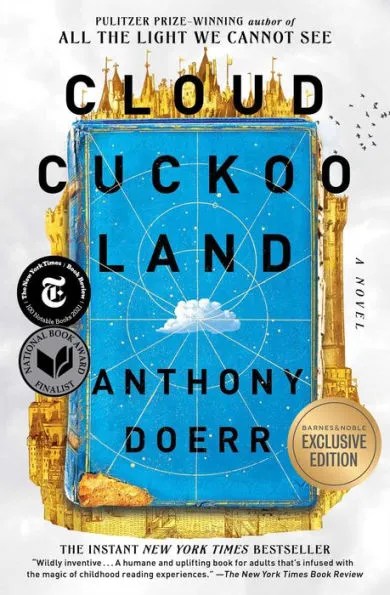
Why this book: Selected by my literature reading group. Initially suggested by my daughter who said she was reading it with her husband, so Mary Anne and I wanted to join them, so we suggested it to our reading group which liked the idea. I listened to it in it’s entirety.
Summary in 3 Sentences: It’s a complicated set of 5 (or so) different stories, that take place in different periods of time with different characters – the earliest a few centuries after Christ, then one in the 1400s, another in the second half of the 20th century, one in the more recent 2100s and the latest 60 or 70 years into the future. All the stories are loosely tied together by a connection to a fantasy story written by Antonius Diogenes about a disenchanted shepherd who longed to escape from his dreary life into a fantasy world – a Cloud Cuckoo Land.
My Impressions: This book is a bit confusing as one gets into it, because there is initially, no clear plot line, as the author jumps from one character and time window to another, with no seeming connection – at first. Then as one patiently gets into the book, each story gathers up it’s own momentum, and one sees the Diogenes story of Cloud Cuckoo Land appearing again and again, and having at first subtle influence, As the individual stories progress, Diogenes’s story assumes a more prominent place in the flow and the lives of the characters in each of the stories told.
Below is a brief look at the key characters and stories that intersect around the theme and story of Diogenes’s Cloud Cuckoo Land story. (the Diogenese characer was indeed based on a real Greek author, but Doerr makes up his fictional story of Cloud Cuckoo Land)
Antonius Diogenes – is the narrator of the eponymous Cloud Cuckoo Land story from 1800 or so years ago, told in his voice from the book at the beginning of each chapter/section of the book. Diogenes is a poor shepherd who longs to fly like a bird and be free of his troubles, and so decides to go in search of a magician or witch who can transform him into a bird who can fly to a wonderful city in the sky where all is good and peaceful. He finds a magician, but instead finds himself transformed first into first load carrying donkey, then a fish, then a crow. At the beginning of each chapter Diogenes, in first person, shares with us his experiences
The story of the book itself and how it came to light in the 20th century is a sub-theme of Doerr’s book. Diogenes (fictional) book was written and apparently lost for centuries, re-found and then lost again, and discovered again.
Anna and Oimir two characters of about the same age who live during the period when Constantinople is over-run and conquered by the Saracens and is transformed from a center of Christian worship to a great Muslim city. Anna is a young girl working in a monastery in Constantinople as the city comes under siege. Anna had found a mouldering copy of Diogenes book in a run down monastery and kept it as a prize possession. Oimer is a young muslim boy with a deformed face, living on a farm in what is now Bulgaria on the route of the Saracen army on its way to lay siege to Constantinople. He is conscripted to join the Army and becomes part of the invasion force. Anna and Oimir connect as they escape from the war.
Zeno and Rex Zeno grows up as the son of a Greek immigrant in Lakeport, Idaho, and feels ostracized as a young boy. His father is killed in WW2 and eventually Zeno joins the army during the Korean war, is taken prisoner by the Chinese and in the PoW camp becomes close friends with Rex, a British soldier and fellow PoW who had been a classics teacher before being conscripted to fight in Korea. They have a close and even romantic though not sexual relationship. During their many days with nothing to do, Rex teaches Zeno ancient Greek, which many years later Zeno uses to do the one and only translation of Diogenes’ book.
Seymour and Bunny Seymour is a young boy who is mentally disturbed and socially very awkward. Bunny his mother, is a single mom, living from manual labor cleaning hotel rooms or waiting tables at restaurants. Seymour does not fit in at school, and Bunny who is always under financial stress struggles to understand and support him while working full time to barely make ends meet. As Seymour grows older he finds himself most at home with animals and in nature and becomes engaged with eco-terrorist groups, as he is increasingly alienated from mainstream culture. Seymour becomes connected to Diogenes incidentally as he disrupts a school play of Diogenies’ story Cloud Cuckoo Land
Constance and Sybil Constance is a young girl on a spaceship – the Argos – that earth has sent to a distant galaxy to colonize a planet which has been determined to have an atmosphere and resources that would support human life. The trip is expected to take several generations, and those on the Argos will live their entire lives on the Argos, but must bear children, whose children and grand children will save the species on a distant planet. Sybil is the AI computer which knows everything and runs life on the Argos. We primarily get to know Sybil as Constance’s caregiver and surrogate parent, telling her what to do and when, and chastising her when she doesn’t follow her protocols. Constance’s classes are with other children on the Argos, where they have a teacher who uses the Argos’s powerful computer as a classroom, which allows the students to virtually visit earth’s many wonders and places, even at different times in the past. Constance is able to visit this virtual world on her own and through that learns that her father had owned Diogenes’ book, which inspires further interest.
All of these characters don’t fit into, and are somehow alienated from main stream society, and are struggling under difficult circumstances. All somehow, directly or indirectly find inspiration in the story and fantasy of Diogenes’ dream of escaping to a better place. Diogenes’ persistence in pursuing his dream inspires and gives them hope.
There are so many tidbits of insight and wisdom in this book. Here are a few that struck me:
Superstition Especially in the early stories, we are amazed at how much superstition drove the lives and decisions of people. Oimir’s disfigured face was seen as an omen of the Devil and bad luck. For Anna, reading books that were not about God and Christ were tantamount to sacrilege and evil. Seymore saw evil everywhere. When people didn’t understand something, they correlated unrelated events to provide a possible explanation. It is a human tendency that science tries often unsuccessfully, to overcome.
Accept where you are? I initially thought that Diogenes misadventures trying to find Cloud Cuckoo land indicated the dangers of failing to appreciate what one has and seeking better. But several of the chareacters only survived by putting all at risk by “going for it” – so there is no simple bromide to just kick back, dude, and go with the flow.
Fate Key events that determined the fate of each of the characters seemed random and perhaps insignificant when they ocurred. This was especially true of Anna and Oimer, but also of Zeno and Constance. What ended up saving them or causing their lives to take key leaps forward were other seemingly insignificant or random events. There seemed to be a message to follow one’s heart and accept the events, coincidences and opportunities that come one’s way.
The drive to escape and transcend. Each of these characters was caught in something of a dilemma that offered no solution or easy way out. They each had to persevere, and each sought a means to transcend – get beyond the seemingly insurmountable challenge they found themselves in. And each in their own way was able to perservere through belief in themselves, persistence, and grit. The City in the Clouds – Cloud Cuckoo Land – was a mirage, but the aspiration to get something better drove each of these characters.
There was a sub-theme throughout the book of how Antonius Diogenes’ story made its way through the centuries. Doerr’s story points to how chance, coincidences, and the work and sacrifice of many have been necessary to preserve these ancient and wonderful stories from our past and make them available to us today. And we note that these ancient stories can continue to teach and inspire us. Each of the sub-stories in this novel contributes to how coincidence allowed this (fictional) ancient tale to impact the lives of people centuries after it was written.
This was an enjoyable read – but the number and variety of the stories and the author’s method of going back and forth requires paying attention. It would not work to read this book slowly over time with other books – too easy to lose the thread of the various stories. Each story was compelling and the characters are memorable in their own way. I’ll not soon forget any of them.


 Bob's Books