
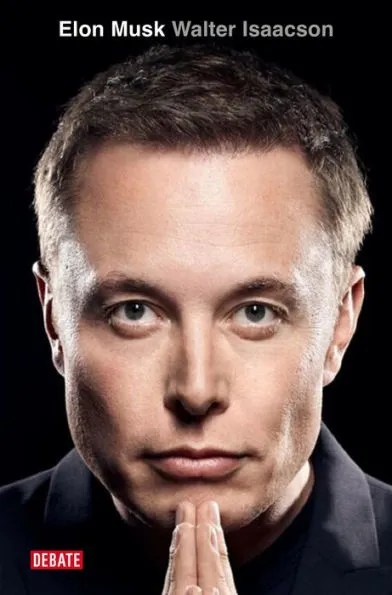
Why this book: I had recently read (listened to) Isaacson’s bio of Steve Jobs and thought he did a great job. My wife was reading this Musk bio and kept commenting on it. So I uploaded the audible and got started.
Summary in 3 Sentences Elon Musk grew up in South Africa under an abusive father – and because he was clearly very precocious, and to escape from his father and teh unpleasantness in South Africa, he left to go Canada as a teenager. Soon after got to the US, made it to Silicon Valley where he began his long journey of turning ground-breaking ideas into reality. This book goes into Musks many near failures that turned into major successes with Pay Pal, Tesla, Space X, Open AI, neuralink and other AI projects, Tesla and self driving cars and more. It also covers his turbulent personality and private life, with judicious praise and criticism and an impressive effort to be fair and dispassionate.
My Impressions: Definitive biography of Musk’s life to this point. I listened to it on audio, so was unable to take notes and highlight sections as I listened to it, which is too bad – there were so many highlight-worthy quotes and insights in the book. A good list of quotes from this book are available on Goodreads here.
This book provides the backstory on so much that is happening in the news today – cutting edge breakthroughs in technology that are taking us into the future: SpaceX, AI, electric vehicles, robotics, neuralink, social media and more… and Musk himself is such a remarkable, yet bizarre character. A world leader w Asperger syndrome. Driven, somewhat narcissistic, an idealistic visionary and of course, his personal life is unique and not one most of us would aspire to. He was emotionally abused as a child – which continues to affect him and the way he treats some around him. He is relentlessly driven, demands that of others around him, and has overcommitted himself to the point of exhaustion, unable to relax for more than a few hours at a time. He has 10 kids w three different women, and wants to be buried on Mars! It’s a fascinating book. And his achievements and contributions to technological progress are legendary. And he’s not done yet.
Though the book doesn’t say so, I assume Musk had read Isaacson’s bio of Steve Jobs which was done with Job’s permission and a promise to be hands off. It appears Musk gave Isaacson the same permissions to do his biography. Musk’s conversations with Isaacson about events and people are balanced by the perspectives and comments from others affected by Musks actions and decisions – who include many who are not great fans, people who’ve been abused and fired by him, as well as his family, friends and people in his inner circle.
Musk has a unique relationship to risk which Isaacson continues to come back to. He loves drama and the process of risking it all and getting the big pay off. With his rocket launches he took many risks, which led to some epic failures but were essential to his ultimate success. His motto is to Fail Fast, learn and move on.
Musk therefore had no patience with bureaucrats and processes that are designed to slow down progress and mitigate risk. With his teams he had an “algorithm” which Musk repeated over and over gain, and which had five commandments.
- Question Every Requirement. And you must know the name of the person who made the requirement.
- Delete any part of a process you can . You may have to add them back later. In fact, if you do not end up adding back at least 10% of the, then you didn’t delete enough.
- Simplify and Optimize. After step 2. A common mistake is to simplify and optimize a process that shouldn’t exist.
- Accelerate the cycle time – after following the first 3 steps.
- Automate. This is the final step – and shouldn’t be done until all reqiremetns had been questions and parts and processes deleted.
Corollaries
- All technical managers should have hands-on experience. There is often too much of a gap between decision makers and those who carry out those decisions. Which leads to bad decisions.
- Camaraderie is dangerous. Hard for good buddies to challenge each other’s work or to fire those who aren’t cutting it.
- It’s OK to be wrong. Just don’t be confident and wrong.
- Never ask your people to do something you’re not willing to do
- Whenever there are problems to solve, don’t just meet with your managers. Do a skip-level, where you meet the level right below your managers.
- When hiring, look for people with the right attitude. Skills can be taught. Attitude changes require a brain transplant.
- A maniacal sense of urgency is our operating principle
- The only rules are the ones dictated by the laws of physics. Everything else is merely a recommendation.
This biography is not only a look at an interesting life, it is a look at a man, a team, a philosophy that is changing the world with not only ideas that initially seem outrageous, but a drive and focus that get them done and prove his detractors wrong. He breaks a lot of eggs and makes a lot of enemies in the process – enemies of people who are invested in conventional wisdom, and slow, deliberate process.
He claims to be politically center-right, economically conservative, and socially liberal, and to have a strong libertarian streak. He has taken on the scions of Silicon Valley and gone to war against what he calls the “woke mind virus” that has infected the progressive left. Musk hates DEI as an enemy to meritocracy and personal accountability – he is clearly not racist, nor homophobic nor any of those other discriminatory labels – he actively seeks the most capable and driven team players who passionately buy into his vision. Kind of like the SEAL Teams – emphasizing competence and drive, being a good operator and good teammate. That’s part of why the SEAL Team reading group I help lead has selected this book for it’s April 2024 selection.
It is also a book about leadership. Being innovative, creative, breaking the rules, demanding and getting top notch performance, not being afraid to let people go who aren’t living up to your demands, or the demands of the job. He insists that it is imperative for the leader to know details – and to insist that all managers and workers know and understand them as well. But we also see the toxic side of being too emotional, blunt and rude when under stress. He is moody, sometimes unpredictable, and not easy to work for. But no one can argue that his approach has not gotten things done and achieved amazing results – even those who work for him admit that he’s gotten them to accomplish things they didn’t think possible.
Musk has little tolerance for mistakes or for people who want a balanced life. He routinely and unhesitatingly calls people in from vacation, at all hours of the night, on weekends and expects uncomplaining compliance. But in this, he leads by example, constantly sacrificing time with his family or other endeavors for his work. Often, he sleeps on the floor in his office and works 7 days a week and doesn’t know how to relax. A number of his best employees leave, simply burned out, unable to maintain his pace and to ask the sacrifices he demands from their families. I might have enjoyed this pace of work when I was in my 20s or 30s, but for long, and not after I had a family
Bottom line: This is a fascinating book about a fascinating man – a somewhat off-balanced, driven, genius. It is extremely well written with insider perspectives from an author who was able to sit in on many of the meetings, and meet with the players. Isaacson gets Musk’s comments on his critics and mistakes, and offers his own balanced perspectives on what he has seen, heard, observed and learned about his subject. Can’t recommend this book highly enough.


 Bob's Books