
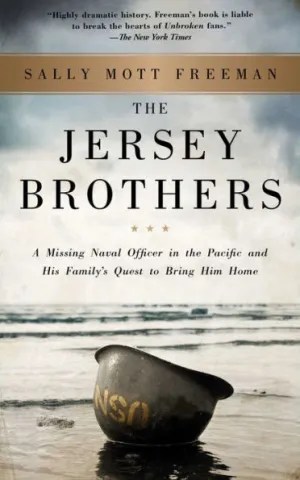
Why this book: My wife read this and was really impressed – she rarely gushes about a book, but she gushed about this one, and when she gushes, I listen and try to read the book. She bought copies for many of her friends. So I put it in my cue and listened to it. Glad I did.
Summary in 3 Sentences: This is the story of three brothers, all in the Navy and at different places working for different organizations during WW2 in the Pacific. One brother was working in FDR’s White House, one was on the Enterprise and a third was in the Philippines and became a Prisoner of War. The author is the daughter of one of these brothers,had acces to all their correspondence, and creates a unique lens through which to view the war in the Pacific through these three individuals – who were like the Forest Gumps of the Pacific War – it seems one of them was wherever many of the most important events took place, and we experience those events through their eyes. Much of the story is about the efforts of two of the brothers to find their youngest brother who was a prisoner of the Japanese, while we also experience the brutal conditions of his captivity – as bad or worse than concentration camp victims in the Holocaust.
My Impressions: Loved this book. It was a great ride through an important and tumultuous time in American History. The author gives us a well researched history of certain aspects of the War in the Pacific through the eyes of three brothers, each a naval officer but participating in, experiencing and contributing to our victory from very different positions. Through their eyes I learned about important aspects of the war with which I’d been previously unfamiliar.
It begins with the story of a well-to-do family in New Jersey with two brothers from their mother’s first marriage, and one from her second, all three attending the Naval Academy, two of them graduating with commissions – the third leaving, beginning a second career, but getting commissioned at the outset of the War. One brother Bill is involved with intelligence in Washington DC and gets called upon to create and run FDR’s famous Map Room which kept track of what US military forces were doing around the world. The other brother Benny became a weapons officer stationed on the USS Enterprise Aircraft Carrier which happened to be outside of but approaching Pearl Harbor when the Japanese attacked on 7 December 1941 The third and youngest brother Bart was a supply officer stationed in the Philippines when the Japanese attacked Manila right after they hit Pearl Harbor. .
This third brother Bart is wounded in the Japanese attack on Manila and was in the hospital and eventually taken prisoner by the Japanese when they occupied Manila. With his capture, the trajectories of the lives of these three brothers during the war take off – and Sally Mott Freeman’s story bounces from one to the other, providing different but complimentary perspectives on how the war affected differnt people in the Navy, supporting the war effort in different but unique roles. She was able to use her extensive access to family letters and diaries and her research into naval archives to create a fascinating, you-are-there narrative.
Bill and Benny are very engaged in playing their key roles in the war, and the author describes their persspectives and experiences with depth and feeling. Bill sees the war from the macro strategic perspective in FDR’s white house, and from his key position, interacts with key leaders in the US government and our allies. We get Benny’s perspective on board the USS Enterprise as a weapons/gunnery officer returning the day after Japan’s attack to a burning and devastated Pearl Harbor, and then we are with him in the Navy’s reaction to that attack with Enterprise involved in the launching of the Doolittle raid on Tokyo, then the Battle of Midway and eventually Guadalcanal, Iwo Jima, and Okinawa.
Eventually after several years, the two brothers essentially trade places. Benny is burned out from being in constant battle in the Pacific and requests shore duty to recover, and so is sent back to the East Coast. Bill requests a break from the 80-90 hour weeks of staff work in Washington, and his request is granted to join the naval war at the front. Soon after Bill arrives, Admiral Kelly Turner, one of the key admirals in the Pacific Fleet requested Bill as an Aide de Camp where he serves out the remainder of the war. From Bill’s perspective with Adm Turner, again we see the war from a unique and strategic perspective. Bill was the author’s father and so she personally heard many of the perspectives he shared about the Pacific war from that perspective. Her father remained in the Navy after the war and eventually became head of the Navy’s JAG corps.
But much of the book was about younger brother Bart and the experience and plight of the Japanese held PoWs in the Philippines. The Japanese were notoriously cruel to allied prisoners, in part due to their belief based on the code of Bushido for which it is the height of dishonor to surrender or to be captured alive. Accordingly the Japanese treated allied PoWs as dishonored and less than human. Bart was moved to several different Pow camps, while Bill and Benny constantly sought to find out first, if he was alive, and second where he might be, in case a rescue may have been possible.
Important players in the book were the mother and father of the three brothers -especialy their mother Helen. Bill and Benny were her sons by her first marriage; Bart was her son by her then current husband, was her youngest and favorite. In her constant efforts to learn the fate of her son, she represented the many thousands of mothers who helplessly waited for news of their sons at war. But Helen did not passively wait for word – she constantly wrote letters to congressmen, imploring them to do more, including President Roosevelt and senior Navy staff. She was involved in whatever efforts she could to provide support to soldiers and sailors on the front. Her pressure on Bill and Benny to do more to find and perhaps help their younger brother added to their own war stress as well as their anxiety for the well being of younger brother Bart.
This is the story of a unique family, written by the daughter of one of the principle players in the family drama. But it is also a very human look at the Naval war in the Pacific through the lives of Benny, Bill, Bart and Helen Mott. Sally Mott Freeman has not written a dispassionate history of the naval war in the Pacific, but in writing about her family’s participation in that war, has put a very human face and dimension to this war that is slowly fading from memory, as those who fought it are rapidly passing away.
I have thanked my wife for so strongly urging me to read this book. I highly recommend it.


 Bob's Books
A belated thank you for this insightful and thoughtful review of my book, Bob.
Merry Christmas to you – and to your wife!
Best regards,
Sally Mott Freeman
Thank you Sally – and thank you for writing the book. I am also part of Navy family -my father a retired aviator Vice Admiral, I’m a retired Seal Captain and my eldest son, an active duty Seal Captain. My wife and I have sent copies and recommended Jersey Brothers to many friends, all of whom have gushed and thanked us! One indeed, who was most impressed, is a friend who was writing his own book about his father and uncles and their experiences (in the army) in the Pacific, based on their letters and family lore.
Another family chronicle which the Navy SEAL Book club selected to read, was “How Ike Led” by Susan Eisenhower – Ike’s granddaughter. Susan joined us for the discussion and is truly a great lady and wrote an impressive book.. You’d enjoy her book as well, and I’ll send her a note recommending yours to her.
Be well and again, thank you for all the work you did to give a personal touch to the Naval War in the Pacific. (Btw. the SEAL book club also had Hampton Sides on to discuss his Ghost Soldiers, which gave me another perspective on the horror of your uncle Bart’s experiences)