
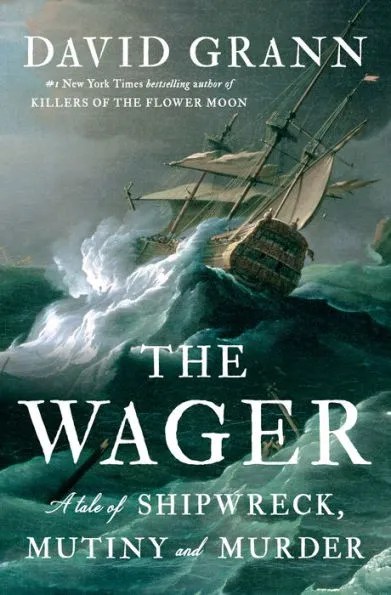
Why this book: Sent to me by my brother who’d read it and thought I’d like it. He was right. It was on the NYT best seller list right after it was published in 2023.
Summary in 5 sentences: In the 1740s, the Royal Navy sent an expedition of several ships around Cape Horn to the Pacific to intercept and capture Spanish vessels carrying gold and other valuables from Peru to the East Indies to trade for silk, spices etc. The ships in the expedition got separated during the storms and tempests at the Cape, and the ship the HMS Wager, though separated and damaged gets around the Cape, but in a follow-on storm wrecks on a remote uninhabited Island off the south west coast of Chile. Most of the crew survive the shipwreck, but then have to find a way to survive on the island with little hope of being rescued. As the heirarchy and discipline of the military chain of command break down, they face the reality that they may not survive. Ultimately, two different groups from the crew separately are able to make it back to England years later, with very different stories of what happened.
My Impressions: Fascinating book, thoroughly researched – providing great insight into the royal navy at that time, how sailors became ship’s captains, how expeditions were formed, how captains of ships were selected, and how they commanded their ships. All of these insights were a prelude to provide greater perspective on how men lived on the ships during a long voyage, and then the author’s description of the almost unimaginable challenges and suffering they experienced getting around Cape Horn prior to the shipwreck.
The expedition included six ships and their transit around Cape Horn (apparently there are multiple ways to get around Cape Horn) was devastating – all the ships were damaged and lost much of their crews. Scurvy is a brutal disease and fully 1/4 to 1/3 of the crews of the different ships were lost, either to scurvy or to accidents, partially caused by the debilitated condition of the crews because of it, as they fought to keep their ships afloat in the huge waves and gale force wind they encountered. It was painful to read about the daily deaths and suffering, and the daily bad news as the expedition struggled to get through. Though the several of the ships were severely damaged, they persisted and reached the Pacific Ocean. HMS Wager was the smallest and slowest of the ships, was separated from the others in the extensive and back to back storms. The Wager’s captain knew he had to catch up, but after finally getting around the Cape, and before he could reconnect with the rest of the expedition, the Wager was hit by yet another brutal storm and in the fog ran into the rocks on an island they couldn’t see. That’s when Part 2 of the book begins.
The captain of HMS Wager had been injured during the storms and was also ill with scurvy, but survived the wreck and sought to keep the crew together, as they found themselves on a remote beach on a small remote island. The ship was crushed on the rocks off shore, but was not completely sunk, so the crew was able to use their lifeboats to board the ship and ferry some of the food and equipment ashore to help them survive. Their situation was dire – it was late fall and cold – they were not far north of the Antarctic circle. And there was little to nothing edible on the island, so this situation tested their resourcefulness to the extreme. In addition to the food they were able to recover from the ship, much of it contaminated with salt water, they were forced to eat sea weed, crustaceans, occasionally fish, celery weeds and a few edible plants they found. The plant food alleviated the scurvy, but at the time, they didn’t know why. Now living ashore, they relied on their ship board organization and chain of command to work together to create shelter, find food and meet the new challenges that confronted them.
The captain had not been popular with the crew before the wreck and his moral authority began to diminish as he made unpopular and often unwise decisions. His gunnery officer, a well respected and experienced seaman became a powerful and respected presence to whom the crew looked for leadership as a counterweight to the captain. As things looked more and more bleak, discipline continued to break down, and a group of malcontent sailors refused to follow the Captain’s orders. They broke off to live apart from the main group, but the gunnery officer stayed ostensibly loyal to the captain and sought to keep the discipline intact, There was conflict between and within the groups and finally, even those who stayed with the captain were questioning his wisdom, his goals, and his leadership.
The gunnery officer was repeatedly unsuccessful in his efforts to influence the captain to compromise with and support the crew and consider options they were proposing for their ultimate salvation. Eventually, though he knew it meant being subject to accusations of mutiny and its harsh consequences, the gunnery officer broke with the captain and with a majority of the men on the island, chose to risk it all with an attempt in two of the surviving boats, to return to the Atlantic thru the Straits of Magellan to reach a town in Argentina.
The story of the breakdown in the captain’s leadership, and the breakdown in discipline and group integrity on the island was fascinating. The captain was a strict, by-the-book old-school British captain and was loathe to take input from subordinates that might be counter to his desires. Some of his decisions that cost him credibility with his crew were driven by orders he wouldn’t share with them. A series of events and actions by the captain cost him his authority and their respect for his rank and position. The Captain had insisted on strictly following his orders to head north to try to rendezvous with the rest of the expedition; the others thought that was tantamount to suicide and refused his order.
The majoirty of the remaining crew led by the gunnery officer in two small boats abandoned the captain and headed back to the Straits of Magellan. They succeeded to make it through the Straits though only one boat survived; the other boat and all aboard were lost. The surviving boat, those aboard starving and suffering from exposure, finally and barely reached a town on the coast of Argentina. Several died just before and just after their arrival. They were greeted warmly by the Argentinians, were fed, clothed and aided in their recovery, and eventually made it back to England, where they were received as returning heroes. They had all assumed that the captain and the small group that stayed with him on the island had perished.
But indeed the captain and his small team of loyal followers were able to craft a small boat, and with grit and luck, and some help from natives they encountered, over several weeks, succeeded in reaching a town on the coast of Chile. Upon arriving, they were immediately imprisoned as enemies of Spain. But eventually they were repatriated to England, and when they arrived, there was a firestorm of controversy about the mutineers, conflicting testimony about what had happened on the island and eventually, a dramatic court martial.
The gunnery officer who led the mutineers and got them to Argentina, had kept a detailed journal and wrote extensively of his experiences, which was a major source for the author. Also, one of the junior officers who stayed with the captain, had also kept a detailed journal and later in life wrote a book about his experiences which diverged from those of the gunnery officer after the mutineers left. The author relied heavily on these accounts, as well as having done extensive additional research to make a fascinating narrative of life, suffering, death and mutiny in the Royal Navy of the 1740s.
I wish I’d read The Wager before reading The Wide, Wide Sea about James Cook’s 3rd expedition some 40 years later. Grann’s extensive explanations of the process of putting together the expedition would have been helpful in appreciating Cook’s expedition. Also, though the suffering that the crew endured from scurvy was painful to read, it also helped me to appreciate how important Cook’s successful efforts to prevent it were on his voyage – forcing the crew to eat vegetables. Cook’s expedition of nearly 3 years with no occurrences of scurvy was ground breaking for all navies of the world.
For those interested in nautical history, or how a group can disintegrate under pressure, The Wager is a must read. I have compared the dynamics on the remote island to the Lord of the Flies story, but also to Shantung Compound a book I read a few years ago about how the Japanese isolated and imprisoned westerners who were living in China at the outbreak of WW2, how they broke up into small groups competing with each other for resources, and not accepting any authority. In both cases without positional or institutional authority to compel group compliance, group cohesion break down. A group needs a Shackleton-like leader to keep it together to survive.
Also for a bit more detail on the HMS Wager expedition and mutiny, without the detail and drama that Gann’s book provides, the Wikipedia article on Wager Mutiny is good.


 Bob's Books