
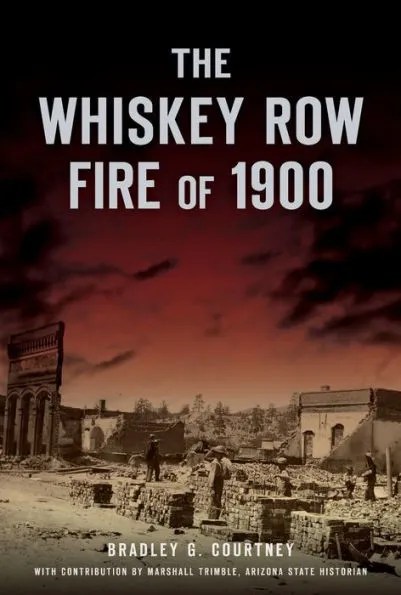
Why this book: I spend a week or so several times a year in Prescott Arizona where I inherited a vacation home from my parents. Prescott has a fascinating history for someone interested in the Old West, and while there, I picked this book up at the local heritage center – I want to know more about the place where I’m spending more and more time. One of the things Prescott is famous for is Whiskey Row – which still has several establishments left over from over a century ago.
Summary in 3 Sentences: This short book covers a brief history of the town of Prescott and Whiskey Row which grew up in the 1860s and had already burned down once in 1883. We learn about the different entrepreneurs who built up the town, the various saloons and other enterprises, and finally about what led to the devastating fire which destroyed not only Whiskey Row, but much of downtown Prescott. The author describes the night it burnt down, how the town responded and then the rapid rebuilding of the whole downtown Prescott including Whiskey Row which has served as the foundation of what Prescott is today.
My impressions: This is a short book (about 150 pages) by a local historian who has done extensive research into the local history in general, and the fire of 1900 in particular. Not the most compellingly written historical narrative but not bad – his account is a prism thru which to look at how Prescott in particular evolved, but probably how all towns throughout the territories of the West evolved after the Civil War.
Prescott is located in the high desert with climate and other features that made it preferable to the desert town of Tucson – with which it was competing to be the center of the then Arizona territories, and Phoenix, the current capital of Arizona. Prescott’s population grew when gold was discovered nearby and when the general mining industry established itself in the mountains nearby. Fort Whipple was also established there to protect settlers from local Indians. Naturally with the dominant male population of soldiers, miners, prospectors and new settlers, Prescott became a center for a culture of saloons and bordellos that thrived and drew more people. Such famous names as Doc Holiday and the Earp brothers spent time there.
The book briefly describes the fire of 1883, but then goes into how the town recovered and was just taking off as a boom town, when the fire of 1900 destroyed the most prominent buildings of downtown. These include not only the low class saloons and boarding houses but also the Palace saloon, the Grandview hotel, regarded as one of the classiest West of the Mississsippi. The author explores some of the myths that have grown up around the fire and validates the most famous of these – that the long bar currently in the Palace saloon and restaurant was rescued from the original Cabinat/Palace saloons before the fire burned it all to the ground.
We learn that with fire fighting still rather primitive combined with a shortage of water, and a town built largely of very flammable ponderosa pine (prevalent in the area,) once a fire got going, it was hard to stop. So the population of Prescott helped store owners and commercial establishments in the path of the fire to rescue key items before the fire inevitably reached those establishments. Fortunately there was an open plaza across the street where these items could be deposited. The famous bar had been built in San Francisco and shipped by rail to Prescott, just a few years earlier and was the pride of the owners, and probably the whole town. There were many saloons at the time in Prescott, catering to different levels of the social hierarchy, and a booming red-light district right behind the saloons. The red light district burned down with the saloons. Temporary tents and building had both up and running within days..
This little book contains plenty of pictures from that era to augment the narrative and concludes with a satisfying epilogue, noting that the town of Prescott soon realized that the fire had been largely a blessing – in that it inspired a renewal, rebuilding and improvement of the whole downtown area. The positive frontier spirit of the “Prescottonians” was lauded, for not dwelling on the misfortune of the fire, but immediately getting to work to put Prescott back up on its feet and poised to become a center of business and culture in that part of Arizona.
Fun little book to read – next time I’m in Prescott (in just a few weeks) there are many places I’ll want to visit and others I’ve already been to, which I will visit with new appreciation.


 Bob's Books