
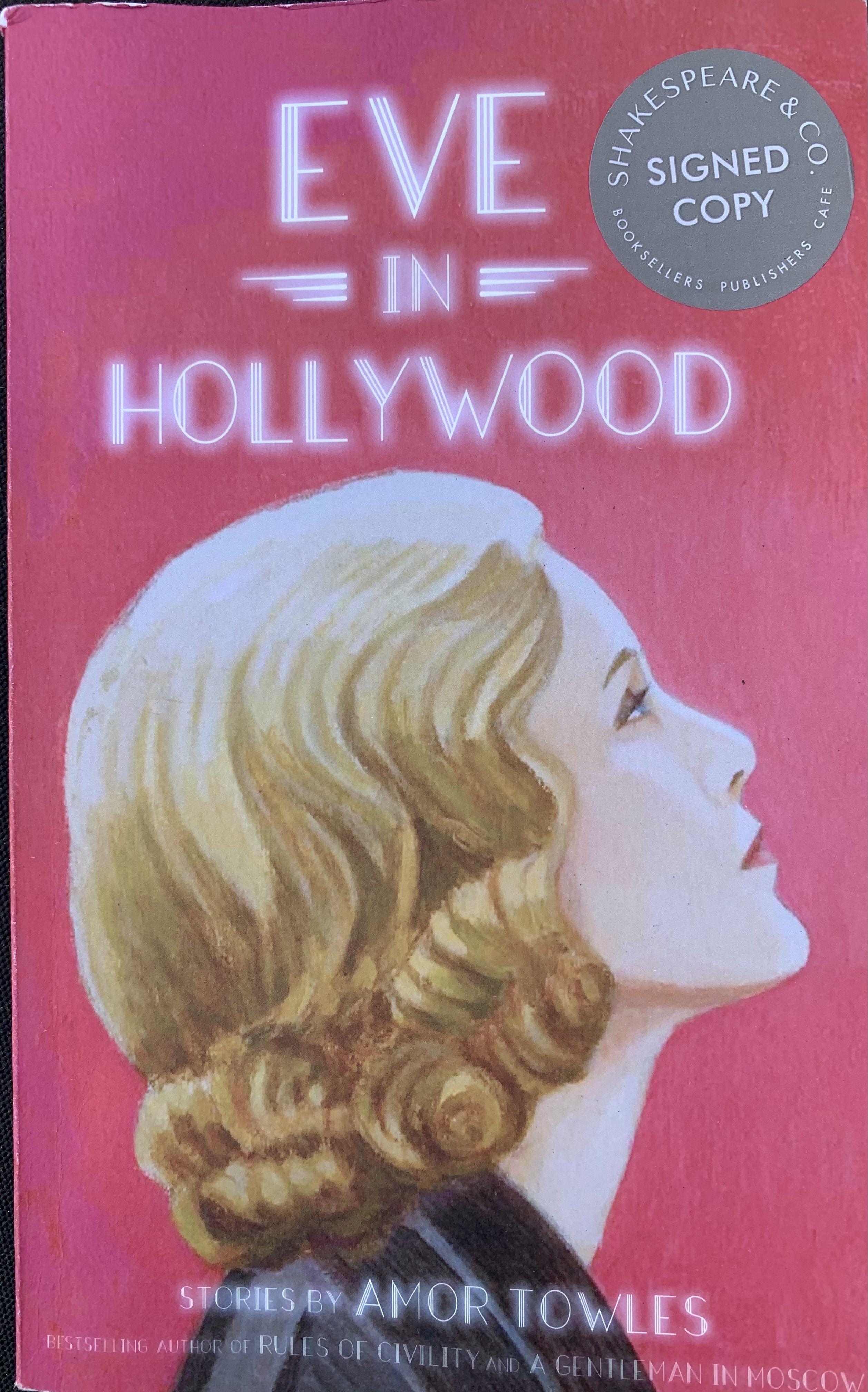
Why this book: I saw this book pop up as an opportunity after I had read and enjoyed Towles’ books Rules of Civility, Lincoln Highway and Gentleman in Moscow. Eve was a most interesting character in Rules of Civility who, part way through the story, had decided to leave the chaos of her life in NYC and headed West, but we didn’t hear much more about her thereafter. I was curious about how Towles would write “the rest of the story” on Eve This novella is no longer available as a stand alone, but I understand that it is included as a novella in Towles’ recent book Table for Two.
Summary in 2 sentences: Eve was running away from a confusing and dissolute life in NYC and heading West to start a new life, and ended up in Hollywood. This book is a series of six short stories in which different aspects of Eve’s character are expressed and manifest in each story – as to how she handles various interactions and challenges in the rough and tumble “man’s world” of Hollywood in the 1930s.
My Impressions: I described this book to a friend as a “confection” – short and not too deep, and great fun to read, but don’t look for any great profound message. I was looking for something light but well written to read between a couple of more demanding reads I was involved with, found this on my shelf and picked it up. It was a very enjoyable interlude between more substantial reading I’ve been doing. Eve is a confident and intelligent femme fatal, but with a limp and a dramatic facial scar from an automobile accident (that takes place in Rules of Civility.) These “flaws” to her beauty add to her mystery and power. She is not intimidated in the least by the glory, power and glitz of Hollywood.
It begins in the first person voice of a gentleman on a train heading to California from the East Coast, who is observing this attractive, detached, interesting woman in the dining car. When the train reaches Chicago, and most of the passengers get off, he overhears her ask the conductor if she can extend her ticket to stay on the train all the way to LA, which of course she then does. The gentleman eventually strikes up a conversation with her, and after a while, asks her why she chose to extend her ticket from Chicago to LA. She responded, “To be perfectly honest, I have no idea.” That concludes the first story, and tees up the intrigue on her and her adventures in Hollywood.
Though it appears that Eve and the gentleman may be on the verge of a closer relationship, in the follow-on stories, there is only a vague reference to him, as Eve purposely and confidently strides into the world of Hollywood, of stars and starlets on the make, and rich executives exploiting their power. Her self-assuredness is obvious; her ‘purpose’ is not – she remains an enigma. It isn’t quite clear what she’s doing or why, but each story describes her interaction with someone who represents a different facet of Hollywood in the 1930s and she deftly plays the Hollywood game with detachment, amusement, and prowess – like an old pro. New York City had prepared her well.
But there is one character who we see in several of the stories – Eve somehow finds herself in the role of guardian/protector of one of Hollywoods promising young female stars who is rather naive and vulnerable in that rather unforgiving world. The young actress is about to star in a blockbuster film called “Gone with the Wind” and Eve is recruited to become a sort of older sister to a young Olivia de Haviland, who had been sheltered by the studios from the gossip and scandal mongers in the tabloids. The studios desperately wanted to protect their investment in her image as pure and virginal starlet for the roles she would be playing, and couldn’t afford to have her mixed up with those who were regularly exposed in the Hollywood tabloids. Eve not only protected her from the tabloids, but also subtly opened doors for her to have fun and experience some of the joys of LA that the studios were keeping from her.
A few good quotes from the book. I loved Towles’ writing:
- When she held out the flask, she could see that Olivia hesitated. “Come on, Livvy, even a church bell’s gotta swing, if it’s gonna chime.”
- In Indiana, a young girl had a good reason to suspect that lists were the foot soldiers of tyranny – crafted for the sole purpose of bridling the unbridled. A quashing, squashing, squelching of the human spirt by means of itemization.
- Pleased by his own poetry, Litsky smiled for the first time in a year. “Ooh,” she replied. “What big teeth you have, Grandma.” Litsky raised his glass in the affirmative and emptied in in her honor.
- Olivia extended her arm in an ironic flourish. “Give every man thine ear, but few thy voice….”
- Olivia: “A lady never finishes a cigarette, a drink, or a meal.”
- Eve: “My mother told me that it was more important to be interested than interesting.” Olivia: “Have you heeded her advice?” Eve: “Only as a last resort.”
I haven’t read Table for Two by Towles, but if the other stories in it are as much fun as this one, it is certainly wortth a look. Like I said, a confection, a well written break from heavier fare.


 Bob's Books
I just listened to this on Spotify, after listening to The Rules of Civility. This is all after listening to Amor Towles’ interview with Doug Brunt on Brunt’s podcast, Dedicated.
In the podcast, Towles describes his painstaking process, to the extent of rewriting sentences to make them perfect. In both of these stories, I really noticed this attention to detail. Each sentence, even the most prosaic ones about setting or description, is essential, but also a real pleasure. Each sentence, with its choice of words, creates atmosphere, even to the very end.
I’d argue that Table for Two is some of the best noir I’ve ever “read.” It’s like it takes place concurrently with L.A. Confidential and the video game L.A. Noire. Hollywood is new, and everyone is getting used to the early days of mass culture. Nobody carries the weight of World War Two, but some carry the weight of World War One. Corruption and abuse are everywhere, but some still struggle against it, or do their best to contend with it.
And The Rules of Civility was just as good, creating a New York I actually believed existed once, with real people navigating real lives.
And all of it was because of Amor Towles’ effort, sentence by perfect sentence.