
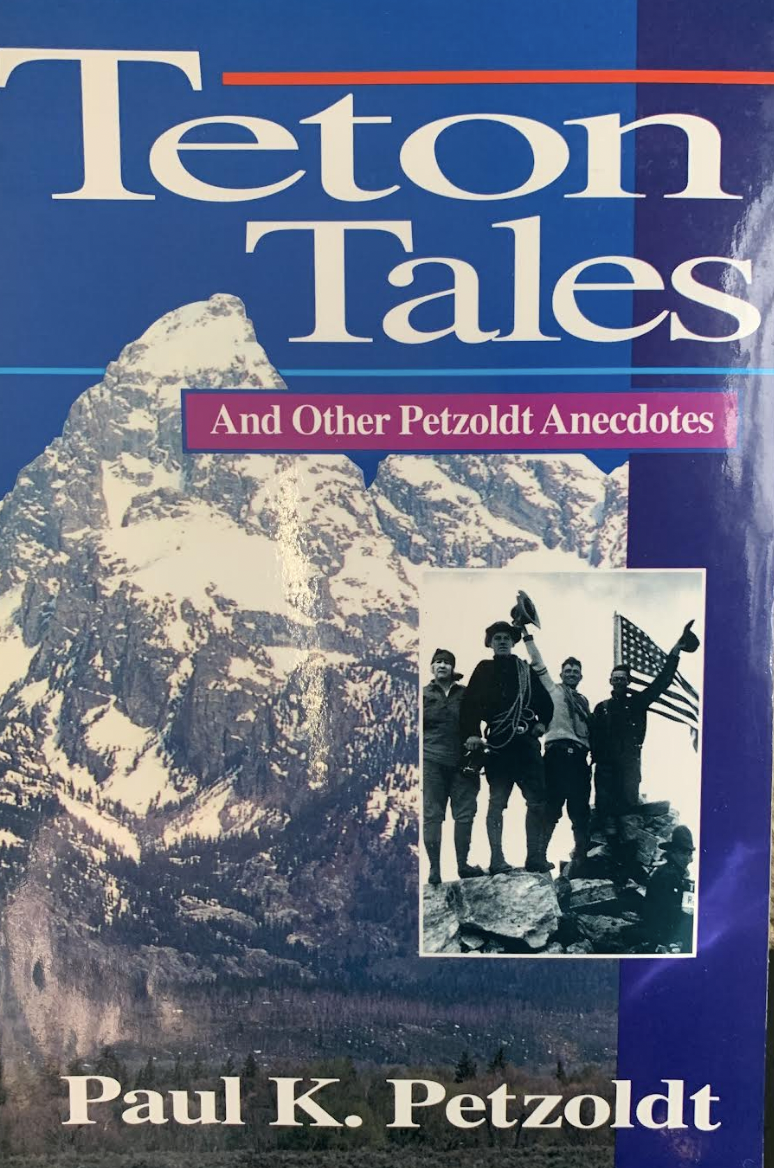
Why this book: I’ve been involved with NOLS for close to 20 years. Paul Petzold is the legendary character and outdoorsman who founded NOLS in the mid 60s, and I don’t know much about him. This copy of the book is signed by Paul himself and was gifted to me by long-time NOLS instructors John Wisnant and Diane Shoutis. So I was intrigued and inspired to read it.
Summary in 3 Sentences: A series of short stories and anecdotes from Paul Petzold’s youth and young adulthood in early 20th century.America as the premier mountaineer in the Tetons, and one of the premier mountain guides in America. He describes his youthful ambition to become a climber and his path toward becoming a well-known fixture in Jackson, Wyoming and in American climbing circles. It is also a look at life in general and climbing in particular in Northwest Wyoming a century ago.
My Impressions: Published in 1995 while Paul was still alive and able to recall his favorite stories and memories from his youth. The book was published with the help of a lot of people who he acknowledges up front. In it, we read stories from his life as a youth and as a more mature young man learning the ropes of being a mountain guide in in the 1920s, 30s, and a couple of stories from even later. It is also a look at American culture in the West during a period of significant change in the American West.
I was particularly amused by how he described the culture and people of what was then called Jackson’s Hole, now called Jackson, Wyoming. It was the Wild West meets 20th century America. Prohibition had no take in Jackson’s Hole – the federal agents wouldn’t go there as it was too hard to get to, and frankly, they were afraid of the reception they’d get. Gambling and drinking were not only tolerated, but were integral to the social structure of Jackson at the time. And as a boisterous young man, Paul Petzold took part in that world as well – but wisely kept his distance from the worst elements of the drinking/gambling crowd. But he was also reverred as the young man who not only respected, but was not afraid of the mountains that surrounded the town, and he was repeatedly called upon by local authorities when a particularly challenging problem came up in the high Tetons. But normally, he was taking up well-heeled, and well-paying clients with a sense of adventure who wanted an expert mountaineer to take them to the top of the Grand Teton. Paul’s hail-fellow-well-met personality along with his recognized expertise and the care and respect he showed his clients brought a lot of business his way.
Paul also dabbled in farmling and a number of other emergent opportunities that arose to help him make a living – and this was apparently the norm for entrepreneurial young men in the hard-scrabble world of the West. Somewhere in there it seems he got married, but though he dedicates the book to his wife, she and any family life are barely mentioned in this book. Paul was a guy’s guy, and a man’s man in the early 20th century, and he is tellling stories to other guys and men. That said, he helped open mountaineering up to women and helped some of the first women to reach the top of the Grand Teton.
Though many of his stories take place in Jackson, and the Tetons, there are many that are centered just outside of Jackson and in nearby towns. For many of the stories he tells in this book he lived in a well populated campsite at Jenny Lake north of Jackson. He also describes in one story his “riding the rails” with very little money, across America to get to New York, and bummed a trip to England on a freighter through a connection with Kermit Roosevelt (Teddy’s son). He was invited by one of his clients, the bishop of Windsor Castle and tells of his interactions with the English aristocracy at Windsor, and then of his trip across Europe – on a bicycle(!) – to climb the Matterhorn and other Alpine challenges. He was interested in learning how Swiss mountaineers guided their clients, and he wasn’t impressed. He noted that Swiss guides pampered their clients, did everything for them, and wouldn’t teach them climbing, in order to reinforce that clients needed the unique expertise of the climbers to ascend Alpine peaks. Paul on the other hand founded his own climbing school, and helped his clients to feel as self-sufficient as their skills would safely allow.
I have compared this book to John Steinbeck’s Cannery Row in that both are a series of connected short stories of young men and their hijinks in a small town, told with a wry smile, a good heart, and an appreciation for irreverent fun.
Teton Tales is a fun and light read – and I enjoyed reading a story (or two) at night befroe going to sleep. The book is available used on Amazon. I’d recommend reading the Epilogue first – it should be the preface – it helps explain the early parts of the book, where Iowa is sometimes mistaken for Idaho.


 Bob's Books