
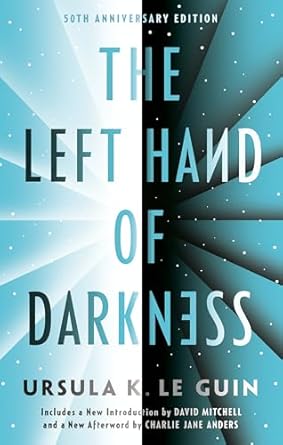
Why this book: I suggested it to my Sci Fi reading group based on having used Le Guin’s award-winning short story “The Ones who Walk Away from Omelas” in ethics classes when I taught at the Naval Academy. I’d heard and read much about her, but none of her novels. This is reputed to be one of her best.
Summary in 5 Sentences: Genly Ai is an earthly human envoy sent from Ekumen, a consortium of inhabited planets across a number of galaxies, to meet with the inhabitants of the planet Gethen, which has human-like, sentient, conscious beings living in a climate/environment like earth in the highest latitudes – very cold and mountainous for most of the year. The mission of the envoy/ambassador is to make contact with the inhabitants of Gethen and convince them to join the Ekumen consortium. The envoy is received with suspicion and gets caught in an ongoing tension between two different societies on Gethen, and is put into prison with little hope of survival. A Gethenian friend, also a political refugee, who believed in the envoy and the Ekumen mission, rescues him from prison, and together they escape by travelling for months across a barren inhospitable arctic landscape. In the course of that long and perilous journey, the two become close friends, learn to appreciate each other’s differences, and we get to know each of them and their different cultures more profoundly
My Impressions: Fascinating book – not a quick read – hard to figure out at first, but worth sticking with it. A thoughtful reader will appreciate it – not a lot of action, but a lot of very interesting dimensions to this story about an earthling on another planet dealing with differnt beings and different cultures. This book has won so many awards and has had so much impact, it is a classic of the Science Fiction genre.
Le Guinn grew up in a home of anthropologists and she was very familiar with cross-cultural tensions and misunderstandings, and cross-cultural bridge building was her specialty. What makes The Left Hand of Darkness stand out is not lots of action or Sci-Fi technological wizardry, space ships, and battles. She creates a human-like culture on an imaginary planet Gethen, many light years away from earth, that on the surface seems similar to ours, but as we get to know it, we learn that the differences are profound in ways that give us insights and force us to consider who we are.
Gender and Sexuality
We learn early on in the book, that the main difference between Genly Ai, a human, and Gethenians is in the areas of gender and sexuality. Genly as a human is a male and has the human orientation that people are born male or female, (though some today are challenging that concept) and most humans consider their gender to be a core part of who they are. That’s not the case with Gethenians.
Le Guinn challenges our concepts of gender by creating the ambi-sexual Gethenians, who are both male and female, and for most of the time, are indeed genderless. But they become male or female only when mating during estrus, and in that process can be either male or female, father or mother of a child they conceive, and they have no control over that. The next time they mate, they may be the other gender.
When they are not in estrus, they are genderless and asexual, and have no sexual drive or hunger. But when a Gethenian goes into estrus – every 26 days for 2-3 days (sound familiar ladies?) a Gethenian becomes in a random manner, either male or female and copulates as such. During this period of estrus, a Gethenian is semi-crazy with sex – completely distracted by the drive to procreate, and is given latitude to fulfill that natural drive, to fulfill that desire during estrus, and then when it’s over, get back to work. There are places dedicated for Gethenians in estrus to meet and fulfill that all-consuming drive. The Gethenians saw Genly Ai as a pervert because as a human male, he had only one gender and was in mild estrus all the time.
There is very little reference in the book to the idea of “romance” associated with sexuality that we are familiar with as humans. Only in one case, we learn that Genly’s Gethenian mentor Estraven had a close emotional tie to one of his partners who was raising their children while Estraven was engaged in politics. And apperently they had had a falling out.
The Story
The story begins with us meeting the human envoy Genly Ai representing a multi-galaxy consortium of planets visiting the planet Gethen with the mission of convincing them to join the consortium of inhabited planets in the galaxy. Genly is attending a political ceremony with his Gethenian host Estraven who becomes a key player in the book. Estraven was the prime minister, and believed in and supported Genly’s mission of convincing the Gethenians to join the Ekumen consortium, but his rivals convinced the king that Estraven had other motives and had him banished.
That left Genly with no sponsor, so he decides to visit a neighboring country to learn their ways and to see if his offer from the Ekumen may have more appeal. But after a warm reception, those suspicious of his motives have him imprisoned in what is remarkably like a communist re-education camp. There he is drugged and constantly interrogated, and begins to lose his sense of identity – when Estraven succeeds at a daring rescue from the prison. After which the two are “on the lamb.”
Genly’s visit to the neighboring country had exposed him and us to two very different Gethenian cultures – one ruled by authoritarian fear, the other by bureaucratic committees with a secret police in the back ground. Though there is tension between these two societies on Gethen, there has been no war. Le Guinn postulates that without the constant drum beat of male aggressiveness and will to violence and power, the possibility of war is greatly reduced.
As the story unfolds, Genly Ai is sharing with us in a first-person narrative, his impressions of the Gethenian culture as he perceives it. In the second half of the book, after Estraven rescues him from the horrors of his prison, their only real option to avoid recapture is to escape across a vast arctic wasteland in subzero temperatures. Estraven has prepared well for this arduous journey of several months to reach a safe haven. During this second half of the book, during their long trek over an arctic ice field, the chapters alternate between Genly Ai’s and Estraven’s first person perspectives, and we see how these two individuals – Genly Ai, a human, and Estraven a neuter with both male and female characteristics, come to respect, work together, and even love (not in a physical way) each other, as they depend on each other to survive in their arduous trek over the arctic wasteland.
At one point Genly and Estraven are discussing the differences between men and women on earth, Estrahan asks if they are fundamentally different. Genly responds that whether one is born man or woman determines almost everything – vocabulary, clothing, opporunities, roes in society – and he notes that it’s extremely hard to separate the innate differences from the learned ones. (P253)
During that months-long trek through an arctic waste land, Le Guin details how they moved and survived in the most inhospitable conditions. I have some experience moving and camping in very cold environments, and Le Guin’s novel accurately portrayed many of the difficulties and processes required to move and survive in that extremely challenging environment. I read separately that she had done research on arctic explorers and used what she had learned from their writings to describe how Genly Ai and Estraven worked together and survived on their long trek in sub zero temperatures.
The book concludes with some drama and surprises and ultimately with contact established between Ekumen and the planet of Gethen.
Some other interestng aspects of the book that caught my attention:
- As a human from earth, Genly had mastered telepathy – what he calls “mindspeak” and teaches it to Estraven. Once Estraven had mastered it, much of their conversation in their tent at night was through silent mindspeak.
- There is a subculture on Gethen of beings (again, neither men nor women, but both) which has many similarities to an Indian or Buddhist culture, that specializes in foretelling the future. Genly Ai paid for their service, but it was an eclectic group that was not in the least materialistic. The responses that were given to questions about the future were ambiguous, clearly modeled after the Greek Delphic Oracle.
- At the end of their very difficult journey over the ice field, there was an emotional letdown that I recognized after completing an exhausting, all consuming task. “We were tired. There was no more joy in us.”
Some good quotes that I found interesting.
- “To exhibit the perfect uselessness of knowing the answer to the wrong question.”
- “The Ekumen is not a government at all. It is an attempt to unify the mustical with the political, and as such is of course mostly a failure; but its failure has done more good for humanity so far than the success of its predecessors.”
- To go thru kemmer (estrus) without a partner is pretty hard on a Gethenian. Suppression (of Kemmer) produced ont frustration, but something more ominous in the long run: passivity.
- Genly to Estrahan – “You’re isolated and undivided. Perhaps you are as obsessed with wholeness as we are with dualism”:
- “Light is the left hand of darkness, and darkness the right hand of light. Two are one, life and death, lying together like lovers in kemmer, like hands joined together, like the end and the way.” p 252
- And I wondered, not for the first time, what patriotism is, what the love of country truly consists of, how the yearning loyalty that had shaken my friend’s voice arises, and how so real a love can become too often , so foolish and vile a bigotry. Where does it go wrong?” p300
The interaction between Genly and Estraven, especially during their long trek over the arctic mountains and ice field was a key part of the book. Genly as a human from a more technologically advanced society was insensitive to the androgynous, male-female dynamic on Gethen, and in fact came off a bit chauvinistic by today’s standards (again this was written in 1969). Estraven was the moral hero of the book, with strong male and female qualities, selfless and wise, not as physically strong as Genly but physically strong enough, with great endurance and a more developed moral compass. .
One of Le Guin’s primary themes in this book was to get the reader to imagine gender as mutable and not a core aspect of our being. What would it be like for there to be no inherent gender, for anyone to be able to bear children, to not have gender specific roles in society, for all beings to have qualities of both men and women, and for both to have responsibility for bearing and raising children, as well as filling traditionally male professions. Can we imagine a society in which “gender” is a temporary state, otherwise irrelevant? These were revolutionary ideas in 1969 when she wrote the book, and some argue that The Left Hand of Darkness has significantly influenced our revolution in gender roles in Western Society.
There is also the theme/analogy of a more technologically advanced culture connecting with less technically advanced, but in some ways, more intuitive and sensitive cultures. We are all familiar with the results of the Europeans colonizing less developed parts of the world in the 16th – 19th centuries on earth – and how technological power drowned or destroyed many more subtle qualities in the colonized countries. Genly seemed to feel a bit superior to the primitives on Gethen and was insensitive to many aspects of Gethenian culture – until he’d been there a while and came to appreciate nuances he’d missed early on. Though Ekumen’s and Genly’s goals seemed noble and non-exploitative, the end of hte book begs the question: would they stay that way? And what would the impact of opening up the channels of communication and influence from Ekumen’s consortium of planets to Gethen have on Gethenian cultures? At the end of the book, we were already seeing the Gethenians fascinated with space ships, airplanes, and other technologies. Where would all that lead?
These are questions, issues that Le Guin leaves hanging, in her very provocative book.
One aspect of the book that was awkward and for which Le Guin has been roundly criticized by feminists (male and femail) was that she used the male pronoun for Gethenians – so it was easy to visualize the Gethenians as men. “They” would have been awkward. S/he would have worked better for me. But occasionally she reminded us that Estraven had female qualities and characterisitics, though reading the book, and having “him” referred to as “he” leads the reader to visualize and imagine Estraven as a male. He was no more a male than a female. This is a shortcoming of this provocative book.


 Bob's Books