
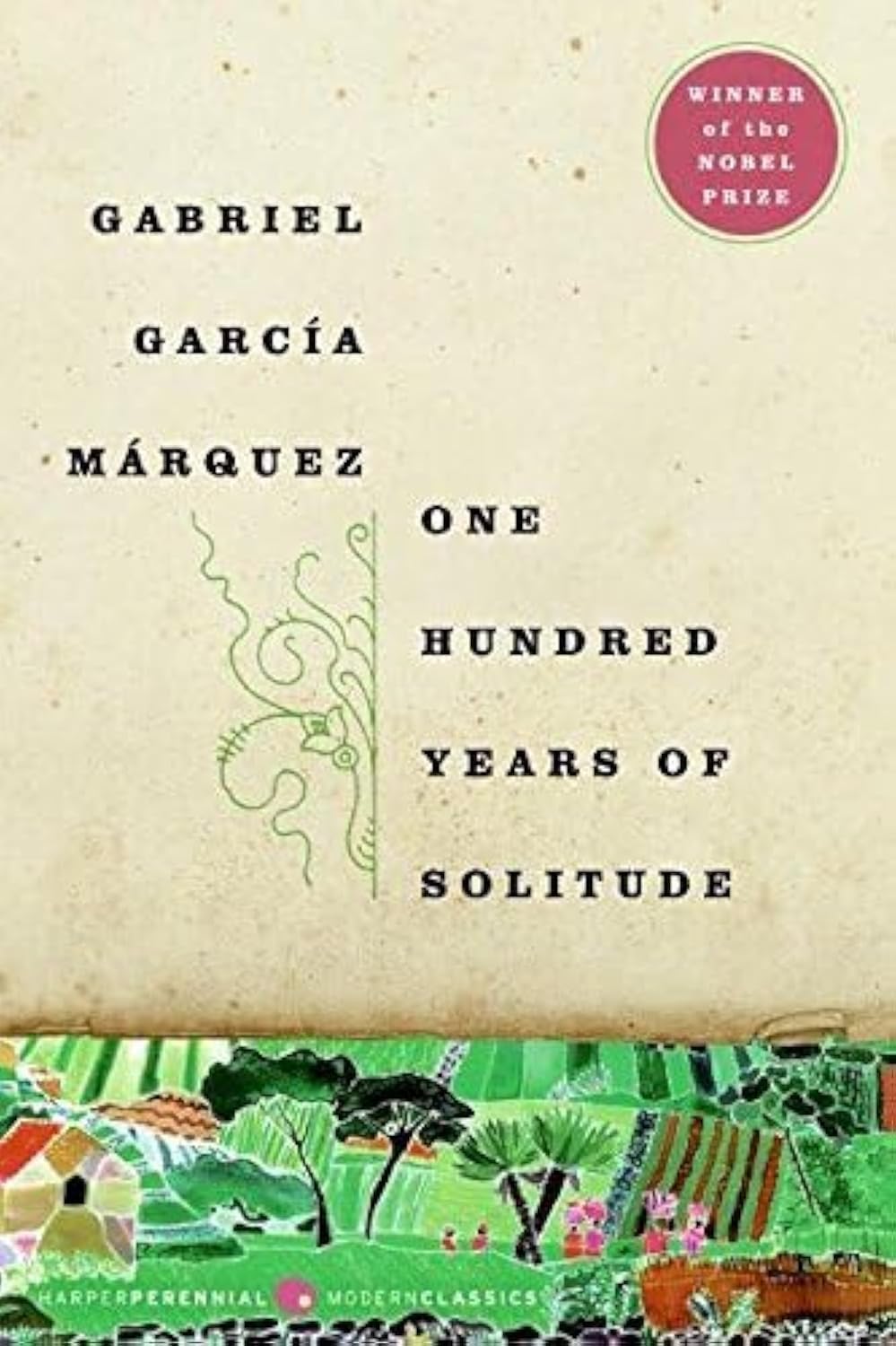
Why this book: Selected by my literature reading group. This was my 3rd time reading it.
Summary in 3 Sentences: A tale of five generations of a family in a village/small town in the remote jungles of Columbia in South America. It is a novel made up of multiple short stories of some normal, many eccentric characters, beginning with the founder of the fictional town of Macando and his multiple progeny over a century of change and human drama. “Reality” is somewhat flexible concept here, as there are occurrences that don’t seem to fit the world most of us live in – in fact this book is considered one of the sources of the genre of “magical realism.”
My Impressions: This very famous book is a panorama of life in a small town anywhere, but with a number of specifics related to Latin America in the early and mid 20th century. It is more a series of stories that provide a trajectory of life that it is a single story – it is multiple stories that happen within a single family over multiple generations, over a century in a small town in a remote part of the jungle in Colombia. We get to know a number of eccentric and interesting characters and their experiences in the narrow mindedness peculiar to small town’s every where. And we see the slow, almost insidious disruption brought on by 20th century modernity creeping into the culture of an isolated small town culture.
There are a multitude of stories and fascinating characters, representing so many different types of people we all encounter – from the ambitious to libertines, to the most practical, to the cruel, deluded, and insane. The book is a compilation of a multitude of stories that together create the mosaic of a family that fragments over many generations, and a remote town that struggles with making the transition from the 19th to the 20th century
After reading the book, and now trying to write e a summary of it, I am somewhat at a loss in trying to describe it. So I have read a summary of it on the site “Super Summaries” and again, I am still somewhat at a loss. Here are a few random impressions.
- The flow of events is not logical – nor even completely sequential. Timelines bounce around a bit. The capriciousness of the many characters in the story take the story of Macondo and the Buendia family in so many different and directions. There is no step-by-step pathway to a happy ending. In fact there are no classic, feel good happy endings.
- The matriarch Ursula is a constant throughout the book, as the one character with her feet-on-the-ground with practical wisdom in the Buendia family focused on making prudent decisions, while her husband and sons chase chimerical dreams and adventures. Her daughter and daughters-in-law eventually supersede her and assume more authority as she ages and her influence wains, but as her simple practical wisdom and influence is ignored, the family and household begin to fall apart. She eventually is considered irrelevant and old fashioned by her children, grand children and their families – much to their detriment.
- Remedios the Beauty and Fernanda del Carpio were the most beautiful women in the book – and men became almost helplessly intoxicated and obsessed with their beauty and erotic appeal. But their characters were the least appealing – they were two of the most psychologically screwed up characters in the novel. Marquez is perhaps making a statement about how men are blinded by the beauty of such women.
- Col Aureliano Buendia was perhaps the strongest character in the book. He is self contained, not driven by sexual passions or greed and unlike many of the Buendia men, is deliberate in his decisons. Over and over again, he instigated and led a revolution for idealistic reasons, but the years of war made him cruel and unfeeling, and eventually detached from life and his family. In the end he isolated himself into his own world, somehow having survived the many attempts on his life. But in spite of his cynicism and bitterness, he was publicly hailed as an icon of patriotism, courage and character.
- Modernity was both welcomed and resisted in Macondo – much of it brought by a gringo owned Banana company. The “Modernity” that slowly crept into Macondo included trains, and electricity, mail and postal service, connections with the world beyond, not only in Colombia but also Europe the US and beyond. and toward the end telephones. These innovations disrupted the tradtional values and patterns of life within Macondo and made the older citizens feel even more disconnected from the momentum of Macondo’s progress and adaptation to modernity.
- Sexuality and the power of the sexual drive is a constant theme in the book. The men in this story always had the outlet of the French bordello in Macondo, while they followed the protocols of their social class with the women they were courting. Several had mistresses as well as wives, and some of the women were as ardently sexual as the men. The spiritual connection between the men and their wives was largely a function of their sexual connection – and where it wavered or fizzled, the relationships began to fracture.
- The House that Jose Arcadio Buendia built when he founded Macondo grew and evolved into becoming the home of the greater Buendia family and legacy. This was largely the result of Ursula’s efforts and as such she became the proponrent and caregiver of the Buendia family. The home she built came to represent the family as later generations used it for good and then abused it for unseemly purposes, over time letting it decay and fall into disrepair, as did the legacy of the Buendia family.
- Melquiades is a mysterious figure who appears early in the novel with a troupe of Gypsies and befriends and intrigues Jose Arcado Buendia – the pater-familia who founded Macondo. Melquiades is interested in new scientific discoveries, and instills that fascination and passion for new possibilities into Jose Arcado Buendia. He returns to Macondo ever few years, then decides to stay there and live in the family’s house working on a manuscript in a coded language until he dies. After his death, the room does not decay and never changes, and follow-on Buendias become obsessed with understanding his writings. When they are finally deciphered, it is realized that the Melquiades had predicted the entire chain of events leading up to the point at which these writings are decode. At which point, the town and all in it, were wiped off the face of the earth by a hurricane. Which leaves me the reader to ask whether Marquez was telling us that all that had happened to Macondo and the Buendias had been predestined.
- Magical Realism. This book is often used as an early example of the literary genre called “magical realism” – in that events and occurrences are described as normal and real that defy the reality that most of us live in. In One Hundred Years of Solitude we regularly see strange occurrences, psychic insights and supernatural events described as unremarkable. We see flying carpets, ghosts, the ascension of Remedios the Beauty into heaven, the longevity of Ursula, Jose Arcadio Buendia living in his own reality for years, tied to a tree outside the home, the reappearance of Melquiades and his prognostications, and other events that bespeak the paranormal, but which are considered a normal part of the strange reality that exists in Macondo. These paranormal events add to the “magic” of the book in my opinion.
The NETFLIX series. As of this writing, I have watched part of the NETFLIX series and agree with several reviewers that it is a worthy representation of the book. Watching the various scenes played out that I had read in the book added some clarity and brought the book to life for me in a way my imagination sometimes struggled with in reading it. If fact, a number of incidents in the story whose significance I missed or didn’t quite get my attention while reading the book, were presented in the series in a way that helped me better realize their significance and broader implications. Watch the series and then read the book, or read the book and then watch the series – the two complement each other and go together like peantut butter and jelly. In my view, they are better together than either one alone.
My recommendation: Yes, read the book – it is considered a classic of 20th century literature, and (I believe) deserves the attention it’s gotten. But it is not a quick, easy read. It is sometimes not easy to follow, but the reader has to be willing to go along for the ride – and let him/herself be amazed and surprised by what comes next. One Hundred Years of Solitude has been widely praised as a classic example of magical realism, and of telling a long and strange story where the strange is normal, but also even the eccentric characters represent people all of us know in our lives. I ask myself whether the Grateful Dead were thinking of this book and the story of the Buendia family, when they wrote the lyrics to Truckin’ “What a long Strange Trip it’s been.”


 Bob's Books