
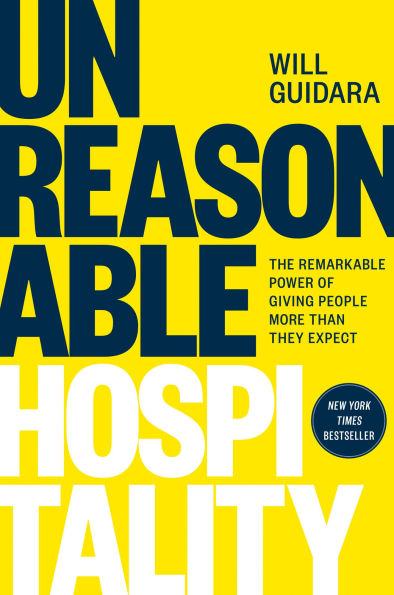
Why this book: Selected by my SEAL book club, based on several strong recommendations
Summary in 3 Sentences: Will Guidara’s first-person account of growing up, deciding at a young age that he wanted to go into the hospitality business, and then, after a lot of experience, being given the opportunity as a young man to manage a prominent restaurant in NYC. The book relates how he developed his ideal of over-the-top hospitality and how he began to implement it at Eleven Madison Park (EMP) in NYC, in a way that took that restaurant from two Michelin stars to four, and ultimately being ranked #1 restaurant in the world. The book relates how his leadership philosophy evolved over the years, experiments that succeeded and failed, mistakes made and short and long term consequences.
My Impressions: My new favorite leadership book! It is mostly about building a great culture – which takes time and patience. Not so much “what” to do, but “how” to do it. Though the context of his personal journey is the restaurant hospitality business – in NYC of all places – his approach and passion, and his philosophy will work in any context where the leader wants to build a strong and enduring culture of commitment, excellence and caring. but it takes time and persistence.
It is very much a personal/autobiographical story. I read the book, but many of my friends listened to it and very much enjoyed that – since Will Guidara himself reads it, telling his own story. And several of my friends who listened to it, then bought the hard copy so that they could review and highlight the many ideas and principles he relates in his story of how he built a great culture which took him and his team to the top.
For someone who just wants a sense of his message, Will helps us out with his chapter titles, section sub-titles within the chapters, and then he boldens/highlights key ideas and insights in his book. It may be tempting for someone in a hurry to just skim the chapter and sub-chapter titles to get the gist of the book – but the impact of those ideas and principles comes from the stories he tells about how he arrived at them and the impact they had on him and his team. For example:
Chapter titles include:
- Restaurant-smart vs Corporate-smart
- Breaking Rules and Building a Team
- Creating a Culture of Collaboration
- Relationships are Simple. Simple is hard.
- Earning Informality
- Learning to be Unreasonable.
A few of the many, many section subtitles within the chapters:
- Invite your team along
- Leaders Listen
- Find the Hidden Treasures
- The Way you do one thing is the way you do Everything.
- Keep the Team Engaged at all Costs
- Language creates culture
- Find the Third Option
- Persistence and Determination alone are Omnipotent.
- Make it Cool to Care
- Slow down to Speed up
What is clear in reading this book, is that a key to Will Guidara’s success in implementing his approach to leadership was his passionate belief in it, and his willingness to live and lead by the example that his philosophy lays out. This is not a “paint-by-numbers” approach to leadership – do these things and you will succeed. That approach has it’s utility – but gets you paint-by-numbers employees – who’ll follow rules, do what they’re told, but without passion, commitment, or creativity. His approach is clearly about passion, commitment, and an intuitive love for people and the process.
In this book we see clearly that Will Guidara believes passionately that great hospitality will lead to success – however one measures it. But Unreasonable “hospitality” is another way of saying unreasonable “caring” for others – taking care of customers and other people – beyond what our culture normally expects. The subtitle of this book is “the remarkable power of giving people more than they expect.”
One of the really fun things about this book are the examples he gives of “unreasonable” hospitality – examples of how and when he, vis-a-vis his employees, and his team, vis-a-vis their customers go WAY out of their way to do favors and make them feel especially valued. This is not always rewarded, but it very often is, when such gestures becomes part of the culture, you have a culture in which people care about much more than their own immediate short term comfort. In the culture that he created, the members on his team sought ways to one-up each other in hospitality gestures, within the guardrails that he created (they still had to make a profit!)
It’s a reasonable question whether this approach could work in a large corporate organization. He addresses this indirectly by pointing out that the CEO of the corporate group that owned his restaurant EMP encouraged and exemplified most of the principles that Will uses in his book, and this CEO gave him the latitude to be unconventional, creative, and to experiment. But even large organizations are made up of a multitude of teams. It is worth considering what it would be like if a CEO’s executive team lived by the principles of Unreasonable Hospitality amongst themselves and toward their subordinate teams. What would that do to organizational culture and cohesion?
I was pleased to see that he emphasized what I used to emphasize when I spoke and consulted on creating a great corporate culture: that is, the importance of the hiring and onboarding processes. He personally was involved in all hires – at least initially, and with aspiring employees, emphasized the mindset and values his team expected and would hold each other accountable to. There are a lot of competent and capable people looking for work, who look good on paper, but who would not be able to adapt to a culture based on innovation, caring, and “unreasonable hospitality.” Guidara points out that he was always looking for people of strong character, who would be willing to experiment, had the capacity to care for others and put the team before themselves. The right people he could teach the skills to do the job he needed done. With few exceptions, everyone started at the bottom as a server/bus boy and proved themselves inorder to work their way up their hierarchy.
Will’s creative approach to his job, willingness to try new approaches, innovate and experiment was what led to so much of their success. But Will was not a starry eyed idealist. He was very much into and obsessed with details and finance, and meticulously went over the P&L records. Not all of his or his team’s experiments/innovations worked. He tracked the financial costs of each of his experiment and was willing to take some losses that might yield long term gains to their culture as well as their bottom line. He saw that the costs of occasional failed experiments were the price of fulfilling his vision of leading a restaurant known for innovative and unreasonable hospitality, where people would love to eat and return to.
I was reminded of one of my other favorite leadership books that I read a few years ago: Loonshots, by Safi Bahcall. In it, Bahcall noted that the best organizations have a balance between its artists and soldiers. The artists are the creative and imaginative ones, who generate new ideas, who want to experiment and maybe find a better way. The soldiers focus on efficiency and making shit happen, here and now, and they usually see the artists as time wasting nuisances, simply good-idea-fairies. Experimentation often comes at the expense of short term results and efficiency. Bahcall noted that a great organization needs both artists and soldiers, recognizing that there’s almost always a tension between those two groups. But in the BEST organizations, the leader is a bridge, brings the two together and teaches both groups to respect each other’s contributions. It seemed to me that Will Guidara is unique in that he seems to be strong in both qualities – artist and soldier.
It may be surprising to some that a SEAL book club would select, much less be over-the-top impressed with a book about leadership in the hospitality industry – but this book was a winner, with even the most hard core of the SEALs who attended the session. They all appreciated the value that Guidara put on building a cohesive team with a common purpose and which teammates care deeply about each other and their mission. As noted, at least a few both listened to and read the book, and a couple who are now active in the corporate world wanted to contact him to speak to their teams.
A couple of our SEALs knew Will, reached out to him and he agreed to join us (by zoom) for the discussion of his book. A highlight of that session was that one of the SEALs attending had worked for Will at EMP for four years a decade ago, but had since left, joined the Navy, gotten through BUD/S served in a SEAL team and then been selected to serve at our most prestigious SEAL Team. This SEAL stated unequivocally that his time and what he learned working for Will at EMP had been a significant contributor to his success as a SEAL. He shared how at one point he was not doing well as an employee at EMP, that others were getting promoted and he was being left behind. He shared how Will’s very professional and straightforward counseling got him on the right track. One of Will’s principles: criticize the behavior or actions, not the person. The back and forth between Will and this SEAL was compelling and was a highlight of our session.
It should at this point go without saying that I strongly recommend this book to anyone who leads an organization and is open to a different but proven approach to building a strong and successful culture.


 Bob's Books
Educating and Impressive.
hello ,
This is such a thoughtful review—thank you for sharing it! I really like how you connected Guidara’s philosophy of “unreasonable hospitality” to broader leadership lessons beyond the restaurant world. The SEALs’ perspective and the story of the former EMP employee turned SEAL really drive home how universal these principles are. Definitely moving this book up on my list.