
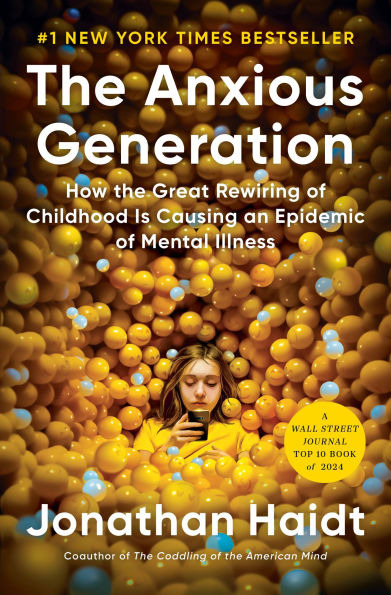
Why this book: Selected by the SEAL book club I help run. We had previously read Jonathan Haidt’s book The Righteous Mind and found it insightful and enlightening.
Summary in 4 Sentences: This books makes a strong case with impressive amounts of data, that giving children and teenagers unfettered access to smart phones and social media is harming them and society. He has separate chapters on impact on boys and girls, noting that girls have had the most negative consequences of full access to social media in their late childhood and teenage years, as evidenced in the significant increase in suicide attempts and other psycho-social disorders, but boys have suffered as well, but differently. He also makes the case that smart phone usage and helicopter parenting are reducing the amount of free play that he believes develops confidence, autonomy and adaptability that youth will need as adults. He concludes by offering four solutions to how to fix this negative rewiring of American youth – what government, schools, parents can do to reverse these negative trends.
My Impressions: An excellent and well documented treatment of the impact that smart phones are having on youth in America – and all over the affluent civilized world. Haight writes for both the social scientist and the lay person – he offers the data, the charts, graphs and resources for the social scientist, but also provides a personalized touch with his own anecdotal observations for the lay reader. He also makes the book easy to skim and review by offering bulltetized summary points at the end of each chapter.
He has two themes and he gives significant attention in mulitple chapters to each of these:
- The Decline of Play-based childhood, which addressees the need that children have for free space to play, take risks, learn to play with others and how these opportunities are declining for children, esp in America.
- What he calls “The Great Rewiring” – the rise of the phone-based childhood and the wide variety of dangers that presents.
Then he concludes the book with recommendations – what we can do about these challenges. He makes four major recommendations to each of us as parents, grandparents, citizens witha chapter on each:
- Preparing for Collective Action
- What governments and tech companies can do now
- What Parents can do know
- What schools can do now.
The book is filled with convincing data that shows that a significant percentage of American youth have become increasingly depressed, unhappy, too often with suicidal ideation or attempting or committing suicide in the last decade. He describes what he calls the “tidal wave” of the conjunction of the proliferation of smart phone usage with social media activity on the part of pre-adolescent and adolescent youth. More social media time almost always means less in-person contact with others, less outdoor play time, less quiet thoughtful time. And he convincingly argues that these areas which smartphone/social media have reduced are fundamental to healthy maturing and to becoming happy, productive adults.
He has a chapter entitled The Four Foundational Harms – “Social Deprivation, Sleep Deprivation, Attention Fragmentation, and Addiction.” In this chapter he points to these as multi-faceted harm and collateral damage resulting from extensive smart phone and social media use. Each of these have key negative impact on the development of children and adolescence. None of this surprised me, but the massive amount of evidence he gave drove home the point.
One of the chapters which I didn’t expect, but which grabbed my attention was one he called “Spiritual Elevation and Degradation.” There is a lot in this chapter about how extensive smart phone and social media use distracts all of us, but particularly young people from the quieter, more transcendental aspects of living on this planet. He notes how a “phone based life distracts us from aspects of living that engender a pull to the more profound, to spiritual values.” “As we’ve seen before, our phones drown us in quantity while reducing quality You watch a morally elevating short video, feel moved, and then scroll to the next short video, in which someone is angry about something….If we want awe and natural beauty to play a larger role in (our children’s) lives, we need to make deliberate efforts to bring them or send them to beautiful natural areas. Withoug phones.” (p215)
HIS CONCLUSION: He concludes the book with chapters entitled: “What Governments and Tech Comapnies Can Do Now,” “What Schools Can Do Now,” “What Parents Can Do Now,” and a final chapter entitled “Bring Childhood Back to Earth.”
SEALBOOK CLUB reaction The 30+ SEALS who joined the discussion were overwhelmingly positive on the message of the book. Author Jonathan Haight joined us for about 30 minutes of the discussion and a number of the active or former SEALs asked questions about how best to implement his recommendations at home with their kids. JH gave advice essentially right out of his book, and recommended making many more fun alternative activities available for them to do, as many as possible outdoors.. Other interesting things that came up in our discussion.
- JH pointed out that the movement to reduce and manage smartphone use by youth and adolescents has been one of the fastest social change movements he’s ever seen.
- Since his book came out, he’s seen more parents acting, schools acting, and family time has become a fight over “screen time”. The biggest success is more and more people are buying into no smartphones before high school.
- He pointed out, as he did in the book, that forbidding phones in class is not a solution, since, between classes, at recess, at lunch, kids will be on their phones instead of interacting in person with their friends. And in class, they will be thinking about what they will do on their phones as soon as the bell rings. Phones need to be forbidden for the entire school day.
- He pointed out one of the biggest collateral damage effects of smartphones and social media, being always connected (and this applies to adults as well as youth, is what he called “attention fragmentation.”
- Multiple countries have legislated against smart phone availability and use during public school time. I recall Australia and some European countries. In the US, 12 states have legislated against smartphones in school.
- Regarding his advocacy for more free play and parents giving their children more freedom and responsibility, this is a price parents have to be willing to pay. Helicopter parents have to be willing to accept measured risk. Also, parents need to work together and cooperate in this, and local governments have to loosen up child protective service guidelines
- JH points out teens are terrified of being socially cut off. Terrified of being left out. Terrified of becoming “socially dead.” They are very susceptible to FOMO – and this is driving teenagers to stay engaged on their phones and with social media.
- One person calling in from Brazil noted that Brazil is one of the most active countries in the world on social media.
- JH was quick to point out that he believes AI and Generative AI will have by far the most profound changes in Western Society, eclipsing all concerns about Social media and smart phone culture. And he warned us to keep our eyes open – this tranformation – for good, ill, or whatever is already beginning to take place and will be very evident in less than 5 years.
- One retired SEAL pointed out that the research cited in the book describing the nefarious influences of smartphones and social media on youth encompass probably less than 1/3 of Gen Z. This officer and a few others in the group noted how their experience with more select groups from Gen Z eg Naval Academy, Elite High Schools, SEAL trainees – is that they are incredibly accomplished and capable, compared to previous generations. Bill McRaven separately in an interview refuted the narrative that Gen Z are all pampered, self centered wimps, noting that his experience has him very much admiring Gen Z. That doesn’t necessarily argue against JH’s thesis, but points out that it is more complicated – than simply stating that smart phones and social media are ruining our youth. It’s clear that social media and smart phone access affects different people differently – some social groups more than others.
- In support of that last point, JH pointed out that the negative impact of excessive use of smartphones and social media seem to disproportionately impact the lower income and less affluent populations in America, where there is a single parent, or both parents are working, not able to give adequate attention to what their children are doing during their free time. The smart phone becomes an un supervised and easily corruptible babysitter.


 Bob's Books