
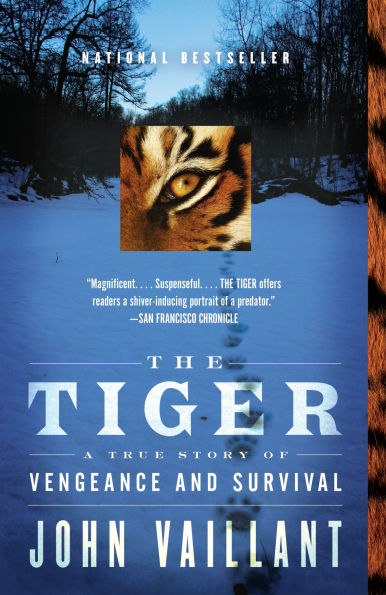
Why this book: Highly recommended by Ryan Holliday. Selected by my “literature” reading group and was a near select by my SEAL reading group.
Summary in 3 Sentences: This is the author’s account of his research into how the Russian government and the local communities in the Russian Far East (SE Siberia, bordering China, Manchuria, and near North Korea) responded to a huge male Siberiian tiger killing and consuming two local hunters. The book describes the rather primitive and poor communities and cultures that live on basically a subsistance economy in this remote, and poorly served part of Russia, and includes the role of the police and wildlife protection services. We also learn a lot about the history, habits, and the role of this species of tigers in this part of the world – they are perhaps the largest, most powerful and intelligent of the mammalian carnivorous predators
My Impressions: I enjoyed this book – because I was keen to learn about the culture of far eastern Russian villages, people living a subsistence life in a remote part of Russia – and the author’s study of the Siberian tiger (also referred to and known as Amur tigers) and its relationship to human communities over the years. He provides this as context for understanding this rare occurrence of a tiger attacking and consuming not just one, but two humans in the same region. Well written and thoroughly researched by the author who spent a considerable amount of time in the region with those affected by, and investigating the incidents.
A number of those in our reading group didn’t care for the story – too much anthropology, history and culture – not enough page-turning action. Women played a very minor role in the book – the wife of one of the victims and the mother of the other are referred to and mentioned, but the majority of the author’s research and interviews were with the men who were associated with the victims, and those involved in investigating what happened and why, and then hunting the man-killer down.
The book is also a tribute to these carnivores, at the top of the food chain – except for humans – and how the encroaching civilization has impacted them, with the worst impact coming from poachers who are very well paid for skins, and other parts of the tigers. The Russian government has wildlife protection and forestry services trying to manage, catch and arrest the poachers, but they are grossly underfunded and under manned for the extensive territory that they are responsible for. A good percentage of their resources come from Western wildlife preservation groups.
We also learn in this book a bit about the history of this region – white Russians from the west moved into this territory during the 20th century that had been for millennia the home of local natives. Native communities still live in the region, and they have retained much of the traditional wisdom from their forefathers who had lived there and co-existed with the tiger for generations. These native hunters had previously had a symbiotic live-and=let-live relationship with the tigers who hunted in the same forests they did – and in fact, the indigenous communities revered the tigers as gods. But with the influx of westerners with new high powered weapons and technology, the balance in the relationship of the natives to the animals and the forest in the region shifted. The protagonists in this book, Yuri Trush was the head of the tiger preservation team in the region – and Vaillant clearly admired him as a man, and the work he was doing.
The final episode of the book is the tracking down and hunting of this specific tiger, who they realized was starving, injured and desperate. That section and the aftermath was indeed a page-turner. He concludes the book with a look at the Siberian tiger’s prospects as an endangered species – only about 500 remaining in the wild, when it was believed that a century ago there were close to 25 thousand. Western conservation groups are helping to fund and support the meager efforts of the Russian government to protect these tigers.
I was also surprised to learn that for the poor people in this region, peristroika has been a disaster. Under communism, there was at least an infrastructure that was responsible for providing jobs (however meaningless) and minimal income to the residents, and was responsible for taking care of the people in remote areas. With peristroika and the advent of the free market, the government infrrastructure collapsed and with it the local economy. As a result, there are very few opportunities for people to work, which forced many to hunt and poach just to feed their families.
Very good book for a perspective on this remote area of Russia and to learn about the predator-prey relationship between the apex predators (man and tiger0 in that part of the world.


 Bob's Books