
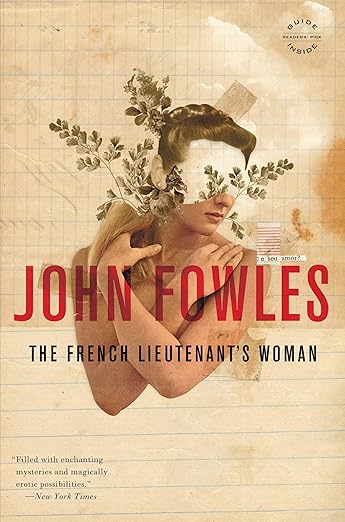
Why this book: Selected by my literature reading group. Also, I’ve had my wife’s copy on my bookshelf, unread by me, for decades.
Summary in 4 Sentences: An upper class English gentleman in the late 1860s, has made a good catch in betrothing himself to be married to a sweet, beautiful, and somewhat spoiled well-to-do woman, with an excellent dowry. He then allows himself to fall in love with an intelligent but mysterious governess – the “French Lieutenant’s Woman,” and is unable to overcome his obsession with her. They then have a brief tryst, he breaks off his marriage, and then his new mistress disappears. After several unhappy years, he finally finds her again, and their interaction when they finally reunite deepens the mystery.
My Impressions: Not an easy book to read, but interesting, challenging and worth reading for a number of reasons. I struggled at first to get through the first 2/3 of the book, as did a number of the members of my reading group. Why ? First, the writing is classic (and elegant) English, occasionally a bit cumbersome. I was regularly referring to my phone dictionary to help me understand words and references that were not familiar to me, though the “elegant” writing was often a pleasure to read. And second, I didn’t particularly care for the two main characters in the book, both anguished, conflicted, weak and indecisive, though I could relate at least to a certain degree with the male protagonist’s challenge.
In short, the story takes place during the height of the Victorian era, when the English upper classes had fully embraced the Victorian values of refinement, sophisticated restraint, and suppression of (nearly) all human emotions that were not publicly endorsed by refined society. Proper etiquette, emotional restraint, follow the rules, and “Don’t rock the boat” seemed to be the prevailing sentiments in the self-satisfied upper classes – at least in public. Our protagonist Charles Smithson is comfortable in this world, doing whatever he chooses that doesn’t rock the boat, and protects his many prerogatives. He has no real ambition or goals in life, though he has come to realize that he is bored with following all the rules of propriety. He also realizes that his engagement to marry the perfect woman for someone of his class and stature, continues to carry him down the same predictable path of conformity. His comfort and self-satisfaction are upset when he is drawn to, and becomes obsessed with Sarah Woodruff, the French Lieutenant’s Woman or “whore” as the people in town referred to her, a woman outside his class. Charles is infatuated with Sarah, but engaged to Ernestina, and wrestles with what he should do. Ernestina is chaste, virtuous and submissive and represents conformity to the path his aristocratic class expects of him; Sarah represents a break from the safe, well beaten path and a new freedom. Finally, he chooses to break his vow to marry his fiance Ernestina, and in so doing, breaks with the predictable trajectory of his life, and is now dishonored in his social class and many of his previous options are gone. This obsession is also coincident with losing the patronage by his very wealthy uncle.
So now Charles has “burned his ships” by breaking off his socially approved (and celebrated) engagement to Ernestina to go with a woman with a “reputation.” But he is now ready to forge a new and more creative path for himself. Then the woman who has inspired this dramatic decision, disappears. He puts his attorney and a private detective company to work to try to find her, while to distract himself from his heartbreak, and now being a social outcast himself, he travels, becomes a tourist in Europe and America (he obviously still has money – so it wasn’t THAT big a break from his previous comfort zone.) Then his attorney wires him that they’ve found her, and he travels back to England, finds and confronts her, and the reuniting is not what he’d hoped for and dreamed of. In meeting and reconnecting, we get to know Sarah a bit better, but she chooses to remain a mystery – to us and to Charles – unwilling to truly reveal herself, but she gives us some more clues as to who she is and what motivates her. But Charles is distraught and does not cope well. And we are left with an inconclusive ending.
In the early stages of the Charle-Sarah infatuation, Sarah does reveal a bit of herself, which intrigues Charles and opens the door to an infatuation with Charles, who listens attentively and compassionately – apparently a new experience for her from a man. She was clearly very lonely, while also being very introverted and shy about who she was, almost ashamed of her past. And she continued to give small clues that she consciously rejected the upper class rules of propriety and conformity that characterized most upwardly ambitious women. We never really get to know Sarah, but Charles and his internal conflicts and obsessions are a major part of the book.
Charles is not an a-typical male and at least some of what he experiences, most men could relate to. Most men are ambivalent about giving up their freedom, getting married, and having their freedom overwhelmed by obligations to a spouse, a mortgage, children, and all the social conventions built around the institution of marriage – what Zorba (the Greek) called “the whole catastrophe.” And most men have become indeed obsessed with a mysterious beautiful woman, and the challenge of breaking through her armor and winning her heart. If/when they succeed, the mysterious intriguing woman morph into a demanding drama queen, and life becomes overly tumultuous and dramatic, or – she may relax and settle into her comfort zone and the old boredom sets in again.
Sarah is more difficult to assess – and one wonders whether some early trauma, augmented by her aborted affair with the French Lieutenant may have caused her distrust of men and society, and led to her lack of confidence in being able to handle these challenges, and may also explain her propensity to fall in love with a man she thinks she can trust. But she is clearly an unusually independent woman, and that becomes more clear at the end of the book. When Charles asks his friend Dr Grogan for advice, Dr Grogan gives a fairly accurate assessment of Sarah and some very reasonable advice to him as to what he should do in order to not “destroy” his comfortable life. But predictably, Charles’ obsession overrides the practical advice he gets from Dr Grogan, and he chooses to follow his heart, not his mind. And let the chips fall where they may – which becomes something of a mess.
The author uses some interesting techniques in telling this story. He shares his personal observations on society, the characters, their dilemma from his, the author’s perspective as someone from the British upper classes 100 years later. From these meta-perspectives we get Fowles’ personal judgments and assessments of the characters and their actions and decisions, and he notes the differences between then and now in what is acceptable, what is not, and how people respond to such challenges. One of the strongest themes in the book is the hypocrisy pf the upper class in their sanctimonious pretensions to virtue and propriety. Behind the scenes, out of sight of the public and lower classes, they don’t hold themselves accountable to the standards they publicly profess and expect of the rising middle class.
Fowles also offers us several possible endings to the story, commenting to us the readers, that though he’s the author, his fictional characters have lives of their own, and he’s just following along the trajectories that they are laying out for themselves. Early on he gives us one simple outcome of the crisis between Sarah and Charles, in which everyone takes the path of least resistance and they all live happily ever after. And then he says, “No wait!” and turns the story in another direction with very different outcomes. As we get to the end of that version, we get yet another turn – another direction the story might have gone.
The book leaves a number of questions open, and I look forward to discussing with my reading group friends.
The Movie. After finishing the book, I watched the movie, and I thought it did well in portraying the essentials of Fowles’ book. The screen writer is creative in how he offers the “meta-perspective” we get in the book, when the author steps out of narrating the story to offer a 1969 perspective on what is happening in 1869. In the movie, we are treated to a parallel story to that in the book The French Lieutenant’s Woman. In the movie, in this parallel story, the same two actors who play the 1869 versions of Sarah (Meryl Streep) and Charles (Jeremy Irons) are now characters in 1970s, in conventional marriages, who connect while working together away from home on location on a movie. They are drawn to each other and fall into a passionate extra-marital affair. In the movie they are both conflicted between their current comfortable marriages and lives, and the passion of their affair. Like in the book, the man has the greater obsession, and the most difficulty controlling it.
One thing the movie changed from the book was in the final confrontation between Charles and Sarah (in the 1869 story) when Charles finally finds her. The movie version is quite a bit more dramatically than what we read in the book, and the movie leaves the viewer with an implied more positive sense of what might be next. But the 1970s parallel version is also left unresolved.
I do recommend watching the movie – after reading the book – but as in a few other movie-book combinations, I believe the two of these together are better than either one alone.
The Guardian gives a fairly negative review of the movie here which I didn’t entirely agree with, but found useful in understanding the book. But this review also notes that Fowles himself was impressed with the screenplay and the movie, and endorsed it.


 Bob's Books