
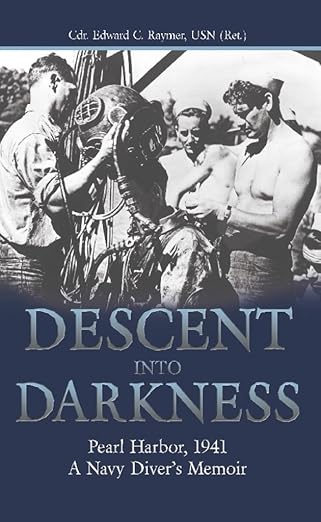
Why this book: I had visited the Pearl Harbor Submarine museum and the Arizona memorial and found this book in the bookstore, while I was reading Shadow Divers, which had fascinated me about difficult diving. The experience of those men who dove on the ships recently sunk by the Japanese on December 7, 1941 intrigued me.
Summary in 5 sentences: This is a first person memoir from a retired officer who had been a Navy Salvage diver called upon to dive on many of the ships only days after they were sunk by Japanese bombs and torpedoes during the attack on Pearl Harbor in December 1941. For over a year he and his diving team dove on such iconic battleships as the Arizona, Utah, Nevada, Oklahoma, California, West Virginia – to try to recover bodies, to recover important equipment and ordnance, or to attempt to get the ships back to the surface to ready them for the shipyards and repair. An important part of the story is the camaraderie of the divers living in a locked-down Honolulu and the various shenanigans these young men pulled – to include drinking, carousing, and chasing the few available females – to distract themselves from their difficult and occasionally gruesome work. After a about a year and a half on Pearl Harbor, the author and his best friend volunteered for duty in the South Pacific where they spent a year supporting the ships and forces fighting the Japanese in Guadalcanal and other locations. They then returned to Pearl Harbor and a much changed Honolulu, for a year of duty to work mostly on trying to right the Oklahoma, before being sent back to the states for shore duty in 1944.
My Impressions: A short book at 215 pages and a quick and engaging look at Pearl Harbor and the life of salvage divers immediately following the Japanese Attack on the US fleet there. The book is autobiographical, told in the first person based on the author’s recollections, and though he wrote the book many decades after the events he describes, he insists in the preface, that all the incidents took place as he describes them and the dialogue is as close to accurate as he and his surviving friends could recall, and accurately reflects how they spoke and what were doing and thinking at the time.
The book is written from the perspective of the author as a young sailor who’d recently enlisted in the Navy and completed Dive school prior to the Japanese attack on Pearl Harbor. Diving in those days was almost exclusively hard hat and salvage diving. He takes us briefly through his enlistment and completion of dive school in San Diego in late 1941 and then how he and his best friend are immediately ordered to Pearl Harbor after the attack, arriving a day or two afterward. They are almost immediately put to work diving on the recently bombed and torpedoed ships to: 1. rescue any sailors still trapped in air bubbles in the ships, 2. to determine if the ships could be salvaged, re-floated and repaired, 3. to make repairs underwater that would enable the ship to be re-floated and repaired, and 4. to recover ammunition and other items of value that could still be of use in fighting the Japanese.
His descriptions of diving in near complete darkness, aware of and feeling his way through unseen dangers of sharp objects and falling or dislodged machinery was reminiscent of what I’d read in Shadow Divers. Many of the challenges they faced has no prescribed solutions – they had to put their heads together and improvise how to repair, or get into certain spaces, try out unproven techniques, and deal with the dangers. It was difficult psychologically to be diving around the floating corpses of sailors who’d died just a few days or weeks before.
What was particularly appealing about this book is that Raymer combines descriptions of his dives, and his experiences during them, with anecdotes from the rowdy young men in the dive locker trying to also have some fun in a Honolulu under martial law immediately after the Japanese attack. They were working 12 to 14 hour days, getting very little time off, occasionally getting a day or two of liberty – but there were no recreational facilities on the Navy base at Pearl Harbor, and Honolulu was in black out conditions at night and under martial law. Being feisty and creative young men, they looked for and found opportunities for amusement in a city that was essentially locked down. He describes the thriving red light district, their efforts to find female companionship outside of the short term transactions in the bordellos, how they found a way to skirt the prohibition on alcohol, how they got into and out of trouble. These crazy escapades gave them something to look forward to, and an opportunity to blow off steam after working in harsh and under very stressful conditions.
But most of the book is about them diving on ships filled with explosives and decomposing bodies, and how the team dealt with occasional fatal accidents in the diving team – in fact the author came very close to dying himself on one of the dives – reminding me of John Chatterton’s close call in Shadow Divers. He and his fellow divers dove extensively on the battle ships Arizona, West Virginia, Utah, Oklahoma, Nevada, California.
After about a year of salvage work on the battleships in Pearl Harbor, Raymer and his buddy Moon Mullins volunteered for salvage work closer to the action in the South Pacific and were sent to the Tonga Islands where they helped refit ships damaged by the Japanese and were subject to regular air attacks from the Japanese. They were then assigned to support the Navy’s efforts to support the Marines fighting on Guadalcanal, and were often on the beach where they hunkered down with the Marines and were subject to attack and regular sniper fire, and where he eventually contracted malaria. While moving fuel and ammunition to supply the Marines ashore, they were often under fire, and were busy helping ships and rescuing sailors from ships that had been hit by Japanese planes and/or torpedoes. Eventually they found themselves on the damaged USS Portland heading for Australia to assist with repairs – and we get some good stories of sailors on liberty in Australia.
After nearly a year in the South Pacific, in 1943 he was sent back to Pearl Harbor where he assisted continuing efforts to salvage and help restore to operational status the battleship Oklahoma. While in Pearl Harbor he was asked to briefly escort Eleanor Roosevelt during her visit to the Oklahoma to observe efforts to put her back into commission. Coming from a strong Republican family, Mrs Roosevelt was not a well loved figure in the world he grew up in, but he found her to be charming and impressive.
The book concludes with the author getting orders in 1944 to the Experimental Diving Unit in Washington DC.
The book’s epilogue tells the stories of what eventually happened to the ships he’d worked on. Also in the epilogue, Raymer points to how during his research in writing this book, he found that official records and documents were often inaccurate and simply wrong – based on his personal experience. This was also a key lesson in Shadow Divers. In both cases, Raymer’s and in Shadow Divers, much of what they found in the official archives was someone’s best guess or assumption about what happened.
One disappointment for me was that the epilogue does not tell us the rest of the author’s story- it simply concludes with him being in DC at the end of the war. After a little research on my part, I learned that Raymer served 30 years in the Navy, retired as a Commander and died in 1997 in California. After getting to know the author and enjoying his company, I’d like to have known more about what he and his buddy Moon Mullins did after the war – how the rest of their lives turned out. That said, I really enjoyed the book and have recommended it to John Chatterton, the diver made famous in Shadow Divers and Pirate Hunters.


 Bob's Books