
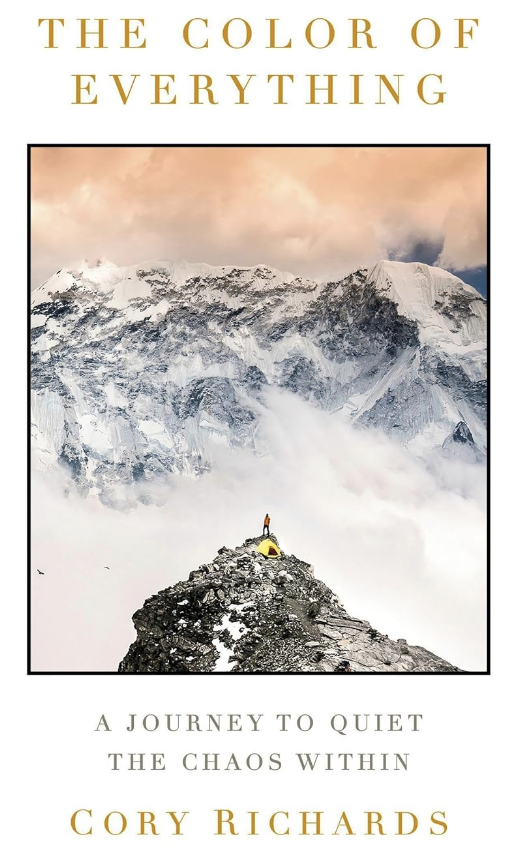
Why this book: I read an interview with the author on a substack piece called Transitions. I found the interview and the author fascinating, inspiring me to buy and read the book, which was even better than I expected.
Summary in 4 Sentences: This is Corey Richards autobiography – a bold move for someone only 44 years old, but he’d led a fascinating, all-over-the-map life so far with lesons learned he believed (rightly I believe) deserved being shared. He shares his difficult childhood, in and out of reform schools, how he took his energy and passion into climbing and photography, and then kept chasing the most difficult physical and mental challenges he could find. He succeeds with many close calls, and becomes a world famous and highly regarded mountaineer and adventure photographer. But his life was still a mess, as he struggled with addictions, bi-polar disorder and ultimately decided to change directions – sharing the wisdom he’d achieved in the process.
My Impressions: Probably the most intense and honest autobiography I’ve ever read. Powerful, insightful, sometimes painful, but very well written and very much worth my time and attention. I’ve recommended this book to my few friends who I believe could appreciate his intense personality, his brutal honesty and the struggles he created for himself, how he endured them, and than moved beyond.
He begins with his difficult childhood – though he says his parents were great and as supportive as they could be. But his own excessive energy, on-going conflicts with his brother and in-ability to accept and conform to any authority led his parents to sending him to various schools, which he was kicked out of, finally being sent to reform school and a treatment program, which he fought as well, and was eventually kicked out of those programs. Sent home, he again could not adapt to the structure and confinement of home life and his parents essentially threw him out of the house. So there he was 16 years old and out on the street. Not an auspicious beginning.
He eventually makes a friend who introduces him to climbing and photography. The climbing satisfies his need for adrenaline, risk and intense adventure; photography appeals to an aesthetic impulse to create photos which have an emotional impact. He pursues both climbing and photography with dogged determination. While he pursues high intensity and challenging climbing, he is sending photos to various publications, eventually landing some contract work with National Geographic which becomes a full time and high profile position. He undertakes extreme challenges for Nat Geo, taking photos and creating articles that garner him international recognition.
But his intensity makes him a very high maintenance employee. This intensity also drives what becomes an alcohol addiction, some intense and ultimately unsatisfying and/or disappointing relationships with women, to include a failed marriage. Casting around for distractions to keep his fire alive and help him deal with his mess of a private life, he continues to pursue extreme adventures – has a very near miss in an avalanche to which he has a very strong reaction, which he later recognizes as causing or contributing to PTSD, about which he is initially in denial. But he continues on – taking on more and more risk, having more close calls, and more short and intermediate term relationships with women, until he finally has a nervous breakdown/panic attack during a final stage of a high risk climb he is doing for Nat Geo.
He describes these incidents and his bad decisions with brutal honesty. He struggles to climb out of his hole and get “back on the horse” but he has not yet dealt adequately with his PTSD, bi-polar disorder, addictions to alcohol and sex. And then, after a year of intense training, planning, and expense to photograph and participate in an enormously difficult route up Mt Everest, part way up the climb, he has a breakdown, tells his partners he can’t continue, which means the climb must abort, the promises made can’t be kept, the money and time spent can’t be recovered. He realizes that his psychological issues are severe, that he must deal with his anxieties about his own mortality and purpose, and he decides he’s done with climbing – which yields another identity crisis. He gets accused of relatively minor sexual harassment incidents in the wake of the Me-too movement (an uninvited kiss, an alcohol inspired pat on the fanny which he admits), result in him being suspended from Nat Geo. Though after a six months investigation, he is exonerated and Nat Geo invites him back, the embarrassment and the process has disillusioned him, so he leaves Nat Geo. This incident inspires a deep dive into his relationship to women, and his insightful perspectives on the challenges women have in today’s society.
Later he goes to a Zen retreat in Thailand which challenges him in new ways and gives him new insights into his own personal issues, as well as ways for him to deal with his demons. In this window he learns that his father with whom he is very close, is diagnosed with terminal cancer, which affects him but also inspires further introspection on life and mortality, and adds to his increasing wisdom.
The book does not have an ending – as Richards is only in his mid-forties. He is now using his own experience to actively campaign for and support helping others recognize and deal with mental health issues – especially bi-polar disorder. I expect another book from him in 5-10 years, which I look forward to reading.
If this brief review intrigues you and you’d be interested in the interview that inspired me to read the book, I encourage you to read it. You can find that interview at https://bldavis3.substack.com/p/transition-interview-21-cory-richards


 Bob's Books