
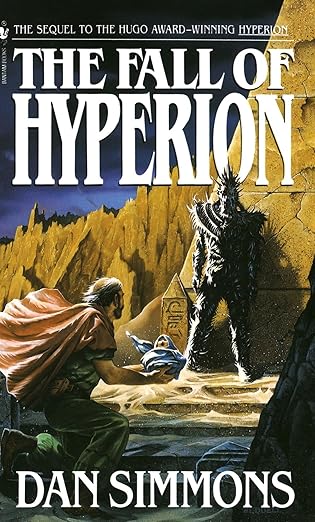
Why this book: My Sci Fi book club had read Hyperion, were impressed with it, and we all wanted to see what happened in the sequel
Summary in 3 Sentences: This book begins where Hyperion left off, but takes a different approach in that we are getting the first person perspective of a new player in the drama. Hyperion focused on the lives, backgrounds and mission of seven “pilgrims” who’d been selected to go to the mysterious planet of Hyperion to learn more about the Time Tombs and potentially the malevolent Shrike, and also to explains how the drama and antagonism had evolved between the Cult of the Shrike, the Ousters (apparently in league with the Shrike) and the Hegemony which represented the natural evolution of the human race that we know. In this sequel, we not only follow and learn the fates of the seven pilgrims, but our new first person narrator introduces us to new dimensions of good and evil in the metaphysical reality of the universe, how man-machine interface evolved to put humanity at risk, the various meta-entities that control the universe, and the subtle differences between the various dimensions that human consciousnesses occupy.
My Impressions: This is an even more complicated and harder to follow book than its predecessor. It is long and the author is very descriptive of scenes beyond what I believed was necessary, and introduces entities which the reader (I assume) was meant to deduce who and what they are. I struggled to follow the plot, as the author digressed to follow the adventures of various individual characters in the book, and it was often unclear to me what their roles were in the arc of the story.
The story takes place within a battle between the TechnoCore which was a group of AI’s which had evolved to want to control the entire universe, and their goal of either eliminating the nuisance of human beings, or of enslaving them to uncomplainingly merely serve their interests. They intended to do that by fomenting an existential battle between the Human universe known as the Hegemony, and the Ousters – a competing set of intelligent beings – a subspecies of humans who in the past chose to live outside of the technosphere sphere to which the Hegemony had become addicted. The Technocore’s plan and expectation was that this battle would either destroy both the Hegemony and the Ousters, or so cripple them that they could essentially be slaves to the Technocore for their purposes.
Eventually the Ousters realize they are being duped, and through a rather complex set of events get that word to Meina Gladstone, who as the CEO of the Hegemony, is the de-facto leader of the entire human species across the Web that ties humanity together. Gladstone must make a very difficult decision: In order to thwart the Technocore in it’s goal to enslave the entire human species, she would have to completely disrupt the network that the Technocore had created to make humans completely dependent upon them. And if/when she would do that, it would break up the entire network of communications and supply that the all planets in Hegemony depended on, and lead to suffering and deaths for billions – but would preserve human independence from the Technocore and free them to evolve independently in the future.
Much of what I now understand about The Fall of Hyperion I got from Google’s AI – asking it to explain the relationship between the Technocore, the Megasphere, the Metasphere, the Web, Universal Intelligence, and the Lions, Tigers and Bears – another mega entity that was never explained in the book. I also got confused at the conclusion, but apparently some of that confusion gets resolved in the next book in the series.
The idea of consciousness and a “soul” is ambiguous in this novel. The Technocore is able to create a digital copy of a person’s consciousness which can be implanted in another body. This is NOT a soul, but a copy of thoughts and memories and most of what comprise the identity of an individual, which later can be reanimated in another body. Interesting question about where thoughts, memories and consciousness end and a soul begins. The book does not address that, but the first person narrator in the book is a replicate of John Keats, and is actually the second replicate of Keats to appear in the book – the first having been a “cybrid” of him – a “cybrid” is a hybrid of a cyborg with an AI implanted consciousness into a body with the DNA of a human and other human qualities. In this book the cybrid has the identity and the memories of the 18th century British poet John Keats. Brawne Lamia, a super strong woman is one of the key protagonists of the book, falls in love with the John Keats cybrid, which leads to some other interesting (and confounding) developments.
The book concludes with a defeat of the Technocore, and attempting to tie up loose ends with the various characters, but leaves a lot of loose ends untied. I had to revert to Google’s AI to better understand some of the more ambiguous destinies of some of the characters.
This is a very imaginative book. I’d say the main theme is to portray how many centuries into the future, the human race has evolved to becoming so dependent on technology provided by AI entities, that they begin to lose their humanity and become vulnerable to self-determining and self-driven AIs which have no empathy nor a sense of loyalty to humanity. That is the situation which precipitates the war that leads to the Fall of Hyperion.
When my Sci Fi group got together (4 of us) to discuss this, two of us were over the top impressed with the book -whereas I and another in the group had a number of reservations. The major pluses were the imagination of the author creating a scenario in which AI entities were essentially at war with each other over controlling the universe, and humans were pawns in that struggle – how he created this not inconceivable scenario was a feat of imagination. Also the novel portrayed various levels and versions of an All-Powerful force in the universe. The author clearly had a very strong background in the humanities and brought in many themes and references from classical literature – some of which I was familiar with – others more obscure. Three of us agreed that the CEO of the Hegemony – Meina Gladstone was the most impressive of the many interesting characters, in this book, for her leadership, humanity, willingness to listen to different viewpoints and how she made the most difficult decisions. I simply believe the author tried to take on too much in the book – it was complicated and hard to keep track of the multiple complex themes he was exploring. And I personally thought the Shrike as the embodiment of evil was overly cartoonish.
To anyone who would read this book, I’d recommend regularly going to Google and asking its AI questions about the different entities that seem to pop up at random, and led me to often ask myself simply “WTF is going on!?”
Bottom line: Not an easy book to read, but the author poses some very interesting and discussion-worthy prognostications of where our addiction to technology and AI enhanced life styles could take us. He also injects some very interesting spiritual issues and the book raises questions about the nature of consciousness, and where it may be headed in the future.


 Bob's Books