
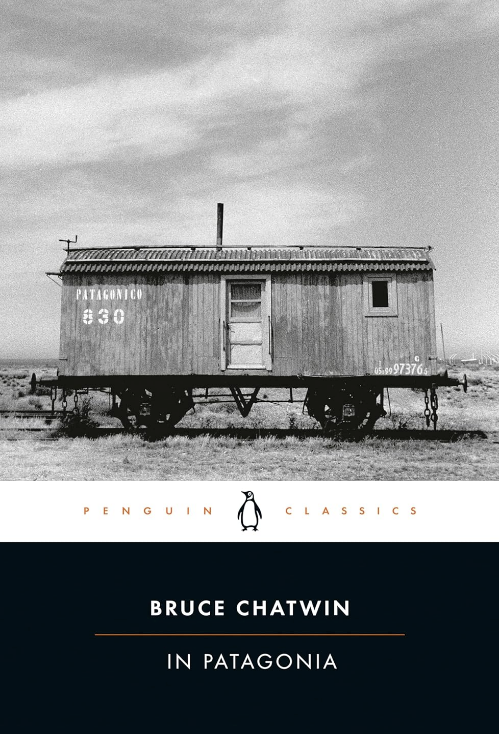
Why this book: I”m preparing to spend 3 weeks in Patagonia with a group of friends, hiking, camping, kayaking. This is a classic in travel literature describing the author’s travels around Patagonia in the late 1960s/ early 70s.
Summary in 3 Sentences: The author travels by foot, bus, train, hitchhiking around Patagonia, interviewing people, following leads on potentially interesting stories and sharing his experiences and this book is a chronicle of the stories he heard and the places he visited. He spends most of his time on the Argentinian side of Patagonia and then in the Tierra del Fuego region, meeting with eccentric and old people who’d lived there for decades, and who knew the people who had been key figures in or had personally participated in the history of the region – it is a sort of people’s history of the region. It is also a personalized look at the type of people who in the 20th century would choose to live almost literally at the end of the world, away from civilization, how they lived, what the thought and experienced, their joys, frustrations and tragedies.
My Impressions: An easy book to read, with short chapters, each dedicated to an anecdote or a piece of a story he is relating from his peripatetic experience traveling around Patagonia. Many fascinating stories by and about people who live very different lives than I do, in a very remote, but beautiful part of the world. I was at some points a bit frustrated in not finding a thread that tied them all together, but after finishing the book and doing a bit of research I found what i had missed early on – his trip was an exploration of the background and people behind the story his grandmother had told him about her cousin who’d given her a piece of dinosaur skin from Patagonis. These stories hsd inspired and intrigued him.
Bruce Chatwin had been a journalist in the UK and become disillusioned with his job, and decided to chuck it all and pursue a childhood obsession and fascination with Patagonia – a place he’d never been. This “obsession” came from the stories his grandmother had told him about her cousin and the piece of what he told her was dinosaur skin he’d sent her as a wedding gift, that he claimed he had found in a cave in Patagonia. As a journalist, Chatwin had also interviewed a 92 year old woman who had done a painting of Patagonia, and told him, “I’ve always wanted to go there. Go there for me.” Stories such as these had fascinated the young Chatwin, fueled his imagination and motivated him to follow his dream and explore this remote, almost mythical place.
The early part of the book he spends largely in the pampas region on the Argentinian side of Patagonia, hitch hiking and traveling west into the foothills and eventually and briefly into Chile. Here he digresses from his exploration of dinosaur skins to explore the stories and myths around the famous American outlaws Butch Cassidy and the Sundance Kid, in the wake of the famous movie with Robert Redford and Paul Newman that had recently captured the imagination of the world. He meets and talks to older people who claimed to have actually encountered these American outlaws in the region, examines various versions of some of the stories and myths surrounding their activities and their ultimate demise. In that process we meet more eccentric nomads, recluses and exiles who have chosen to live in the remote foothills of the Andes, and then he heads south, to literally the end of the continent in Tierra del Fuego.
In this region he is able to pursue the story of his grandmother’s cousin Captain Charley Milward a man who in some ways typified the eccentrics and interesting characters who’d settled in Patagonia. Chatwin provides a brief bio of Milward who had begun his life in Australia, over many years became a somewhat controversial ship captain who survived a ship wreck in 1898 in the Straits of Magellan. Which led to him settling in Punta Arenas, a large town sitting on the north shore on the Chilean side of the Straits of Magellan. Milward died in 1928, some 50 years before Chatwin’s visit, so Chatwin found and spoke to people who’d actually known him, which allowed him to further explore the myth of the dinosaur skin his grand mother had shown him.
The so-called “dinosaur skin” had prompted a certain degree of controversy in the world of paleontology. It was soon realized that it had belonged to a mylodon – a huge, long-extinct sloth-like creature. But because one so-called expert believed the piece of skin was of recent origin, indicating that the long extinct mylodon may still exist in the region, a number of explorations were launched looking for a living version of the mylodon. Apparently many skeletons of mylodon have been found in the region, and it was finally determined that the so-called dinosaur skin was from a mylodon from close to 10 thousand years ago.
The last portion of the book described his experiences, adventures and the eccentrics he met in this far southern region of Patagonia, which straddles by both Chilean and Argentinian national boundaries. This sharing of the land on either side of the Straits of Magellan had over the years been a source of tension between Argentina and Chile, but a treaty between the two in 1881 seems to have dampened that animosity. Chatwin also recounts some of the rich and tragic history of European interactions with the indigenous populations of the region over the previous century and a half.
The book concludes with Chatwin finally visiting the cave where Milward supposedly found what he believed was a piece of brontosaurus skin. Chatwin searches through the rubble in the cave and among petrified mylodon turds, finds for himself a small piece of mylodon skin – similar to the piece Milward had sent his Grandmother so many years ago which had inspired him as a boy. And then Chatwin concludes his trip and boards a ship back to the UK. He published the story of his wanderings through Patagonia in the UK, which launched his career as a travel writer and novelist.
Apart from his personal agenda of exploring this family mystery of the dinosaur skin from Patagonia, this book reminded me a bit of Robert Pirsig’s Zen and the Art of Motorcycle Maintenance. Both books are a travelogue through a vast landscape, and recount in first person terms the authors’ experiences and impressions of the people they met and the places they visited. For each, their trips were an exploration of how people have coped with the circumstances life had handed them, and how they’d dealt with their restlessness and disillusionment with conventional middle class living. Both Chatwin and Pirsig were themselves loners and nomads, and in their books, are exploring their fascination with people living different lives in different places. In writing about these people, they seem to be seeking insights into themselves, the human experience, through the experiences of those who’ve rejected the structured lifestyle of civilized society.
When I was consulting AI Gemini for more info on Chatwin, Gemini offered to draft a paragraph connecting Chatwin’s life-long focus on “nomadism,” which he explored not only in In Patagonia but in his subsequent writings, to the journey he describes In Patagonia.” Here is what Gemini offered me, which I find interesting and insightful:
While In Patagonia is a journey centered on a family mystery, it also captures the early development of Chatwin’s lifelong obsession with nomadism. Throughout the book, he is drawn to the “eccentric nomads, recluses and exiles” who have abandoned conventional society for the remote edges of the Andes. This fascination eventually blossomed into the radical theory he proposed in The Songlines: that human restlessness is a biological necessity and that our natural state is one of constant movement. By documenting the lives of those living “away from civilization” in the far south, Chatwin was already beginning to explore his belief that the settled world is a source of human malaise, and that true fulfillment is found only on the open road.


 Bob's Books