
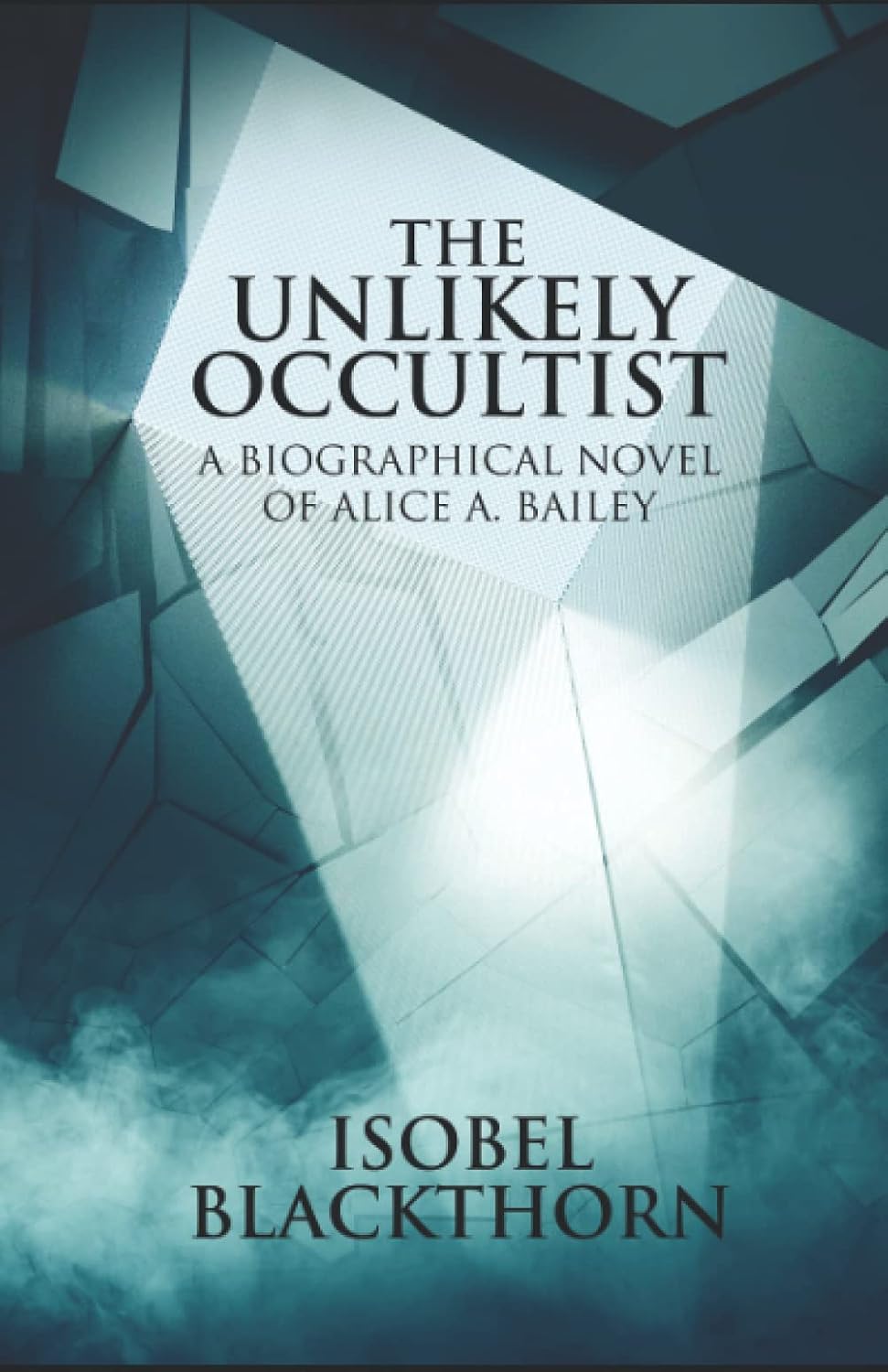
Why this book: I had read Tom Murphy’s Beyond the Trident which referred to Alice Bailey and her telepathic “coach” being a Tibetan Monk – I was intrigued. Isobel Blackthorn wrote a full biography of Alice Bailey after writing this novelized version – I chose the shorter, less detailed, and perhaps more interesting read.
Summary in 3 Sentences: This is a big picture, main events and themes biography of Alice Bailey written within the context of a novel of a young woman researching the life of Alice Bailey while trying to unravel a huge trove of documents that a previous academic had gathered to write about Bailey, but who had died before she could complete the work. The “fictional” female researcher was assigned to catalogue these documents for a library but as she got into them, she became engrossed in understanding Bailey, her life, and the impact that she had made on the arcane world of Theosophy and occult studies in the first half of the 20th century and later. The novel includes Bailey’s life story, within the personal challenges of the life of the young woman researcher, as the two intertwine to create a double story.
My Impressions: This was a means for me to get a “lite” introduction to who Alice Bailey was, her life and works, without reading Blackthorn’s detailed biography nearly twice as long. This novelized version of her life is built around known facts about her, and Bailey’s own writings, and the autobiography she was in the process of writing when she died. This novelized story of Alice Bailey’s life is told in parallel with and from the perspective of a fictional researcher Heather Brown, who, like Blackthorn herself, becomes engrossed in putting the pieces of the puzzle of Bailey’s life together based Bailey’s own writings, and scraps of evidence she could find in other research. Blackthorn herself said that the process of writing The Unlikely Occultist inspired her to go deeper into answering the questions that arose and the issues of her life.
Who was Alice Bailey? In short a woman born of an aristocratic English family in the Victorian era, a fundamentalist Christian, with a strong independent streak, who became estranged from her family, and eventually moved to America. At one point while still trying to find her way, she began hearing a voice that was giving her spiritual guidance that was in contrast to her orthodox Christian beliefs. This voice was ostensibly coming from a Tibetan monk Djwal Khul living in Tibet transmitting telepathically to Bailey spiritual truths about human metaphysical evolution. He was representing the wisdom of enlightened masters, and he was “tasking” Bailey to transcribe and publish the wisdom he was transmitting to her.
The novel doesn’t go into great detail as to what this wisdom entailed, though it was generally characterized as what Bailey called “Ageless Wisdom” – or what others have called the Perennial Religion. He claimed that here is a spiritual hierarch of advanced beings who work to uplift human consciousness, The key tenets of their philosophy (unsurprisingly) involve the importance of love, cooperation, compassion, meditation leading to higher consciousness, and acceptance of spiritual wisdom. Bailey was assigned by the Tibet to transcribe and interpret his teachings and promulgate them in the Western world, which is what she accepted as her personal mission. In so doing she became a key figure in the Theosophical movement of the early 20th century.
Before she had this contact with her Tibetan master, her life had been somewhat of a mess. She laudibly had gotten involved with supporting and proselytizing her strong Christian beliefs to English troops stationed in first Ireland and then in India. These experiences had a profound influence on her – but her very constrained (by her very strict Victorian Christian morals) social life exploded when she fell head over heels in love with a man not of her social class and decided to ignore her family’s warnings and to essentially elope with him to America. This marriage did not serve her well, as he turned out to be violent and abusive and after she’d had 3 children and a lot of suffering, he left her and they were divorced. By that time she was involved in Theosophy in the Santa Cruz area and met Foster Bailey and they were married – happily it seems for the rest of her life.
The book details Bailey’s efforts with the support of her husband Foster, to participate in, and then to influence the international movement toward increasing spiritual consciousness – which she and others considered of paramount importance in the midst of the depression and the build up of military aggression which all saw as probably leading to war. In her efforts to underscore and promulgate the spiritual teachings she was given by the Tibetan, she became simultaneously much admired and revered, and much maligned and ostracized by those who disagreed with her or were jealous of her fame and influence.
The character Heather, like Blackthorn herself, admired Bailey and her character, her teachings, her dedication and idealism, but was somewhat skeptical about the physical existence of the Tibetan master himself. He is not described in the book, nor apparently in the papers Bailey left behind. Those of the esoteric bent believe in him as a spiritual, non-physical entity speaking to Bailey from a different dimension of a reality that most of us don’t see. . Others believe he was an unconscious manifestation and construct of her own mind. No one seems to believe that Bailey intentionally deceptively created Djwal Khul to preach her truth. I tried to read one of the books that Bailey wrote that ostensibly was dictated by her Tibetan Master, but the language (and perhaps the ideas) were too far outside my experience to make a lot of sense to me.
Heather was emotionally moved by Bailey’s idealism, character, and her struggles, which are described in this novelized biography and which indeed reflects Blackthorn’s own views. The Tibetan himself was not much of a presence in the book, which disappointed me. Bailey apparently had no relationship with him except to accept and transcribe what he told her and pass it on. I was disappointed that the book did not explore more about the possible sources of the Tibetan and his wisdom.
One of the other insights I gained from this book is how the world of Theosophy, occult, esoteric and spiritual movements is rife with conflicting egos, conflict, power dynamics and other unenlightened tendencies that they all decry and seek to rid from the world, but don’t recognize in their own behavior. It seems that idealists of any color often seem to have blinders on, believing in their own ideal and their own importance in realizing that ideal, and are willing to diminish anyone who doesn’t accept their views, but they are unable to see or rectify their own tendencies in the same direction as those they malign. Very reminiscent of vicious competition for power and influence in politics anywhere. Alice Bailey did not seem to participate in the character assassinations that others practiced then, and apparently still do, against her.
The Unlikely Occultist book is an interesting and entertaining means of exploring the world of Theosophy in the last century.


 Bob's Books