
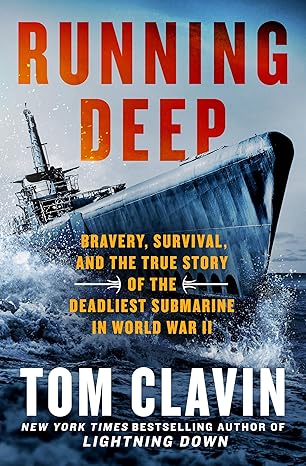
Why this book: I proposed this book based on reviews I’d read of it and it was selected from several outstanding options by members of my SEAL book club.
Summary 4 Sentences: The book bills itself as a story about the USS Tang and a biography of its skipper Captain Dick O’Kane – but it is about much more than that. In providing the context for the story of the Tang and O’Kane, Running Deep provides a fascinating history of the evolution of the submarine, primarily as a maritime asset in war, but also in research and other underwater endeavors. That takes us up to WW1 when the submarine first truly proved itself as a deadly tool for navy’s to combat each other, and then finally leading into WW2. We learn about the neglect that submarine warfare suffered under the US Navy’s predominantly surface oriented culture, and then the rapid development of the capability, during WW2, through the lens of the careers of Dick O’Kane and also his mentor “Mush” Morton. It concludes with the war patrols of the Tang under O’Kane’s leadership, the sinking of the Tang by one of its own torpedoes and the experience of O’Kane and the few surviving crewmen as Japanese POWs.
My Impressions: A powerful read and fascinating lens through which to learn about and come to appreciate the indispensable role that submarines played in our victory in the Pacific during WW2.
Clavin begins “Act 1” of the book at a critical moment in the Tang’s final war patrol – and introduces us to some of the main players in the story of the Wahoo and the Tang. He then leaves us hanging as he backs up a couple of hundred years in Act 2 of the book, to relate how submarines evolved to lead up to submarines becoming perhaps the most deadly and effective weapons of naval warfare in the 20th century. And when the technology that was evolving to permit men to drive maritime weapons beneath the surface of the water resulted in tragedies, Clavin relates how scientists and leaders were motivated to develop tools and technology to help the men survive and be rescued if/when submarine systems failed or other tragedies left them sitting on the bottom of the ocean. Act 2 tells the stories of some of these tragedies and the resulting limited success of measures that were developed to help mitigate the losses.
Then he gets into his Act 3 which focuses on the Pacific in WW2, and how the submarine became the primary and most successful naval weapon of war. We learn about it largely through the experiences of the two most successful submarine skippers, Mush Morton and Dick O’Kane, but he also relates the successes and failures, the stops and starts of others and the challenges of unreliable torpedoes developed in a hurry with insufficient testing.
These guys were bold. And brutal. They aggressively went after whatever Japanese vessel they could find, and wherever – and begged to be sent to the most “target rich environments,” though every time they surfaced, and every torpedo they fired exposed them to retaliation and attack from destroyer escorts and air craft – and that’s how so many submarines were lost.
I was really impressed with the mindset of the submarine captains he described, but Clavin also writes of some who were less aggressive, more risk averse, and of several leadership failures that were costly. But the overall story is one of bold and aggressive men, volunteering for extremely hazardous duty to take the war to Japan.
At the end of the book and just before the Tang is about to complete its final war patrol and return to Pearl Harbor for repairs, refit, and to give the crew a break, the Tang is sunk when one of it’s last torpedoes boomerangs and comes back and strikes the Tang. Fortunately they were in relatively shallow water – about 200 feet – and 9 of the crew were able to get to the surface and survive, including the captain – Dick O’Kane. They were picked up at sea by the Japanese and these nine men spent the next 10 months until the end of the war in Japanese PoW camps.
O’Kane in particular was targeted by the Japanese for special abuse. The horrors of Japanese PoW camps have been described in greater detail and depth in other books, such as Louis Zamparini’s story in Unbroken by Laura Hillenbrand, King Rat by James Clavell and Narrow Road to the Deep South, by Richard Flanagan. That said this final phase of Clavin’s book is an important part of the story.
Though Clavin only spends a few final chapters on O’Kane’s PoW experience in Running Deep, partly as a postscript to his successes as CO of the Tang, but also to highlight O’Kane’s heroism in the face of great suffering and abuse, while protecting and supporting his men and other PoWs, and not revealing the secrets he knew. O’Kane was in the same prison with Louis Zamparini, was abused, starved and tortured, and was barely alive when US Doctors arrived at the PoW camp just after VJ day. When he was finally delivered into US care, doctors initially gave him little hope of survival, but with an extremely strong will and over many months, he slowly and courageously recovered and went on to continue serving in the Navy after the war. When he had recovered enough, President Truman awarded him the Congressional Medal of Honor
I’d recommend this book to anyone interested in the naval war in the Pacific – and in effective leadership in combat, as well as a biography of a naval hero in the arcane world of submarine warfare. I was previously very much unaware of the heroism of these intrepid warriors, and was impressed and enlightened by what I read. .


 Bob's Books