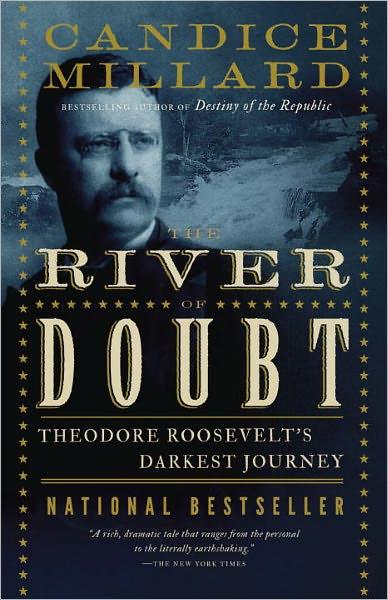
The River of Doubt – Teddy Roosevelt’s Darkest Journey, by Candice Millard

Why this book: Selected by the SEAL reading group I’m a member of. I’d had a copy for years, which inspired me to finally read it. 

Summary in 3 Sentences: After dramatically losing his Bull Moose Party run for President to Woodrow Wilson, Teddy Roosevelt accepted an invitation to do an exploratory first run down a tributary of the Amazon into unmapped, uncharted territory.  He did not know what he was getting himself into, hired the wrong people to organize it and almost paid for his negligence with his life.  It ended up being a fight for survival in the most hostile of jungle environments,  losing several men, and succeeding only by a narrow margin, and only because of the leadership of his Brazilian co-leader.

My Impressions:  An impressive book in so many ways.  Obviously, the story is compelling – an American Hero president takes on a huge physical/mental challenge after the prime of his life, suffers dramatically and almost dies, but becomes one of the heroes of Brazil and the world toward the end of the last great age of discovery.  In addition to  the amazing story of courage, heroism, and  discovery, Ms Millard adds a fascinating summary of  research she did into the natural history, ecology, and  anthropology of this remote and previously uncharted part of the Amazonian jungle and river network. 

She beautifully combines the adventure and suffering of exploration and discovery with the biographical picture of Teddy Roosevelt,  with the dynamics within a mixed culture team of characters, with a curious scientist’s-eye look at the many facets of the world they had entered.  Indeed, one of the main goals of the expedition was scientific, not simply geographic discovery.  It could be compared to an International team exploring a new planet, with some similar and many very different rules from the world we live in.  In retrospect their expedition is referred to as the Roosevelt-Rondon Scientific Expedition.

She begins with a brief biography of Teddy Roosevelt and how throughout his life, when confronted with mental and emotional hardship, he broke off and took on a physically and mentally challenging adventure – he had done that many times and she gave examples.  In 1914, after he lost his Bull Moose run for president against William Howard Taft he accepted the challenge to lead this expedition of discovery down the uncharted Rio da Duvida (River of Doubt – later renamed Rio Roosevelt) – without doing much research or preparations for the rigors of living in the jungle. He delegated that to others,  and that was a serious mistake. 

MIllard outlines the poor preparations, poor selection of people to go on the trip, the disorganization that plagued the preparation for the early phases of the expedition.  Indeed it appeared that Roosevelt believed that this would not be much different than his rather comfortable expedition to Africa a few years earlier.  This assumption had significant costs to the expedition, and can be compared unfavorably to how well Shackleton prepared for his trip to Antarctica.  Eventually Roosevelt’s relieved and sent home two key organizers of the expedition before embarking on the river itself, because of their incompetence or unsuitability for the effort that would be required. 

Though Roosevelt was the titular leader of the expedition, the true leader and real hero of this expedition was Col Candido de Mariano de Silva Rondon of the Brazilian army.  The book provides a fascinating story of Rondon’s background and how he indeed was a highly experienced expedition leader and was one of the most knowledgeable men in Brazil about the area they were entering and challenges they would be facing. Most importantly, he was the strongest member of the expedition with regard to mental and physical resilience, and character, and indeed was the backbone of the expedition.  He was ahead of his time as a great proponent of the rights of indigenous tribes, and protecting their Amazonian world.  Roosevelt did not always agree with Rondon, but admired and respected him, usually acceded to his desires.  Eventually, Roosevelt became so weakened and debilitated during the expedition, that he delegated all decisions to Rondon.

One of the sub-stories of this expedition was Teddy Roosevelt’s relationship with his son Kermit who accompanied him on the expedition.  Kermit lived in Brazil at the time and spoke Portuguese,.  Roosevelt had taken Kermit with him on his big game hunting expedition in Africa, was impressed with his performance and wanted to give his son this opportunity as well.   Roosevelt’s wife wanted Kermit on the expedition to look after his father, who at the time was 55 years old, overweight, and she knew that he was no longer as strong and resilient as he believed himself to be.  Kermit turned out to be a strong and resilient team player, performed his role in the expedition well, and served admirably as his father’s keeper.

The only Americans on the expedition were Teddy and Kermit Roosevelt, and George Cherrie a renowned naturalist who would be taking samples to add to the body of knowledge. The others on the expedition were Rondon, his principle assistant Lyra, a doctor, and the sixteen young, strong men referred to as “camaradas” who did the most difficult physical work, and probably suffered the most. 

The expedition was brutal. Given that they were in completely new territory, they had no idea how far down the river they were, or how far they still had to go – only that it eventually flowed into the Amazon.  The bugs, snakes, animals, piranhas, jaguars, caymans, the daily downpours and humidity, and the unpredictability of the river were daily challenges.  They faced numerous rapids and waterfalls, and often had to unload and portage their boats and all equipment through the jungles to the next navigable part of the river, sometimes thousands of yards through very rough terrain – when they were weak with malnutrition and fever.  They ran out of the food they brought – in part due to the poor preparations of Roosevelt’s team,  in part because of losses on the river of boats and cargo in the rapids.  Food in the jungle was scarce, and starvation was a distinct possibility, as they resorted to eating almost anything that could provide the least bit of nutrition. They simply didn’t know how to survive in the primeval jungles that extended on both sides of the river.  Weakness due to malnutrition was a serious problem – especially for the camaradas who were doing most of the paddling and the most arduous physical work.  Eventually all-hands, including Roosevelt had to pitch in with all tasks. .

They also knew that they were being watched by indigenous peoples – they saw signs, and abandoned villages, heard them occasionally, but never saw them. At one point a dog who was with them was killed by arrows, reinforcing their sense of vulnerability.  But the tribes knew how to move and hide without being detected – the expedition simply lived with their sense of vulnerability – which increased, the weaker they got.

The expedition lost several of the camaradas – one drowned in the rapids, one killed another over a dispute, and the expedition left the killer in the jungle – where he was either killed by the natives or died. It was said that the jungle consumes all that enter it. The expedition was struggling to get through it before it consumed them.  

Roosevelt himself became very ill, with malaria, dysentery, and a seriously infected cut, and in spite of all the doctor’s efforts, it appeared that he would die. Roosevelt himself expected to die, and when things became most dire, he requested that they leave him behind and save themselves. Rondon refused.   He almost did succumb, but he survived, barely, until they reached civilization and could get him good nutrition, medical care and a chance to recover.  When the expedition finally reached civilization,  all of of its members were malnourished and weak, Kermit was sick with malaria and half of the camaradas were so sick with fever and malaria, they couldn’t work.  In the epilogue, we learn that upon return to the US, Roosevelt got right back to work lecturing and campaigning passionately for his causes, but it appeared that in spite of his best efforts, he never fully recovered.  He was weaker,  and was never able to sustain that characteristic Roosevelt optimism and energy again.

MIllard concludes this amazing story with an epilogue which describes Roosevelts remaining years and what happened to the other key characters in the book after the expedition. Rondon went on to become one of the great heroes of Brazil, nominated by Albert Einstein for the Nobel Peace Prize, and who outlived everyone else on the expedition, dying at the age of 92 in 1958.   Roosevelt continued to be plagued by issues stemming from his time on the River of Doubt, lived another five years and died at the age of 61 in 1919. The saddest story was Kermit’s.  Though strong on the expedition, he never found his footing after his father died, was idealistic but not practical, and of a melancholic disposition. He became an alcoholic and eventually committed suicide at the age 53. 

 I was impressed with Millard’s research, which included being escorted into the jungle to meet with the descendants of the Cinta Larga indigenous tribes who live in the territories through which the River of Doubt flowed, to talk to them about Roosevelt’s expedition.  Indeed, that expedition and how the tribes responded to it over a century ago is still alive in their oral tradition – these were the first westerners to venture into their world.  We learn that Roosevelt and Rondon were more vulnerable than they knew. The tribes debated killing them all, and stealing their valuable supplies – which made complete sense in their world – since these were unknown and uninvited intruders into their territory.  But apparently there was dissension within and among the various tribes, and in their culture,  key decisions required consensus.  Since the expedition was moving through and not staying,  pretty soon it became irrelevant. The expedition survived in part because the indigenous tribes could not agree on what to do about them.   A future expedition into that area disappeared without a trace. 

I’d put Millard’s River of Doubt into the great literature of exploration and suffering, out-on-the-edge, along with among others, Shackleton’s expedition described in Endurance by Lansing, and the de Long expedition to the Arctic as chronicled in Kingdom of Ice by Hampton Sides.  Another review of this outstanding book that I would recommend is  Big Stick in the Jungle from the Washington Post. 

For those interested in this topic, PBS has an excellent documentary available on Amazon about this expedition entitled American Experience: Into the Amazon, just shy of two hours long, produced in 1988 before Candice Millard wrote River of Doubt.  It is an excellent representation, complete with photographs and even a few videos. The story is the same, well-depicted, and I highly recommend it.


Posted in Uncategorized | Leave a comment

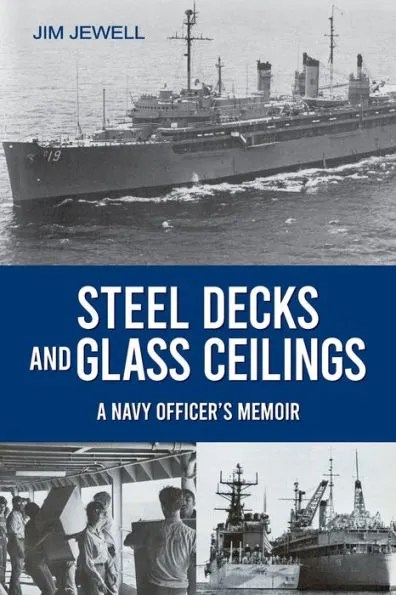
Steel Decks and Glass Ceilings – A Navy Officer’s memoir, by Jim Jewell

Why this book:  The author Jim Jewell is a good friend of mine, and he’s been sharing with me his process of writing and publishing this book. I was anxious to read it.

Summary in 3 Sentences: Jim Jewell was the Executive Officer (XO – 2nd in command) of the USS Yosemite in 1983-84 when it was selected to be the first Navy ship to make a long deployment with a mixed crew of men and women.  This is his story of being the XO during a deployment to the Indian Ocean and the Arabian Sea,  about the standard and routine challenges of being XO of a large deployed Navy ship, and some of the new challenges as well as advantages of having women as part of the officers and crew. Additionally, Jim was newly married at the time and he shares the  loneliness of being in a key position of responsibility for seven months, away from the support of loved ones, in the days when letter writing with long delays was the primary means of communicating between deployed ships and home.

My Impressions:  As a retired Navy Officer, I really enjoyed this retrospective look at life at sea on a Navy Ship from nearly 40 years ago.  But it was also the life of an XO – one of the most demanding jobs in the Navy, and in this case, in a particularly challenging environment.  Jim had previously had extensive as-sea experience and numerous deployments on combatant ships.  The Yosemite however was a very large destroyer tender, with a crew of nearly 1000, whose mission was to provide shipyard-like maintenance and repair services to deployed combatant ships, complete with sophisticated repair and engineering capabilities and expertise.  They also provided enhanced medical, dental and other administrative services that are not available on many smaller combatants. His narrative explains how being on a tender was an additional challenge for him, since he’d never served on a tender before, and tenders rarely deployed –  most of his crew were making their first long (7 month) deployment.

The book is full of stories and anecdotes from this deployment, and to provide context, Jim often goes back and shares stories from earlier deployments in his career on different ships.   But this was new – a different, larger ship, and now with the new challenge of having women on board.  He shares stories of what the XO had to deal with to prepare the crew of men and women for “liberty” in such ports as Mombasa, Kenya;  Diego Garcia;  Palma, Majorca;  Chismayo, Somalia; Rota, Spain. And he tells us some interesting and entertaining stories of what happened in these liberty ports.  He also shares interesting stories about the impact USO shows had, coming to entertain the troops.

It is also a book about leadership.  Jim describes how he had to balance his commitments to his ship’s mission, to the ship’s crew, to his Commanding Officer (CO,) and to his own personal values and well-being. Usually, these commitments were in alignment, but occasionally they weren’t and Jim had to weigh priorities, do some soul searching and decide.  All of these challenges were amplified by being isolated on a ship, with 24/7 responsibilities, only rare opportunities to get away and unwind, the loneliness at the top with few to share frustrations with, and navigating the uncharted waters of men and women isolated and working together on a US Navy ship for weeks and months at a time. 

  But for me, most interesting and enjoyable, were Jim’s very candid and personal perspectives on dealing with these daily XO challenges, anticipating and preventing problems and crises, and at the same time, taking care of his personal needs and dealing with his loneliness and separation from Maureen, his new bride.  In addition to his great memory, Jim saved and shares much from that deployment, including some of the Plans of the Day (PoD), some official guidance, and congratulatory messages to the ship.  Maureen, his confident, saved his letters, and Jim quotes liberally from them to provide insight into what he was really thinking and feeling, including a couple gems (p 164 and 189,) in which the normally positive and upbeat Jim spews forth to Maureen in colorful language, his anger and frustration at the nonsense he has to deal with as XO.  Jim Jewell himself is the star of this book, and his challenges, struggles, and successes as XO during a tough deployment is the real story.  And he brings the reader along for the ride.

Women in the Navy.  The “glass ceiling” aspect of the book is Jim and the ship dealing with the new challenge of having young men and women working and living alongside each other, isolated from other company, friends and family, for seven months on a US Navy ship.  This was an important sub-theme of the book, but was not THE theme of the book. It was simply one of the challenges, and a new one,  that he and the ship had to step up to meet.  The Navy’s strict “fraternization policy” prohibits intimate relations between men and women who serve together in the same unit, to prevent the fallout of personal romantic relationships impacting the work or the morale of the crew.  Jim knew romantic or intimate connections were impossible to prevent, and he strongly suspected that they were occurring, but his focus was on the readiness of the ship, and not letting such things impact the ship’s performance of its mission. 

So practically speaking, his focus was on preventing the negative impact that the appearance or knowledge that such pairings-up could have on readiness and the crew.  He gave strict guidance against “Public Displays of Affection” onboard, or on or near military activities ashore, such as MWR tours or fleet landings etc. guidance which he indicates was generally followed. Jim shares his discussions with his CO about their specific concerns, and what steps they took to anticipate and prevent problems. 

The CO’s policy was that as far as possible, men and women would be treated the same, that there would be no “female” sailors, no “male” sailors – just sailors, and Jim and the CO endeavored to reflect that policy in all their decisions.  According to his memoir, it seemed to work – no significant incidents, women integrated well, and in fact he’s convinced that the significantly increased numbers of Yosemite sailors who chose MWR tours over drinking and carousing, and the dramatically reduced number of liberty incidents ashore, were due to the male sailors choosing to go on liberty with their female colleagues, rather than getting soused together, and then seeking local female company in the seedier parts of the ports they visited.  

Jim notes several times how senior officers in the Navy were less than enthusiastic about the Navy’s Women at Sea initiative to integrate genders in ship’s crews.  In fact he sensed that many Navy leaders had hoped this experiment would fail, to give them ammunition to curtail this unwanted, and forced experiment.  The CO and XO were convinced that the record proved that this first long deployment with women as part of the crew went very well, and that the experiment was an unqualified success.  My impression, and I believe most readers will agree, that the CO’s and Jim’s leadership were key to that success. To the Navy’s credit, the Yosemite was rewarded and publicly recognized for their outstanding performance while undertaking this experiment, and achieving a highly successful deployment under arduous conditions with a new, mixed gender crew.

At the conclusion of the book Jim states (and explains) “The female officers and enlisted aboard Yosemite not only did their part to meet the ship’s mission, but in many ways improved our performance, because they were women.”  (“Because they were women…” I assume is because women joining the men on liberty seemed to moderate the behavior of young men, and significantly reduced  liberty incidents.)

Quibbles: As XO, Jim’s primary interactions with ship’s women were with the six female officers, and he shared how impressed he was with their performance. Several of the female officers appear regularly in his narrative, and in some cases, their voices are heard.   The book would have been better had we learned more about the experience of the 90+ enlisted women, and to have heard their voices in this narrative.   We don’t learn what Yosemite’s women thought – were they as enthusiastic about the success of the experiment and the deployment as the CO and XO?  What might have been their recommendations? 

Also, I suspect Jim knew about incidents during the deployment that may have run counter to the “everything worked great” narrative.  I’d like to have heard about those.  I wonder if there were any marriages later between Yosemite crew members (not necessarily a bad thing, but…) or divorces that may have resulted from deployment romances.  None are mentioned.  I’m always a bit skeptical of “everything was great” narratives.

One other shortcoming: There are numerous editing errors – typos, misspellings, grammatical issues -that should have been caught before publishing. Jim is aware, and a bit embarrassed.  Not sure how he’s going to take that up with his publisher.  

Those quibbles aside, this is a fascinating look at the Navy of forty years ago, and how this particular deployment was a key first step in the successful integrating of Navy ships’ crews with women.  The Navy has come a long way in 40 years, but my Navy women friends assure me that there are still challenges, and I suspect probably always will be.  I thoroughly enjoyed this opportunity to share this key phase of Jim’s life and career, his leadership lessons, and the key role he played in this important period in the evolution of our Navy. 

I’d strongly recommend Steel Decks and Glass Ceilings as reading for Surface Warfare Officers getting ready for deployment, or for any XO of a deploying unit in any branch or service, or anyone interested in understanding what it’s like being deployed on a Navy ship for seven months.  I believe it also is an important addition to the literature on integrating the genders on military deployments.  


Posted in Uncategorized | Leave a comment

The Obstacle is the Way – The Timeless Art of Turning Trials into Triumph, by Ryan Holiday

Why this book:  Selected by my SEAL/SWCC candidates reading group to read as preparation for basic SEAL/SWCC training.  Also this is a key book in the canon of Stoic literature that has helped Ryan Holiday bring Stoic values to the attention of many Americans. 

Summary in 5 sentences: The premise of this book is that obstacles, challenges, problems should be viewed not simply as inconveniences that stand in our way,  but as MEANS to grow stronger, wiser,  more resilient, more successful.  This process begins with the right attitude and seeing the challenges clearly for what they are, which he describes in the first section of the book, entitled Perspective. Secondly we must take action appropriate to our clear vision and attitude, a process which he describes in a the second section entitled Action.  And finally we must have the wisdom to see and accept the world as it is, to persevere and endure with the course of action we have chosen, but also to know when to change course and try something new,  which he describes in a section entitled Will.  His message is that how we respond to challenges not only reveals our character but more importantly enriches, shapes and strengthens it.

My Impressions:  The message of this book is in its title – whatever may appear to be an obstacle that may stand in the way of achieving what we want, a challenge, a problem, a seemingly insurmountable barrier, beckons us to not only overcome it, but also to make us better,, challenging us to develop our creativity, resilience, insight, wisdom and strength.  It is a short book – 186 short pages – divided into three sections, each of which provides often well known, occasionally lesser known examples of people who have achieved great things BY overcoming, not in spite of overcoming obstacles in their way.

The Obstacle is the Way is divided into discussions of Perception, Action, and Will and each of those sections has chapters that address different aspects of that main idea.   Though there is a strong overlap between the sections and the chapters, the ideas reinforce each other from different perspectives and give Holiday a variety of venues to tell different stories with different nuances to support his thesis.

PERCEPTION: This section basically advises the reader to take the long view, keep the big picture in mind, and not to get too caught up in the immediate challenges and problems that may seem insurmountable.  He says that the right perspective has a strange way of cutting obstacles and adversity down to manageable size.  He advocates attempting to minimize one’s emotional and personal responses to a problem and instead,  to seek to be as objective as possible.  We can defeat emotion with logic he argues.  He suggests we place things in a broader perspective,  to focus on the present and what we can control right now, to help us steady our nerves.  He says “there is the event itself, and the story we tell ourselves about what it means… WE decide what story to tell ourselves.”

He points out that perspective has two key parts – Context – seeing and looking at the larger picture, and Framing – our own way to look at a problem and how we understand and interpret it.  Part of perception is to see that burdens and blessings are not mutually exclusive.  He then segues into the next section by noting that perception precedes “action,” and “right action” follows “right perception.” 

ACTION:  The main point of this section is that a great and positive attitude is just the beginning.  If obstacles or challenges are to make us stronger, wiser, more resilient, we have to take action, and act with deliberation, boldness, and persistence.  He often repeats the Stoic mantra of “No excuses. No exceptions.  It’s on you.” It doesn’t matter what happens to you, or even what happens.  All that truly matters is how you respond – YOUR action.   He emphasizes that we must not be afraid of failure, noting that action and failure are two sides of the same coin, and that boldness means not being afraid of failure.  When we fail, we learn – we find out what we didn’t see, what we did poorly, what doesn’t work, what isn’t the way.  It is up to us to turn disappointment into opportunity.

WILL This was my favorite section -as it emphasizes the individual’s responsibility to maintain the big picture as we implement our Stoic Perspective and Action.   He says, that “If Perception and Action were the disciplines of the mind and the body, Will is the discipline of the heart and the soul…Will is fortitude and wisdom…gives us ultimate strength…to endure, contextualize, and derive meaning from obstacles we cannot simply overcome.”  Will is more subtle- he lists a number of qualities that include managing expectations, accepting what we are unable to change (and the wisdom to know the difference.)

He has a whole chapter in this section on the wisdom of anticipating and preparing for failure or disappointment – this balances  the positive attitude and belief in oneself we read in Perception. He points to the wisdom of conducting what he calls a premortem – if our plan doesn’t work, what probably went wrong, and how do we anticipate and better prepare for these challenges (military planners do this, sometimes to excess.)  He distinguishes between acceptance, and giving up.  Not the same – the Stoic sage knows when good judgment says it’s time to move on,  or to pivot, and try something else. 

In this section he has a chapter with a title he borrowed from Nietzsche “Amor Fati” Love your fate and all that happens.  He has a chapter focussed on perseverance, which he distinguishes from persistence. “Perseverance. Force of purpose. Indomitable will… traits uniquely part of the American DNA.” And he offers us a chapter advising us of the wisdom of mediating on our own mortality.

——–

Throughout the book Holiday provides anecdotes and stories to support his points, providing examples and inspiration from people who most Americans have revered and been inspired by.  We learn from the lives of such well known figures as Abraham Lincoln, Ulysses Grant,  James Stockdale, Thomas Edison, Erwin Rommel, Amelia Earhardt, Tommy John, George Clooney, Hurricane Carter, Teddy Roosevelt, Ralph Waldo Emerson, Marcus Aurelius, Epictetus, others.  

This book is full of wisdom and useful epigrams and aphorisms, backed up with examples.  The distinctions he makes between Perception, Action, and Will are to me somewhat artificial:  As I was reviewing this book to summarize those three parts, I found so much in each that would fit in the other two.    But that doesn’t take away from the value of reading the same point made several times, reinforced in different contexts and in different sections. 

Much of what he offers is also available in different form and tone in Michael Manson’s clever book: The Subtle Art of Not Giving a F*cK (my review here) written primarily to appeal to Gen X and Gen Y young adults.   Holiday’s The Obstacle is the Way will appeal to a more mature audience, in a more didactic style, and more easily lends itself to being picked up and opened to a random spot and extracting a bit of wisdom – which is what one would expect from the author of The Daily Stoic.  

“You will have far better luck toughening yourself up than you ever will trying to take the teeth out of a world that is  – at best – indifferent to your existence.”  p137  In this little book, he provides a prescription for how to do that – beginning with attitude, then action, then wisdom and perseverance.  

Posted in Uncategorized | Leave a comment

Things Fall Apart, by Chinua Achebe

Why this book:  Selected by my literature reading group. I had read it before, but wanted to read it again and advocated for it. 

Summary in 3 sentences:  Okonkwo is a prominent leader in an indigenous village in the upper Niger valley in Africa, and we get to know him, his family, the customs and culture of his village.  Various challenges befall him, his family and village and through how they deal with them, we get to know him and the world he lives in.  When English Missionaries arrive to spread the word of Christ and the values of the Church and Mother England, we are witness to the collision between two cultures and systems of values.  

My Impressions: My second time reading it – this is a classic for a number of reasons.  It was first published in 1959 and provides what appears to me to  be an unvarnished, un-romanticized look at an African (Nigerian) indigenous culture before, during, and after contact with clumsy though perhaps well-meaning missionaries.  It is a classic because it is an African perspective on the cultural imperialism that took place throughout the African continent under the guise of Christianization and civilization, but what in the process disrupted and destroyed the social order that had been working more-or-less effectively for generations, perhaps millennia, and caused untold suffering in a heavy-handed paternalistic effort to civilize and “improve” these people. 

The protagonist of the story – both hero and anti-hero – is Okonkwo who we get to know as a child growing up as the son of a ne’er do well in his village, how he overcame that stigma and rose up to be one of the leading men of his village. He would not be seen as virtuous by our Western standards – but he met the standards of his time and place – not a bad man at all, but powerful, a courageous warrior, an ambitious man, who took his obligations to his immediate and extended family and kin and his village seriously..  Okonkwo was hardly an ideal father or husband by our standards – to his multiple wives and many children –  but he was a man of his time and context.  He provided for them, took care of them, and expected complete obedience, which was a cultural norm.  

The first 2/3 of the book is a series of stories and incidents that show his evolution from a young strong hero into an influential, well-respected and powerful leader of his community, with rank and titles,  until due to an accident, he was banished from his community for seven years, as was the custom of his community.  Never one to violate the customs and traditions of his community,  he complied without complaint, and took his family to live in another village, where he did well in farming and as a new member of that community, until he was allowed to return to his own.  At this point he is close to 40 years old.

During the time of his exile, Christian missionaries began proselytizing in the various villages of that part of Nigeria, arguing that people should give up the primitive gods and customs of their ancestors and accept the one Christian God and the values of Western civilization.  Okonkwo and many others in the native community were deeply offended by this presumption of superiority of a white religion and culture,  and were especially angered that some in their community chose to give up their own religion and values and follow those of the white missionaries and their black converts. The tension between the traditional customs, religion and values and those imported by the whites and adopted by many of otherwise disenfranchised from the native community, came to a head, with predictably unpleasant results.

We get to know Okonkwo and some of his wives and children within their own context and as real human beings with whom I could relate, not as cut-out aboriginals playing symbolic roles in this conflict between cultures.  Though many of the customs that they had in their community I found distasteful, eg, twins were considered unnatural and were put out in the forest to die, and women were clearly subservient in a patriarchal society.  But the villages had their own effective means for settling disputes and there was a stability that seemed to work. All that was upset at the forcible imposition of outside values on the community.

The first of the white missionaries was relatively enlightened, as he seemed to respect differences and found compromises between Christian values that seemed to work with the indigenous customs and values.  When he left, he was replaced by an uncompromising, my-way-or-the-highway, us-against-them minister who chose to rule with the heavy-handed authority of the Church and the Queen. That’s when things started falling apart. 

This simple little book is thought provoking and deserves its status as a classic of Western interaction with indigenous African cultures. I recall reading that Things Fall Apart inspired Barbara Kingslover to write The Poisonwood Bible, another great novel about missionaries in Africa, which I’ve read twice. 

Things Fall Apart is part of what is referred to as Achebe’s African Trilogy.  I have not yet read the follow-on book written by Achebe a couple of years later, No Longer at Ease, which features Okonkwo’s grandson. 


Posted in Uncategorized | Leave a comment

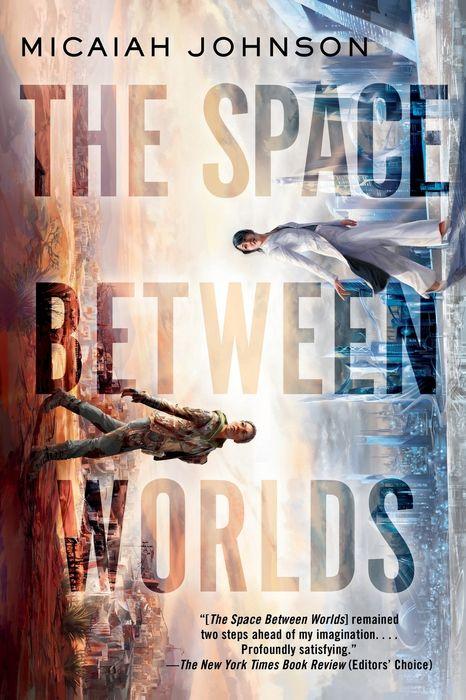
The Space Between Worlds, by Micaiah Johnson

Why this book: When I asked my friend Alison what book in the past few years she’d read that had impacted her, she responded immediately with this book. I mentioned it to my friend Luke, an avid Sci Fi reader who responded “Fantastic book.”  Reviews on line are mixed, from very positive, to strong down checks. 

Summary in 3 sentences  The novel is written from the first person perspective of a paid universe traverser who travels to different versions of Earth that simultaneously exist in parallel, to gather information.  We also learn about the version of earth that she lives in, which is a dystopian future vision of the America we live in today.  In traversing these multiple realities, our protagonist is learning not only about other versions of our earth in parallel universes, but also about herself and her world of friends, enemies, relations, and trusted confidants,  and she and the story evolve from confronting different versions in different realities, of the people she knows in the world from which she is travelling. 

My Impressions: Very imaginative book – a Sci Fi novel which includes a lot of different and creative ideas and content.  Frankly, I was confused for the first 70 or so pages and considered putting it down – but chose to read on, out of curiosity to see what came next, and with the assumption that somehow,  it would all come together. It did, finally.  Though especially in the early scene-setting stages, I was more confused than entertained or inspired,  the author had a fascinating idea, which became more compelling as I read on,  and as more details fell into place, it came together quite well at the end, with a satisfying and morally relevant conclusion that helped me understand why Alison may have found The Space Between Worlds so impactful. 

In a future world, a genius has developed a capacity for people in his world to travel to different versions of our reality, BUT with the caveat that, if in the visited parallel reality, there is a version of the travelrser living in that reality, the traverser cannot co-exist in that visited reality with the a different version of themselves.  One of them must either be already dead or the traverser will die upon entering it.  In this future world, the novel’s protagonist Cara, is hired by the controller of this multi-verse travel mechanism to travel between multiple parallel versions of his reality and gather data about things that have happened, or have been developed that would be of value in the reality from which she is traversing.  Her job is to bring valuable data and information that will help the corporation that is paying her for making these trips.

Additionally, and adding a different dimension to this novel, the Earth reality from which and to which our protagonist traverses is a dystopian version of our own – well into the future.  “Civilization” has subdivided itself into the “haves” – living in Wiley City –  with all the current and future advantages of our civilized welfare state, and the “have nots” – living in “Ashtown” –  a primal hell-scape of pollution, gang violence, controlled by a brutal warlord. These two worlds are kept separate with a border which in order to cross it, requires permission and passes.  The analogy that occurs to me is San Diego and Tijuana.  It also reminds me of the dystopian future sci-fi novel Void Star, by Zachary Mason (my review here.) Cara grew up in Ashtown, and is now living and working in Wiley City and her greatest aspiration is to become one of the Wiley City privileged by acquiring  citizenship.

And to add another human dimension to our story, there is a tense and complicated love story between Cara, our protagonist, and Dell, her handler and mentor within the Eldridge corporation that is conducting the research based on the multi-verse travel. Dell is a native and pure Wiley City person, and manages Cara’s schedule of assigned travels and responsibilities.

It took me a while to figure all this out, as slowly throughout the novel, the pieces to the  puzzle started falling into place, one piece at a time, answering my questions, and slowly dissipating the confusion I was experiencing.

Why did I struggle with this book?  First, I didn’t particularly care for Cara, the book’s protagonist in whose first-person voice the book is written. During much of the book, she is angry, with a chip on her shoulder the size of Idaho (where I finished reading the book.)  Having grown up in Ashtown, with a broken, dysfunctional family, mother a sex-worker and addict, she has gotten a job in Wiley City and feels very lucky, but also struggles to adapt.    She is VERY keen on fitting in and ultimately gaining citizenship in Wiley City, where all the disadvantages and challenges of poverty and lower-class vulnerability she had experienced growing up in Ashtown are taken care of. She is tough, angry, bitter, and ambitious, but also vulnerable and even a bit paranoid.  

As a traverser, Cara travels from Earth Zero which it seems is the baseline reality for the novel, into various versions of Earth-reality that are given different numbers (Earth 22, Earth 175, etc) where her task is to study and report on differences she finds in the versions of the reality she visits, different from where she lives in on Earth Zero.  I got confused between characters who appear in multiple versions of Earth reality, but indeed are either somewhat or radically different in each reality – which eventually I realize, is part of the message of the book. 

The story is told from Cara’s perspective, and she is the only character who is truly well developed.  The other characters are less so, partly because we get to know different versions of each of them in different realities – again, part of the message of the book. We only really get to know Cara’s love interest Dell in Cara’s Earth Zero reality.  

As this complex story progresses, there are a number of surprises, twists and turns that keep the reader a bit off-balance.  The story culminates in a power struggle between the leaders from Cara’s life in Ashtown and her life in Wiley City – a power struggle with origins not only in their Earth-Zero lives, but also influenced by events and occurrences in other earth realities that Cara has visited – and Cara is a key catalyst in precipitating this power struggle. 

If all of this sounds confusing, it is – but as one moves through the novel, the various themes develop and come together:  the Wiley City – Ashtown tension, the goals of the Eldridge – the company that controls the multi-verse traversing, the love story between Dell and Cara, the good-vs-evil theme behind the separation of Wiley City and Ashtown, not only in Earth Zero but in the 352 (or so) other Earth realities.  And ultimately, and what I found most interesting in the book, all this has an effect on Cara, and we see how from her experiences in multiple dimensions, the evolution of Cara’s character, her goals, dreams and ambitions.  And finally through Cara, we gain insight into what all these multiple realities may mean in practical terms, to someone (each of us?) who is living in one of the multitude of realities that may exist. 

In The Space Between Worlds, Micaiah Johnson creates a novel which explores the implications of some of the quantum multiple universes theories that theoretical physicists have proposed.  It also begs many metaphysical questions about “reality” and whether there is such a “one” thing.  If you google “quantum theory multiple universes” you’ll see a multitude of entries discussing this intriguing idea.  To the question “Can you live in a parallel Universe?”  Google responds:  “Those alternate universes are completely separate and unable to intersect, so while there may be uncountable versions of you living a life that’s slightly – or wildly – different from your life in this world, you’d never know it.” In The Space Between Worlds, that assumption is set aside and we play with an imagined future scenario in which it may be possible to get to know a different version of oneself in different situations and contexts, good bad, evil or spiritually transcendent.


Cara: “Maybe I’m not the only one who feels the tugs of my other lives. Maybe they hover over us, steering us, constantly.” p 220

The Space Between Worlds is not a book I’d recommend to most of my friends, few of whom read Sci-Fi.  But I found it clever and intriguing, and the conclusions were worth the effort to get there.   

Posted in Uncategorized | Leave a comment

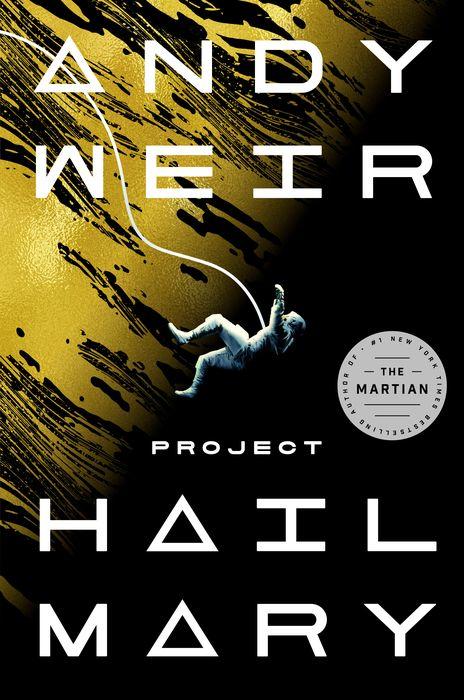
Project Hail Mary, by Andy Weir

Why this Book:  Selected by my SEAL reading group as our June 2022 selection, based on input from several who had read it.

Summary in 3 Sentences:  Project Hail Mary begins with our narrator waking up on a gurney, covered with sensors,  with numerous tubes attached, and not knowing who he is, where he is, or how he got there. As his memory slowly returns he realizes that he is on a spacecraft, no longer in our solar system, and begins recalling the events that led to his current situation, as well as realizing that he has a crucial tasks to fulfill. The story of the book bounces back and forth between his memories of what was happening in his life on earth that led to finding himself alone on a spaceship, and then forward to being on the spaceship, trying to figure out what he has to do to fulfill his mission, which is critical to the future of planet earth. 

My Impressions: Very creative and clever Sci-Fi novel.  I listened to it on audible and enjoyed the hypothetical story, the characters, the audible version, and the way it was told.  If you liked The Martian and the main character Mark Watney, you’ll like Project Hail Mary and the main character Ryland Grace.   They are both avatars of Andy Weir – practical engineers and scientists who systematically and dispassionately look at the most perplexing and seemingly hopeless problems to come up with solutions that I, a decidedly non-scientific thinker, could never imagine.  Not having a strong background in science and engineering, I couldn’t judge whether his logic and solutions indeed made sense, but if not, they fooled me. 

Project Hail Mary begins with Ryland Grace waking up, not knowing where he is, but slowly realizing that he’s strapped into a bed, alone in a spaceship, with two dead people strapped into beds near him, and he doesn’t know why.  The initial part of the book is him slowly getting pieces of his memory back to help him figure out, not only who he is, but what he is doing there, who are these other dead people and what it is he is supposed to be doing.  As his memory slowly comes back and he begins piecing things together, we are taken back to his life on planet earth before this strange space ship ride.  

The book bounces back and forth between Grace’s emerging memories of events prior to and leading up to finding himself alone on a space ship, and Grace sharing what he’s thinking, seeing, doing and problem solving on the space ship – figuring out how it runs, where it is, where it’s going and why.

Slowly we learn that he has been sent into space on a mission to find what may be a possible solution to the problem of our sun cooling rapidly, due to an infestation of a unique microbial bio-phenomenon called “astrophage.”  If the cooling of the sun by astrophage is not reversed, planet earth itself will cool over the next several decades enough to endanger most current life, bring on another ice-age, and perhaps eventual death of all life on earth.  So Grace is on a pretty important mission, and as the book is named, he and this mission are a last desperate attempt by a Manhattan Project-like effort to find a solution to this problem.

There are several amazing things that Weir includes in the book.  This hypothetical bio-phenomenon offers hints at the potential of fusion as an energy source.  Also, astrophage itself is vulnerable to another microbial bio-phenomenon which Grace names taumoeba, for reasons explained in the book.  Taumoeba can be and is, both a friend and an enemy, depending on context, and Grace has to figure out and test the properties, strengths and weaknesses of each of these two bio-phenomena, which are key to his mission.

Perhaps most interesting is that Grace, alone in his spaceship trying to figure out his mission and role, finds that he is being approached by another space vehicle, and we are treated to an inter-stellar/extra-terrestrial cross-species communication experience, as Grace and the being in the other space vehicle overcome numerous obstacles and differences in their make-ups to communicate and eventually work together. Grace names the other being Rocky (for reasons he explains in the book) and Grace learns that Rocky is on a similar mission from his planet in a different solar system, also under threat from their star cooling, due to the influence of astrophage. 

The collaboration process and the various efforts, solutions, challenges, catastrophes they face together become the focus of the second half of the book, while we continue to regularly revisit Grace’s memories which help him (and us) understand how and why he was put on a space ship and launched on this mission of such importance.  It is enjoyable and interesting to read about the international Manhattan project-like effort to save planet earth – and it all sort-of makes sense.  Grace himself is an interesting character in this drama – a sort of nerdy everyman – a humble one-time middle-school science  teacher – who somehow finds himself in the center  of arguably the most important project in the history of the world.

Between these two settings – the leading minds on earth trying to solve the cooling of the sun, and Grace alone on his space-ship with an extra-terrestrial, we are treated to practical example after practical example of the scientific method being used to solve problems, explore possibilities, solve problem, question results, and move on to the next steps.  In this, Project Hail Mary is similar to The Martian.  But then Weir introduces the extraterrestrial, another intelligent and sentient being, he gives us insights into our own limitations and strengths and unique qualities as human beings.  

Rocky is made of different stuff, has 5 legs which also serve as hands, and has many capabilities that we don’t have. As Grace and Rocky connect and get to know each other, they question each other about each other’s worlds, cultures, values etc. And we are introduced to a VERY different versions of sentient creatures which have adapted to a different environment.  For example, in Rocky’s culture, one must always be watched and protected when sleeping, because in sleeping Rocky and his species essentially go completely catatonic and inert, and are vulnerable to a whole host of problems.  They couldn’t live in our atmosphere, nor we in there’s.    Rocky shares with Grace how they get their energy – what we would call calories – very different from us.  Rocky and Grace both believe (and I assume this reflects what Weir believes is worth considering) that life in various solar systems, and perhaps galaxies, has evolved from a common source….which Grace and Rocky believe may explain the similarities – as tenuous as they may seem – between how the human and Rocky’s species evolved.  And how astrophage and taumoeba have evolved.  

Over the course of the book, and especially at the end, we see a transformation in Ryland Grace as he rises to the challenges he finds himself confronting, and truly takes his responsibilities seriously. There is a moral development piece to this book which simmers in the background, until the end. But it is definitely worth mentioning.  

Fascinating book – highly recommended as a combination scientist-engineer’s and astrophysicist’s Sci- Fi fantasy which has a fascinating and believable human element.  


Posted in Uncategorized | Leave a comment

No Country for Old Men, by Cormac McCarthy

Why this book:  Selected by my literature reading group – strongly advocated for by Janar.

Summary in 3 sentences:  A man hunting out in the outback in South Texas stumbles upon a number of shot up vehicles, a bunch of dead men and a satchel full of money – and figures out quickly that this was a drug gang war, and so absconds with the money, expecting to never get caught. That sets off multiple bad guys trying to find him to recover the money, and a lot of killing which includes not just bad guys, but no shortage of innocent bystanders. Meanwhile throughout the story, the local Sheriff, the key protagonist in the book, is on the trail of both the man who found the money, as well as the multiple bad guys who are committing murders and mayhem in their efforts to track him down and recover what they believe is rightfully theirs. 

My Impressions:  I listened to this book, so my impressions are colored (positively!) by the excellent rendition the audible reader gave representing the various characters in the book.  The story takes place entirely in South Texas, and nearly all of the characters are working class, down-to-earth Texans and their voices and accents bespeak the region and their origins.  I could also argue that the book is largely about small-town Texas and its people, and how their culture of simple courage and hard work is being corrupted by the influence of the traffickers who are moving through their world, who do not share their values – in fact whose values directly oppose those of the people who settled and live in that space. 

There are two main characters who represent both sides of this cultural divide: Sheriff Ed Tom Bell and narco trafficker hit man Anton Chighurh.  Sheriff Bell’s voice and perspective begin each chapter – he is a WWII veteran (the book takes place late 70s/early 80s) whose grand father had been a sheriff and whose influence led to Ed Tom becoming a sheriff – which at the time of the story, he’d been for nearly 30 years. Chigurh is an extremely intelligent, cold-blooded, socio-pathic killer, who works for the big money players in the narcotics trade. He has no qualms at all about killing anyone who might compromise him or his purpose, and he does ALOT of killing in No County for Old Men. 

A third major character is Llewelyn Moss, who early in the book, happens upon the scene of a shootout between rival drug gangs.  He finds numerous dead bodies, a van full of heroin, as well as an unclaimed valise full of over $2 million in cash.  He believes he’s hit the jackpot – takes the money, and makes a plan for himself and his young wife to disappear and live happily ever after.  Obviously, it turns out to be not that easy, as the “bad guys” are pretty resourceful and intent on not only finding that money,  but also in punishing the individual who took it. 

In the midst of all this, Sheriff Bell is trying to solve the crime of so many dead bodies in his jurisdiction, with very few clues to go on – though it’s clear to him that it’s all drug related – no IDs on the bodies, mostly Mexican, lots of bullet holes in the vehicles without valid license plates.  And then more bodies start turning up as he tries to put the pieces of the puzzle together. 

Meanwhile Chigurh is on the trail of the money and is tracking Moss, as is separately, one of the fat cats who is now out his $2million plus.  Bodies keep piling up, while Sheriff Bell is a couple of steps behind.  We are seeing the situation evolve through Moss’s eyes,  and separately Chigurh’s, as well as the Sheriff’s.  As we accompany the Sheriff on his investigation, we already know the answers to his questions, because we are privy to Chigurh’ and Moss’s thoughts and actions.   Pretty much all the way to the end. 

Both Bell and Chigurh are great characters – Chigurh is extremely intelligent in a diabolical way, consistent in his evil logic and actions, and extremely effective at covering his tracks.  Sheriff Bell is very sharp in a practical, everyman/commons sensical way, and figures things out pretty quickly.  Sheriff Bell is also a man of principle and a dedicated public servant,  who cares for the people in his community, his friends, and his country.  He has seen a lot of bad in his 30 years on the job, but also a lot of good and has empathy and appreciation for the hard working, poor people in his community. Moss is likewise a good man, practical and smart,  but not as smart as he thinks he is. 

We see in the book that it’s hard to defeat an enemy who has no moral scruples.  Sheriff Bell shares his frustration at what his job has evolved into, what his county and South Texas have become as a result of the drug and gang wars, and what America’s new generation has become.  Chigurh  has no such concerns.  Moss is basically a good guy, who is just trying to take advantage of what looks like a really good break, at stumbling upon this ill-gotten money.  In some ways, this story reminds me of the movie A Simple Plan with Billy Bob Thornton

I can’t say that I enjoyed all the evil and killing in this book, but the story is very well told.  I thought the story had almost religious overtones – Chigurh is the devil, and Sheriff Bell is a good man, struggling to believe in a God who would let someone like Chigurh do what he does, struggling to have faith in a good God when so much evil seems to continue to occur, and to go unpunished.   The battle between Good and Evil taking place in South Texas is difficult to watch, especially when Evil seems to have so much power and so much influence.  Sheriff Bell has the unpleasant feeling that perhaps Evil is winning.

I really liked Sheriff Bell’s voice and insights at the beginning of each chapter.  He represented the practical wisdom and humility that is the best in the American character.  He is quite vocal about how important his marriage is in his life and how much he admired and needed his wife Loretta.  It was easy to empathize with him when he expressed his despair, to admire him for his courage, and to like him as a protagonist in this story.

I haven’t seen the movie yet – but I will.  I hear it’s quite good and I want to see how Hollywood portrays these interesting characters. 


Posted in Uncategorized | Leave a comment

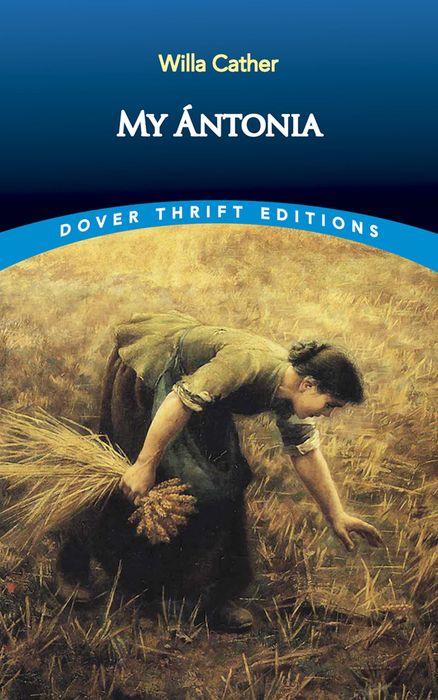
My Antonia, by Willa Cather

Why this book: I first heard of Willa Cather a few years ago when I was at a conference chatting about books with a woman from Nebraska, who mentioned that when she was in school, everyone had to read Willa Cather.  I had never heard of Willa Cather, though I was born in Nebraska and my parents are from Nebraska, so I was intrigued. Then a few years ago, I read Cather’s Pulitzer prize winning One of Ours, and have been wanting to read more of her since. 

Summary in 3 Sentences: My Antonia is a novel that takes place mostly on the prairies of Nebraska in the final two decades of the 19th century, and is told as a reflection of a man who had grown up initially on a farm and then in a small town there, looking back on his youth, and in particular at stories surrounding his friend Antonia Shimerda. The book is more about life in rural Nebraska prior to the end of the 19th century, with the focus on the lives, trials and tribulations of our narrator’s close friends and family, and especially Antonia. At the end of the book, the author switches back to the time when he is relating his story, and returns to the town of his youth and shares with us his impressions, his reunions, and his nostalgia. 

My Impressions: Wonderful book written in 1918 by a woman who grew up on the prairies of Nebraska, conveying a sense of what life was like in the late 19th century in small rural farming communities on the great plains.  My Antonia deserves its reputation as classic of early 20th century literature.  It depicts a lifestyle and a time in America long gone – when life was simple, hard, there was a strong social contract in the community, no real social safety net other than what neighbors, relatives, friends would be willing to contribute to help people out.  And it is beautifully written. 

My Antonia reminded me of the writing of Ivan Doig – a male voice describing life of farmers and ranchers and working class people in rural Montana and Wyoming.  In particular his book The Whistling Season comes to mind.  I was also reminded of the writing and life of Laura Ingalls Wilder – her Little House  books describe a similar setting in time and place,  but whereas Wilder’s books are written for children or young adults, My Antonia and Cather’s other books about life on the prairie are written for a more mature reader. 

My Antonia begins in the late 1880s and is told in the first person as a retrospective by Jim Burden, a man looking back on his youth.  He begins when he was sent by train from Virginia to Nebraska after his parents died, to be raised by his grandparents on their farm.  Arriving on the same train that brought him to the fictional town of Black Hawk, Nebraska, is the Shimerda family, a poor family from Bohemia (what is now the western part of the Czech Republic)  who speak no English and are arriving to work a farm they had just purchased from a previous immigrant from Bohemia.  One of the children in that family is Antonia, a girl just a few years older than Jim, and their farm is not far from the farm where Jim Burden grows up with his grandparents. 

Jim tells his story about life on the farm, about his grandparents and his interactions with the much poorer neighboring Shimerda family over the years of his youth.  His friendship with the young Antonia gradually grew as they played and interacted as children, but took a leap forward when Antonia’s mother asked Jim to teach her English.    Antonia was a good student, energetic, actively, quickly and playfully learning English, and Jim truly enjoys her company, and as he gets older is smitten with her – from a distance.   Antonia and her siblings did not go to school – rather they were needed to work on the farm from which the family struggled to make a living.

The book covers the trajectory of Jim’s and Antonia’s lives converging and diverging, as they mature over the years into teenagers and young adults, sometimes going for long periods without seeing each other.   But Jim has a strong crush on Antonia who is clearly a remarkable girl, who becomes a remarkable young woman – healthy and strong, resilient in the face of hardship, sensitive in the face of difficulties and tragedy, yet still upbeat, positive, and determined.   Additionally we get to know other interesting characters in the small town of Black Hawk, and we experience small-town Nebraskan life, as Jim’s grandparents move off the farm and into town, and Antonia eventually takes a job working as a housekeeper for a well-to-do family in town. We learn of the prejudices that town’s people have toward “country girls” and immigrants in general, and how “hired girls” and immigrants stick together and support each other.  Jim describes the country girls who had  helped to “break up the wild sod, learned so much from life, from poverty, from their mothers and grandmothers” as much more self-confident and interesting than the coddled and protected girls who had grown up in town.  

There are many examples of immigrant families in My Antonia, who responded to the Homestead Act of the 1860s and moved West to get free land in exchange for working it for a number of years.  These Swedes, Norwegians, Bohemians, Germans developed their own communities to help each other deal with how difficult life was in these early days on the prairies.   We learn of the small town prejudices, the strict and conventional morality, as well as the simple joys and sense of community that people find when there are not many distractions from simply working, eating, sleeping.  When things got hard, people had to simply deal them, but neighbors and friends always seemed ready to chip in as best they could to alleviate the worst of suffering. 

Eventually, Jim goes off to college and a career that takes him away from Black Hawk, and Antonia and her girl friends also go their separate ways, and the idyllic time of their youth fades as the demands of adulthood take hold.  At the conclusion of the book, Jim return to Black Hawk and we learn how the lives of Antonia and other characters in the book have changed and evolved, along with the country they live in.  But it is clear in Jim’s narrative that Antonia was the original love of his life, and his story is a nostalgic look at not only his relationship to her, but also at the life they had lived on their farms and in Black Hawk, Nebraska.

My Antonia was published in 1918, and the story ends prior to the advent of WW1. 

The Writing and descriptions. Willa Cathers’s descriptions of places and nature have been described as like reading a painting.  There are some beautiful evocative passages in her descriptions of the prairie where she grew up.  There is a strong Buddhist sense in her descriptions of nature. A few examples:

I kept as still as I could. Nothing happened. I did not expect anything to happen.  I was something that lay under the sun and felt it, like the pumpkins, and I did not want to be anything more.  I was entirely happy. Perhaps we feel like that when we die and become a part of something entire, whether it is sun and air, or goodness and knowledge. At any rate, that is happiness; to be dissolved into something complete and great. When it come to one, it comes as naturally as sleep. p 12

(At sunset) The blond cornfields were red gold, the haystacks turned rosy and threw long shadows. the whole prairie was like the bush that burned with fire and was not consumed. That hour always had the exultation of victory, of triumphant ending, like a hero’s death – heroes who died young and gloriously. It was a sudden transfiguration, a lifting-up of day.  p22

The pale, cold light of the winter sunset did not beautify – it was like the light of truth itself.  When the smoky clouds hung low in the west and the red sun went down behind them, leaving a pink flush on the snow roofs and the blue drifts, then the wind sprang up afresh, with a kind of bitter song, as if it said: “This is reality, whether you like it or not.  All those frivolities of summer, the light and the shadow, the living mask of green that trembled over everything, they were lies, and this is what was underneath. This is the truth.”  It was as if we were being punished for loving the loveliness of summer.  p 85

Willa Cather – After reading My Antonia, I listened to several pieces on Youtube about Willa Cather and read what Wikipedia had to say about her.  She was a major force in American Literature in the first half of the 20th century and lived a fascinating life.  She grew up in Red Cloud, Nebraska, which is represented by the town of Black Hawk in My Antonia.  She eventually attended the University of Nebraska in Lincoln, then moved to Pittsburg and then New York City, and became the main editor of McCure’s magazine before she wrote her first novel. My Antonia is one part of what has become known as Cather’s Prairie Trilogy which includes O Pioneers! (1913) and The Song of the Lark (1915.)  Her novel One of Ours about a Nebraskan farm boy who goes off to fight in Europe in WW1 was awarded the Pulitzer Prize for fiction in 1922, and she wrote several other highly regarded and successful novels, which are not as well known today as her Prairie Trilogy.  She died at age 73 in 1948 of breast cancer and its complications. 


Posted in Uncategorized | 1 Comment

The War of Art – Break Through the Blocks and Win Your Inner Creative Battles, by Steven Pressfield

Why this book Over the years, I’ve heard this book referred to and praised a lot – by Tim Ferriss among others.  Also I’ve read and enjoyed several of Pressfield’s historical novels, as well as his Warrior Ethos (reviewed here,) and we recently hosted him in an on-line  discussion of his book Virtues of War (reviewed  here.I really admired the man, as he humbly shared how he wrote such a fascinating book about Alexander the Great in Alexander’s voice – in the first person. The War of Art explains the process he shared with us in that session.    I’ve had The War of Art on my shelf for quite a while, so I figured it was time to read it and see what Pressfield has to say about creativity.

Summary in 3 sentences: In The War of Art  Pressfield is sharing his wisdom after a lifetime of struggling to overcome simple human impulses to avoid the hard work of venturing out beyond oneself to engage in a creative endeavor.  He anthropomorphizes “Resistance” as this human impulse to avoid the hard work of creating; he encourages us to fight it as an implacable enemy who never is completely defeated and is always ready through subterfuge to undermine our best efforts.  Finally he shares with us how to feed and cultivate our “muse” as the connection between our inner creative selves and something Pressfield doesn’t claim to understand, but which he believes is bigger than us and to which we must connect, in order to open up our creative channels. 

My Impressions:  There is a lot of content, wisdom and insight in this short work – only 165 pages with large print. In this review, I’ll try to give a few highlights that may inspire you to pick it up – especially if you the reader, have ever struggled to lose yourself in a creative endeavor. It is structured in short, readable, almost aphoristic chapters, that make it easier to absorb his esoteric concepts in small bites.  The style reminds me a bit of how Legacy by James Kerr is written – easy to pick up, open it at a random spot, and grab a quick bite of insight and inspiration. 

The War of Art is written in three parts, and each of these parts is broken up into short, one-to-three page chapters, and the titles of those chapters give us a heads up as to the point he’ll be making.  The three parts build on each other, the culminating section – Part 3 Beyond Resistance – is in my view, his piece de resistance.  The chapter titles themselves give a sense for the wisdom Pressfield is imparting in each part and in the book. 

Part 1 Resistance: This chapter sets up the book, and makes “Resistance” into a conscious, sneaky, clever and diabolical enemy intent on keeping us from doing what we know we need and want to do.  Treating “Resistance” as a personified enemy, who we must be willing to fight continuously, is a perspective he offers to help us do what we may be struggling to get ourselves to do. Pressfield is open and unabashed about his own battles with Resistance,  and is not reticent about describing the battles he’s won and lost. 

Some of the chapter titles in this part include: Resistance and Criticism, Resistance and Self-Doubt, Resistance and Victimhood, Resistance and Procrastination, Resistance and Rationalization, Resistance Recruits Allies, Resistance is Most Powerful at the Finish line, Resistance and Choice of Mate.   

A few quotes from “Resistance:”

  • Most of us have two lives. The life we live, and the un-lived life within us. Between the two stands Resistance.
  • Resistance cannot be seen, touched, heard, or smelled. But it can be felt.  Its aim is to shove us away, distract us, prevent us from doing our work. p7
  • Resistance will tell you anything to keep you from doing your work. p9
  • Remember our rule of thumb: the more scared we are of a work or calling, the more sure we can be that we have to do it. p 40

Part 2: Combatting Resistance. In this part, Pressfield makes the distinction between the Amateur and the Professional  – noting that to be serious about what one is doing, one must be willing to commit to fight Resistance, in order to open the door to one’s muse, and keep it open. Resistance will always be there like a dormant virus, waiting for a moment of weakness to strike.  Amateurs compromise with and accommodate Resistance and give it its head.  That’s ok, but they are not Pros.  To be a true Professional is to commit seriously to one’s art and to keeping Resistance at bay – to never let it gather momentum.  

Some of the chapter titles in this part include: Professionals and Amateurs, What a Writer’s Day feels like, For Love of the Game, a Professional is Patient, a Professional Seeks Order, a Professional Acts in the Face of Fear, a Professional Accepts no Excuses, a Professional plays it as it lays, a Professional does not Show off, a Professional dedicates Himself to Mastering Technique, a Professional does not Hesitate to Ask for Help, a Professional does not take Failure (or Success) Personally, a Professional Reinvents Himself.  

A few quotes from “Combatting Resistance:” 

  • The amateur plays for fun.  The professional plays for keeps. p 62
  • What’s important is the work. That’s the game I have to suit up for.  That’s the field on which I have to leave everything I’ve got.  p 65 
  • The more you love your art/calling/enterprise, the more important its accomplishment is to the evolution of your soul, the more you will fear it and the more Resistance you will experience facing it. p 73
  • Resistance outwits the amateur with tho oldest trick in the book: it uses his own enthusiasm against him….The professional, on the other hand, understands delayed gratification. He is the ant, not the grasshopper; the tortoise, not the hare. p75
  • The professional identifies with her consciousness and her will, not with the matter that her consciousness and will manipulate to serve her art…. Madonna does not identify with “Madonna.”  Madonna employs “Madonna.” p86

Part 3: Beyond Resistance.  In this part Pressfield acknowledges the mystery and wonder about where creative inspiration and insight come from – and this part has a quasi-mystical tone to it.  The rest of the book is basically a build up to and foundation for this part – Part 3 is the essence of his message.  Understanding and combatting Resistance are only worth the effort if one can find and nurture one’s muse.   He notes that most mammals, humans included, identify themselves by either their rank within a hierarchy or by their connection to a territory, and he uses the term “territory” in a broad way.  He says that artists must be territorial, noting that “For the artist to define himself hierarchically is fatal.”

Some of the chapter titles in this part include:  Approaching the Mystery, Invoking the Muse (Part 1,)  Invoking the Muse (Part 2,) Invoking the Muse (Part 3,) the Magic of Making a Start, the Magic of Keeping Going, Life and Death, the Ego and the Self,  Fear,  the Authentic Self,  Territory versus Hierarchy, the Artist and the Hierarchy, the Supreme Virtue, the Fruits of our Labor, and his concluding chapter, the Artist’s Life.

Some quotes from “Beyond Resistance:”

  • When we sit down day after day and keep grinding, something mysterious starts to happen. A process is set into motion by which, inevitably and infallibly, heaven comes to our aid. Unseen forces enlist in our cause; serendipity reinforces our purpose. p108
  • The last thing I do before I sit down to work is say my prayer to the Muse. I say it out loud, in absolute earnest.  p110
  • This is why artists are modest. They know they’re not doing the work; they’re just taking dictation. p127
  • Here is what I think. I think angels make their home in the Self, while Resistance has its seat in the Ego.  p136
  • In other words, the hack writes hierarchically.  He writes what he imagines will play well in the eyes of others. He does not ask himself, What do I myself want to write? p 152
  • We must do our work for its own sake, not for fortune or attention or applause.  p 161

Loved this short book. It gives a different and insightful perspective about why many/most of us often choose the path of least resistance, and don’t fulfill many of our life’s dreams. It challenges all of us to examine whether we are, or have been “pros” or “amateurs.”  It challenges the reader to find his/her muse, to feed and nourish and sustain her, and to live by her guidance.  Our muse, Pressfield would claim,  is our better self.  A worthy challenge indeed.  

Posted in Uncategorized | Leave a comment

A Purple Place for Dying, by John D. MacDonald

Why this book:  In a great podcast interview Tim Ferriss did with Mike Rowe (of Dirty Jobs fame) Mike Rowe strongly recommended the entire John D. MacDonald Travis McGee series.   This recommendation was subsequently reinforced by a friend who had read all of MacDonald’s Travis McGee novels and said he envied me the opportunity to read these for the first time. so I  picked up and  read The Deep Blue Good-bye (my review of it here)  and found it a unique pleasure for a mature reader.  I was recently looking for something light, fun and distracting to read, so decided to return to MacDonald and picked up A Purple Place for Dying, my second Travis McGee novel. It won’t be my last.  

Summary in 3 Sentences:  Travis McGee accepts an offer to fly out from his home in Southern Florida to the Southwest (state not specified) to meet with a woman to discuss helping her recoup money that she was convinced her husband had stolen or was hiding from her before she divorced him.  McGee was not inclined to accept the work, but before he decides, the woman is murdered.  His better judgment tells him to go back home and leave this to local authorities, but his outrage at how it was done, his curiosity, and his sense that he could contribute to finding out how, why, and by whom she was murdered seduced him to stay and look into it, and pretty soon he is VERY involved.  

My Impressions:  If All the King’s Men, or Angle of Repose are literary gourmet meals, then Travis McGee novels, to include A Purple Place for Dying,  represent gourmet Fast Food.  A Purple Place for Dying is a who-done-it mystery novel – one of the 21  books in MacDonald’s Travis McGee series, written in the first person voice of Travis McGee.   McGee might be described as a cross between Jimmy Buffett and Jim Rockford (the James Garner character in The Rockford Files TV series of a few decades ago.) 

Travis McGee is something of a boat bum in his mid/late 30s/early 40s, who lives on a yacht he won in a poker game and which he named “The Busted Flush.”  He claims to be enjoying his early retirement in installments.  He accepts work when he runs out of cash – and his specialty is helping people recoup money they’ve lost unfairly or through some chicanery.  If/when he succeeds, his cut is half of what is left after his expenses.

It’s easy to like Travis McGee.  He is un-pretentious, easy-going, un-ambitious, non-materialistic, suffers no fools, is principled and compassionate.  He has a good head, a good heart, and the urges of a healthy male in his 30s/early 40s and he is respectful and solicitous of the women he meets.   His judgment and decision-making balance these qualities in a way that most men would envy.  At least I do.

In A Purple Place for Dying McGee reports the murder of his potential client and is warned by the local sheriff to stay out of this case – since the woman’s husband was a man of significant power, wealth and  influence in the region, and the sheriff had political ambitious.  But McGee can’t resist – he gets to know the first obvious suspect – the woman’s husband who knew she was having an affair with a local professor.  Strangely the murder is set up to create the impression that it didn’t happen – that the woman and her lover simply left and disappeared to live happily ever after (disappearing was easier back then.) That McGee witnessed the murder was clearly not part of the plan.  We are with Travis McGee as he goes through his process of determining who might have had a motive to commit this murder and hide it, and we’re along for the ride in his independent sleuthing, in spite of the warning by the local sheriff.    Without giving up the story, I’ll just say that  his investigation goes down some surprising rabbit holes, introduces us to some interesting characters, and the book concludes with a number of startling turns, a few more murders, and Travis McGee is involved up to his neck.  Couldn’t put it down.

A bit about the Travis McGee novels and John MacDonal:

The Travis McGee novels were written in the early sixties, the context is late 1950s/early 1960s, when America was a simpler place than it is today – with most adult men having served in WW2 or the Korean War, no 24 hour news cycle keeping people informed but also enraged, concerned, anxious.  The structures and rules of society were simple and well known – not necessarily better, but not as contentious as today.  So part of the appeal of the Travis McGee novels is that the context takes the reader back to  (at least on the surface) a simpler America.  MacDonald writes very well – he is clever and easy to read, and through the voice of Travis McGee, MacDonald shares his keen and (I thought) interesting insights about American culture, men and women, people in general, and how they get along – or don’t.

John D. MacDonald got an MBA from Harvard just prior to WW2, joined the army in 1940 and served throughout WWII, leaving the army at the end of the war  as a Lt Col.  But rather than jump into the post-war race to join a corporation, develop a career and accumulate wealth, he chose to become an impoverished writer of pulp fiction, who once said about his writing, “They pay me to do this! They don’t realize that I would pay them!”  In 1962, he was named Grand Master of the Mystery Writers of America and in 1980 received a National Book Award.  He sadly died at the young age of 70 in 1986.

A few quotes that I highlighted while reading the book that may give the reader a sense for MacDonald’s style and perspective. Unless otherwise noted, these are Travis McGee’s thoughts: 

When you can keep moving, when you have to keep moving, you can keep a lot of things at arm’s length. But when you stop, they come at you. p 30

Speaking of students he observed at the local college:  They all seemed to have an urgency about them, that strained, harried trimester look.  It would cram them through sooner, and feed them out into the corporations and tract houses, breeding and hurrying, organized for all the time and money budgets, binary systems, recreation funds, taxi transports, group adjustments , tenure, constructive hobbies. They were being structured to life on the run, and by the time they would become what is now known as senior citizens, they could fit nicely into planned communities where recreation is scheduled on such a tight and competitive basis that they could continue to run, plan organize, until, falling at last into silence, the grief therapist would gather them in, rosy their cheek, close the box and lower them to the only rest they had ever known.  p 48-49.

Education is something which should be apart from the necessities of earning a living, not a tool therefor.   It needs contemplation, fallow periods, the measured and guided study of the history of man’s reiteration of the most agonizing question of all: Why?……A devoted technician is seldom an educated man. He can be a useful man, a contented man, a busy man.  But he has no more sense of the mystery and wonder and paradox of existence than does one of those chickens fattening itself for the mechanical plucking, freezing and packaging. p 49

He had a chauffeur’s hat, a big belly, a damp cigar end, little gray pebbles for eyes, and an air of petty authority.  p70

There was a tomcat tension between us, and I had the feeling that if we could each give and take one good smack in the mouth, we might get along fine from then on.  p 133

I had one of those strange moments of unreality, that old what -am-I doing-here feeling. p137

Jass Yeoman speaking:  “They stood in line for it, boy. They always do. Ring the bell and the suckers come on the run.  In this world you either take, or you’re tooken. P143

I had seen him on a hundred corners in a dozen cities, staring at me with a combination of defiance and stupidity, standing with an indolent tomcat grace.  p 145

Maybe the entire murder arrangement was like one of those bloody cinema farces the British do so well.  Everything goes wrong, and bodies keep falling out of the wrong closets.  p 150

Speaking of suicide: This was the monstrous selfishness of self-destruction. Somebody else has to pick up the pieces.  p154

I felt an inexplicable depression. This was the foolish end of all the foolish things, in a purple place for dying.  p 199

Posted in Uncategorized | Leave a comment