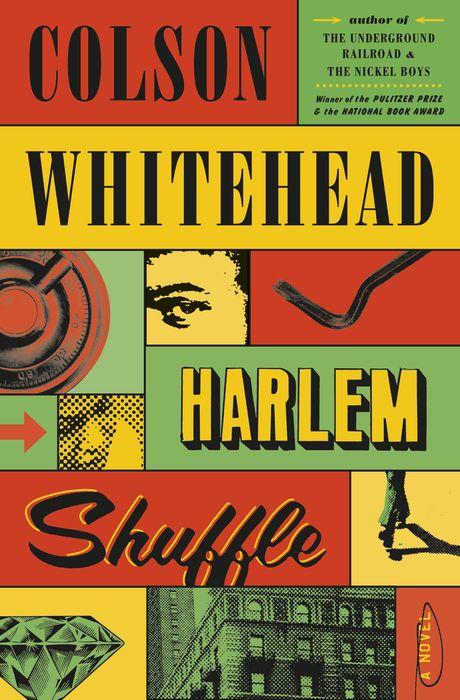
Harlem Shuffle, by Colson Whitehead

Why this book: I kept seeing this book pop up on lists of the best books of 2021 and the story intrigued me. I had read his Nickel Boys and was impressed, and wanted a bit of escapist fun, while also learning a bit about the black experience in Harlem in the 1960s.

Summary in 3 sentences:  The period is early 1960s and Ray Carney is an African American who owns a furniture store and is trying to make a living as a small business owner in the black community of Harlem.  He had grown up the son of a small time hustler and crook and found that, though as an adult he was trying to go straight, his cousin with whom he’d grown up kept pulling him into the world of small time crime, serving as a fence for guys who were stealing,  which also provided Carney much needed extra money.  Meanwhile he had a nice family, things were going well, but he starts losing control of the small time hustling and the fencing he is doing on the side, and eventually, everything he’s worked for – his business, his family, his life are at risk. 

My Impressions:  I listened to this book and it captivated me from the start.  Whitehead creates the world of Black Harlem in the early sixties and it is VERY different from the world I grew up in.  We get to know a wide variety of characters in the community.  The protagonist Ray Carney is at first a struggling small business owner, and then over time and with some success, his business grows and his status starts to climb in the local community.   The story is told from a third person narrator but with a God’s-eye spotlight on Carney, his life, his thoughts, his dreams, his fears.  And through him, we get a perspective of what it was like to grow up and try to make a living in Harlem in that period.

This is not a book about race or prejudice or white privilege – those things are there, but are incidental, like the weather, or the geography – a reality that someone who lived in Harlem had to accept and deal with.  During the story, there are race riots in Harlem after a policeman shoots an unarmed youth, but for Carney, the riots and violence are very inconvenient, and simply create obstacles to his business and the plans he has.  He is angered by white prejudice, but has reconciled himself and accommodated his life to its reality – he is not an activist. His cousin and others are on the make to find ways to capitalize on the rioting – when all the police are fighting the riots, that’s a good time to burglarize black businesses as well as white communities in Manhattan.  

In Harlem Shuffle, we see Carney caught between two worlds in Harlem – on the one hand, those who make a living on the edges of “legitimate” society, with crime, preying on white (and black) people of means.  On the other hand, there are those who have “made it” in the so-called legitimate and more well-to-do classes of Harlem society –  attorneys, bankers, successful businessmen, politicians within the black community.   And then outside of that world is white society, downtown, those who own the political machine, the police and the wealth of New York City.    Within Harlem, Carney has interactions with both the legitimate powers and the underworld, and as the story progresses, he also has interactions  with those with wealth and power in white Manhattan.  He comes to realize that those in the “legitimate” world, both black and white, were not so virtuous as they presented themselves to be.  In Harlem, Carney refers to people as either crooked or straight, and guys like him, who are not quite either, are “bent” – not really crooked, but their straightness is compromised.  

Harlem Shuffle is full of colorful and believable characters. 

  • Ray Carney himself is who we get to know best. He is self-aware and Whitehead’s narrative gets inside his head and heart. He grew up without a mother, an absentee father who was a hoodlum bad guy, and Carney was on his own a lot, sometimes living with his aunt.   He stayed straight in school, and on his own and with no support from his father, got an undergraduate degree and then a graduate degree in business, and was working hard to make his furniture business succeed. 
  • Carney’s cousin Freddie, with whom Carney grew up almost as a brother, is a n’er do well opportunist, living on the dark side, hanging with thieves and punks – not really a bad guy, not evil or cruel, but an easy mark for bad guys, since he was always looking for a way to get something for nothing, whether it be money, pleasure, prestige.  He routinely pulls Carney into criminal or sketchy deals to bail him out of some trouble he’s gotten himself into, which then associates Carney with Freddie’s crime(s) and misdeeds.  Carney is frustrated with Eddie’s decision making, but loyal to him, and puts himself at great risk to protect him.
  • Carney’s wife Elizabeth grew up in a straight upper-middle class Harlem family, and has little inkling of Carney’s escapades on the dark side.  She is a dedicated mother to their two children and has hopes that Carney’s business will move them up the social ladder and improve their standard of living.   Her parents were disappointed when she married someone from the lower classes like Carney, but Elizabeth doesn’t share their prejudices and defends Carney against her parents’ condescension.  She is clueless about Carney’s illicit work that was helping to finance their improving life style.
  • Pepper, a bouncer and underworld hit-man is practical and fearless, with an interesting past from WW2. He had done work with Carney’s father in the past.  Pepper became an unlikely ally of Carney’s when Freddie pulled Carney into a caper that almost got Carney killed – and then Pepper saved Carney’s life.

There are of course a lot many more colorful characters in the book, and Whitehead brings each of them to life, and through getting to know them, we get to know more about life in Harlem in the 1960s. 

Harlem Shuffle is a good read, an engaging and good story and provides what seems to be a well researched and accurate picture of life in a different culture in American in a different time.  I can imagine that there are rather close analogies to that world in todays inner cities, where good people are trying to have a life, and it is very difficult to go straight when crime is rampant and law enforcement spotty or corrupt. 

It is also a morality tale, as we see Carney step onto the “slippery slope” of small-time criminal activity  to help out his cousin and to make a few extra dollars. Then, without his intention, he becomes involved in more serious criminal activity, and before he knew it,  he was in way over his head, and everything he truly valued and worked so hard to achieve was at risk.  It’s like Serpico (convicted NYC cop for corruption) said: His biggest mistake was accepting that first piece of free pizza. 

As noted, I listened to rather than read the book.  That was a really good experience.  The reader had the black inner-city dialect and accents down, used different voices w different accents for the different characters – it was engaging and a pleasure to listen to.  I suspect that the emotion that the reader gave to the voices and the story gave Harlem Shuffle more immediacy and power than the printed word would have.  I recommend listening to Harlem Shuffle. 

NOTE:A more complete summary of this book is here on Super Summary

Posted in Uncategorized | Leave a comment

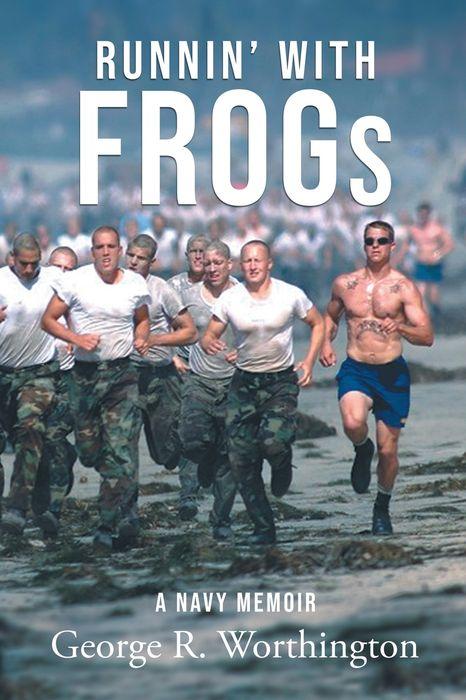
Runnin’ with Frogs – a Navy Memoir, by George Worthington

Why this book: George Worthington was one of the senior officers in the Navy SEALs as I was growing up during my career.  He was the second Admiral to command Naval Special Warfare Command. He recently died, and I learned of the existence of this memoir only after going on-line to find a brief bio and picture of him to notify the community of Old Frogs and SEALs of his passing.  I had not known of this memoir, nor had most of my friends.  I bought it and read it.

Summary in 3 Sentences:  George is telling his life’s story – beginning with his childhood, schooling, and then after graduating from the Navy, focussing almost entirely on his professional life.  He describes the many things he learned as a Surface Warfare Officer driving ships and working for an Admiral in the surface navy before becoming a SEAL, at what was then the very senior rank of Lieutenant.  Then he skips pretty quickly through his tours in UDT and SEAL Team One, his time in Vietnam, his command of SEAL Team ONE and eventually Naval Special Warfare Group One.  He spends a good part of the book on his 6 years in the Pentagon on the Navy Staff protecting and fighting for the continuance of and support for Naval Special Warfare in a time when the Navy was not convinced we needed SEALs. 

My Impressions:  This little memoir (205pages) had the potential to be really good – and as it is, with all its flaws, it is still a valuable addition to the history of how the SEALs came to be what they are today (2022.)  There are also some great lessons learned for junior officers who plan to make a career of being a Naval Special Warfare (SEALs/Special Boats) officer in the US Navy – and at the bottom of this review, I list a few key lessons from his memoir that occur to me.  Each of his chapters covers a window of his life, and most conclude with a paragraph: “What’d I learn?”  in which he shares a couple or several of key insights that came from the experiences he describes in the chapter he is concluding.

George Worthington enlisted in the Navy in 1957 and attended the Naval Academy, getting commissioned as an ensign in 1961.  He initially served on surface ships and then transitioned to Naval Special Warfare with over 30 years of commissioned service (1961-1992)  during a key period of change for the Navy and Naval Special Warfare.  He was one of the very few officers in that era (early 60s) who went thru BUD/S as a lieutenant, and was one of the very few Naval Academy graduates allowed to become a frogmen at that time, given that serving in the UDT/SEAL Teams was not considered career enhancing. He graduated from BUD/S so senior that he immediately became the Operations Officer of UDT 11 and then “fleeted up” to become the XO, and deployed with his team to Vietnam.    At that time, a tour with a UDT or SEAL TEAM was viewed as a brief hiatus for a naval officer, so after serving as XO of UDT 11, he had to get back to the real Navy, and was sent to Destroyer School and then back to sea as the operations officer of a surface ship.  He was clearly good at surface warfare skills and ship driving, and enjoyed this assignment – it was full of engaging challenges and opportunities.  When he completed that assignment in 1970,  he was sent to Vietnam to a major Navy staff – Naval Forces Vietnam –  where among other things, he served and represented SEALs and Special Boats in the Navy’s piece of the fight against the Viet Cong and the NVA. 

By the time he concluded his Vietnam assignment, Naval Special Warfare had matured, and offered officers a career path, and Worthington was able to spend the remainder of his career in Naval Special Warfare. He recounts stories and lessons learned from his assignments as Commanding Officer SEAL Team ONE, Commander Naval Inshore Undersea Warfare Group ONE and then later, Naval Special Warfare Group ONE.  He also spent 6 years in the Pentagon, and much of his narrative was about the battles he fought and the successes he had defending and resourcing NSW programs in the budgeting and planning processes in Washington DC.   During this window, I was a junior officer in NSW, and as new force structure initiatives,  new equipment, and new opportunities kept positively affecting my professional life,  I had no idea how they came to be, nor of the work and struggles that George Worthington and other SEALs in Washington had undergone in order to achieve these results. This was one of the most enlightening aspects of the book for me.

His first flag assignment was to stand up, and serve as the first and interim Deputy Assistant Secretary of Defense for Special Operations, in 1988-89.  From there he was called upon in 1989 to serve as the 2nd Admiral to Command Naval Special Warfare Command which owns and resources all the SEALs and Special Boats in the Navy, and he shares many of his successes and adventures from that time.  At the end of that tour in 1992, he retired from the Navy.  The last of chapter of his book briefly covers his life and activities after retiring from the Navy.  George died from complications from Parkinson’s Disease in December 2021. 

Shortcomings of the book: While I found much of the content of this book of great interest to me as a retired Naval Special Warfare Officer, I found a couple of key shortcomings to his book: 

  • First, it is very poorly edited. The book is full of mis-spellings, typos, cut-off sentences and in some cases redundancies.  He may have been deeply into his Parkinson’s when he was ready to self-publish the book and unable to give it the detailed editing it deserves.  But it badly needed a good editor to put the excellent content into a more professional form.
  • Second, he includes very little about his personal or family life in his memoir.  There is no mention of Sydna, his first wife, little about their 3 kids, nor does he mention his divorce from Sydna, or his  30 years spent with his final partner and wife Veronica. Nor does he mention a messy incident or two that I understand hastened his retirement, when he still had plenty to give the Navy and the SEALs. 

My impression of George Worthington is that he was an extremely talented and very energetic man who led a full, active, and very engaged life.  He was a clearly a gifted naval officer who loved the Navy and was fully committed to serving Naval Special Warfare.  George was known as a good shipmate, loyal and generous to his friends, a fun guy to be with whether at a party or in tough circumstances.    He was irreverent, funny, and had a biting sense of humor.  He could also be vain, irascible, and impulsive, often sharing his views and acting on impulses without due consideration to context or impact.   This was a darker side of his positive enthusiasm, intense energy and passion.  His final years with Parkinson’s were very difficult for him, as his energy and freedom of action diminished, his athletic abilities and physique withered,  and he struggled to maintain his joy and positive energy.  By all accounts he faced these difficulties with great courage and humility to the end. 

I attended George Worthington’s memorial service and celebration of life on 27 January 2022 in Coronado and it was well attended by members of the Coronado community, and by active and former SEALs who wanted to pay their respects to him, his service and his family.   He had led an amazing and full life and contributed enormously to the success and growth of the Navy SEAL community, and he deserved to be so honored.   Most impressive at the event was the eulogy that his son Rhodes, now a Chief Petty Officer in SEAL Team SEVEN, gave at the memorial service – about what a great Dad he’d been – compassionate, engaged and loving, always sharing his enthusiasm for trying new things, and embracing the joys of life. At the celebration of life afterward, his daughter Greer, reiterated the points made by her brother Rhodes, and gave examples of how he’d helped her be strong when she was down. Both Sydna, his first wife and mother of their three children, and Veronica who was his partner and then his wife over his last 30 years, were very gracious at his memorial, and celebration of life.  

One of the quotes Rhodes shared in his eulogy of his dad is practical and profound: “In life when faced with two choices, the choice that is most personally difficult will never fail you.” 

Lessons from Runnin’ with Frogs for aspiring SEAL officers:

  1. The value of experience outside NSW.  He regularly referred to the value of his time in the Surface Navy in his later NSW career, and the contacts he had from that window gave him credibility with the Navy and with key decision makers in the Navy.
  2. The importance of working in the Pentagon – he made a HUGE impact on NSW by the work he did and the connections and credibility he established in Washington, which translated into increased force  structure and money for the Teams.  The credibility he earned with the Navy was key to his getting selected for flag. 
  3. Don’t whine.  Get to work. He often didn’t get the assignment he wanted or felt he deserved.  But by making top performance in the undesired assignments a priority, it led to bigger and better things. He realized that he got what he needed, rather than what he wanted. 
  4. Build bridges with the civilians.  He shared how important it was for him to make friends with the civilians and civil servants in the big staffs to get things done.  He had sympathy for the reality that they were there for years, while officers like him came and went, full of urgency and impatience to make an impact during the short window of their assignment. 
  5. Learn to play the game.  He tells us in the “What’d I learn” section after his Pentagon tours  how important it was to not try to end-run the process, have your facts right, and maturely accept what the process gives you, work with and try to modify/improve it, rather than fight it.  Have a plan, sell the plan to others, and then refer to your plan as you campaign for the things you want. 
  6. The importance of good staff work.  The operators in the field need competent and very engaged staff officers supporting them in higher headquarters, to get the coordination and support they need. Without competent, engaged, and credible representatives fighting for them on the staffs above them, the operators don’t get the intel, equipment, coordination, support they need to succeed. 
  7. Stay active and build your network.  He found a way to stay active with his athleticism – swimming, sky diving, etc, even when assigned to remote areas. His involvement with athletics and other outside activities built his network of friends and allies which served him well professionally and personally. 
Posted in Uncategorized | Leave a comment

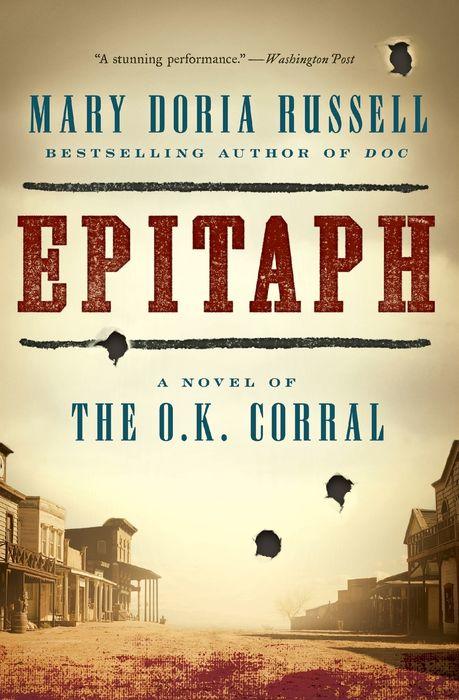
Epitaph, by Mary Doria Russell

Why this book Selected by my literature reading group, based on our appreciation for Mary Doria Russell’s The Sparrow, and Children of God, and our enjoyment of McMurtry’s Lonesome Dove last year. Also it is the sequel to the novel Doc which we read in conjunction with it.

Summary in 3 Sentences: This is a novelized version of the story of Wyatt Earp and his brothers, and Doc Holiday and the circumstances that led up to the gunfight at the OK Corral, what happened that day in 1881, and the brutality that followed it.  Russell says she did extensive research and her novel is based as best she can on the facts as she understood them, though there remains some controversy about many aspects of this legend.  The book concludes with “the rest of the story” about what happened to the main characters in the drama after that dramatic window of time in Tombstone Az in the 1870s and 80s.

My Impressions: I really enjoyed this book – it’s a fascinating period in our history, and these incidents did a lot to create and sustain the image of the Wild West that I grew up with.  Epitaph gives the reader a  look at life in a Western boom town in the 1880s, as well as the “pretty true” story behind the mythology that has grown up around Wyatt Earp, Doc Holiday, and the shoot out at the OK Corral.   Russell clearly did an amazing amount of research – in the acknowledgments she says she “absorbed nineteen linear feet of background books for this novel”  but she also spent a considerable amount of time in Tombstone and traversed on horseback some of the areas where her stories take place, noting that “the five day Wyatt Earp Vendetta ride was the hardest fun I ever had.”

This book flows and follows easily from Doc, though it’s not necessary to have read Doc to thoroughly enjoy the story, characters, setting and insights about life in remote Arizona in the late 19th century.  Epitaph includes just a few of the same characters as Doc, most notably the Earp brothers and their ladies, and Doc Holliday, but it adds many new and interesting additions to the story – people who were part of the historical reality that Russell is novelizing. 

The Story is about the characters and the setting and background that led up to the famous gunfight at the OK Corral, which mythology, several books, and multiple movies have dramatized and exaggerated over the 140 years since it occurred.  A lot of what has been written is conflicting, since there were many different agendas behind the retelling from various sources.  The movies naturally exaggerate and amplify those aspects of the story that will appeal the most to a public paying for a couple of hours of entertainment. In Epitaph, Russell takes the various versions of what happened in Tombstone in the 1880s, and the different stories about the lives of the characters in the drama, and distills them into what she believed was pretty close to the truth, and then with a bit of poetic license added color, context, emotions and dialogue that support the version that she is telling. And in so doing, brings the story to life.  

Epitaph begins describing the childhood of a young girl Josie Marcus, one of the key protagonists in Epitaph who later became Wyatt Earp’s mistress.  She grew up a Jewish immigrant in a NYC tenement and moved with her family to San Francisco. The story progresses by looking individually at several of the characters whose lives converge in Tombstone, and then we get to know the other players in Tombstone, as well as the politics and economy of the boom town, flush with money from recently discovered silver deposits, as well as an influx of ranchers and others hoping to strike it rich, or at least make a living.  Tombstone is rather chaotic with an under developed local government and justice system, and a very strong criminal element used to getting its own way.  All of those factors lead to the OK Corral incident and the bloodshed afterward.  We also get to know the various antagonists – the so called “Cowboys” who are rowdy criminals and cattle rustlers who are generally doing whatever they like around Tombstone and getting their way with impunity  – they have the local authorities intimidated, and the support of local ranchers who are benefitting from their cattle rustling raids into Mexico.

As the story picks up, the details and interactions between the close associates of the Earp brothers – there are four in this story – and the Cowboys led by the infamous Johnny Ringo get more intense as we approach the Ok Corral.  The actual gunfight itself goes pretty quickly – it is said to have only lasted 30 seconds, leaving Virgil Earp and Doc Holiday wounded and 3 cowboys dead.  But the story AFTER the gunfight is even more intense, as the Cowboys vow revenge on the Earps and Doc Holiday, and begin a campaign of disinformation about how it happened, who started it, and partly thru intimidation and disinformation, gain their allies.   Their cause is aided by the sheriff of Tombstone who is an ally of the Cowboys.

The Cowboys nearly kill Virgil, and they do kill Morgan Earp, and are intent on killing Wyatt and Doc Holiday.  At that point, Wyatt gives up on the justice system holding these murderers accountable, and decides to take justice into his own hands.  He, his brother Warren, Doc Holiday and a couple of their other allies begin what is referred to as a Vendetta Ride to hunt down the Cowboys. They do in fact kill three of them – and that is an engrossing part of the book. Wyatt is then indicted for murder but leaves Tombstone before he could be arrested, to follow Josie, his lover to San Francisco.

The last 50 or so pages provide a fascinating look at the lives of Wyatt and his common law wife Josie after leaving Tombstone.  By that time, the story of the OK Coral and Wyatt’s Vendetta Ride have already become mythology in America.  Wyatt and Josie are on the move, trying to make a living, establishing saloons and gambling parlors in numerous towns and cities, including heading North to Nome Alaska during the gold rush.  For a while, they are quietly out-running the legend of the OK Corral, while also looking to profit from Wyatt’s notoriety.  At the end of their lives, their health is failing, and they are strapped for money.   Wyatt is ill and Josie has symptoms of dementia as they’ve entered into the cinematic era.  They are approached by numerous authors and journalists wanting to interview them and write their story, but Josie insists that it be told in a way that leaves out anything she believes doesn’t reflect well on her or Wyatt.   Wyatt dies before Josie, who lives another 10 yrs campaigning to air-brush the truth about her and Wyatt’s lives in Tombstone, giving revised and cleaned up versions to authors and screen writers anxious to capitalize on the legends, to entertain America with a story America wants to believe. 

What I liked about Epitaph

  • The Writing This is the fourth book I’ve read by Mary Doria Russell.  I like her writing, her literary eloquence and how well she tells a story.
  • The History – I believe her version of the story of the Earps, Doc Holiday, Tombstone and the OK Corral are pretty accurate, and follow pretty closely the contours of the known history.  It’s fascinating to step back into that world, painted in pretty good detail by MDR in Doc and Epitaph.
  • The Context – What would it be like to live in a world with little law and order and that much corruption?  We certainly have places in America today that have a lot in common with Tombstone in those days – Chicago?  Baltimore?  How would I behave? What choices would I make?
  • The Characters –  I really liked the characters, and though MDR does well at giving them each a personality and character – the book could have been better (IMHO) had we gotten more deeply into the perspectives of one or two of the characters and seen the world more from their first person perspective.  The book is written from a narrator’s view.  
  • The Final Years – she took the story all the way to the end – the last years of Wyatt and Josie’s lives and we learned briefly about “the rest of the story” of other characters.  That took us into the 20th century – across that great transition in America from the Wild West of Tombstone and other parts of Arizona, to Los Angeles, Hollywood and the beginnings of the modern era. 
  • Relevance to Today – MDR made numerous comments that invited comparisons and perspectives to life in our world today.  These include the struggles of the poor especially in the big cities (NYC and San Francisco), how scandalous and false rumors spread in Tombstone, were believed and shaped the views of the public (similar to what social media does today),  how public anger can become infectious, build momentum, and motivate acts of violence, the role of the press in political activism and shading how events are perceived by the public,  and in Josie’s case, how dementia can amplify strong feelings that can fuel poor judgment.

    Just a few quotes that I liked and that represent Russel’s writing in Epitaph: 

  • A man might wind up in Texas for any number of reasons, but few of them were based on solid achievement elsewhere.  In Texas your Pilgrim Fathers were leftover Mexicans, a bunch of land hungry German immigrants, and hardscrabble Scotch-Irish backwoodsmen.  After the war, you added your white trash and bankrupt planters driven off their land by Yankee troops and carpetbagger taxes – all of them resentful about the way the war had ended. Of course, there were Yankees in Texas, too.  They were apt to be cheerful about the outcome of the conflict, but generally arrived in Texas just as broke….Round the population out with orphans, and runaways looking for others of their kind to gang with – Johnny Ringo was a fair example of that. Anyway, “failure” might be too hard a word for those who’d come west. Unlucky, maybe.  p144

  • Tommy sighed, for there are people – his brother <Frank McLaury.> was one of them – who can become so convinced of their own rendering of events that believing something is tantamount to proof.  Arguing only makes them dig in deeper.  p148

  • Bob Paul: “Crime is compounded by vengeance and brutality.  The law and its strict enforcement are all that separate civilization from barbarism.  That’s why I’m running for sheriff, Wyatt, and I’d like to have your support.”  There were very few men Wyatt Earp looked up to, morally or physically. Robert Havlin Paul was among them.  p 212
  • Seven years after the Crash of 1873….Do what works.  That was the motto. Grab what you can when you can. That was the plan.  It was not a golden age, as Mr Twain had recently pointed out, but a cheap and flashy gilded one.  A time of fakery and exuberant corruption, of patronage and cronyism, and every species of shameless self-seeking .  In such times, even honorable men give up trying to draw the line…p220
  • Sheriff Behan during the Vendetta Ride:  Even if he brought the Earp riders in, what good would it do?   The Arizona justice system was corrupt, top to bottom and all but impotent. Between allies and alibis, nobody was ever convicted of a serious crime. p 498
  • Opinions about the events in Arizona had divided predictably along party lines.  The  Earps were stage robbers, thugs, and murderers; Doc Holliday was worse than any of them, a  quarrelsome drunk and a killer.  Or, the Earps were incorruptible lawmen; Doc Holliday was their loyal friend, a gentleman, and a scholar. There was a reliable market for either version and editorials were easy to write. p520
  •  Doc Holiday; “I don’t believe I shall mind bein’ dead. Gettin’ there has been a trial.”  p526
  •  That’s when his <Bill Hart, movie producer> career really took off, for his films portrayed the Old West with a zeal for authenticity that was immensely appealing to those who were sentimental about a by-gone era, which had lived ugly, but read romantic and ennobling. p 550-51

Epitaph is a fun and captivating way to learn about Wyatt Earp, Tombstone and the end of the crazy Wild West era.  For those who’d like to read more about Earp, Tombstone, and the Ok Corral, I recommend Wikipedia’s article on Wyatt Earp, and  American Heritage’s article on Wyatt Earp .


Posted in Uncategorized | Leave a comment

Rogue Heroes – History of the SAS by Ben MacIntyre

Why this book: Selected by the SEAL book club I’m in.  I wasn’t keen on reading another specops book, but this one was really well done and enlightening.

Summary in 4 sentences; The book begins in North Africa, with David Sterling, generally recognized as the father of the SAS, coming up with a non-standard tactic for intrepid men like himself, who felt stifled by traditional military bureaucracy, to go behind Rommels forces and wreak havoc in their comfortable safe spaces in the rear.  The first half of the book is about their steep learning curve and accounts of their multiple successes as well as some of their tragic failures in North Africa.  In the second half of the book, the British Army and the SAS are applying their lessons learned in Africa against the Germans in Italy and in France, working with local resistance fighters fighting in Italy and in support of the D-Day invasion and the move through France to Germany. The book then moves to operations inside of Germany before the final surrender, and concludes with an interesting section about what happened to the many heroes in the book, after the war.  

The Book:  Copyright 2016, Paperback published by Broadway Books, 351 pages. 

My Impressions:  Rogue Heroes tells the improbable story of the formation of the SAS, their initial challenges getting started, and provides great stories of brave men breaking new ground in warfare,  conducting daring operations behind the lines in World War 2, the likes of which I have never heard of or read before.  There have always been daring commando units; what was new here, was small units over months and years, successfully applying stealth, surprise, and hit and run tactics to destroy supply lines and disrupt enemy operations,  against an enemy as powerful and sophisticated as the Wehrmacht, in an environment as unforgiving as the North African desert, in a war with new technology on both sides.   

MacIntyre was the first author given access to the SAS war diaries for his research.  He not only had access to the facts, the archives, and other documents, and did extensive additional research not only on the operations conducted, but on the individuals who conducted them.  And importantly, he is a great story teller.  This book is a great read and was hard to put down.  

In the early days of the SAS, there was a steep learning curve.  Parachuting was a new tactic, and they made a number of serious and sometimes tragic mistakes in learning how to apply it to their needs.   Using vehicles to insert commando raiding forces over hundreds of miles of desert required learning new lessons from the beginning, many the hard way.  They also established their own operating bases behind enemy lines and operated out of them for weeks, vulnerable to air reconnaissance and attacks, as well as betrayal from indigenous herders.  They lost many men in learning their painful lessons, but they kept at it, focused on the mission, the enemy, and learning from their mistakes.  Eventually they started racking up enormous successes, way out of proportion to the size of their force.  And they never stopped having to fight the traditionalists in the British Army who felt that what they were doing was somehow not proper, not sporting, not….military.  

MacIntyre gives us a look at the men who made up the SAS in these formative years – their quirks and strengths, their fears, and weaknesses, their backgrounds and personalities – and this makes his stories that much richer.  We follow several heroes until they are killed or captured – and only a few of the originals were leading and fighting with the SAS through to the end of the war.   Many of them then struggled after the war to find a life and an environment that was as engaging as being an SAS commando fighting alongside similarly motivated men, against an evil foe.  Navy SEALs and Army Special Forces operators often have the same challenges upon leaving the military – some adapt well, many do not. 

At the conclusion of the North Africa campaign, the SAS had to shift focus to support the main allied effort against the Nazis in Europe.  It took the SAS some time to adapt their desert tactics to fighting the Nazis in Italy and France – in much closer proximity to conventional forces and civilian population centers.  They played key roles in support of conventional operations in Sicily, and afterward in support of the allied campaign to defeat the Germans in Italy.  Then later, MacIntyre gives us stories of SAS teams parachuting behind German lines in support of the Normandy invasion, and then continuing operations in different parts of France supporting the French Maquis – the French Resistance – attacking supply lines and creating havoc in the Wehrmacht’s rear, as Allied forces drove the Wehrmacht out of France and across the Rhine into Germany.   This was a very different type of warfare, and it took some time to learn to  fight along side and in support of  maquis operations.   Developing trust with the maquis was often a challenge – there were informers everywhere, and they were often compromised with tragic results. 

Hitler’s Kommandobefehl issued in October 1942 directed that any allied forces captured doing commando operations behind German lines were to be immediately executed, even if in uniform and surrendering.  This meant that any captured SAS operator had no Geneva convention or POW rights, and many SAS operators were executed under this order.  The Nazis were also exterminating entire villages in France as reprisals for SAS operations, on the assumption that French Resistance had assisted.  This did not inspire the SAS to take prisoners or treat German prisoners with Geneva Convention protocols, though they often did.  At this phase of the war, the Nazis were increasingly desperate, and the killing became more vicious, cruel, bloody and brutal.  

Some of the parts of this story that resonated with me and my time with the SEALs (though I have never been, nor have any SEALs I know ever been in a war as all-encompassing and brutal as WW2).

  • RESISTANCE from CONVENTIONAL FORCES. David Stirling faced stiff resistance from the staffs of conventional forces to his proposal to create a specialized commando raiding force.  He referred to these staff officers as a “freemasonry of mediocrity” and “layer upon layer of fossilized shit.”  Establishing the SAS required General Auchinleck, Commander in Chief of Middle East Command, to over-ride his staff officers, who hated that an upstart young 1st Lt would be allowed to create a unit of what they saw as renegade, ill-disciplined commandos, not required to submit to the rigid standards of in-garrison military discipline. This challenge is familiar to all special operations forces and inhibited the development of Navy SEAL forces for decades.  Just like for the SAS, the establishment of the Navy SEALs required a few imaginative senior leaders to over-ride the resistance of their conventional staffs.  This story for the Navy SEALs is beautifully told by Ben Milligan in his book:   By Water Beneath the Walls.  
  • THE MEN WHO VOLUNTEER –  The men who volunteered for the SAS knew they were volunteering for hazardous work against a brutal enemy, to operate often unsupported behind enemy lines, and while in garrison, receiving poor logistical, food, billeting and other support, and few of the amenities that are available to most conventional forces.  This has been the case when volunteering for special forces in the US and in the case of all elite forces I have worked with, especially in Europe. 
  • SCREENING and THE NATURE OF THE TRAINING. Screening of potential SAS operators didn’t appear to be very sophisticated.  Most importantly they had to volunteer, and have a reasonable idea what they were volunteering for.  Many were recruited based on personal reputation and connections with those already within the SAS, and  a brief interview.  It didn’t appear that there was a physical or fitness test.  Physical and mental fitness were determined during prep training – those who were not be mentally or physically fit enough or otherwise didn’t fit, either dropped on request, or were not allowed to go on operations. This is not unlike the screening in the early days of UDT and SEAL training, or as I understand it, Special Forces training.   A candidates performance during basic training was the primary screening tool.  Today most Special Ops Forces have  extensive and sophisticated screening protocols to best determine who will succeed as a Special Operations operator or leader PRIOR to beginning basic training. 
  • ETHICS ON THE BATTLEFIELD – The SAS killed or wounded hundreds of Wehrmacht soldiers during their operations.  MacIntyre related several cases when they did killing that some felt was not strictly necessary,  and there were mixed feelings about that – many were uncomfortable with killing that wasn’t critical to the success of the mission. Later, when fighting in Europe and after Hitler’s Kommandobefehl was in full force, it became more difficult for SAS leaders to enforce discipline on SAS troops when taking German prisoners.  MacIntyre notes how “The distinction between rough justice and murder was blurring” and “an eye for an eye brutality <was> met by greater brutality…The gentlemanly, jovial, dangerous, and exciting warfare pioneered by Stirling was evolving into something harder and cruder under the pressure of  long and horrific conflict.” p271
  • POST TRAUMATIC STRESS – MacIntyre concludes the book with a chapter entitled “Afterlives” in which he gives us brief post-war biographies of the many SAS operators who survived the war.  Many did not do well adapting to peacetime and civilian life.  Many had internal demons which gave them the energy and drive they harnessed to fight and survive against an implacable enemy during the war, but which after the war, were much more difficult to deal with. Paddy Mayne, one of the SASs’s key leaders had, according to MacIntyre, “enough internal demons…to populate a small hell,” (p272) and after the war “drank far too much, and not happily.” (p346  He was not atypical.  This has been an issue after any war; Britain had struggled with this phenomenon after the first World War, as soldiers in the US, Australia and other countries are struggling with it now after nearly 20 years of war in Iraq and Afghanistan.  

This book is not only a great compendium of stories of acts of heroism by brave men in war, but also a clear-eyed look at the types of men who repeatedly volunteer for and conduct very high risk operations in small groups, unsupported in the enemy’s back yard.  It is an excellent look at the beginnings of one of the world’s premier special operations units, but also a look at special operations in general – capabilities, limitations, and possibilities.  

Posted in Uncategorized | Leave a comment

The Intention Experiment, by Lynne McTaggart

Why this book: Selected by one of the book clubs I’m in at the strong recommendation of Jay.  So we all read it, and it has generated some great discussions, and it will continue to do so. 

Summary in 3 Sentences:  The basic theme of this book is that there is scientific evidence that supports the proposition that has existed for millennia in native cultures and even in religious traditions, that with intense thought and focus (eg, prayer, chants, rituals) we CAN and do impact the world around us.  And that we are all connected  and are always communicating with and affecting each other in subtle ways of which most of us are not conscious and which science is still trying to understand.  Though most of the book explores the wide variety of scientific experiments intended to explore and better understand such psychic phenomena as psychic healing, psycho-kinesis, and the impact of thought and intention on the world outside of the individual’s own thinking or intending, she also looks at some of the metaphysical and moral implications of what scientists are uncovering.  

My Impressions:  Fascinating book, written for the educated layman who is interested in, and open to the idea that reality may be more complicated than Newtonian physics implies, and that it is worth exploring the implications of phenomena which are not explained by traditional laws of physics.  The “experiment” in The Intention Experiment refers to a series of experiments that have been taking place for decades and are continuing, that explore uncanny connections between living organisms and even inanimate objects that defy rational (by current standards) explanation.  At the end of the book she invites the reader to participate in ongoing and planned experiments.  She explores and describes experiments that seem to validate that our minds, with focused attention have an impact outside of and beyond the thinker him/herself.  “Even your current state of mind carries an intention that has an effect on life around you. The mind continues affecting its surroundings, whether or not we are consciously sending an intention. To think is to affect.” p155

The Intention experiment begins with a look at quantum theory, describing some of the experiments and observations that indicate that what we believe regarding space, time and relationships between individual people and objects, is not as it may seem.  Quantum reality, the book argues, includes a network of subtle energetic connections between all things – alive and even inanimate – a rather daunting proposition.  That idea sets up the following chapters which describe experiments that explore the implications of the statement that “Every organism, from bacterial to human beings appears to be in a perpetual quantum communication.”  

What does that mean?  McTaggart systematically explores dozens of experiments in which physicists, psychologists, scientists from a number of disciplines try to measure and replicate these strange phenomena that would seem to tell us that people and things have connections we don’t yet see or understand.  Shamans, psychics, and religious leaders over the millennia have always “known” the power that some people have of using focused thought, prayer, rituals, and strong intention to affect outcomes in the physical world in ways that have been inexplicable to Western science.  She describes how we are all caught up in a web of “quantum entanglement” which transmits energy between people and objects in ways we don’t yet understand, and which she says, “could well be the key to life itself.” p11. The Intention Experiment surveys the scientific efforts to explain and better understand these phenomena.  It is very well footnoted, for those wishing to know more about the experiments she describes.

One of the early efforts to measure these psychic connections came after, Clive Backster, one of the early developers of the polygraph, on a whim hooked up his sensors to a plant and found that the polygraph indicated that the plant responded to physical distress similarly to how humans respond.   But what truly surprised him was that it also responded to intention as yet unexpressed, and that time and distance didn’t seem to matter.  “At the very moment that he had the thought, <to burn a leaf> the recording pen swung to the top of the polygraph and nearly jumped off.  He had not burned the plant; he had only thought about doing so.  According to his polygraph, the plant had perceived the thought as a direct threat and registered extreme alarm.” p37  When he changed his mind and decided not to burn the plant, the polygraph went back to normal.  The Intention Experiment describes a multitude of experiments that further explore the implications of Backster’s experiences. 

The Intention Experiment covers a lot of ground.  It describes experiments in which people’s bio-physical processes came into synchrony, how clocks in the same room would eventually synchronize and stay synchronized. She has a whole chapter which explores what she calls “The Voodoo Effect” – intending negative effects or harm to another.  She looks at the implications of how the art of visualization can affect outcomes and other people.  She also looks at the  mysteries of remote viewing, and the implications of people able to “see” places they’ve never physically been.

She also explores another aspect of “non-locality” not only in space, but also in time – a concept which still confuses me. Scientists are challenging such foundational principles as cause-and-effect, and she looks at what is called “retro-causation” – how the future may impact the present, and how we now, with intention,  might impact the past.  (yep, I’m confused too, but theoretical physicists are convinced that time and space are not stable truths in the universe.)  There have also been experiments that show that psychic, psychokinetic and healing outcomes are also influenced by fluctuations in the earth’s magnetic field and by sunspots and other such esoteric phenomena that also affect other energy sources on the electro-magnetic spectrum.  This has led to scheduling such experiments around these variables. 

The book explores “faith healing” and describes experiments that attempt to validate (or not) whether and how prayer or focused intention can heal the body – not only of the person praying, but remotely of another person separated in space.   She’s found that someone else’s healing intentions for us may be as powerful as our own.  McTaggart explains efforts to find the variables – such as the well-being of the healer, whether the healer and person being healed have a shared belief system, variables such as time, distance, the placebo effect, the electro-magnetic spectrum, sun spots, etc   She also explores what well known healers say about what they do, how they do it, why they think it works, and what might be impediments to building connections that can have a positive effect on the person being targeted.   After looking at her evidence, her conclusion: “Repeatedly, the mind has proved to be a far more powerful healer than the greatest of breakthrough drugs.”  p195

The last chapter of the book, written in 2007, describes future experiments and invites the reader to participate. Her research shows that in general, a group of people desiring a specific outcome with focused and coordinated attention, seems to have more power and impact than a single person.  When she wrote the book, there were ongoing efforts to recruit people to focus attention on a specific desired outcome, at a specific time, to concentrate and coordinate efforts to further test and better understand this phenomenon.   For those interested in participating, she offers up the website theintentionexperiment.com, which I found does not work in 2022, but to get updated on what she’s doing, lynnmctaggart.com does work. 

HER BOTTOM LINE: 

“Our definition of the Universe as a collection of isolated objects, our definition of ourselves as just another of those objects, our most basic understanding of time and space, will have to be recast. At least forty top scientists in academic centers of research around the world have demonstrated that an information transfer constantly caries on between living things, and that thought forms are simply another aspect of transmitted energy.   Hundreds of others have offered plausible theories embracing even the most counterintuitive effects, such as time-displaced influence, as now consistent with the laws of physics.”  p194

Implication: “All these possibilities suggest that we have an awesome level of responsibility when generating our thoughts.  Each of us is a potential Frankenstein, with an extraordinary power to affect the living world around us. How many of us after all, are sending our most positive thoughts?  p144

MY BOTTOM LINE – McTaggart tries to be even handed and objective in making her case, though she is clearly a true believer – and her book and views have credibility with me.  I have long believed in such phenomena, and that there is an “unseen order of things” which drives the world we experience every day.   I must admit however that I have not “operationalized” this belief – that is, built it into an active principle in my life.  Reading this book has inspired me to further explore how focused attention, prayer, visualization, strong intent in my own life might help me make the most of the time I have left – for myself and others.  Because I have dabbled in this area over the decades, I have found a number of books in my library which speak to McTaggart’s thesis, most of which make little effort to explain their positions scientifically, rather, merely state their “truth” and give examples that support it.   That said, what these books claim about reality and peoples’ ability to influence it, and what Mctaggart’s book explains are in almost perfect harmony.  If you are interested in what books I am referring to, contact me.  


Posted in Uncategorized | 2 Comments

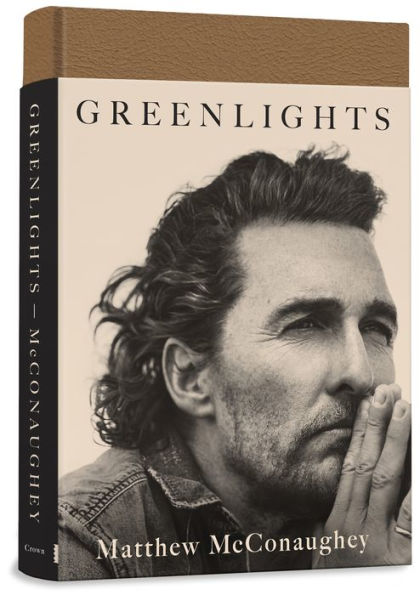
Greenlights, by Matthew McConaughey

Why this book: I read an interview with McConaughey in the NYT, sent it to my friend Jay, and he and I decided to read it, and decide whether it might be a good one for a book club we run together. We both said “Yes!”

Summary in 3 sentences:Matthew McConaughey’s personal memoir from when he was a child, through adolescence and into his early years breaking in to Hollywood.  He shares his struggles, his lessons learned, his lucky and unlucky breaks and the path that led him to become one of the most successful male actors in Hollywood.  But it is also about his personal journey to grow, mature, and distill wisdom from his journey, to include his family, friends and starting his own family – a personal, intimate and fun adventure

My Impressions: Before I started to read the book, my friend Jay strongly recommended that I listen to it, as McConaughey reads it himself – in fact, I’d say he performs it!  And indeed, he is quite a story teller, not just the stories but the way he tells them makes the audible version worth considering.  But this memoir is more than stories – he distills from his pretty crazy experiences life-lessons that apply to all of us.  It is a fun read, with humorous and often profound insights from stories well-told – an engaging look inside the life of a 50 year old man who has done much of what most men can only dream of.  But it all didn’t come easy – he took chances, and followed his heart, often against conventional wisdom, and at least so far, it seems to be working out well for him.  And he clearly enjoys sharing his story with us.

MM had been keeping a diary of his experiences and insights since he was a teenager, and he used these diaries as a basis for this memoir.  The insights and epiphanies he had recorded along the way he shares with us, with the sensitivity and perspective that comes with age.   Many of his insights he calls “bumperstickers” – easy to remember heuristics that provide guideposts for life.

What is a “greenlight?”   It’s a signal that says “Keep moving”  – in his words, “an affirmation of our way. They’re approval, support, praise, gifts, gas on our fire, attaboys, and appetites…health, success, joy sustainability, innocence and fresh starts. We love greenlights….<but> greenlights can also be disguised as yellow and red lights.  A caution, a detour, a thoughtful pause, an interruption,…sickness and pain.  A full stop, a jackknife, an intervention, failure, suffering a slap in the face, death.  We don’t like yellow and red lights …They say no, but sometimes give us what we need.”  p 13  MM’s book is about greenlights -some of which started out as yellow or red, but he turned them green.

He begins with his youth growing up in small town Texas with a strong, autocratic and traditional father who ruled the house with an iron fist.  And likewise a strong and opinionated mother, and of course, that meant sparks in the marriage.  His parents married three times, divorced twice.  Some of his strict Texas upbringing is disturbing at first, but over time it seemed to work for MM and his brothers, as they grew up strong and resilient, with strong values of courage and independence. 

He was a wild, rambunctious, and creatively “naughty” young man, but he also did well in school.   One of the best stories of his early life was when he was accepted into a Rotary Club overseas High School exchange program to study in Australia,  under the condition that he guarantee that he would stay the full year.  He arrived in Australia, and found himself placed in a rural community, with an eccentrically conservative family, who were intent on molding him to fit their very strict values and ideals.  That story, and how he dealt with it, is itself worth the price of the book.

He tells how he eventually stumbled into acting, how with some luck, perseverance and hard work he got his first minor film roles, and then his breakthrough in A Time to Kill.   He shares how overnight, he went from a nobody on the street to a celebrity recognized wherever he went, and the impact that had on him – good and bad.  

He kept getting better parts and became a huge success in the Romantic Comedy genre – which he said was fun and paid well, but after a while, he got bored with RomCom parts.  When it seemed that those were the only roles he was being offered, against the advice of almost everyone, he took a chance and quit accepting them.  That led to a long dry spell – before he eventually got roles that he found interesting, challenging, and fit more with what he wanted to do.  Then  Dallas Buyers Club came along.  To prepare for that role he went from 182 to 135 lbs to play the role of Ron Woodruff.  He won an Oscar for his stunning performance in that movie.  True Detective with Woody Harrelson won him even more respect, accolades  and satisfaction.

He also shared how every couple of years he would be inspired to just take off,  alone, and explore the world and himself – doing what he called a “walkabout.”  He went to remote parts of Africa and Peru, following guidance he’d gotten from a rather bizarre recurring dream.  In one case, he went to stay in a very remote monastery in Arizona to figure out some things that weren’t coming together for him in his life.  To me, his impulse to step away from the glamour and fun, off the conventional path and explore other worlds and his own consciousness and life, is a big part of what I respect about him. And I believe these trips were key to his willingness to be vulnerable and share intimate as well as entertaining aspects of his life.  

Toward the end of the memoir, and certainly after scores of romantic and otherwise erotic adventures, MM meets a woman who inspires him in new and different ways, and with whom he wanted a longer commitment.  He shares how that happened, as well as what it meant to him to become a father and a family man.  Great stuff for one who had taken advantage of the opportunity to milk all that life could offer a good looking, healthy, famous, and adventurous single man. 

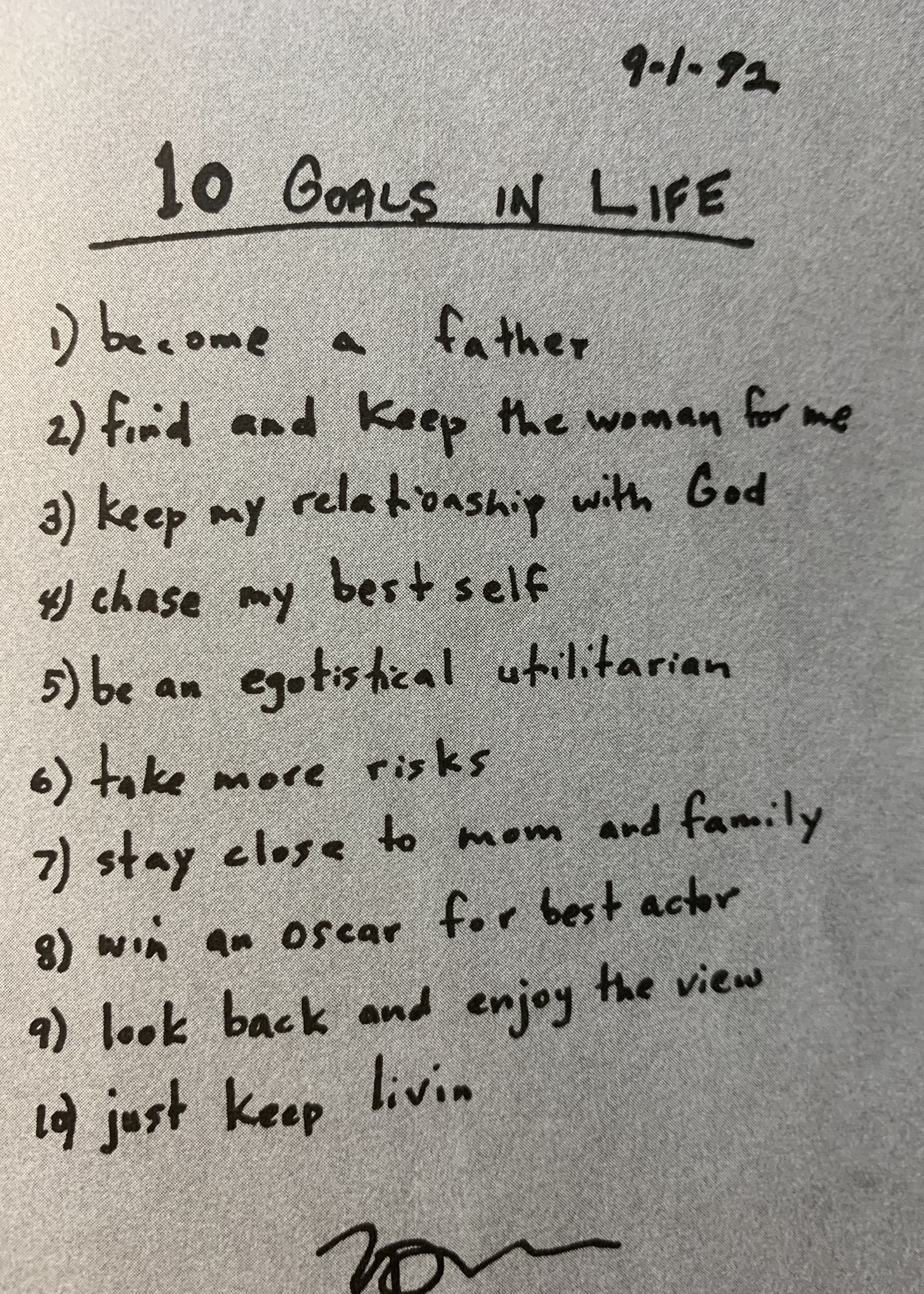
In the print copy, many of his words-of-wisdom, insights and bumper stickers are photos of his own notes in his own handwriting from his diaries.  I loved how he concluded Greenlights with a note he says he found  “in a pile of my journal-buck-slip-napkin-beer coaster notes and scribbles.  I’d never seen it since I’d written it…two days after finishing my first ever acting role as “Wooderson” in Dazed and Confused. Fourteen days after my dad moved on.” 

Talk about “Write it Down, Make it Happen!”  This is an amazing case of life following his intention: 

Loved this book – will listen to it again – lots of fun and wisdom here – a pretty damn good combination! 

Posted in Uncategorized | Leave a comment

Doc, by Mary Doria Russell

Why this book: Selected by my literature reading group, based on our appreciation for Mary Doria Russell’s The Sparrow, and Children of God, and our enjoyment of McMurtry’s Lonesome Dove last year.

Summary in 4 sentences: Doc is a biographical novel of John Henry  “Doc” Holiday and his life up until 1881 when his close friends ,the Earp brothers were planning to leave Dodge City and move to Tombstone, Az.  Doc Holiday grew up in Georgia, had a classical education, attended University in Pennsylvania, but upon returning home to Georgia found that he had Tuberculosis – from which his mother died, so headed West to where the air was drier and he may have a better chance to live with or even beat his disease. The majority of Doc takes place in Dodge City and is an account of how a well-educated and cultured man adapted to the culture and people of a town on the edges of civilization, his relationships with the people there, his struggles with his tuberculosis.  Russell’s novel is based on extensive research on the people, times, and location, and her intent was more to be true to the people and their times, than to create an exciting, page turner novel. 

My Impressions: I really enjoyed reading this book, though it won’t be everyone’s cup of tea.  I love Russell’s writing, how she filled out the characters and created a realistic picture of the world of Dodge City, which I found really interesting. 

Doc is a novel more in the form of a “doc”udrama, than a story using the traditional beginning-middle-end formula.   In novelizing Doc Holiday’s biography, Russell paints a picture of the characters of a few well-known figures in American folklore, that is very much at odds with the mythology that has come down to us, mostly thru dime-novels and television. She also provides a series of vignettes in the lives of those characters, which bring the town of Dodge City to life and makes it more real than the “wild west” popularized on TV. 

I just watched the 1939 movie “Dodge City with my mother, starring Errol Flynn and Olivia de Havilland, both well coifed and beautifully dressed in tailored western chic.   Flynn plays the role of Sheriff Hatton, doing much of  what Wyatt Earp did in real life – cleaning up Dodge City, which is wilder, and much more violent than what is described in Doc.    Olivia de Havilland is his virtuous and beautiful love interest whose heart Flynn (naturally) wins in the end.  My mother’s favorite TV show is Gunsmoke, also set in Dodge City in the 1880s and she still watches reruns daily.  Sheriff Matt Dillon runs the town like a wise, benevolent and well respected cacique.  These are but two examples of how Hollywood has mythologized Dodge City, and part of what inspired Russell to write a novel that rings much closer to the truth.  

In Doc, Russell’s Dodge City did include rowdy cowboys getting paid after months on the trail, getting drunk fighting, whoring, and shooting up the town. But it was a lot tamer than in the movie Dodge City.  Doc also included all classes of people making lives for themselves, as one would expect in any small frontier town far from the resources of civilization.  There is small town political intrigue, people struggling to survive, dealing with prejudice and racism, and tragedy.  The moneyed few had conflicting visions of how Dodge City should evolve, and they struggled with each other as they sought to steer the town and its laws in directions that favored their interests. 

Though he was young and consumptive (tubercular,) Doc Holiday became a prominent figure in Dodge City because he was unique. I found him to be the most interesting and compelling character in the novel  – a charming and very polite southern gentleman, the best educated man in town, a caring and generous dentist,  an excellent card player and gambler, a quick wit, quick on the draw, and with a multitude of surprising talents.  He was Stoic in dealing with his tuberculosis and other misfortunes. He rarely lost his equanimity, but when he did, and sometimes for what seemed like an insignificant slight, it was intense, and people paid attention. 

Doc Holiday was not ambitious for money or power – he knew he didn’t have long to live and had other values to live by.  He came to Dodge to set up a dental practice – the first and only one in the region, but had to become a gambler to earn enough money to live.  When on occasion he became financially embarrassed, his partner Kate was able to bail him out.  He befriended the Earp brothers who were established in the town – Wyatt and Morgan as deputy sheriffs, and James who with his wife, ran a bordello.

Doc’s paramour Kate was was also an intriguing character.  Born into European aristocracy, classically trained, she found herself with no way to make a living other than to rent out her body, and she continued to work as a prostitute with Doc’s full knowledge, while also being Doc’s companion, and when he was sick, his caregiver.   She was highly opinionated, mercurial in her moods, and nobody’s fool.  She was what one today might call a “wacko” and I liked her. She and Doc often conversed in French or Latin. 

Doc’s relationship with his companion Kate was a fun roller-coaster ride – they often fought, and their partnership was an on-again-off-again affair – she would leave him, and then come back.   Likewise,  we got to know James Earp and his prostitute wife Bessie, running the “best” whorehouse in Dodge City. Morgan Earp was easy-going and the most likable of the brothers, and shacked up with his gal Lou, also a former prostitute.  Wyatt Earp struck me as a different incarnation of Cal from Lonesome Dove; they are cut from the same cloth. But unlike Cal, Wyatt did have a gal, Mattie Blalock, also a former prostitute, and like Cal, he struggled to understand and relate to women.

I enjoyed stepping back 150 years to spend time with these folks and immerse myself into the life of Dodge City.   In Russell’s final chapter “The Bitch in the Deck,”  and in her author’s note and interview at the end of the book, she provides amplifying historical background, details and context to the characters she portrays in Doc.

A couple of other aspects of this book that appealed to me:

REAL CHARACTERS – At the front end of the book Russell gives us a list of all the characters – including horses – in the book, and italicizes the few that are fictional. The vast majority are historical and she based her portrayal of them on what she was able to find in the letters and other records she researched.

LANGUAGE – When writing in her own voice, Russell adjusted her language as much as possible to the language of the 19th century midwest.  The cowboys and midwestern characters in her book also spoke in earthy and simple American prose.  Doc himself speaks in the language of a well-educated southern aristocrat – eloquent, refined and delightful.

RACE – two important characters in the book are fictional: John Horse Sanders a mixed race Native/African American young man, and Jau “China Joe” Dong-Sing, one of the many Chinese who immigrated to the US to do manual labor.  Their experiences reflect how in that time and place, non-whites had few rights, and were considered by many as free game and easy prey to any nefarious characters who wanted whatever they had.

PROSTITUTION – Many of the female characters were prostitutes and most of the male characters patronized them in the various bordellos in Dodge City.  The sex trade was open in much of America at that time, and was just part of the background noise in Dodge City, though the prohibition movement  also gathering steam at that time, was also targeting prostitution. All the Earp brothers’ partners  had been and a couple still were  prostitutes, renting out their bodies to men, to make a bit of extra money.   A single woman didn’t have many options in Dodge City in the 1870s, and in an economy built largely on spendthrift cowboys at the end of a cattle drive, prostitution and gambling were lucrative sources of income for many who were struggling to survive.  

DEATH Doc had watched his mother die of tuberculosis and he knew that his disease would also be terminal.  Russell makes clear that his disease was often excruciatingly painful.   But he soldiered on and did his best to not let it slow him down.  At one point in the book, Doc appeared to be on his death bed, and his friends put up a death watch to protect him and provide anything he needed in his final days. Eventually he recovered, but he knew it was just a short reprieve; sooner rather than later, his time would come.  His tuberculosis, and knowing that his time was short colored all that he did.   Russell has a great section on death and hope on page 289

MUSIC – Doc was a truly accomplished pianist in his youth, but never played in the bars or bordellos, of Dodge City because, he said, the pianos were all out of tune.  At the end of the book, Bat Masterson threw a big party, and Kate had a good piano brought in.  Doc finally sat down and played his favorite piece, The Emperor Concerto by Beethoven.  Those present didn’t even know he could play the piano and were stunned by his virtuosity – and for Doc, it was an almost other-worldly, ecstatic experience.   This scene was powerful, and moved not only all those at the party, but me, the reader. 

A few quotes from the novel that caught my eye: (page numbers from paperback edition shown)

“Dodge City had a single purpose: to extract wealth from Texas…there was really only one rule to remember. Don’t kill the customers.  All other ordinances were customarily negotiable.  p28-29

Doc: “Nora honey, I’m perishin’ for a dish of peaches in cream.  Will  y’all join me?”  p 93

Doc: “Do tell sir!  We are agog with anticipation.” p105

Doc to Father Angensperg:  “You heard Chopin?  I am prostrate with envy, sir!…We are an atoll of culture on this godforsaken ocean of grass.”  p107

It would be nearly a century before proper police procedure for handling crimes went much beyond (1) arrest a suspect within a few hours and (2) beat a confession out of the bastard.  p189

Doc: “We are none of us born into Eden. World’s plenty evil when we get here. Question is, what’s the best way to play a bad hand?  Abolitionists thought that all they had to do to right an ancient wrong was set the slaves free.  Trouble was, they didn’t have a plan in the world for what came next. Cut ’em loose. That was the plan. Let ’em eat cake, I guess.” p259

Nine out of ten Lakota died of tuberculosis in those days….p282

She was the last person in Kansas anybody should feel sorry for, given that she was tolerably pretty and her daddy was indecently rich and her whole life was laid out before her like a banquet on a fine lace tablecloth, and yet….p295

Hope smiled. The Fates laughed.  p295

Wyatt Earp thinking to himself:  Farming is a suckers game. You can work like an ox – put everything you’ve got into the land – but if the weather doesn’t break you, the markets will.  p 308

They had come to believe that combat and commerce presented similar challenges and drew on similar talents;  the tactical brilliance Elijah Grier displayed in battle had made Bob Wright an astonishingly successful entrepreneur. Others saw risk and danger; they saw openings and opportunities.  Others stood stunned in the face of shifting complexity; they cut through to solutions that seemed to arise without thought or effort. p 319

Doc: “Toujours l’audace!”

Doc:  “A gentleman is judged by the  way he treats his inferiors, sir.” p324

Doc: “Ovid tells us that Fortune and Venus befriend the bold.” p326

Doc: “Flaubert tells us that three things are required for happiness: stupidity, selfishness, and good health. I am an unhappy man…’ p344

In a standup contest, remorse and self-loathing can battle whisky to a draw. 356

The Milky Way was strung across the sky like the diamond necklace of a crooked banker’s mistress. p379

Posted in Uncategorized | 1 Comment

Alexander Hamilton, by Ron Chernow

Why this book: I was so impressed with Chernow’s biography of U.S. Grant that I wanted to learn as much about Hamilton, of whom I knew little, in the same voice. It was a good call.  Since I was already “reading” a couple of other books, I chose to listen to the audible version of Alexander Hamilton.  I have the written version as well, but the audible worked well for me – it is well read and was enjoyable tolisten to.

Summary in 3 Sentences:  Alexander Hamilton is a well researched and beautifully written chronological biography of Alexander Hamilton, from his childhood,  to his coming to America, his role in the revolutionary war and then his rise to become one of the pre-eminent men in the early days of our republic.  It is not a short book at 730 pages, but it flows well, is easy to read, and is well worth the time to learn not only about this remarkable man, but also, thru the lens of his life, about the early days of our country.  Chernow quotes someone as saying that while Washington was the father of our country, and Madison the father of our constitution, Hamilton was the father of our form of government.  

My Impressions: Another “Wow!” biography by Ron Chernow.  I listened to his biography Grant just last month and was so impressed with the way  Chernow told the story,  I decided right away to listen to him tell the story of Alexander Hamilton, about whom I knew little – only that he was an important “player” in the early days of our country, is considered one of our “founding fathers,” and that Aaron Burr killed him in a duel.  In this book Hamilton’s life is a fascinating lens through which to look at the early years of our country, from the 1770s until the early 1800s. 

After listening to Chernow tell his amazing story, I’m not only much better informed about the stormy beginnings of our country and form of government, but I also have a much better appreciation for the characters of not only Hamilton, but also of other iconic figures, such as Washington, Jefferson, Madison, Monroe – their quirks and personality differences, them as courageous but fallible men, and the often vicious differences between some of them in the early days of our country.

As in Grant, having listened to the book, on my bike, in my car, on walks, I have no notes or marginalia to remind me of what I read. I will say that Chernow’s command of the English language is stunning – and the elegance of the language used by our forefathers, in the days before TV,  radio,  mass media, and other homogenizing influences on our language, is also an aesthetic pleasure to listen to.  Would that I had that eloquence at my fingertips for my writing and self-expression as did Hamilton then, and as does Chernow today.

Three key takeaways from this book before I try to recount a few interesting things I learned about Hamilton’s life: 

  • First, the importance of Alexander Hamilton in the formation of our country can hardly be overstated.  Hamilton studied other forms of government, and articulated a vision for a new American government, and then played a key role in creating a government that was a unique hybrid of the other forms he’d studied, with his own ideas.   He also founded what became the US banking system, created the US mint, developed processes for the government to borrow money and manage debt, work economically with the private sector, and more. All this against significant opposition from Jefferson, Madison and others who advocated for an America that was more simple and rural and primarily agricultural.   He was also one of the strongest early anti-slavery voices in America.  As noted, his influence can hardly be overstated. 
  • Second, Hamilton was at loggerheads with Jefferson and Madison for much of the last 20 years of his life.  He was allied closely with Washington, and insisted on an executive branch that had some authority and power, and would not be emasculated by the varying passions and fads coming from the legislative branch.  Jefferson and Madison opposed both Washington’s and Hamilton’s vision, but Washington’s stature was such that he could not be attacked, so they went after Hamilton, and accused him of wanting to establish an almost monarchical executive branch, with quasi-dictatorial authority.  The antipathy between Hamilton and both Jefferson and Madison was initially a political/philosophical disagreement, but devolved into personal and vicious attacks.  Chernow in his telling, doesn’t spare Hamilton’s excessive zeal for some of the blame in the viciousness of these disputes,  but he clearly is not an admirer of Jefferson nor Madison in the evolution of their dispute. 
  • Third, the antipathy between Federalists and Republicans presaged today’s political polarity.   The differences between the Federalists, of whom Hamilton was the key and most articulate and visible leader, and the Republicans, represented primarily by Jefferson and Madison were as polarizing to the country as our current disputes between the right and the left.  The Federalists believed strongly that a strong central government was essential to keep the new country united, to represent it internationally, and to enforce the best interests of the whole over the parochial interests of the states.  The Republicans wanted most governmental power to rest with the states, and for the federal government to be a weak arbiter in disputes between states. Slavery was a huge question even at the beginning of our nation, and the Republicans wanted to protect the practice of slavery in the South, from the abolitionists in the North.  Chernow is quick to point to the hypocrisy of Republicans who claimed to advocate strongly for human and state’s rights, while owning hundreds of slaves themselves, though even some Federalists who claimed to be abolitionists, wouldn’t give up their slaves.  

Below are a few key perspectives on Hamilton’s life which were new to me and that I found most interesting.

  • Early years Hamilton was born in Charlestown on the small island of Nevis in the Lesser Antilles, out of wedlock, and bounced from relative to foster parent around the Caribbean.  From early on, he was precocious and resourceful, learned and spoke fluent French as well as English, worked as a clerk as a young teenager, helping his mother to survive.  It was a humiliating struggle which shaped the rest of his life.  He was an ardent autodidact, observing, reading, learning all he could, impressing many.  He experienced poverty, but as a white Englishman, was still privileged compared to how blacks and natives were treated, which appalled him.  His precocity was recognized and he was sponsored and sent to be educated in the English North American colonies.
  • Middle Years and the Revolutionary War.  Arriving in NY area in his mid-teens, Hamilton attended a prep school, and then Kings College (now Colombia University) in NYC.   There he became a star student writing opinion pieces under a nom de plume, and a passionate orator, arguing for resistance to unjust laws the English were imposing on the colonies and writing .  From early on he had a gift for passionate oratory, which won him admirers among those seeking independence, but hatred enmity among the Tories.  When war broke out he was quick to volunteer to fight.  He dearly wanted to be respected as a war hero and his brazen courage and intrepidity were soon recognized and he was promoted and given increased responsibility.   But his administrative skills were unique,  and still in his early 20s, he was essentially forced into an administrative role as Washington’s aide de camp, a position in which he served for several years.  There he and Washington developed a strong and trusting relationship, not only in matters of leading the Continental army but also discussing political theory. He finally resigned from that position, against Washington’s wishes, in order to lead men in combat, which he did at the end of the war, and indeed did distinguish himself in battle and become a war hero at Yorktown.
  • Post War years, establishing our Country  Hamilton was one of the most thoughtful of the early founders of our country and had a clear and well researched vision for what the country should become. He was a prolific writer of opinion pieces and he was the principle author of the Federalist Papers, though Madison contributed a lot and gets most of the credit.  He also completed his law degree during this window.  As the government was being formed after 1782, different visions and ideas were still coalescing into what would eventually become the Federalist and Republican perspectives which eventually led to the political parties we have today.
  • Family life: Hamilton’s wife Eliza was a hugely important person in his life and Chernow made this point strongly. Many of their letters survive and he quoted from them liberally. They had eight children, and Hamilton seemed to be a devoted father though also a  workaholic, but Eliza held the family together which Chernow emphasized.  Hamilton was also apparently something of a philanderer, and became involved in a nasty sex scandal, but was also devoted to his wife and family.  Eliza stuck with him throughout, and their letters reflected a lot of love, respect and mutual affection.
  • Washington’s presidency.  When Washington became president, Hamilton eventually became the Secretary of the Treasury and the most powerful man in Washington’s cabinet. This was due to several factors:  Washington trusted him from their time in the revolutionary war and Hamilton therefore had more access to him than others, though Washington did not give Hamilton all he wanted; 2. He was clearest on his vision, and was the most articulate and thoughtful writer supporting it; 3. He had an almost inhuman capacity for work.  Chernow repeatedly expressed amazement at how much he did, how well he did it, and how he was able to find the energy, much less time,  to do so much quality work.  He established the foundations of the banking and financial system of America today, though these initiatives were strongly opposed by Jefferson, Madison and the southern Republicans. During this window, Jefferson was the Secretary of State and opposed Hamilton at almost every turn, but usually lost the battles. Many suspected Washington simply acceded to and rubber stamping Hamilton’s recommendations in key policy issues in shaping the United States, but Chernow denies this.  At the end of Washington’s second term, Hamilton was one of the most powerful men in America, as well as one of the most hated and resented, by those who opposed his efforts to establish a strong executive branch and federal government.
  • Post Washington – John Adams and Jefferson.  When Washington left office, Hamilton’s main patron, supporter and protector retired to Mt Vernon.  John Adams, like many of the more eminent men of his time, clearly felt threatened by Hamilton, his intelligence, clarity of vision, zealotry in pursuing it, and his capacity for hard work.   Because of the way Presidential elections were run then, though Adams was a Federalist, his VP was Jefferson, the head of the Republican contingent  (it was as if Trump had Kamal Harris as his VP!)  But John Adams the Federalist, did not like nor trust Hamilton the most ardent, eloquent well-known representative of his own political philosophy.  Chernow doesn’t have a lot of good things to say about Adams as President – Adams pushed Hamilton out of the inner circle and actively opposed many of Hamilton’s initiatives, seemingly more out of pique than principle.  But Hamilton still had huge influence and remained actively engaged at the edges.   And when in the next Presidential election, Adams was defeated by Jefferson his VP,  and the Republicans won Congress, Hamilton was pushed even further outside the centers of power.  But he kept fighting a rear-guard action to keep Jefferson from reversing the many practices and institutions he’d put in place. As Hamilton expected, when Jefferson became President, he was not nearly as opposed to a strong and decisive executive branch and a strong central government. 
  • The Duel w Aaron Burr and its aftermath.  Hamilton and Burr had been social acquaintances and had worked successfully together over decades, but, whereas Hamilton was a principled idealist, Burr was practical and politically ambitious, and his principles would adjust to whichever team or idea appeared to give him the greatest immediate advantage.  Hamilton had no respect for Burr, who was Jefferson’s Vice President, and neither did Jefferson.  Hamilton however readily expressed his opinion of Burr to others, which led Burr to challenge him to an affair of honor – a duel.   The section of the book on their duel is a fascinating look at the tradition and customs of dueling, its various forms and codes, and includes a well researched and detailed account of the duel itself, what led up to it, and its aftermath.  Interesting to note that Hamilton’s eldest son Philip was killed in a duel just shy of 3 years before Hamilton was killed by Burr.  In the last chapter, Chernow tells of the courageous life of Eliza Hamilton, and what became of their children after Hamilton’s death. Chernow is clearly an admirer of Eliza, who lived to 97 years, and was an honored and well-respected presence in Washington DC into the 1850s. 

Conclusion: It is hard in a short review to do justice to the depth, detail and eloquence of Chernow’s biography of Hamilton.  Every thoughtful American should know this story – it is far different from the  the mythological fairy tale of our courageous founding fathers coming together to form a new and revolutionary democratic paradise in the New World.  It was enlightening to learn how Alexander Hamilton was one of, if not THE key architect of our form of government and the challenges he faced in creating the foundations of the political and economic system that we enjoy today. 


Posted in Uncategorized | 3 Comments

The Alchemist, (2) by Paolo Cuelho

Why this book: I had read it 3 times before, and chose to read it again when one of the reading groups I’m in selected it. This review augments my review of  2010, which can be read here.

Summary in 3 sentences: A type of fairy tale in which a shepherd boy in the south of Spain, maybe 100 years ago,  is challenged to expand his horizons and chase his “personal treasure,” and so decides to take the risk, and follow the omens that tell him to go to the pyramids of Egypt.  He sells his sheep, takes the boat across the straits to North Africa where he lands in a new world and faces setback after setback, but he stays the course and soldiers on.  In spite of many setbacks and seeming insurmountable obstacles, he maintains a positive attitude, continues to pursue his dream, each setback opens a door to new possibilities, and eventually indeed finds his treasure in the most unlikely of places. 

My Impressions: Loved this book again – the fourth time I’ve read it.  I am currently reading The Intention Experiment which dovetails nicely with this book, in that it presents scientific evidence that focus, will, and strong desire can indeed physically influence the world around us.  If we believe this, and the statement that occurs repeatedly in The Alchemist that “When you want something (badly enough,) all the universe conspires in helping you to achieve it,” then most of us have three significant challenges in using this power that Paolo Cuelho and so many others tell us we have:  1. We don’t have a dream that we truly and strongly believe in and are willing to sacrifice for; 2. We are unwilling to take the risk and make the sacrifices necessary to fulfill that great dream, ie we lack sufficient courage;  3. We don’t have the persistence to stay focussed on the dream or goal, through thick and thin, in spite of what seem like dream-killing setbacks.  

Below are some of my favorite quotes from the book: Note: Unless preceded by “E” or “A”, quotes are from the impersonal narrator of The Alchemist.  E: quotes are from the Englishman. A: quotes are from the Alchemist.

Everyone believes the world’s greatest lie – that at a certain point in our lives, we lose control of what’s happening to us and our lives become controlled by fate.  p30  As time passes, a mysterious force begins to convince them that it will be impossible for them to realize their Personal Legend p24

The Soul of the World is nourished by people’s happiness. And also by unhappiness, envy, and jealousy.  To realize one’s Personal Legend is a person’s only real obligation. p24

And when you want something, all the universe conspires in helping you to achieve it.  p24

In the long run, what people think about shepherds and bakers becomes more important for them than their own Personal Legends.  p25

It’s called the Principal of Favorability. When you play cards for the first time, you are almost sure to win…Because there is a force that wants you to realize your Personal Legend; it whets your appetite with a taste of success.p31

God has prepared a path for everyone to follow.  You just have to read the omens that he left for you.p32

Don’t forget that everything is only one thing and nothing else.  And don’t forget the language of omens. p33

The secret of happiness is to see all the marvels of the world, and don’t forget the drops of oil on the spoon p35

“Learn to recognize omens and follow them,” the old King had said. p44 

He had to think of himself not as a poor victim of the thief but as an adventurer on a quest in search of his treasure.p45

“Maktub … in your language it would be something like “it is written.” p61 

Making a decision was only the beginning of things. When someone makes a decision, he is really diving into a strong current that will carry him to places he had never dreamed of when he first made the decision. p70

E:”Everything in life is an omen. There is a universal language, understood by everybody, but already forgotten.  I am in search of that universal language among other things….I have to find a man who knows that universal language.  An alchemist.” p72

E:”…luck and coincidence. It’s with those words that the universal language is written.” p73

E:”…fear evaporates when we understand that our life stories and the history of the world were written by the same hand.” p79

“We make a lot of detours, but we’re always heading for the same destination.”  p80

E:”In alchemy, it’s called the Soul of the World. When you want something with all your heart, that’s when you are closest to the Soul of the World. It’s always a positive force.”  p81

E:”I learned that the world has a soul, and that whoever understands that soul can also understand the language of things.”  p85

E:”It’s only those who are persistent and willing to study things deeply, who achieve the Master Work.” p85

If  you can concentrate always on the present, you’ll be a happy man p87

The closer he got to the realization of his dream, the more difficult things became. 92

…The language that everyone on earth was capable of understanding in their heart.  It was love.  p95

E:”To do that successfully, I must have no fear of failure. It was my fear of failure that first kept me from attempting the Master Work.” ; 102

When you are in love, things make even more sense…p102

…people looking at what was occurring around them, could find a means of penetration to the Soul of the World.  p105

…He felt a strange sense of joy: he was about to die in pursuit of his Personal Legend….Here he was, face-to-face with this enemy, but there was no need to be concerned about dying – the Soul of the World awaited him, and he would soon be a part of it.   p 114

A: “Courage is the quality most essential to understanding the Language of the World.” p115

A: “Wherever your heart is, there you will find your treasure.”  p119

A: “You must understand that love never keeps a man from pursuing his Personal Legend.  If he abandons that pursuit, it’s because it wasn’t the love that speaks the Language of the World.” p124

A: List to your heart. It knows all things, because it came from the Soul of the World, and it will one day return there.”p132  “My heart is a traitor, the boy said..”It doesn’t want me to go on…. why should I listen to my heart?” A: Because you will never again be able to keep it quiet…You will never be able to escape from your heart. So it’s better to listen to what it has to say.That way, you’ll never have to fear an unanticipated blow.” p133-134

A: “Tell your heart that the fear of suffering is worse than the suffering itself ”  p134

All people who are happy have God within them. And that happiness could be found in a grain of sand from the desert, as the alchemist had said. p134

Most people see the world as a threatening place, and, because they do, the world turns out, indeed, to be a threatening place.  p135

A: Every search begins with beginner’s luck.  And every search ends with the victor’s being severely tested. p137

A: “When you possess great treasures within you, and try to tell others of them, seldom are you believed.”  p 138

A: “If a person is living out his Personal Legend, he knows everything he needs to know. There is only one thing that makes a dream impossible to achieve: the fear of failure.” p146

A: “That’s what alchemists do.  They show that, when we strive to become better than we are, everything around us becomes better, too.” p 155

The boy began to pray. It was a prayer that he had never said before, because it was a prayer without words or pleas. His prayer didn’t give thanks…didn’t ask…didn’t beseech…In the silence, the boy understood that the desert, the wind and the sun were also trying to understand the signs written by the hand and were seeking to follow their paths. p156

Arab proverb:  “Everything that happens once can never happen again.  But everything that happens twice will surely happen a third time.” 

If he hadn’t believed in the significance of recurrent dreams, he would not have met the Gypsy woman, the king, the thief, or… p 169

Posted in Uncategorized | Leave a comment

Grant, by Ron Chernow

Why this book:  I watched the PBS documentary special on Grant, was fascinated and wanted to know more.  I had heard many good things about this book, but suspected I wouldn’t get around to reading it – so I picked it up on audible and listened to it – in the car, on my bike, whenever and wherever I could. The narrated version is excellent, but one doesn’t get footnotes, nor pictures, nor the opportunity to highlight, underline, make marginalia to return to. 

Summary in 4 sentences: This thorough biography takes Grant from his boyhood growing up, to his appointment to West Point, to his service in the Mexican War, to then a series failures and disappointments after leaving the Army, then his meteoric rise from Cpt to LtGen of the Army in 4 years during the Civil War.   Extremely well researched, but more importantly told in a non-academic narrative style that kept me coming back.  So much I didn’t know about the Civil War, and even more surprising, about reconstruction and the battle Grant had as President to implement Lincoln’s and his vision for a united country with civil rights for all.  This is the story of Grant’s life as a lens through which to look at this hugely important time in American history – HIGHLY recommended

My Impressions: This is an amazing biography – long and detailed, but a fascinating look at a man who was a surprise key player in a defining period of our national history.  We learn not only about Grant himself and the circle of those closest to him, but we learn also about America in the middle 50 years of the 19th century, we learn about the Civil War, and about well known and more obscure players in that great drama – and we get to know them as human beings.

Chernow’s research was impressive.  He must have read the autobiographies and biographies of dozens of those with and against whom Grant fought.  He has Grant’s perspective from Grant’s excellent memoir, and he has Mrs Grant’s autobiography as well, but he balances that with what other players in the drama of his life said about him, and with that broader, almost 360 degree perspective, he provides us with a more accurate picture of Grant and events in Grant’s life.   Chernow is a not only a superb historian, he is also a superb writer.  His narrative carried me along like a novel – though I knew the ending, I couldn’t stop listening. 

I finished listening to this book a couple of months ago.  The audible version is excellent – but I got a hard copy from the library to view the photographs and compare the reading with the listening experience. Both excellent.  But without a hardcopy on which I could highlight key passages or write notes, I’ll just list in this review some of the many things I recall being surprised by in Chernow’s biography of Grant.  I’ll also note that the  PBS documentary on Grant, available on Amazon, is an outstanding companion piece to this book and this 7 minute interview with Chernow about the book is a great introduction to the book.

Here are the highlights of what I remember about Grant’s life from listening to the book a couple of months ago.  

  1. Childhood. I knew that Grant had had a tough childhood and an unpleasant experience in his early years in the Army.  I didn’t realize that his father despaired of him as a failure, rode him hard, constantly reinforcing Grant’s failures to Grant himself and essentially forcing him to go to West Point. At West Point he excelled as a horseman – one of the best – but had an otherwise non-descript performance there. Grant was shy, didn’t want to be there, but was unwilling to leave and deal with his father. 
  2. Mexican American War – his bravery and conscientious adherence to duty stood out. He took chances that others wouldn’t take, and he had a sangfroid in battle and under fire that was remarkable – to others and even himself. This early experience exposed him to the tremendous amount of suffering and death that comes in war, and it moved him.
  3. Middle Years – after the Mexican American War, in spite of his heroics, Grant was given undesirable positions. The army then was a fraternity and good-ole-boy network into which he didn’t fit. He married Julia Dent but spent very little of their early married years together while he was stationed in remote areas, with little to do, under bosses who didn’t like him.  He began to drink out of boredom and loneliness, which led to his leaving the army – he quit before they fired him – establishing a reputation as a drunk that followed him for the rest of his life.
  4. After the Army – Grant struggled.  He had very little business sense, was overly trusting of people and many took advantage of him. He invested in get-rich-quick schemes that went broke, and loaned money to many people who had no intention of paying him back. He was often broke and his family often depended on his in-laws to keep from starving.  He was forced to work for his father and  depended on the charity of his father in law, who had no respect for him.
  5. Slavery –  Grant never supported slavery, though his father-in-law gave him one slave, who Grant freed.  His own family were abolitionists, while his wife’s family were staunchly pro-slavery.  This caused tension in his family and for Grant.  When the Civil War broke out Grant’s sympathies were with the North and he offered up his services to the Illinois militia, exacerbating the schism in his family, as his wife’s family. But his wife always supported him. 
  6. The beginning of the Civil War.  Grant’s offer of his service as an officer with experience in combat was initially ignored, and then he was given assignments that were little more than an insult. He was not adept at playing the political game that was an important part of getting leadership positions in the Army.  But whatever unglamorous assignment he got, he performed superbly, eventually garnering the respect of those above him, leading to positions of gradually increased responsibility, and as the war became more serious, and political appointees to military positions failed and were relieved, Grant’s star began to rise.  
  7. Early and middle years in the Civil War in the the Western Theater  Grant eventually was promoted to BG but he struggled under the autocratic and arrogant leadership of Major General Henry Halleck, but eventually, even Halleck couldn’t deny that Grant was a talented battlefield commander.  Grant was an aggressive, audacious, and creative battlefield commander. He sought found, and exploited the advantage against his enemies.  He won key and unexpected victories at Ft Henry and Ft Donelson which got him attention in Washington. Eventually, and somewhat reluctantly, Halleck allowed him to plan and execute the Vicksburg campaign which continues to be studied at military leadership schools around the world.   Then after winning the difficult battle to rescue Chattanooga, he was promoted to Lt Gen.  Finally when Lincoln was fed up with cautious and incompetent Generals in the East, he fired McClelland and put Grant in charge of all the armies fighting for for the Union. 
  8. Final years of the War.  The final  year of the war pitted Grant against Lee, who many in both North and South believed to be invincible.  Grant was not intimidated and went after him aggressively, which cost the Union many lives, but the Union could afford the losses, the Confederacy couldn’t. Finally Grant took Richmond and won a decisive battle at Petersburg, after which Lee’s forces were decimated, were out of resources and Grant’s armies had cut all their supply lines. 
  9. Grant accused of being a “butcher” – the Battles of Shiloh and the Wilderness.  Grant was accused of being a “butcher” for wantonly sacrificing troops for victory.  In particular, the battles of Shiloh,  and later while chasing Lee in Virginia, the battle of the Wilderness, cost the Union heavily in losses.  He was accused of fighting a war of attrition, which had some merit, but other Uion generals had been so cautiously afraid of loses, an audacious Lee was able to regularly defeat numerically superior forces.  The Special Operator in me believes Grant could have found less costly ways to win his battles,  but given the times and circumstances and his background, Grant’s choices made sense, and they did indeed work. 
  10. Appomattox. Grant accepted Lee’s surrender on generous terms, for which he was criticized by many.  Grant believed that for the Union to survive, minimizing bitterness would be key.  He paroled all the Confederate men and gave them amnesty, (protecting them against charges of treason) and let men keep their horses.  The guarantee of amnesty in particular was a sore point with many who wanted to punish the South.  The amnesty guarantee protected Lee and other officers later against charges of treason

GRANT IN THE YEARS IMMEDIATELY AFTER THE CIVIL WAR At the end of the War, Grant was a national hero, seen as savior of the Union and was the most popular and honored man in America – of course primarily in the North, but also by many in the South who appreciated the lenient terms he gave Lee and the Confederate army at Appomattox. He remained in charge of the Army after the war, and Congress voted to create a new position, General of the Army making Grant a 4-star General appointed by Congress.  Fully 1/3 of Chernow’s book covers the period following the Civil War.

  1. Grant, Lincoln, and Johnson  Grant and Lincoln had been close, personally, and politically, both believed fully in the cause of freeing the slaves, giving them full citizenship, and preserving the Union. Grant was devastated at Lincoln’s assassination, and in fact he and his wife had been invited by the Lincolns to join them in their box at Ford’s theater, and J.W. Booth had hoped to kill both of them. Grant declined the invitation largely because his wife did not get along w Mary Lincoln.  When Andrew Johnson became president, Grant became slowly disillusioned with Johnson’s lack of commitment to Lincoln’s vision.  President Johnson tried to undermine the Civil Rights amendments and laws that Congress passed, while Grant was doing all he could to support Reconstruction, and the two feuded. Congress supported Grant in this, and Johnson’s efforts to get rid of or marginalize Grant were in part what led to Johnson’s impeachment, which failed to remove him from office by only one vote. 
  2. Grant’s alcoholism.  Grant’s many political enemies and the press throughout his life accused him of regularly becoming irresponsibly drunk and disorderly, and Chernow spends a good bit of time exploring these charges. He concludes that Grant indeed was an alcoholic, could not drink in moderation, and when he occasionally let himself have a drink, he often took it to excess.  Both Grant and his wife set up protectors to help Grant avoid drink, and to avoid becoming drunk.  Chernow admires Grant’s discipline, but notes that the evidence supports Grant indeed abusing alcohol on inappropriately on occasion, but the accusations against him were personal, political and  unfair and did not reflect the reality of his deportment.  
  3. Julia Dent Grant. Grant’s wife plays an important role in Grant’s life and therefore in Chernow’s biography.   She wrote her own autobiography after Grant’s death and Chernow quotes from it liberally in sharing her perspective on key events in Grant’s life.   Where Grant was uncomfortable socializing, his wife thrived in it.  Grant was happy to leave the Presidency; his wife was not – she loved the social life and prestige it gave her.  She was always consummately loyal to her husband and he to her, and he counted on and relished her love and support throughout his life.  I couldn’t help but find her rather annoying and obsessed with social form and status – which of course Grant tolerated much better than I would have.  But she was able to add an important bit of social polish to his public persona which in fact he needed, and balance his quiet introspection. 

GRANT AS PRESIDENT 1869-1877  The final half to a third of the book is about Grant’s life after the Civil War to include his tenure as President.  During his political career, the level of vitriol and partisan fighting astounded me – and makes today’s squabbles look tame.  There is a lot in this part of the book but three things stood out to me:

    1. Overly Trusting.  History books accuse Grant of having had an unusually corrupt administration, plagued by scandals. That is in part true, but this was due to  Grant’s nature to trust people.  He did not make the transition from military leadership to political leadership well.   Repeatedly he was let down after trusting people the way he would in the Army; he believed everyone was as honest and conscientiously loyal to principle as he was.  Even some of his closest associates, who sold themselves well,  turned out to be working primarily for their own personal advantage and gain.   He refused to believe warnings about the perfidy of some of his appointees, until the evidence was overwhelming  and the damage done.  This trusting nature of Grant’s cost his administration much credibility, when a number of his key appointees, whom he had trusted and backed, were revealed as self-serving scoundrels. 
    2. Civil Rights Champion. Grant found it extremely difficult to uphold Lincoln’s and his visions of reintegrating the South with the North and reuniting the country, while also assuring freed slaves their civil rights and integrating them into society. Most of those in power in the South, sought to undermine through local laws and political influence the aims of the war.  Blacks were routinely murdered, the Ku Klux Klan flourished and local politicians and law enforcement supported them and refused to prosecute crimes against Blacks.  Grant also found that many in the power elite in the North did not object to Southern recalcitrance and did not support the aims of reconstruction.  He aggressively went after the Klan and fought un-reconstructed southern leaders who were elected by their white constituents, where blacks were intimidated or murdered when they tried to vote.  This was the primary struggle Grant dealt with during his two terms as President. Several times he faced the possible threat of reigniting the civil war when he sent  federal troops into certain states to enforce federal laws that the local political leaders and law enforcement officials wouldn’t enforce.  He similarly fought for the rights of Native Americans, and in this too, he was opposed and undermined by a population largely wedded to their racist prejudices. 
    3. Under valued President.  Grant has been called by many recent historians the most under valued and under appreciated President in American History. His personal integrity and lack of concern for the trappings of success were unusual – he achieved power position because of his performance, not as a result of political maneuvering and personal ambition.  He is the most dedicated advocates of civil rights for all, and worked harder for it and sacrificed more for it than any President we’ve had since Lincoln.

FINAL YEARS AFTER THE PRESIDENCY  1877-1885 Grant was asked to run for a third term, which was opposed by many to violate the unofficial two term limit since Washington. Grant was ambivalent – on the one hand had he been drafted, he could have continue to carry out his goals of increasing civil rights, and supporting reconstruction in the South.  On the other hand he was exhausted by the social and political demands of the office, which he detested, and was ready for a break. He chose to not actively politic for a third term, and former Union General James Garfield  was chosen by the Republican party, and Grant went into retirement.  Garfield was not as lucky as Grant had been in avoiding assassination attempts – he was shot by an assassin less than a year into his presidency.  The most interesting things I recall about this final period of Grant’s life: 

  1. STILL A HERO.  He left the Presidency still regarded as the hero who saved the Union and though many were not impressed with his administration, those who supported the liberal Republican party’s goals of reconstruction still applauded his efforts.  He and his wife were feted wherever they went, which she enjoyed more than he did.  He was often asked to speak,  which he  did not particularly enjoy, but because his speeches were short and laconic, he was much appreciated.
  2. TRIP AROUND THE WORLD.  He and his wife Julia with a small coterie of supporters were invited with the support of the US Government to make a tour of the world on board ship.  He was still seen as a hero in much of the world and he was received as a representative of the United States and its still nascent experiment with democracy.  Wherever he went, he was received not only as a former President but also as a military hero.  This part of the book is fascinating for describing his experiences in the 1880s in such places as France, Italy, India, China, Japan – places which then were far more obscure to America than they are today.   Chernow rushed through his description of this voyage more than I would have liked – I would have liked more details.
  3. FINAL YEARS.  After returning from his world tour, Grant followed his pattern of trusting the wrong people and invested almost all of his money with a Bernie Madoff-like character, and when the ponzi scheme collapsed, he and his son lost everything.   On top of that, due no doubt to years of almost non-stopping cigar smoking, Grant was diagnosed with an extremely painful case of throat cancer.    Near destitute, and faced with little time to live and the prospect of dying and leaving his wife with no money,  he acquiesced to writing his memoirs, and again trusted the wrong people and made a bad deal. Mark Twain came to his rescue, got him out of the bad deal and got him the advances and support he needed.   Grant wrote, dictated, edited his memoirs through the great pain and discomfort of his cancer  – an act of almost inhuman will and courage. He finished his memoirs, and died a few days later at the age of 63.. His memoirs continue to be regarded as a classic.  Attendance at his funeral in NYC exceeded 1.5 million and he was eulogized in cities around the country as an American Hero on par with Washington and Lincoln.  Julia his wife wrote her own autobiography which, with the royalties from Grant’s memoirs, ensured that she would live out her live in comfort


Posted in Uncategorized | Leave a comment