The Dictator’s Revenge, by Paul Shemella

Why this book:  The author Paul Shemella is a good friend of mine and we both served together in the Navy SEALs.  I had read and enjoyed one of his previous novels, Jungle Rules, which, like The Dictator’s Revenge, takes place in Panama where we had both served – I followed him in commanding the SEAL Command in Panama in 1992.  The Dictator’s Revenge is a prequel to Jungle Rules and serves it well. 

Summary in 3 sentences: Manuel Noriega is in prison after having been deposed in the US invasion of Panama in December 1989. He is seething with anger and a desire for revenge against the United States, and finds a way to enlist the aid of one of his drug lord cronies to secretly help him get back at the US by severely damaging or destroying the Panama Canal.  Neither the US nor the Panamanians are aware of this, as the steps are taken by the drug lord to earn the money Noriega has promised him for achieving this objective.  The US and the Panamanians notice that something very nefarious is going on, and engage a Navy SEAL Lieutenant Commander and a few SEALs to help figure it out and prevent a catastrophe of international proportions.  

My Impressions: An engaging and exciting page turner – a very enjoyable read.  Paul knows his subject, having commanded the SEAL unit in Panama right after Operation Just Cause, which had deposed Manuel Noriega from power in 1989.  While stationed in Panama, Paul explored many of the nooks and cranny’s of the area around Panama City and worked with the Panamanians as they were rebuilding their country after the reign of Noriega and the subsequent invasion by US Forces. The Dictator’s Revenge gives the reader a sense for living in Panama as part of the US forces during the period following Operation Just Cause. 

The novel’s main protagonist is Navy SEAL Lieutenant Commander Carl Malinowski, who is working on the staff of USSOUTHCOM’s Special Operations component. He is brought in to help resolve a complicated situation that appeared ominous.   One of the most experienced Panama Canal harbor pilots is mysteriously and violently kidnapped, several people murdered and it seemed to be a lot more than a “mere” ransom operation.  It appeared that this crime and its potential implications were more than the Panamanian government felt fully competent to handle effectively while still rebuilding after the US invasion, so they requested US assistance.  LCDR Malinowski is given tactical lead, asks for and gets the assistance of several enlisted SEALs he’d worked with in the past, and in conjunction with the Panamanian national police, the CIA,  the SEAL Unit in Panama, and other Special Operations resources stationed in Panama, they put together a team to sort who may have done the kidnapping and why. 

The antagonists in this story include Manuel Noriega who we only see a few times in the book, as he is a guest enjoying the hospitality of the US federal prison in Florida.   Also, there is the leader of the drug cartel who Noriega is paying to exact his revenge, and the numerous  sicarios – Colombian henchmen who are ready at the drop of a hat to perpetrate whatever horror their drug lord bosses deem useful to achieve their evil objectives. 

Malinowski and his team have very little to work with, but they are dogged in tracking down whatever leads they have to retrieve the harbor pilot and better understand why he was kidnapped.  Their deductive process is fun to observe, since we the readers know exactly who is behind the kidnapping and why.  It is impressive to watch the SEALs and the other organizations go through their deliberative planning process to explore different possibilities and options, and then plan and execute missions designed to get the harbor pilot back, and then prevent the perpetrators from shutting down the Panama Canal, which would be a disaster with huge international consequences.

There are two main stories in The DIctator’s Revenge: The first is about the SEALs and their supporting organizations figuring out that the destruction of the Panama Canal was Noriega’s objective, and then undertaking the various steps and operations necessary to prevent it.  In this story we learn of and go along for the ride on many of the special capabilities of SEALs and other special operations forces use to fight those who would harm the US or its allies.  

The second story is the romantic relationship between LCDR Malinowski and his main counterpart with the Panamanian Police force, a beautiful, intelligent, and driven Panamanian woman who is a major in the Panamanian national police force.  At the beginning of the novel their relationship is a mutually convenient friendship “with privileges,” but as the story progresses, it grows into a romantic love affair that has them both looking to make it a long term commitment.  This becomes a bit awkward as they are both key players on the team planning planning to resolve this critical mission.  It also adds additional tension to the story, as she also becomes a target of the drug lords.  

Additionally, Paul Shemella wickers into this story another enemy whose hate for the United Staes the drug lord leverages to help him meet his and Noriega’s objectives:  Islamic Extremists.  Eight or so years before 9-11, Islamic extremists were already seeking ways to do major strategic damage to the United States, and there was no shortage of extremely committed young men willing to die in an effort to achieve that goal.  It is no secret that criminal organizations in Latin America and idealogical extremists in the Middle East have worked together – each with a different cause, but achievable through common means. 

Paul Shemella knows his subject well – Panama, fighting drug lords, and Navy SEALs – Paul spent 26 years inspiring, planning and leading SEAL operations around the world. As a retired SEAL myself my only quibble was that the team of SEALs he put together, in both The Dictator’s Revenge and Jungle Rules, was a team of All Stars that any SEAL would aspire to be part of .  These were all great SEALs, but unfortunately, not all SEALs are great. But Malinowski’s team was a nice counterpoint to the dysfunctional team that has been in the news lately in the wake of the Eddie Gallagher trial.  For me it was nice to read about truly competent SEALs who believe in and follow the SEAL Ethos.  After reading ALPHA , it was nice to have Paul remind me of how good a SEAL squad can be, and of the good they can do working well together.  

Posted in Uncategorized | Leave a comment

All Quiet on the Western Front, by Erich Marie Remarque

Why this book: I was in a zoom meeting with my friend Luke on Veterans (Armistice) Day, and he mentioned that his daughter was assigned All Quiet on the Western Front in school and he planned to read it with her. That inspired me to read it again.  I had read it 40 plus years ago and somehow, it didn’t impress me. Since then, I’ve read and studied a lot more about WW1, and lived a life in the business of war,  and decided to read it again.  Really glad I did.

Summary in 4 Sentences:Young Paul Bäumer is in his final year in High School in Germany when his school master marches him and many of his classmates down to the recruiter’s office to enlist in the Kaiser’s army to fight on behalf of his country in WW1.  The story takes Paul and his mates through several years of trench warfare as the war progressed, giving us the soldier’s perspective on life in the trenches, life in their platoon, their shenanigans when they are in the rear,  the death, dying and suffering they experience, and their struggles to survive when they are on the front.  In the chaos and horror of war, the soldiers feel no sense of connection to why they are fighting and dying. no sense of glory or patriotic fervor, or sense of serving and suffering for a greater cause.  The book provides an unadulterated first-person account of a broad spectrum of the typical experiences of a young soldier in WW1, or almost any war, without being air-brushed by patriotic speeches, heroics, and flag waving. 

My impressions:  Very powerful.  Apart from the final paragraph, All Quiet on the Western Front is written entirely in the first person, in the voice of Paul Bäumer a young man who is18 years old at the beginning of the novel, 20 yrs old at the end.   Beautifully written  and engaging.  Bãumer is a very sensible, disciplined, thoughtful young man who gets caught up in a war he doesn’t fully understand, but to which he was called to serve as his duty to his country. He shares his experiences, his impressions, and his attempts to understand the meaning of what he is experiencing, and his place in the world he finds himself in.  The translation of this book is important – see the last paragraph of this review for my comments on the translation. 

Though our narrator is a German youth from a century ago, and warfare has certainly changed since then, it is easy to identify with Paul Bäumer, to like him and empathize with his struggles to adapt and survive – physically and emotionally – as a lowly soldier in the trenches of World War 1.  

Bãumer and a number of his classmates in high school go through bootcamp together, which is more brutal and autocratic than what we today are used to, but that was not just Germany – the US was that way too, a hundred years ago.  Then they are sent to the front and have their first experiences of battle, of artillery barrages, of the alternately miserable, boring, and terrifying life in the trenches, and of losing friends.

Over time, Baumer and his classmates become experienced in the ways of the war and they learn tricks to somewhat reduce the misery and risk, and improve their chances for survival. He shares some of the painful futility of trying to teach new recruits how to survive, and eventually he becomes numb to watching the newbies arrive on the front, make new-guy mistakes, and die like flies.  “to every one old soldier, between five and ten of the recruits are killed. “p91 He shares how he and his mates deal with the misery of being stuck in the trenches, the poor and inadequate food, how they scrounge for better food and clothing while just trying to survive until they get a reprieve to go spend some time in the rear. 

And he shares some of the antics they pull in the rear when they are given a break from the trenches.  Even in the rear, there is a constant adaptation, until they are then sent back to the front and the trenches. They make connections with supply sergeants who have access to resources to make life a little bit easier, they loot abandoned villages, and otherwise find ways to relax and forget about the war.  Over time he and his mates figure things out, and enjoy their reprieve.   At one point he and a couple of his buddies connect with some French girls in a village, but he has become so jaded by the stress and horrors of the battlefield, he struggles to find a connection.  He compares the more personal connection he is trying to find with the French girl, to the impersonal and transactional connections he and his mates have with the whores in the brothels that are made available to men in the rear, noting that the war has blunted his ability to connect with people in the world outside of the battlefield. 

A particularly poignant piece was his description of going home on leave, visiting his parents, friends and family, and finding it very awkward.  He thinks to himself, “You’re home, you’re home.  But there is an awkwardness that will not leave me.” He cannot tolerate the patriotic bravado of those in the bars telling him to go give ’em hell and win the war for the Kaiser and Germany.  Particularly moving is his visit to the mother of one of his classmates who has died, as well as his efforts to connect to his own mother who is dying of cancer .  As hard as he tries, he feels distant and unconnected to the life he had with her in his family before.  He thinks to himself, “Oh Mother, Mother! Why can’t we get up and go away from here, back through the years, until all this misery has vanished from us, back to when it was just you and me, Mother?”  Eventually he sees that being in the war causes his mother more suffering, which he deeply regrets, and concludes, “I should never have come home on leave.” 

On the front, his life is defined and circumscribed by his mates and their efforts to support each other and survive.  He is amazed at how the horror and misery of combat has brought them together.  “We don’t talk much but we have a greater and more gentle consideration for each other than I should think even lovers do.  Before the war we wouldn’t have had a single thought in common – but here we are, sitting with a goose roasting in front of us,  aware of our existence and so close to each other that we can’t even talk about it.” 66   

They see so much death, and over time, one-by-one, he loses his closest friends and he almost becomes used to that.  He talks about the arbitrariness of death – who lives and who dies on the front. “It is this awareness of chance that makes us so indifferent….Every soldier owes the fact that he is still alive to a thousand lucky chances and nothing else.  And every soldier believes in and trusts to chance.” 70

Interspersed with stories of combat and life on the front are his ruminations about his alienation from the life he’d grown up with – life at home and in a normal community – and what that alienation is doing to him and his mates. “The war has ruined us for everything.  We’re no longer young men. We’ve lost any desire to conquer the world. We are refugees. 61  “We are dead men with no feelings, who are able by some trick, some dangerous magic, to keep on running and keep on killing.” 80

He notes that most of what he’d learned prior to coming in the army was of little use to him.  Life on the front is very practical and immediate.  Thinking about his time in school, he notes: “We don’t remember much about all that stuff any more.  It was no use to us anyway. Nobody taught us at school how to light a cigarette in a rain storm, or how it is still possible to make a fire even with soaking wet wood, or that the best place to stick a bayonet is in the belly, because it can’t get jammed in there the way it can in the ribs.” p60 .

Bäumer does have moments of hope, as he thinks of happier times in the past, of the peacefulness of being in nature, letting his thoughts wander to “…all the things to come, the thousand faces of the future, the music of dreams and books, the rustling and the idea of women. All this cannot have collapsed in the shelling, the despair and the army brothels.” 200

It is indeed a dark novel and it’s message is that war is not glorious, it turns men into animals and squeezes the civilizing influences of home, family, and community out of them.   Remarque’s message runs counter to the jingoism we hear from political and even military leaders.  I’m not surprised that Hitler banned it in Germany.  But though his story is dark, Remarque, through Bäumer, tells his story in a very personal and fully engaging way.   My own view – this book is too powerful, too graphic and mature in its themes for high school kids or even most young adults. I didn’t appreciate it when I first read it, even in my early 20s.  As a (late) middle aged adult, after spending a career in the military, I agree with the cover line –  it is one of the great books on men at war.  I put it in league with the best novels on war I’ve read: The Forgotten Soldier (WW2), The Naked and the Dead (WW2) and Matterhorn (Vietnam).

ON THE TRANSLATION
I began reading the Wheen translation in the Ballantine Books edition of All Quiet on the Western Front, and was unimpressed, with both the translation and the copy style of the book.  So I found the Vintage books edition, translated by Brian Murdoch. I immediately liked it better and I thoroughly enjoyed reading it, though the subject is dark.  The translation can make a big difference, if you are planning to read this book. Some have criticized the Murdoch translation as not being sufficiently literal, and the translation is for a British audience (using British slang in translation of German slang,) but for readability and style, and for capturing the personality of the narrator and the sense of the environment, I found it much more engaging than the Wheen translation. For more on the translation of All Quiet… this website provides additional background. 


Posted in Uncategorized | Leave a comment

ALPHA – Eddie Gallagher and the War for the Soul of the Navy SEALs, by David Philipps

Why this book:  Every active or retired SEAL I know who’s read ALPHA told me that they believed every SEAL should read this book. That’s  a good enough recommendation for me.   I’ll be leading a discussion of this book among (mostly retired) SEALs in the near future, to see what we think about it. 

Summary in 3 Sentences: SEAL Chief Eddie Gallagher came into ALPHA platoon with a strong reputation in SEAL Team 7 and prepared his platoon to go into one of the most demanding and dangerous areas in their forthcoming deployment to Iraq.  During that deployment, Chief Gallagher seemed to go off the rails and not only was not leading his platoon well, he was committing acts that his platoon-mates saw were contrary to the Laws of Armed Conflict and the Navy SEAL Ethos they’d sworn to uphold.  ALPHA tells the story from the perspective of many of the SEALs in that platoon, to include recounting specific criminal behavior they observed, how the platoon struggled with what to do about it, the return of the platoon from deployment, the trial and the media carnival around it, the impact of President Trump’s support for Gallagher,  the bungling by the Navy of the prosecution, and the potential impact of it all on the Navy SEAL culture.

My impressions: Powerful.  Disturbing. Well written, well researched. I felt Philipps did a good job reporting what his research and interviews revealed to him.  For most of the first part of ALPHA, he makes an effort to be objective about Chief Gallagher, but by the end of the book, he does not hide his disdain for Gallagher and what he’d done. 

The book has credibility to me.  I’ve heard the Leading Petty Officer Craig Miller address a group of SEAL NCOs about his challenges and experiences being Gallagher’s number 2 in that platoon – he was credible and his story is moving.  It is a cautionary tale for young SEALs.  For those of us who were in the Teams in the past, it is disturbing.  We have to ask ourselves whether we could have done more to quell the “pirate” culture that has always been there, and which arguably allowed Eddie Gallagher to be promoted and thrive – until a few guys stood up to him and called him out.  It is a story of moral courage versus self-protection, and going along to get along.

Many of the books by and about SEALs highlight the dramatic and the heroic, and paint a picture of SEALs as America’s playful young warrior-heroes, but do not show much of the dark side. This one does.  But it also shows bright young men struggling with their consciences and struggling to balance their loyalty to each other, their team, their chain of command, with their personal values and their consciences.  

AlLPHA starts out in Coronado where SEAL Team 7 Alpha platoon is training and getting ready to deploy.  Gallagher is a highly regarded chief and is doing a good job motivating his platoon.  A few things pop up in that pre-deployment window that the boys find odd or a bit disturbing, but nothing that they are overly concerned about.  That changes when they get in-country (Iraq).

ALPHA takes us through the entire deployment and the interviews the author had with many of the platoon members chronicle Gallaghers neglect of his responsibilities as Platoon Chief and how he repeatedly put himself into shooter roles that are not appropriate for the Platoon Chief, but which he hoped would garner him an opportunity to get an award for valor and be the “war hero” he so wanted to be.    His platoon mates noted that he repeatedly put the platoon in unnecessary danger without authorization, in order to get closer to the fighting – and in one case, refused to call medevac in for a wounded platoon member, because it would reveal that he had taken them into an unauthorized area – risking the life of that member (he did recover.)

Gallagher spent a good part of the deployment in a sniper hide, shooting at targets his men didn’t see, and claiming many kills. This is not the role of a Platoon Chief;  his Leading Petty Officer, SO1 Craig Miller had to step up and assume as much of the Platoon Chief responsibility as he could, though he was often over-ruled by Gallagher.   The many shots Gallagher took from his sniper hide, and his claimed kills (unseen by anyone else) got to be a joke in the platoon, until some of his guys saw him shooting civilians.  Though no one claimed to have seen him pull the trigger,  they heard the shot from where he was, and saw what were to them clearly civilians fall – in at least two cases specifically.  When guys realized he was shooting at non-combatants, other Alpha platoon snipers in different hide sites tried to find his potential targets and protect them by shooting warning shots before Gallagher could shoot them.  The incident for which he went to trial,  killing with a knife a young Iraqi POW, was described in great detail based on interviews and accounts given to to the author and to NCIS, 

The platoon finally began to stand up to their Platoon Chief,  a very difficult step in a SEAL Platoon.  The Leading Petty Officer Craig Miller had already assumed much of the leadership in the platoon, while Gallagher had stepped out of his Platoon Chief role to engage in shooting ISIS.  When the platoon rebelled, Miller continued that leadership.  Where were the Platoon officers?  Miller and others had gone to the officer leadership about Gallagher, and they said they would take care of it.  But they didn’t – they looked the other way.   

The later part of ALPHA describes how, after ALPHA platoon returned to the states,  the platoon agreed they had to stick together to make sure Gallagher would be held accountable for his criminal actions and would not lead SEALs again.   When the officers immediately over them did not take action, the platoon NCOs decided to go over their head to more senior officers, who then got engaged and brought in NCIS.  And ALPHA describes their investigation, their challenges, their mistakes. 

When it got to court, only four of the Alpha platoon SEALs were willing to testify to what they’d agreed to.  Much of the eyewitness evidence of Gallagher plunging a knife into the prisoner was not recounted in the testimony in court for a number of reasons –  a couple of the key witnesses followed their attorney’s advice and wouldn’t repeat what they’d said earlier, or those accounts were not permitted in court for other reasons.  Many of the original group who had agreed to go to the authorities about Gallagher’s actions ended up hiring the same attorney who advised them to back away from their original statements and protect themselves – which was a good part of why Gallagher was acquitted of pre-meditated murder and manslaughter.  Philipps clearly admired the moral courage of the SEALs who elected to tell their stories in court, unadulterated by advice from an attorney to hedge and not remember.

The book concludes with Gallagher’s acquittal of all but the one charge of posing with a dead enemy, and him basking in the glory of being a darling of Fox News, President Trump’s description of him as a hero and martyr to politically correct and wimpy military leaders.  Gallagher and his wife Andrea referred to those who had testified against him as “pussies” seeking revenge on a chief that pushed them hard in combat.  The platoon itself fractured along the lines of those who stood up for what they believed in in court, and those who bailed from their earlier commitment in order to protect themselves. 

ALPHA describes a SEAL deployment and what SEALs were doing in Iraq, dealing with the Rules of Engagement, the risks and the type of work they were doing, the challenges and advantages of working with the Iraqi army.  The reader gets a sense for the men in the SEAL platoon, their personal stories,  their attitudes and some of the dynamics within a SEAL platoon, which was upset when their Platoon Chief went rogue.  There are heroes here, there are guys who were conflicted, who showed moral weakness if not cowardice under pressure, and there were a couple of villains – Gallagher in particular, and the officers above him who refused to step in when they were told of his behavior.   Philipps addresses the still-uncertain impact of the whole highly publicized event on the SEAL culture, and the  ongoing efforts of senior SEAL officers to undermine the “pirate” culture which arguably created Eddie Gallagher, and which still supports him.

I highly recommend this book to anyone interested in getting past the “SEALs-as-heroic-super-commandos” narrative to better understand SEALs as men doing a job they are well-trained to do – as the SEAL Ethos says – “common citizens with an uncommon desire to succeed” – and some of the moral and physical challenges they face.  

Posted in Uncategorized | 1 Comment

Cat’s Cradle by Kurt Vonnegut

Why this book: Selected by one of the book clubs I’m in, a different karass of mine (see below for “karass.”)  I’d read it nearly 50 years ago, it made an impression on me then and I was happy to read it again.

Summary in 4 Sentences: A journalist is writing a book about a now deceased (and fictional) leading scientist and one of the fathers of the atomic bomb and in doing his research, gets pulled into some of the crazy drama of his family’s life.  His research takes him to the fictional Caribbean Island of San Lorenzo where one of the scientist’s sons is the general in charge of the island nation’s very small military.  The journalist learns that the scientist he was  researching had developed a chemical that potentially could put mankind at risk.  When he arrives in San Lorenzo, the craziness and absurdity reach new levels, surprises abound, and Vonnegut has a ball with his satire on our human foibles. 

My impressions: A clever and at times hilarious satire on the absurdity and hypocrisy of humanity.  Fun, funny, crazy, written and published in the early 60s at the height of the Cold War when the destruction of the human race as a result of misunderstandings and/or the selfish and unreasonable behavior of humans was a palpable threat and a real concern.  

The novel is written from the first person perspective of a journalist who is doing research to write a book about a recently deceased nuclear scientist whose genius was key to developing the atomic bomb.  Our protagonist journalist is investigating who he was, his background and his life, and we learn that this scientist’s genius in science was more than outweighed by his almost complete lack of common sense, or concern for his environment and the world he lived in. He focused on scientific challenges with an intensity that excluded not only the people around him and his family,  but also the potential consequences of his work. He would develop solutions to relatively small problems that had the potential of creating much larger problems.  Nuclear weapons come to mind.

Our journalist’s investigation takes him to the fictional island of San Lorenzo in the Caribbean,  which becomes a caricature for hopelessly impoverished Caribbean islands run by selfish and ignorant dictators.  While visiting the island he encounters one absurd situation after another, and we are amused by aspects of life and the national narrative on the island which they considered completely normal and unremarkable.

Our journalist protagonist uncovers that his “mad scientist” had developed a product to help Marines better march through mud, which he called “Ice-9.” Ice-9 would immediately freeze and solidify any liquid it contacted,  and this would make it easier for Marines to negotiate muddy terrain.   But if a little piece of Ice-9 would somehow find its way into the ocean, it would unleash a chain reaction that would freeze and solidify all the oceans of the world, including all the waterways that flowed into them. In other words, kill almost all living things and make earth uninhabitable.  Our journalist learned that the scientist’s adult children, who had grown up in his dysfunctional family and inherited their father’s lack of common sense, each had a piece of Ice-9.

San Lorenzo had a native philosopher, an elderly reclusive black man named Bokonon who had written a philosophy which offered a very cynical and non-heroic (realistic?) description of how human beings behave. His philosophy strives for human happiness, rather than human perfection, and accommodates conscious and unconscious hypocrisy, child-like credibility and the primary desire for comfort and pleasure of most humans. His philosophy doesn’t preach nor try to make humans better; rather it intends to make people content by accepting their very human, self-centered, and unheroic characteristics. And in the end, when Bokonon himself lies down to die, he thumbs his nose at God – for having created a world with so much suffering, weakness and stupidity.

Bokonon’s philosophy is detailed in the fictional “Books of Bokonon” which is regularly quoted and creates a humorous sub-theme to the second half of the book. It is Vonnegut’s clever description of how people actually behave, what they actually believe, and how they routinely deceive themselves.  On San Lorenzo, Bokonon himself is state criminal number one, wanted, dead or alive, and it was forbidden to own the Books of Bokonon, though it was commonly accepted as the underground state religion.  To be caught practicing Bokonism’s rituals such as boko-maru, was punishable by death. All this of course ensured that Bokonism would be enthusiastically, but secretely embraced by the people of San Lorenzo, and one of the most devoted secret observers of Bokonism was the dictator himself,  “Papa” Monzano – the enforcer of the laws against Bokonon and Bokonism. 

 Cat’s Cradle gives names to concepts and practices from the underground holy texts of  The Books of Bokonon.  Some of those concepts that I found most insightful, and enjoyable:

  • karass– A group of people linked in a cosmically significant manner, even when superficial linkages are not evident.
  • duprass– a karass of only two people, who almost always die within a week of each other. The typical example is a loving couple whose lives focus almost entirely on each other.
  • granfalloon – a false karass; i.e., a group of people who imagine they have a connection that does not really exist. An example is “Hoosiers.” Hoosiers are people from Indiana, and Hoosiers have no true spiritual destiny in common. They really share little more than a name. It can also include members of the same family.
  • wampeter– the central theme or purpose of a karass. Each karass has two wampeters at any given time, one waxing and one waning.
  • sin-wat– a person who wants all of somebody’s love for themself
  • pool-pah– shit storm, but in some contexts: wrath of God
  • boko-maru–an intimate act of Bokonists consisting of prolonged physical contact between the naked soles of the feet of two persons
  • zah-mah-ki-bo– Inevitable destiny, fate.

Boko maru,  helped people feel connected to each other and they found this practice to be as pleasurable as sex.  But it was punishable by death – again ensuring that it would widely practiced, the risk and thrill  associated with the danger intensifying the pleasure, and providing a cheap pleasurable distraction from their otherwise desolate and impoverished lives. I’m reminded of a line from Huxley’s Brave New World, spoken by their Grand Controller:  “You can’t have a lasting civilization without plenty of pleasant vices.” 

Vonnegut’s satire of people’s unconscious hypocrisy and absurd behavior I find particularly relevant  today, in view of widespread virtue signaling, and the quasi-religious adherence of those on the left to woke “ideals,” and those on the right to a mythological vision of America.   Vonnegut died in 2007 but his cynicism pointing to the weakness and fallibility of humans is timeless, and certainly resonates –  from our slave-owning founding fathers promoting life, liberty and the pursuit of happiness, to the sexual abuses of our celibate priestly class, to hundreds of leaders in their private jets flying to Glasgow to promote measures for reducing CO2 emissions and slowing climate change. 

The crazy humor and satire in this book will not appeal to all.  But I had great fun reading it again.

Posted in Uncategorized | Leave a comment

Narcissus and Goldmund, by Hermann Hesse

Why this book: Selected by my literature reading group for our bi-monthly selection – something different. I’d read Hesse’s  Siddhartha, Steppenwolf, and The Glass Bead Game before, but not this one. Considered by some to be his masterpiece.

Summary in 4 sentences:  Set in 14th century Germany, two young men meet as residents of a monastery, share much with each other and become very close friends.  Narcissus is a teacher under instruction, and Goldmund a new student, and while Narcissus serves as a somewhat older mentor to Goldmund, he encourages Goldmund to pursue his life in the world outside the monastery.  Goldmund has an epiphany, does indeed leave the monastery, and as a vagabond has many adventures for many years,  roaming the countryside, meeting and seducing women, encountering various interesting characters, training as an artist and sculptor and finding himself in the middle of the devastation caused by the Black Plague in Europe.  After many years and many hardships, he eventually returns to the monastery to find that his old mentor is now the Abbott, they reconnect on a new level with each admiring and envying the other. 

My Impressions:  An interesting story, an adventure story of the soul,  with two characters who represent two important aspects of human nature who pursue two very different paths in their lives. Their lives begin together, then they separate, and then come back together again to resolve the tension between the different paths they’d chosen.  The book includes a lot of Goldmund’s internal dialogue and soul searching, and his efforts to understand the world he wandered through.  We don’t get inside Narcissus’s mind until the end of the book after their reunion, some 20 years after separating. Goldmund and his “adventures” and efforts to find himself and understand where he fits in the world comprise the majority of the book.

Narcissus and Goldmund represent two approaches to life:  Narcissus represents the life of the mind, of thinking, of dedication to the spirit, almost in denial of the body and one’s primal instincts.  He is extremely intelligent, perceptive and disciplined, and he commits fully to becoming the best priest and teacher he can be in the monastery.   While Goldmund was a very promising and intelligent  student, Narcissus sensed that he had other work to do in the world, that the religious/spiritual path was not where he would find fulfillment, and recommended that he indeed leave the monastery to find out who he really was meant to be.  

Goldmund is young, energetic, attractive and charming and these qualities help win him the favors of many of the women he meets.  He has many casual and pleasant sexual encounters but also falls in love several times, but for various reasons, one of which being that Goldmund was not ready, these love affairs do not lead to marriage or a long term commitment.   But these love affairs each leave an indelible impression on Goldmund as he goes through life with an Epicure’s delight in the joys of love, food, and pleasure, while also undergoing hardship and tragedy with a Stoic’s resilience.  All the while, as we accompany Goldmund on his wanderings, we are inside his head as he considers and tries to find meaning and significance in the things he’s seeing and experiencing.

At one point, looking back on his experiences, he sensed, “Something remained, something inexpressibly horrible but also precious, something drowned and yet unforgettable, an experience, a taste on the tongue, a ring around the heart.  In less than two years he had learned all the joys and sorrows of homeless life: loneliness, freedom, the sounds of forests and beasts, wandering, faithless loving, bitter deathly want. ” p 139

DEATH: Goldmund sees much death on his journeys, including the mass dying that was the Black Plague in Europe in the 14th century.  He also nearly loses his life several times and gives much thought to death,  and considers it thoughtfully, in contrast to the joys of living.  Death and the transitory experience of life is a theme throughout the book until the very end.  His personality is alternately animated, optimistic and joyful in experiencing the simple ordinary things in life, and withdrawn, contemplating the ephemeral nature of our experiences, of joy, of happiness, of life,  recognizing that it will all be over, sooner or later, for all of us.  A couple of quotes:

  • He thought that fear of death was perhaps the root of all art, perhaps also of all things of the mind.  We fear death, we shudder at life’s instability, we grieve to see the flowers wilt again and again, and the leave fall, and in our hearts we know that we, too, are transitory and will soon disappear. p 155
  • To others death might be a warrior, a judge or hangman, a stern father.  To him death was also a mother and mistress; its call was a mating call, it’s touch a shudder of love.  p221

ART Narcissus pegged Goldmund early on as an “artist,” though at the time Goldmund did little more than draw sketches.  But Narcissus saw in him an artist’s personality type, and indeed Goldmund eventually found something to which he could commit himself, when he saw a statue of the Madonna that shook him to his core – how could someone create something that so spoke to him of the mystery of woman, of the mother figure, of life?  He’d found his passion, and with some effort, committed himself to become an assistant to the artist who’d created that sculpture.   Goldmund discovered that he indeed had the talent to take an images he held passionately in his mind and make it real.  A couple of quotes on art.

  • Goldmund: (Art) was the overcoming of the transitory. I saw that something remained of the fools’ play, the death dance of human life, something lasting: works of art.  They too will probably perish some day; they’ll burn or crumble or be destroyed. Still they outlast many human lives; they form a silent empire of images and relics beyond the fleeting moment. p268
  • Goldmund: The basic image of a good work of art is not a real, living figure, although it may inspire it.  The basic image is not flesh and blood; it is mind.  It is an image that has its home in the artist’s soul.  p 269
  • Goldmund: I have often been extremely happy. And I was also fortunate enough in my experiences to learn that sensuality can be given a soul.  Of it, art is born. p 307

While Death and Art are two major sub themes in the book, Hesse gives us examples of an honorable sensualist and an honorable ascetic – how their lives differed – each with a different calling. Narcissus did not hold it against Goldmund that he was not called to the priesthood – in fact encouraged him to go out into the world.  Nor did Goldmund negatively judge Narcissus for choosing to live a life circumscribed by the walls of the monastery and his duties as a priest and eventually, Abbott. To take an epigram from Lucretius “Live life fully, if not perfectly,”  we see Goldmund indeed following his heart to “live fully,” and he went wherever he could to learn and grow.   Narcissus, one might say, chose to live life perfectly, if not fully, choosing the path of the mind, duty and discipline. 

Nietzsche argued that to live fully, one must balance our Apollonian natures (representing rationality and order) with our Dionysian natures (disorder, passion, ecstasy) and Nietzsche saw these as always in tension.  The great, he argued, seek a fusion of the two.  Narcissus and Goldmund is a story of two men who represented each side of this duality, neither finding the full satisfaction of a fusion, though at the end, Goldmund in his art, and Narcissus in his appreciation of Goldmund’s life may have moved closer to that greatness in the middle. 

Posted in Uncategorized | Leave a comment

Brave New World, by Aldous Huxley

Why this book;  I had read it some 45 years ago, and then, listening to Yuval Harari’s 21 lessons for the 21st Century recently, he noted that Brave New World is more relevant today than when it was written and is continuing to increase in relevance. That intrigued me and inspired me to read it again, and to convince some of my friends to join me.

Summary in 4 sentences: This is a science fiction novel published in 1932 with the story taking place many centuries into the future in the “ideal” society that Huxley saw many in Western culture striving to attain.   The story begins with a tour of an incubation facility for artificially inseminating harvested female eggs, and then describing a process for creating multiple versions of the same genetic identity, and then how they provide the growing fetuses with more or less of critical nutrients to create various levels of motivation and intelligence – a test-tubed-created class structure and a happy and stable society.  Afterwards the story involves two individuals who are somehow dissatisfied living in a world designed and structured to make everyone happy and satisfied, always.  Then into this ideal society enters the disruption of a more primal Savage. 

My impressions: Very thought provoking.  Not great literature, and the satire is perhaps a bit corny by today’s standards, but amazingly prescient and original, given that it was first published in 1932. Though I believe Huxley was creating a parody of the ideal world to which Soviet and western Communists in the 20s and 30s aspired, these same general ideals are insidiously creeping into the ideals of Western democracies today.   Which is in part of why Yuval Harari noted that this book is of ever-increasing relevance.  

Huxley describes a world that seeks to homogenize differences in people, by taking out genetic variables through test-tube fertilization and testing, and eliminating the variable of how children are raised by different parents – no parenting is involved in procreation, nor in education.  It is all done to standard – by the state.   Genetics are managed, education and personal development is standardized, and people live by a prescribed set of cliches, proverbs and principles  that are piped into their brains as they sleep, in what are called “hypnopaedic proverbs,” from childhood through and into adulthood. People are in fact strongly discouraged from thinking about values, choices, priorities – it is all taken care of for them – by the state and the structure of their society. 

The “brave new world,” is a phrase taken from Shakespeare’s The Tempest.*   It is a world designed and structured to have the state guarantee stability, comfort and happiness as primary goods and inalienable rights of all people.  Scientific truth, progress, wisdom, or individual desires should never take precedence over stability or group happiness.  This means mitigating or eliminating stress, personal conflict, disappointment, anger, striving, etc as sources of instability, anxiety, and unhappiness.   This is the world built on the one goal of happiness and the first part of the book introduces us to it.

To create contrast and tension in the novel, one of our protagonists is permitted to take his girlfriend to  visit a  “Reservation,” a tribe of Zuni Indians living in the traditional Zuni manner in the Southwest of the US.  The trip is intended to reinforce the wonders of their own world.  There they witness ancient Zuni rituals, and the primitive state in which people live; our visitors are amazed and appalled by what they see.  They also meet a woman from their own world who was stuck there on a visit a generation ago, and the woman had been unable to adapt well to Zuni culture (the Brave New World is not strong on developing resilience.)   She longs to bring her son out of the primitive world and into the paradise she remembers from her younger years in the Brave New World.  Our protagonist succeeds in getting permission for the woman and her son to return with him. 

Upon return, the woman chooses to enter a drug induced ecstasy from which she never returns. The young adult son on the other hand, had been brought up by the Zunis to believe that manhood requires overcoming challenge and suffering, developing strength and courage, and an ability to know oneself in solitude.   He finds that these are alien concepts in the Brave New World, and the young man rebels and refuses to adapt.  Accordingly, he is seen as a curiosity, a freak and a savage.   His attempt to understand this new world becomes the confrontation between more primal human values of striving, courage, competition and understanding, and a civilization that has sought to eliminate all sources of tension, discomfort, pain, disappointment, and unhappiness.

The Grand Inquisitor. There is a key conversation near the conclusion when The Controller – the leader of a large part of the Brave New World, has a conversation with the Savage, in which he attempts to describe and explain his world. The Controller is in on the deal – he has read literature and philosophy that is forbidden to others, has a broad and rather deep understanding of human nature, and is a key architect and caretaker of this Brave New World, which he notes, fulfills the dreams of countless generations of men and women.  He is like the Grand Inquisitor in Dostoyevsky’s Brothers Karamazov.  He explains to the Savage the how and the why, the logic and the goodness of the functioning of the system.  He acknowledges that yes, there are sacrifices, but argues that they are worth it – they are the  price of stability.  The Savage won’t buy it.  He wants challenge and adversity.  He states he’d rather live in a world with the right to be unhappy. The Controller asks if he indeed wants the right “to grow old and ugly and impotent; the right to have syphilis and cancer; the right to have too little to eat; the right to be lousy; the right to live in constant apprehension of what may happen tomorrow; the right to catch typhoid; the right to be tortured by unspeakable pains of every kind?”  “I claim them all,” the Savage replies.

The Brave New World.  These are some aspects of the world Huxley describes in his novel.

Political Correctness. In Huxley’s Brave New World, any disruptions to prescribed codes or managed stability are treated as apostasy and punished.  This is a picture of “political correctness” run to its extreme – what we saw in the Soviet Union, or see in China today.  Divergent views are either “corrected” or the person expressing these views is ostracized and exiled.  Divergent views are not tolerated, nor even allowed to be expressed. 

Henry Ford They worshipped Henry Ford as the founder of the idea of efficiency above individualism. He is regarded as civilization’s savior.   “Oh, Lord” becomes “Oh Ford.”  And they borrow from Catholicism as well;  the sign of the cross as a reverential symbol becomes the sign of the “T” – in reference to the Model T.

Soma – People were given prescribed doses of Soma – a drug which calms the nerves, eliminates fear or anxiety, makes one happy and generous and good natured, and in various doses can go beyond calming to putting one in an ecstatic trance. It is always available – and those in the lower classes are given an allotment – to ensure that they continue to do their work. “Anybody can be virtuous now.  You can carry at least half your mortality about in a bottle. Christianity without tears – that’s what soma is.” p238

Sex is not to be a source of tension or unhappiness.  Monogamous relationships are strongly discouraged, since “everyone belongs to everyone else” and exclusivity can result in jealousy – a source of tension.  Promiscuity is not only encouraged, it is a cultural value.  Sex is recreational and fun – why limit it?  There are no pregnancies nor STDs to inhibit us.  And everyone is biologically healthy until it is time to die, and so the sex drive in men and women remains a source of pleasure and distraction well beyond youth. “You can’t have a lasting civilization without plenty of pleasant vices.” p237

Class and Caste – people are born into a caste – Alpha’s being the highest, Epsilons the lowest, and this is determined by how the fetuses are nourished, with nutrients and oxygen adjusted to make the resulting child more or less intelligent, motivated, capable.   A person is assigned work in life according to his/her caste and their work fits their capabilities – no stress.  People accept their place in society – there is no class tension.  This is the ideal outcome of “from each according to his ability, to each according to his needs.”  The strict class/caste structure is a fundamental source of stability.

Solitude and thinking are dangerous.  Literature and philosophy are banned because they can be  sources of confusion and alienation.  Shakespeare is banned. Our Savage had (somehow) had access to Shakespeare and quotes his works extensively in his response to what he saw in the Brave New World.  When he fell in love, his reference point was Romeo and Juliet, with predictably unhappy consequences. 

Continuous Vitality – “We give transfusions of young blood. We keep their metabolism permanently stimulated…Youth almost unimpaired till sixty, then, crack! the end.”  p111 “The mere suggestion of illness or wounds was to him not only horrifying, but even repulsive and rather disgusting.” p138

Death Children undergo “death conditioning” at a young age – exposing them to death and dying in a positive way, to pre-empt fear of death.  There is a scene in which children are sent to play in a hospital with terminal patients, all on soma and smiling blissfully.  Nobody is visiting them.  Though the novel doesn’t deal with this theme in any depth, it appears that the key to dealing with death is the same as the key to dealing with anything with which might make one uncomfortable or anxious  – take more soma and look the other way.  

Change/Progress “Every change is a menace to stability…Every discovery in pure science is potentially subversive; even science must sometimes be treated as a possible enemy…It isn’t only art that’s incompatible with happiness; it’s also science….we have to keep it most carefully chained and muzzled. p225

Everyone is beautiful – The genetic engineering revolution has created a race of beautiful people, “pneumatic” women, and mostly handsome men.  And yet with the exception of a couple of the protagonists in this novel, these beautiful people are mostly vapid and superficial.  The best example is Lenina (her name is noteworthy,) a stunningly beautiful woman, desired by every man who meets her, and she is quite generous with her favors.  But her character is about an inch deep.  She is certainly a caricature of beautiful women whose primary concerns are their appearance, their toys, their comfort and their own amusement.

Freedom: “Don’t you want to be free Lenina?”  Lenina responds:  “I don’t know what you mean. I am free. Free to have the most wonderful time. Everybody’s happy nowadays.”  p91

Nobility – “In a properly organized society like ours, nobody has any opportunities for being noble or heroic. Conditions have got to be thoroughly unstable before the occasion can arise.  P237

Some hypnopaedic proverbs to live by, that people in the Brave New World grow up hearing repeated to them, again and again, while they’re asleep, while they’re awake.

  • Everybody’s happy now.
  • Everyone belongs to everyone else.
  • Everyone works for everyone else.
  • We can’t do without anyone.
  • Never put off till tomorrow the fun you can have today.
  • When the individual feels, the community reels.
  • I take a gram and only am.  (a gram of soma)
  • Hug me till you drug me, honey.

On the other hand….

There are aspects of what I read in Brave New World  that have some appeal to me, and I believe are  worth considering, if not taken to the extremes that Huxley takes them in his novel.  For example: 

  • Hypnopedia – Let’s not dismiss the idea of a few basic principles of living well and good social behavior that we might engrave into most people’s consciousness as default values.  How about: “Patience is often a virtue.”   Or “Do unto others as you would have them do unto you.” Or “Be Kind.”  Or “Act as if your action were to become a law for all mankind.” (Kant’s Categorical Imperative).
  • Choosing Virtue – in the Brave New World, the Controller states that his goal is for people to make the right choices because they desire the right things,  that is what they have been taught to want. That in fact, was Aristotle’s goal when he promoted “habituation” as a primary tool in his virtue ethics – to train oneself to want to do the virtuous thing.  The difference is, that in our (and Aristotle’s) world, that is the project of a lifetime.  In the Brave New World, virtue is built in, and comes with no effort and no sacrifice – no character required. 
  • Continuous Vitality – with currently on-going improvements in health and wellness, and knowledge of how we age, we are rapidly getting to where 60 is the new 40, and lifespan and wellness are increasing dramatically for those who pay attention to certain rules.  Who can argue against extending youth, vitality, and wellness by several decades?  What is different in the Brave New World, is their abhorrence of physical deterioration, and an unwillingness to look death in the face. As well as – there is no effort involved.
  • Sexual liberation – The sexual revolution of the 60s and beyond has taken us more than halfway to the promiscuity described in Huxley’s Brave New World.  Remember that Brave New World was written in the UK at the tail end of the Victorian era.  There has certainly been value in bringing sex out into the open, though I believe Huxley’s world has taken it to an extreme, and we are seeing some tendencies toward Brave New World promiscuity in some circles today.  Emotional intimacy that can be deepened and enhanced through sexual connection is eschewed in the Brave New World,  but (I believe) emotional intimacy has increased in importance and value in today’s world, in the wake of so much exposure to purely physical arousal and the act of intercourse.  Most would agree with overthrowing the severe restraint (and hypocrisy) that Victorian morality put on sexual activity, limiting it to only those specific conditions endorsed by the Church.  But most would also disagree with trivializing it to be as casual as a cup of coffee between friends.   Clearly, attitudes toward sexuality are very much culture driven – the mullahs in Saudi Arabia probably view sex in the West now as we might view Huxley’s Brave New World.   
  • Greatest Good for the Greatest Number The Brave New World may indeed be a better place for most,  than one filled with pain, suffering, hunger loneliness, deprivation, and quiet desperation, which may indeed characterize the lives of a large percentage of the world’s population.   For people living in dire circumstance, the comfort and happiness of the Brave New World probably look pretty good.   Does the Brave New World only look hellish to those of us privileged enough to have most of our needs at the bottom of Maslow’s hierarchy met?

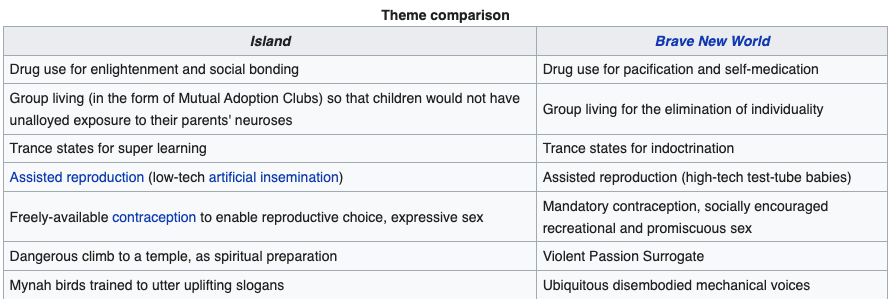
But then John Stuart Mill, the popularizer of the Utilitarian philosophy prioritized pleasures of the mind over those of the body, and famously said that he’d rather be Socrates dissatisfied, than a pig satisfied.  But I wonder what percentage of the world would prefer the Brave New World to the one they live in.  And I’m curious about what life was like on Iceland where Bernard Marx and Helmholtz would be exiled.  That may have been the question Huxley was answering when he wrote Island 30 years later, which described his idea of a utopian counterpoint to his Brave New World.  Below is a comparison of themes in Island to Brave New World, out of Wikipedia.Screen Shot 2021-10-24 at 10.21.49 AM

*In Shakespeare’s The Tempest, Miranda says, “How beauteous mankind is! O brave new world / That has such people in’t!” (5.1. 186-187).


Posted in Uncategorized | Leave a comment

Children of God, by Mary Doria Russell

Why this book: I just finished reading The Sparrow for the second time and was inspired (again.)  I wanted to follow up with reading Children of God again, and be inspired again, and that was a good call. 

Summary in 4 sentences: This is the sequel to The Sparrow, in which the sponsors of the first mission to Rakhat believe there is unfinished business on that planet and plan a follow-on mission.  Meanwhile, one of the strong characters on the earlier mission, thought to have been killed on Rakhat, survived, though that is not known by the Jesuits on earth planning the follow-on mission.  In parallel with the preparations on earth, Children of God follows her life and the lives of several of the characters from the Runa and Jana’ata cultures in the aftermath of the departure of the Earth visitors. There is drama on Earth, in the controversy about how the mission would be undertaken and who would go on it, and drama on Rakhat during a great upheaval as the spark of revolution ignited by the earthlings in The Sparrow, becomes something of a conflagration…and then the Jesuits return…..

My impressions: A powerful story and an excellent follow-up to The Sparrow in exploring issues of faith, suffering, and the human condition.  Mary Doria Russell is thoughtful, creative and articulate – and I really like her writing style. I felt that she went deeper psychologically, morally, philosophically in Children of God than in The Sparrow.    

As a novel, Children of God was not as well constructed as The Sparrow – it was a bit harder to follow, there were more characters than I could easily keep track of, especially those natives to Rakhat with strange names.   I would have liked a glossary to help me keep track of the characters, as Hillary Mantel did in Wolf Hall.  Also, though the inhabitants of Rakhat were not human, Russell gave them very human psychological characteristics; apart from some rather trivial physical traits, they seemed all but human in their emotions, reactions, and decisions.  Which of course made it easier for we, her human readers, to relate to.

Those quibbles aside,  I really, really  liked the book.  I had a number of  “wow!” moments as I read conversations between characters arguing between the short vs long view, ends vs means, accepting vs fighting to change reality, whether pain and suffering indeed have meaning and redemptive value.  Russell says in the postscript interview that 80% of the correspondence she’d received preferred Children of God to The Sparrow, whereas she herself preferred The Sparrow. 

The book begins where The Sparrow left off – with Father Emilio Sandoz struggling to deal with his experiences on Rakhat, with the Jesuit leadership, with his own loss of faith.  He does renounce his faith and his priestly vows, and as a layman begins to find joy, love, as a door opens to a life that promises to  redeem him.  Then he is kidnapped, drugged and wakes up part way into an expedition to return to Rakhat.  The Church deemed that his unique skills, language, knowledge of the culture were essential to fulfill the objectives of the second Jesuit mission, and this greater good superseded his personal wishes and happiness.  

Much of the book takes place in the six or so years flying near the speed of light to Rakhat -around 20 years in earth-relative time (the book’s timeline is measured in “earth-relative” years.)  During this transit period, we get to know a team very different from the team in the first expedition.  This second team which included the kidnapped Sandoz, was filled with tension and mistrust,  which included Sandoz extremely angry and resentful at his abduction from a life that promised joy, love, happiness.  The very different individuals in this group eventually learn to accommodate each others and the group eventually evolves into a functioning team, though one very much in contrast to the high-functioning team we saw in The Sparrow

Meanwhile we learn that unknown to any on the expedition, Sofia Mendes,  one of the central characters in The Sparrow had survived the massacre that took the lives of most on the initial expedition to  Rakhat.  After that slaughter, she had been nursed back to health and protected by the Runa who she had been trying to protect.  She becomes part of their community and applies her significant skills, insights and leadership to help them survive and resist further persecution by their erstwhile tormentors -the Jana’ata.  Meanwhile,  she bears and raises a child with which she was pregnant when her husband and the others from the first expedition were killed, becomes a foster mother to a Jana’ata child and develops a close relationship with a Jana’ata leader. 

That is the setting.  As in The Sparrow,  Children of God takes the reader back and forth between what is happening on Rakhat, with Sofia Mendes and several of the key characters from both Runa and Jana’ata cultures, and what is happening within the group of Earth people on the space platform, on their way to Rakhat and after they land.  When they finally do reach Rakhat, they are surprised at how much has changed in the nearly 40 earth-relative years since Sandoz had left after the first expedition.  The ideas of freedom and revolution had unleashed a level of violence reminiscent of the French or Russian revolutions.  The former Jana’ata masters are now the hunted and the persecuted.  And eventually Sandoz and his team are supporting a group of Jana’ata that is being pursued by Mendes and her Runa.  

In Children of God, Russel introduces a number of new characters and one old one, who serve as vehicles for her to share perspectives that I found fascinating, among them,  Carlo, Danny Iron Horse, Suukmel, and Isaac. Carlo is the leader of the second expedition, charming, intelligent, practical, but ultimately an unscrupulous opportunist. From Danny Iron Horse we learn how native American culture harmonized with Jesuit culture or didn’t – depending on the objectives and context.  Suukmel is a Jana/ata woman of great wisdom – perhaps Russell’s own muse.  And from Isaac we gain insights into the perspectives of an autistic savant. 

Unlike The Sparrow, Children of God does not end in ambiguity. As the author says, it is a long dark tunnel that ends in the light. There are surprises all the way into the last couple of pages of the book.  The paperback copy I read includes an interview with the author, and she is very forthcoming and direct in her answers to questions about meaning, intent, and sources.  

In both books, we are given new perspectives on being human, by how the author portrays these other sentient beings who have different though similar capabilities and qualities.  The moral issues of how different tribes, cultures, races interact are highlighted by the tensions between three different, but similar species – human, Runa, and Jana’ata.  We also see how misunderstandings, and a tendency to make negative judgments with imperfect information can create hate, violence and war.  There is a lot to learn, think about and discuss in this two part series – highly recommended for thoughtful readers.  

Some themes/perspectives that I found interesting in Children of God:

  • Smell not sight is the primary sense for natives of  Rakhat.  One gets perhaps a dog’s perspective.
  • Physical and aesthetic beauty can be seductive and a source cruelty and ugliness
  • We see the dangers of excessive idealism and ambition for good.  We see crimes against humanity committed for “the greater good”.  
  • Sex on Rakhat is transactional and focused on procreation or recreation.  Romance is not involved.
  • We see the negative health impact of forcing a vegetarian diet on carnivores.
  • Interesting to consider what if our meat animals (Cows, pigs, chickens) could think and talk….
  • Danny Iron Horse, a native-American leader on the expedition, sheds light on the perspective of someone who has grown up in the Lakota Sioux culture on a reservation with both native-American and European ancestry in his blood.
  • How drugs can control psychological pain, but don’t permit true healing. and growth.  Being willing to go through, deal with, and address psychological pain is necessary for Post Traumatic Growth. 
  • How the imperatives of time and necessity can allow a functioning team to evolve out of a group of antagonistic individuals. 
  • Even the evil characters in this book have redeeming qualities.  Russell gets into the heads of those we are tempted to hate, and provides perspective. “Don’t be too quick to judge!” she says in her interview, as one of her messages.
  • How hate and the desire for revenge can infect whole communities and incite them to feel justified in committing atrocities.  Good people infected by a drive for revenge for wrongs done them.  Humans: Sandoz and Sofia Mendes. Jana’ata: Supaari and Hlavin Kthiri. 
  • The perspective and wisdom of those with autism. In the second half of the book, one of the key characters is “on the spectrum”,  a-social, but wise and talented in unique ways. 
  • A new vision of God emerges in the end out of a unification of music with DNA.

Below are some of the many passages I highlighted because I found them interesting, insightful, or inspirational: 

Candotti:  “All spiritual enlightenment begins with a neatly made bed.”p59 (Did Bill McRaven read this book?)

Sandoz  “The redemptive power of suffering, in my experience at least, is vastly over-rated.”  P60

Sandoz. “Cynicism and foul language are the only vices I’m capable of.  Everything else takes energy or money.” P64

“What if?” was more dangerous than “Why?” p77

Comparison is the source of all significance  81

Never give a woman reasons that can be argued with.  Say no, or prepare for defeat. P87

Danny Iron Horse: “Like Saint Teresa said: If that’s how God treats His friends,  it is no wonder He’s got so few of them.” P111

They (the Runa) accepted Isaac’s solitary silence as they accepted his lack of tail and his hairless body, as they accepted nearly everything in their world: with placid good humor and unruffled calm. P136

Sofia:  “Anne said that wisdom begins when  you discover the difference between ‘That doesn’t make sense’ and ‘I don’t understand’” p143

DW Yarborough: There was no such thing as an ex-Jew or an ex-Catholic or an ex-Marine.  “Now why is that?…  Talk is cheap.  We believe in action. Fight for justice. Feed the hungry.  Take the beach.  We none of us sit around hopin’ for some big damn miracle to fix things….We don’t preach. We listen.”

DW Yarborough: “Maybe God is only the most powerful poetic idea we humans’re capable of thinkin’…On my best days, I believe in Him with all my heart…(and on my worst days) even if it’s only poetry, it’s poetry to live by, Sofia – poetry to die for. Maybe poetry is the only way we can get nearer the truth of God….and when the metaphors fail, we think it’s God who’s failed us!”  p145-46

Sofia: Even the laws of physics resolve to probabilities.  How can I know what to do?

Vince Giuliani: “In the darkness of my soul, I have wondered if God enjoys watching despair, the way voyeurs watch sex.  That would explain a great deal of human history!”

Danny Iron Horse: “Do you believe that the end justifies the means?”Sandoz: “Sometimes. It depends, obviously.  How important is the end? How nasty are the means?”158

Carlo: I always thought it was a tactical mistake for God to love us in the aggregate, when Satan is willing to make a special effort to seduce each of us separately.” P185

Danny Iron Horse: “You know the facts, so decide. Are the Pope and the Father General frauds?  Or do you understand less than you think?” p209

“Have you discovered a preexisting truth? Or have you imposed an arbitrary meaning on whatever it is you’re considering?”p210

(Of Sandoz) After all, he thought, the one thing an agnostic knows for sure is: you never know. p215

There was for Daniel Iron Horse, some hope that he might live long enough to know the answer to a question Giuliani would carry to his grave: What if I am wrong about everything? p216

(Native Americans ) fought to preserve a way of life that valued, above all else, courage, fortitude, generosity and transcendent spiritual vision.  P217

Suukmel:  “Fear corrupts, not power. Powerlessness debases. Power can be used to good effect or ill, but no one is improved by weakness.” P220

Suukmel:  ..Any institution considering itself the guardian of truth will value constancy, for change by definition introduces error…How then does a wise prince introduce change when the generations have enshrined a practice or a prohibition that now harms or cripples?” p221

Suukmel:  Dani, when we change things, we are like the little gods: we act and from each act falls a cascade of consequence – some things expected and desired, some surprising and regrettable. Bt we are not like your God who sees everything!”  p225

Marcus Aurelius: “The noblest kind of retribution is not to become like your enemy.”p248

Seneca:  “The safest course is to tempt fortune rarely.” P250

Sofia Mendes had, after all, survived a great deal by blocking out emotion – her own and others’.  And love was a debt, best left unincurred. p 257

Ha’anala: “The  God of Israel can’t be seen, but hesees us – when we are ready, when we are not ready,  when we are at our best or at our worst or paying no attention. Nothing can be hidden from such a God.  That’s why people fear Him.”  p259-60

But reality didn have a great deal to recommend it these days and Emilio was quite willing to exchange whatever message was embedded in these new dreams for the artificial tranquility of Quell…. Chemical Zen he thought…  p262

Sean Fein: “All is vanity and chasing after the wind.  The wicked prosper and the righteous get rooted up the hole, and is that all y’learned ina quarter of a century in the Company of Jesus/”  Sandoz:  “Fuck off Sean.” p267

(Amazing stuff on SUFFERING and  God p290 -291)

Candotti:  How long did he protect himself from the fear that God was just  bullshit story, that religion was just a load of crap?…And where the hell was Emilio finding the strength now to hope again that maybe it would all make sense?” p290

Her soul seemed to him like colored glass: translucent but not transparent. p305

Sandoz: “Father Iron Horse, I detect a certain indulgence in wishful thinking.” p313

Sandoz:  “It’s called irony Nico.  Irony  is often saying the opposite of what is meant.  To get the joke, you must be surprised and then amused by the difference between what you believe the person thinks and what he actually says.” p314

Sandoz:  “Religion – the wishful thinking of an ape that talks!  You know what I think:  Random shit happens, and we turn it into stories and call it sacred scripture -” p346

(of Suukmel) Chaos demanded not the death of Virtue in her life, but the birth of Passion. Joy. Creation.  Transformation. p355

Suukmel: “Listen to Isaac’s music again. Remember what you thought when you first heard it. Know that if we are children of one God, we can make ourselves one family in time.”    “And if God is just a song?” Ha’anala asked, alone and frightened.  Suukmel did not answer for a while. Finally she said, “Our task is the same.” p 359

Of Sean Fein: In his own soul, he knew with sudden certainty that it was not rebellion or doubt or even sin that broke God’s heard; it was indifference.  p362

If anything could prove the existence of the soul, he thought, it is the utter emptiness of a corpse.  p 400

Danny Iron Horse: Now finally, he was in a place where note of that made any difference, where he was simply an Earthman. Only here (on Rakhat) had he come to understand that he was not a battleground – to be divided and conquered by his grandparents – but a garden, where each person who’d contributed to his existence longed to see that something of themselves had taken rood and grown.  p 419

Danny Iron Horse:  “I could ask you to trust me, or I could just tell you to do as you’re told.” p420

Rukuei Kthiri: He would tell the foreigner: I have learned that poetry requires a certain emptiness, as the sounding of a bell requires the space within it.p 425

Isaac:  “It’s the DNA for humans and for Jana’ata and Runa. Played together   A lot of it is dissonant.  I remembered the parts that harmonize.” p427

Sandoz: In the absence of certainty, faith is more than mere opinion;  it is hope.  p431

On Sandoz:  He was a linguist after all, and it seemed entirely possible to him that religionand literature and art and music were all merely side effects of a brain structure that comes into the world ready to make language out of a noise, sense out of chaos. Our capacity for imposing meaning, he thought, is programmed to unfold the way a butterfly’s wings unfold when it escapes the chrysalis, ready to fly.  We are biologically driven to create meaning.  And if that’s so, he asked himself, is the miracle diminished?  It was then that he came very close to prayer.  Whateever the truth is, he thought, blessed be the truth.  p431

——


Posted in Uncategorized | Leave a comment

The Sparrow, by Mary Doria Russell

Why this book:  I had read this book about 12 years ago in my literature reading group.  It resulted in one of the richest discussions we’d had after reading a book.   All of us who were in the group at that time agreed we’d like to read it again, so we prevailed upon the newer members of our group to selected it to read. 

Summary in 3 sentences:  A group of Jesuit Americans embark on an expedition to a nearby galaxy to explore the source of spiritual sounding music coming from a planet in that galaxy.  They prepare in early 21st century and make the journey and connect with sentient intelligent beings on that planet, learn their language, live with them and learn their culture. But something goes terribly wrong, and only one member of the expedition returns, but is so traumatized he struggles to confront and recount and explain his experiences. 

My Impressions.  An incredible story, powerful, well-written by a well-educated, thoughtful and articulate author. Mary Doria Russell is a paleo-anthropologist and her extensive background in the science of humanity is evident in this, her first novel. The story itself is imaginative, but the story serves primarily as a framework on which the author hangs powerful themes of good and evil, faith and disillusionment, love and friendship, and more.  It is a search for spiritual meaning and understanding man’s place in the universe wrapped in a science fiction novel.  I found the characters in the book rich, multi-dimensional and believable – I could relate to them, though it took some imagination to relate to the unique circumstances in which the author develops them.

There are two stories going on simultaneously in The Sparrow, and the two stories come together at the end of the novel.  The first story is about an eclectic group of astro-scientists who detect haunting and spiritual music coming from the Alpha Centauri Galaxy – one of the closest galaxies to our own.  The Jesuit branch of the Catholic church then feels compelled to finance and sponsor an expedition to explore the source of the music, in an effort to connect with other spiritual and sentient beings in the Universe.

In this part of the story, we get to know the main characters of the novel, and follow their preparations and ultimately their voyage to beyond our galaxy to find the source of this music.  During this part of the novel, we get to know each of the six or so main characters of the expedition, and that is interesting and enjoyable. The author makes some effort to make this travel to a different galaxy at least superficially scientifically believable.  The team explores and attacks the types of problems that would be associated with such travel, such as food, fuel, time relativity, navigation, communications and more.  In this part of the story, our team leaves earth, leaves our Milky Way, finds and is able to land on the obscure planet of Rakhat.   The story follows their adaptation to that world, and the symbiotic relationship they develop with the sentient creatures they encounter on that planet.  They learn and adapt to their language and culture, and eventually see a way to connect with the source of the music.

The second and parallel story on-going in The Sparrow is taking place some 40 years later and is the investigation into what happened on the expedition. Father Emilio Sandoz is the only one of the original team to survive and return to earth, and he is severely traumatized. He was the most spiritual of the Jesuits who went on the mission, and upon his return, is unwilling to confront nor discuss what happened, what traumatized him so, and how and why he has lost his faith.  In this part of the story we get to know a separate set of characters – those conducting the investigation and the interrogation of Father Sandoz.  Father Vincent Giuliani, the Father Superior of the Jesuits insists on coaxing the story out of Sandoz, while trying to be sensitive to Sandoz’s obvious suffering from severe post -traumatic stress.

These two parallel stories in The Sparrow are told in alternating chapters.   We share in the excitement of the expedition members as they prepare for the expedition, become a high functioning team, and get on with one of the human race’s greatest adventures.  There is much joy and camaraderie in the first part of mission, and it is easy to like and relate to the characters Russell creates, and how they connect in powerful ways.  The author permits a bit of bawdy humor and very human connection among this group of religious space pioneers, as they bond and build a solid team dynamic. They deal with mistakes, disappointments, tragedies and the team holds up – they take care of each other and their mission

In the separate and alternating chapters we come to understand that somehow it all went terribly wrong, as we struggle with Emilio Sandoz’s efforts to deal with the tragedy of what happened – though we don’t yet know what that tragedy was.  But we know it wasn’t good.

Emilio Sandoz is interrogated, sometimes accused, often with little finesse or sympathy, and is slowly nursed back to health 40 years after the expedition had departed earth.  We are kept in suspense to learn what ultimately happened to the expedition after such a promising beginning, until the last 30 or so pages of the book.

Wrapped in a fasincaitng science fiction novel, The Sparrow addresses faith in God in the face of pain, evil, suffering and tragic disappointment.  In the voices of the characters in the book, Russell makes strong cases both for faith, and for loss of faith and atheism. 

In the interview at the conclusion of the paperback edition of the book, Russell says she was inspired to write this book during the celebration of the 500th anniversary of Columbus discovering America – when she asked herself what it might be like today to leave all that we know, and arrive in an alien land and confront a completely different culture.  She also clearly drew inspiration from the suffering and privations of Jesuit missionaries who sought to educate and convert Native Americans to Christianity – Isaac Jogues in particular, as well as the Jesuits known as the Canadian martyrs. 

It was also interesting to note that Russel was raised a Catholic, left the church and declared herself an atheist, and then in her 30s had a child, returned to belief in God, but as a Jew. As a converted Jew she learned of how the Jews experience God during and in spite of  centuries of pogroms and genocide, and the Holocaust, suffering on a scale most Christians have difficulty imagining.

I couldn’t help but see this story as a modern day version of the book of Job.  How could a loving God let this happen?  I also saw parallels with Chinua Achebe’s book Things Fall Apart about how well-meaning missionaries appalled at what they perceived as barbarian native practices, intervened to upset a delicate balance in an African native village. Coincidentally, after finishing The Sparrow, I re-read Viktor Frankl’s Man’s Search for Meaning for another book club –  It could be a companion piece to The Sparrow, and Frankl, a Jew, would have a lot to say to Emilio Sandoz. 

I highly recommend The Sparrow to thoughtful readers. But if at the end you may be a bit confused about the message, read the interview with the author at the conclusion of the paperback edition – it is very enlightening.  

Posted in Uncategorized | Leave a comment

The Secret Lives of Alexandra David-Neel, by Barbara and Michael Foster

Why this book:  After reading My Journey to Lhasa in which she describes how she became the first Western woman to visit Lhasa (and which I review here), I felt inclined to learn the rest of the story of the life of this remarkable woman.

Summary in 3 Sentences: This thoroughly researched biography of Alexandra David-Neel begins with what little is known of her childhood and early years in Europe, and fairly quickly moves to the main events of her life exploring and living in Asia. The “meat” of the book describes her many and multi-faceted experiences for 40 years in India, Tibet, China and other Asian countries, including a couple of chapters which provide some different insights into her remarkable trip to Lhasa. It concludes with the last third of her life, as her physical health deteriorated, but her cognitive skills remained intact – though as for anyone who reaches that age, life was not easy for her at the end. 

My Impressions: This is a fascinating biography of what has to be one of the most amazingly intrepid women of the 20th century.  She grew up in the Victorian era in Belgium became fascinated with Buddhism early – showing signs at a young age of rebelling against the standard paths for young girls at that time. As a teenager, she ran away from home, got involved in Madam Blavatsky’s circle of mystics and clairvoyants in London, then found her way into operatic singing and show business,  before heading to India and the East to pursue her passion for studying Eastern religion and cultures.

This biography offers what little is known of her youth before getting into the main act of  her life as a trail blazing woman student and scholar of Tibetan religion, religious practices and philosophy at the very beginning of the 20th century. Very few Westerners, and no other Western women were aggressively pursuing knowledge and experience of Tibetan practices at that time, and given her intelligence, charm, and ambition, she came to the attention of the 13th Dalai Lama and the Panchen Lama (second to the Dalai Lama in the Tibetan Buddhist hierarchy) as well as becoming well known and respected in the broader circle of  other senior members of the sect.  She also became well known, and not completely trusted by British authorities who still controlled much of that part of the world.  

This biography outlines her extensive travels through India Nepal and China in search of knowledge and direct experience of the cultures she was studying, at a time when travel was primitive and dangerous.  David-Neel was often short of cash – relying on funds wired to her from her husband in Algeria, or what she earn, beg, or borrow on her own, and was often nearly destitute, putting to the test her incredible resourcefulness and adaptability.  She had adopted a Tibetan son who was her travelling companion and essentially aide-de-camp during these often difficult times, and who stayed with her for the rest of his life.  Travelling with caravans, walking, on horseback, or in carriages through remote areas on the borders of Tibet and China, she anticipated being subjected to the vagaries of civil war, brigands and highway robbers and other dangers – but she was undeterred and usually lucky. All of this prepared her for her most famous adventure – her months long hike in winter through the Himalayas avoiding government authorities to sneak into Lhasa, which was absolutely forbidden of Western women. 

Because of the discretion expected of Victorian-age woman in their public and private correspondences, and because she was married, she was not forthcoming in her letters and other correspondences on matters that may have touched on the romantic or the erotic.  The authors however believe that she probably had an affair with a Maharajah of Sikkim during this period, and they have indicators that her explorations of Tantric sexual practices were more than merely academic.  In her study of Tibetan Buddhist practices, she was typically unwilling to take information or wisdom on authority – she always wanted to experience things directly and personally.  For example, in order to better understand the Tibetan Buddhist tradition of isolating and meditating under the tutelage of a yogi, she spent nearly 3 years living alone under great austerity in what was essentially a cave high in the Himalayas, with regular visits to her Tibetan yogi mentor. 

Eventually, she decided that to truly understand Tibetan Buddhism, she needed to visit Lhasa, the capital of Tibet and and the Vatican of Tibetan Buddhism.  But Lhasa was off-limits to Western women, by order of the Dalai Lama and Tibetan authorities.  Respecting the desires of the Tibetans, the British, who controlled much of the Far East at the time, also actively opposed her efforts to visit.  Not one to simply give in to authority, she found a way, which she describes in her book My Journey to Lhasa which I review separately

In this biography we learn about the nearly 20 years she spent learning the Tibetan language, experiencing the culture and becoming strong and resilient enough to  successfully and convincingly disguised herself for months as a Tibetan peasant woman hiking through the Himalayas in winter with her adopted son to Lhasa. This biography goes beyond that specific journey to provide additional stories about what she experienced in Lhasa and some of the aftermath of her visit, her challenges with funds, with her husband, with various bureaucratic officials who didn’t trust her, nor know quite what to make of her.

Over her lifetime, Alexandra David-Neel wrote nearly 30 books on Tibet and Buddhism, and is credited by the 14th (the current) Dalai Lama with having introduced Tibet to the West, through her writings, her adventures and her love of Tibet.

Alexandra David-Neel as a person was not only an impressive and interesting woman, she could also be difficult.  She was clearly a powerful and brilliant woman with amazing strengths, but she also had her own character flaws and contradictions.  She was on the one hand intellectually curious,  compassionate and respectful toward those at the lower end of the social scale, bold and self-confident in taking on great challenges, tough and resilient, and almost un-intimidatable. She could also be imperious, egotistical, ambitious for fame and recognition, entitled and arrogant.   Crafting and maintaining a certain persona and image were important to her to help ensure she could pursue her projects and ambitions.  She was often deceitful and manipulative toward  her husband, in order to keep his funds flowing to support her ambitions.

In this biography, the authors, while clearly admiring her, were not shy about exposing these some of these less savory aspects of her character.   Toward the end of her life, she had her caregiver burn many of her letters that she believed might challenge the image she wanted history to have of her.  That’s too bad, since the whole picture of the woman would be much more interesting than the air-brushed version she hoped to leave.

She lived to be 101 years old, living the final 30+  years of her life in Southern France, continuing to write, to lecture and to host and entertain other scholars of Tibet and Tibetan Buddhism. 

This biography is 1998 update of an earlier biography the two authors had written:  Journey: The LIfe of Alexandra David-Neel published in 1989. They felt this update was necessary after discovering important new material that came to  light after publishing the first book. They also indicate that there is much more material on her life that remains to be released – so those of us interested should stand by.  The authors are clearly conversant in Buddhist philosophy and religion and were sympathetic to David-Neel’s desire to study it and uncover its truths,  and I felt did a good job of explaining some of the more esoteric aspects of Tibetan Buddhism to me a lay reader. 

Some of the key take-aways and insights I had from this book, apart from being fascinated by the life of an amazing, bold and ambitious woman:

  • How much different the world of India, China, Tibet in which she spent much of her life was from the West at the early part of the 20th century, before globalization brought so many of civilizations comforts, corruptions and distractions into that part of the world.  Her travels on foot, in caravans, by train, ship, and plane, disguised as a beggar, a religious figure, scholar, she lived in and traveled through a world of brigands, warlords, European expats that today seems exotic and probably no longer exists. 
  • I learned much about Tibetan Buddhism and Tibetan culture, which was the primary focus of her learning and exploration.  I hope to read her book Magic and Mystery in Tibet (still in print and easily available, also in audio and pdf format) which is considered a classic on how Tibetan Buddhism incorporated local superstitions and more “Pagan” beliefs, along with some of the amazing things she observed and experienced that are  inexplicable by modern western science.  She herself was a skeptic about mystical powers associated with Tibetan Buddhism, but she also routinely observed and experienced phenomena that challenged that skepticism. 
  • The multifaceted aspects of her character fascinated me – her fearless and relentless pursuit of her ambitions, her ability to draw on Buddhist serenity when she needed it, while also manifesting very un-Buddhist like ambition, egotism and focus on achievement.
  • The early part of the 20th century – prior to WW1 and in the inter-war years, was a period of great power competition for influence in Asia, between the British, the Russians, the Japanese, the Nationalist and Maoist Chinese, and at every turn, these larger political forces impacted the life and goals of Alexandra David-Neel.  She became an internationally known figure – considered by many to be a spy, by others a nuisance, and by still others a threat.
  • The authors are clear in how the Chinese are actively seeking to destroy Tibetan culture and homogenize it with Chinese Communist culture.  In the introduction and in the epilogue, they provide shocking statistics of the number of Tibetan monks who have been murdered, monasteries destroyed, and legislative and legal steps taken by the Chinese to put pressure on traditional Tibetan religion and culture.  This process is brutal, and continues unabated.
  • The epilogue discusses the impact Alexandra David-Neel has had.  Her books on TIbet are still read and studied. Her intrepid life and courage continue to inspire, especially women who are fascinated with learning more about Tibet and Buddhism.  And as noted, the current Dalai Lama gives her a lot of credit for publicizing Tibet, Tibetan Buddhism and its many appealing aspects to much of the West.  
Posted in Uncategorized | Leave a comment

The Popes of Avignon – a century in exile, by Edwin Mullins

Why this book: I was preparing to do a bike ride in Provence starting and finishing in Avignon, and riding for 8 days in the environs.  This book came strongly recommended to provide a historical perspective on the world we would be biking through, by Francine, who with her husband Jeff, organized the trip.

Summary in 3 Sentences:  In the early 14th century, violence, anarchy, brigandage, and warlordism around Rome threatened the center of Christianity, so the then Pope Clement V decided to move the papacy and his court to one of the papal-owned regions of what is now France. This book walks through the reigns of the 7 popes who led the Catholic church through the nearly 7 decades that Avignon hosted the Pope and his retinue, their challenges, successes, failures and their relationship to the Holy Roman Empire, France and other temporal powers in the region.   We learn of the widely varied personalities and approaches to papal leadership exhibited by the seven popes, the political intrigue involved in selecting and then supporting the popes, how the papacy mimicked autocratic and self-indulgent leadership styles that were standard and expected of temporal kings and princes in Europe at the time, how the popes themselves, their cardinals and bishops succumbed to the temptations of power, wealth, and pleasure that were freely available to them. 

My impressions:  An enjoyable lay-person’s history of the period during which the Papacy moved from Rome to Avignon.  It is also naturally a look at the history of Avignon, why it was selected as an alternate location for the center of Christianity at the time, the impact that the Papacy had on what was previously the small town of Avignon and the region, and then what happened after the papacy returned to Rome.

The book is divided into chapters the first of which address each of the seven Popes who resided in Avignon.  The book begins with a look a the environment and the events that led Pope Clement V’s decision to move the papal court to Avignon in 1309 where it remained until 1378 when Pope Gregory XII returned the papacy to Rome and then shortly afterward died.  His death left the door open for a power struggle between the French and Italian cardinals.  The book concludes with the Papal Schism, a rather confusing era of about 30 years when the Italian and French cardinals selected two competing popes – one in Avignon and one in Rome until this awkward situation was finally resolved in 1414 and the Papacy remained in Rome.

The Papacy moved from Rome to Avignon in response to two key factors:

  • First, Italy at that time was a collection of independent principalities, each led by a King many of whom were ambitious, gathered their own money to hire mercenaries to intimidate or defeat his rivals to gain more power and resources assume regional ascendancy – and Rome was a wealthy  target.  When it appeared that Rome and the Papacy were most vulnerable  to threats, intimidation or being conquered militarily,  Pope Clement V decided to move to a safer locale in France.
  • Second, that “safer” locale was under the protection of the King of France – but that protection came at a price.  The King of France,  Philip the Fair (“Fair” not being “just,” instead meaning handsome) contributed to convincing  Clement V to move the papacy after which he essentially became a vassal of the King of France, .  Eventually the Popes, cardinals and Bishops became primarily French which kept much of the wealth the Papacy spent in France – which created a momentum for keeping the Papacy in France.

The popes of Avignon were very different.  Some were self-effacing introverts, others extravagant and  bold. The most interesting to me was Pope Clement VI, (1342-1352) a charismatic and extravagant leader who was well known for his celebrations and parades, his generosity in giving money away to his supporters as well as to the poor. Clement VI was a boisterous partier and reputedly had several mistresses. He was not afraid to take on the Holy Roman Emperor, raised armies to protect papal property in Italy, and during his 10 years he built out the papal palace in Avignon to be one of the grandest in Europe. He also had the challenge of leading the Church during the worst of the Black Plague in Europe.  When he died, he left the papal treasury almost empty.

Typically the Cardinals selected a new pope to offset any excesses excesses of the previous pope.  When Clement VI died, the cardinals selected Pope Innocent VI who could hardly have been more different, coming from a tradition of hermits and ascetics, and naturally, he sought to reform many of the excesses of Clement VI.  Innocent VI’s successor was Urban V, one of the most highly respected of the popes of that era, one who more closely than most, abided by today’s standards for Christian behavior and leadership.  It was Urban V who initiated the return of the papacy to Rome, but it was his successor Pope Gregory XI who finally succeeded in moving the papacy to Rome, and then soon after reestablishing himself in Rome, died.  When the Italian Cardinals elected an Italian Pope, and the French Cardinals wouldn’t accept him, that initiated the Great Schism referred to above, which continued for nearly 40 years until it was finally and not very gracefully resolved in 1418.

The Papacy was very much about power and patronage and protecting the resources of the Catholic church from rapacious Kings, warlords and marauding bandits who looked with great envy upon the land and wealth of the Church. The popes behaved as kings in a kingdom and this was expected since then even more so than today, it was generally accepted that power and wealth had their privileges and which included not having to follow the rules that apply to everyone else.  

One interesting character who appears through much of this book is Petrarch, a well known poet and an open critic of the papacy for its hypocrisy and self-indulgence.  Petrarch was pretty vicious in his criticism of the popes, cardinals and bishops, but the popes never seemed threatened by him – in fact they often patronized him.  

When I was in Avignon, I visited the papal palace and walked the gardens.  Avignon is surrounded by it’s famous ramparts – a 2 mile circumference of thick and high walls, still maintained, intact and impressive. These walls were begun by Innocent VI and completed by Urban V to protect the city from being sacked by out-of-work mercenaries who formed up private armies that preyed upon castles, towns and citizens throughout France,  during periods of peace between England and France.  Avignon itself, its wealthy cardinals and merchants, and the wealth of the papacy were lucrative targets to these armed bands of former soldiers.  Eventually Urban had to pay protection money to preserve Avignon from the ravages of these  “companies.”  

The Popes of Avignon inspired me to revisit a wonderful book I read about 40 years ago about France in the 14th century The Distant Mirror, by Barbara Tuchman, which gave a fascinating look at how people lived, the culture, the times, the challenges of life in medieval France – which included the papacy in Avignon.  

I would echo Francine’s recommendation to read The Popes of Avignon before visiting Avignon and Provence, or to anyone interested in the history of the papacy, or southern France in the 14th century.  

Posted in Uncategorized | Leave a comment