My 25 Years in Provence, by Peter Mayle

Why this book: I was preparing to do an 8 day bike tour through Provence, beginning in Avignon, and I was looking for something light to read that would give me a different perspective on the region I was biking through, and provide me with a perspective that I would not get from the seat of a bicycle. 

Summary in 3 sentences:  Throughout much of his youth and working life, Peter Mayle had a dream of moving to and living in Provence,  which after achieving a certain degree of affluence, he finally was able to fulfill in middle age.  His writing about Provence and the adventures he experienced living there defined the last third of his life and this was his final book. This book is a compilation of short chapters sharing different experiences and insights the he as an expatriate Englishman gained over a quarter of a century living in Provence.  Mayle has had a love affair with Provence and this book, through its many short stories and vignettes, is an admiring look at a place and region he loved. 

My impressions:  A fun, light read in the easy going, almost poetic and unpretentious style of Peter Mayle.  For me it did its job well – an enjoyable look behind-the-curtain at life and the culture of the people of this justifiably famous part of France. Provence is a very popular tourist destination for people from all over the world, in no small part due the many books Peter Mayle has written about it.   In addition to his delightful language and relentlessly positive attitude, for me an important part of the charm of this book is that he enjoys comparing what he has found and learned about Provence with his native England and the United States where he also had a home.

I have not read any of his other books about Provence (most famous, A Year in Provence, and Toujours Provence,) but one can’t help but like the man – his style is so upbeat, friendly, and respectful of his subjects, and he avoids strident or angry criticism of that to which he compares the joys of the life he has found in Provence.  He is certainly a connoisseur of the simple but comfortable and civilized life of the small town, the customs and traditions that have grown up over the millennia in Southern France.  This book and his others (I’m sure) share his joy at getting to know and savor life in the region. 

My 25 years in Provence was his last book, published the year he passed at the too-young age of 73. It is written in a very personal, first person style – he, Peter Mayle is telling stories to us, his readers, and reads like a series of short magazine articles in which each chapter shares his experiences and personal impressions on different aspects of life in Provence. 

Mayle offers us short chapters with titles such as: “The pulse of the village,” “Learning French, Inch by Inch,”  “La Politesse Française.”   He has other chapters which are simply personal stories which share some of the highlights of his life living in Provence.  For example, Mayle was awarded the Legion d’Honneur for the positive impact that his books have had on France and Provence.  His chapter “A Gift from Napoleon” not only shares with us what that award means and its origins, but how he found out that he’d been selected to receive it, and the charming aftermath.  His chapter “Dinner at the Èlysée Palace” shares what it was like being one of the 200 people invited in 2004 to a dinner hosted by the President of France (Jacques Chirac at the time) and Queen Elizabeth II to celebrate the centennial anniversary of the Entente Cordiale between France and Great Britain.

The easy going, civilized, relaxed and comfort-loving life that Mayle describes is appealing to me – to a point. As an American, and some may say, a rather driven one, I couldn’t live that way for long.  I am also drawn to intense, unforgiving, and less comfortable endeavors to test myself, grow, and learn.  That side of life is not reflected in Mayle’s book, nor does it appear was he someone drawn to such challenges. I do enjoy the civilized life, but I believe it is enjoyed best in interludes,  and in contrast to more primal and challenging environments.  I can enjoy the 4 or 5 star Hotel that much more,  knowing intimately also how to live out of a rucksack, in a tent in the mountains, in the wind, rain, and cold, cooking my meals over a camp stove.

My 25 years in Provence was perfect for what I was looking for on this bike tour – a light and enjoyable book to read evenings and mornings, before cycling during the days in the environs of Avignon in Provence.  And I truly enjoyed Mayle’s writing – and would enjoy reading more of his books, not only for his light touch and poetic language but also to re-experience some of the joys I touched in my bike tour through Provence.  He also has written a couple of mystery/crime novels which also apparently reflect his joie de vivre and positive approach to the civilized and easy going lifestyle in Southern France and the Mediterranean.


Posted in Uncategorized | Leave a comment

The New Rules of War, by Sean McFate

Why this book: My friend Doug recommended it to me. After looking at it and starting to read it, I convinced several of my friends to read it with me, in order that we could meet on zoom and discuss it.

Summary in 3 Sentences:  McFate argues that war has changed, but we in the US and the West have not evolved our thinking to fit the new reality, and continue to use old and outmoded approaches to respond to current versions of warfare.  He argues that today we seldom see war as state-sponsored military-on-military conflict, but there is extensive ongoing warfare in the model he outlines, noting that we are at war now, whether we realize it or not.  Today, war is much more subtle and insidious, and no longer fits traditional or conventional paradigms of the first half of the 20th century, and he warns that if we in the US and the West fail to recognize that and fail to adjust to the new reality of warfare, we will be (are being)  strategically outmaneuvered by our adversaries.  

My Impressions:  What a thought provoking and extremely relevant book. It is short, pithy, easy and engaging to read, and it  definitely grabbed my attention.  He is provocative, and occasionally even incendiary.  His thesis is that the paradigm for “war” has changed, yet our leaders, our military industrial complex, our society is still thinking in terms of the old paradigm – that war is one state pitting its military against that of another state in search of victory.  He is arguing that version of warfare is no longer how war is fought.  In fact we are already at war in a new paradigm, which he describes in this book. And he points out that the “new” paradigm is not really so new – it has been around in different forms for centuries.

The book begins with a forward by Gen Stan McChrystal who asks the question: How do we create strategically adaptable leaders in a world afraid of change?  McFate then launches into a couple of brief chapters that explain how and why things have changed and how and why we in America have missed the changes.  He states; “No one fights “conventionally” anymore –  except us.” p5 and “Those stuck in the traditional mind-set will probably not even recognize future conflicts as wars at all, until it is too late.”  p6

 It would be easiest for me to summarize his points by looking individually at his ten new rules of war, to each of which he devotes a separate chapter: 

Rule 1:  Conventional War is Dead – In this chapter McFate gives us a brief history of state-on-state warfare that followed the Peace of Westphalia, evolving to the Geneva Convention and other mechanisms designed to create rules to manage war, rules which he argues are obsolete – since the main instigators of “war” as he describes it, don’t follow them. He argues that our expensive weapons and military infrastructure are designed for a war that is obsolete. He says that nothing is more unconventional these days than conventional war and  argues for more Special Operations Forces (SOF,) but he says, SOF also needs “rebalancing” with more focus on working in the political and soft-power arenas, and the nation needs to make better use of other less violent tools of national power.  He quotes Gen Jim Mattis to Congress: “If you don’t fund the State department fully, then I need to buy more ammunition ultimately.”  p42

Rule 2:  Technology Will Not Save Us. The hyper-expensive F35 is the bête noir of this chapter and he  says that “People want cool stuff, rather than weapons that work.” p 46.  “Low tech – so easy to obtain and so difficult to defeat – will form the future’s weapons of choice.” p46 He argues against the “Third Offset Strategy” which intends to give us robotics and artificial intelligence which  it is claimed will be the answer to future warfare problems, but also will feed billions of dollars into the high-tech defense industry. “Intelligent humans will always find a way to outfox smart weapons” p56 McFate says, arguing that we should invest more in people. He concludes  “This does not suggest we forsake sophisticated gear, but we should stop worshipping it….War is armed politics, and seeking a technical solution to a political problem is folly.”  p57

Rule 3: There is No Such Thing as War or Peace – Both coexist, always.  In this chapter he makes the point that traditionalists see a duality between war and peace and that others – especially China – use this against us.  While we may not be engaged in military vs military or state-on-state warfare, we have to recognize and combat these more subtle forms of warfare that undermine our national security.  He offers many examples of how China is “playing” the US, using the media against us, controlling the narrative of our differences, and he uses a term new to me  “..’lawfare’ .a form of combat against the international rules-based order” p69 which is an element or version of “war”  that doesn’t fit into traditional concepts of warfare.  He notes that the US has no recognizable “grand strategy” that addresses how we defend against and/or use these subtler forms of power that one country uses to gain strategic advantages over another.  

 Rule 4: Hearts and Minds Do Not Matter  McFate argues against traditional Counter-insurgency (COIN)  doctrine which calls for winning hearts and minds, nation building and developing “legitimacy.”   He said it has failed the US at every turn. That may not appeal to our sense of fairness, morality and justice, but he gives multiple examples to make his case.  He says that insurgencies are like armed social movements, and he notes that populations are not bribable – people will take your stuff, but not  your ideology.  “Legitimacy in societies like Iraq and Afghanistan is conferred by …political Islam.” p 94  “In the end, effective COIN is brutal and heartless – the opposite of Petraeus’s warm and fuzzy version. ” p97  He proposes that we consider creating a type of “foreign legion” to represent the US in “zones of disorder” to avoid “inept proxy militias, wily contractors, and American casualties.”  p102

Rule 5: The Best Weapons Do Not Fire Bullets  In this chapter McFate makes the point that influence is more effective than blunt force and traditional deterrence by military force is obsolete. “To eliminate jihadism you need to delegitimize the ideology.” p 109  He talks about weaponizing influence by monitoring and understanding your target, discrediting fake news, alternative facts, trolls, etc, and counter-attacking with our own messages delivered in a way that is effective in the target culture.  Here, “Tone may be more important than information” p111  He advocates “velvet regime change” and that we seek to undermine and corrupt overly strict moral values that run against human nature in target cultures.  “Who cares about the sword when you can influenc the hand that wields it” he asks.

Rule 6: Mercenaries Will Return A fascinating chapter that points to the long history of mercenaries working for the highest bidder in war, and he describes how mercenaries continue to play a key role in international influence and war.  “Private military companies, private security contractors, or just contractors –  it’s all euphemism.  If you are an armed civilian paid to do military things in a foreign conflict zone, you’re a mercenary.” p121 He lays out the fascinating history of mercenaries (“the second oldest profession”)and addresses the objections many people have to them.  “Mercenaries are butchers, while soldiers make innocent mistakes,” p122 and “People view soldiers like wives, and mercenaries like prostitutes.” p 124 

He points to how the US has unabashedly hired contractors and private military companies to do their work overseas, and that everybody seems to be doing it – because it makes sense from many perspectives.  Provocatively he predicts that “future American wars may be fully outsourced.” 131.  The challenge is that mercenaries make the option of force and forceful deterrence an option for any entity with  enough money since “…renting force is cheaper than owning it.”p125  He also notes that “..for-profit warriors constitute a wholly different genus and species of fighter….Unsurprisingly, mercenaries do not fight conventionally.”  133.

Rule 7: New Types of World Powers Will Rule   In this chapter, McFate points to the weakening power of the traditional nation state, and  builds on the last chapter’s point that military force is no longer the sole prerogative of the nation state.   And he notes that “most of the world’s 194 states are fragile…” p149  and are vulnerable to internal insurrections funded by internal or external sources.  “The illusion of states may continue on maps but not in reality, as new types of powers slowly take over.” p149  He again derides our nation- building strategies, arguing that “countries are not machines that can be built.” p 150

“The use of private force will expand in the decades to come, because nothing is in place to stop its growth, and in so doing, it will turn the super-rich into potential superpowers.” p146  “When anyone can hire mercenaries to wage war, the ultra-rich can become a new kind of power in world affairs… War is becoming marketized, and mercenary supply will attract new demand” p151 and he points out that organized criminals are becoming increasingly wealthy and constitute new potential power brokers.  

He concludes the chapter with a discussion of “deep states,” distinguishing between conspiracies – powered by individuals, and deep states – driven by institutional actors. “Conspiracies seek to undermine the system, while deep states seek to hijack it. Conspiracies hide in the shadows, while deep states operate in the open.” p161  In the US he points to the military industrial complex as a deep state alliance among the military, the arms industry that supplies it, and Congress.   He warns that “When a deep state is threatened, it does not go gentle into that good night. It attacks.” p169 And he points to how deep states have centralized power and authority in autocracies in Russia, China, Turkey, Iran, Egypt.    Is the US vulnerable?

Rule 8: There Will Be Wars without States  He begins this chapter by pointing to Mexico, noting that “cartels are not street gangs but regional superpowers.” p177  He makes the point that wars fought for money and material gain have not been considered “war” by “experts,” but he believes that is a mistake. “The irrational distinction between war and criminality is killing Mexicans daily.” p176 He notes that “Traditionalists cannot contemplate wars without states…most of wars in Africa fall into this hazy category, and most of the world’s wars are in Africa….Africa shows us the future of war.”  

Privatizing war changes warfare in profound ways, and conventional strategists who fail to grasp this will get their troops killed.  “The availability of private force lowers the barriers of entry into armed conflict for those who can afford it, tempting even more war.” p188

Seeing private wars as a business proposition, at the conclusion of the chapter McFate offers to those who wish to purchase or rent military power (demand side) strategies for for winning a privately financed war, and then separately, a list of strategies for force providers (supply side – mercenaries and contractors) for making sure they win in the negotiation and outcome, noting that Wall Street will recognize these strategies as everyday business practices. 

Rule 9: Shadow Wars Will Dominate In this chapter, he uses Putin and Russia as the primary example of masters of the shadow war.   “Shadow wars are fought by weaponizing information.” p201 and points to “troll factories” and bots that drown out legitimate content.  “For shadow warriors, the media is not a liability but an opportunity.”  p203 

This chapter extols the wisdom of Sun Tzu, and he provides a whole section on how Clausewitz, the god of Western military thinkers, is obsolete.  “Subversion will be everything in future wars.” p203  He quotes Sun Tzu extensively advising “don’t fight your enemies – outfox them. Done well, this approach manipulates the enemy in order to create vulnerabilities you can exploit.” p204   In this type of warfare, information supremacy is supreme and recognizes that the cunning mind is superior to the martial one – noting that this is NOT the Western, nor the American way of war.  In the battle for influence, “plausible deniability is the shadow warrior’s weapon of choice” p207 especially when using civilians as targets and exploiting a nation’s respect for human rights.   He argues that “the laws of war have devolved into a punch line…” saying that “the rise of shadow wars will be the dominant form of warfare in the decades ahead.” p208

He gives some examples of options that the West should consider to be able to play effectively in the international shadow war arena, to include facilitating corruption in our adversaries and reconsidering the Foreign Corrupt Practices Act that puts the US, UK and other Western powers at a great disadvantage in the international market place. But he also notes that “The West needs to learn how to fight in the shadows without losing its soul,  or it will continue to get sucker punched by autocracies.” p212   He concludes that “Power no longer comes out of a barrel of a gun, but rather from the complicated shadows.” p218

Rule 10 Victory Is Fungible.   McFate repeats his dictum that “War is armed politics, which means that victory is as much political as military.” p222  “There are easier ways to win than open warfare, and such strategies do not require a big military or even a military at all…This is how David defeats Goliath.” p223  He quotes Henry Kissinger, “The guerrilla wins if he does not lose.  The conventional army loses if it does not win.” p229 He offers a formula for how a militarily weaker adversary can defeat a much stronger one if certain pre-conditions exist – drawing lessons learned from the mistakes the US has made over the last 70 years to outline  his prescription.   

He then goes on to argue that in recent wars,  the US has focused on tactical victory at the expense of strategic victory, and this has cost us dearly. ” Failure to translate military victories into political ones equals defeat, and this is how big militaries lost in Vietnam, Iraq, and Afghanistan.” p233  He echoes McChrystal in pointing to how tactical warfare is complicated and military leaders are taught to win by applying formulaic solutions appropriate to complicated problems, but inadequate to the complexity of effective strategy.  Strategic victory is complex which requires a different type of thinking – which he argues requires more of an artist’s mentality than a scientists. “In systems theory, complicated systems can be solved, while complex ones cannot.” p236 

He concludes the chapter noting that “an agile strategic mind is more important than smart bombs, gee-whiz technology, or numerical superiority. None of these things win war without a quality strategy behind them.  War artists can win the future, if we cultivate them.” p 240

Concluding Chapter – Winning the Future. McFate’s final chapter reiterates the points of his last chapter about the need for broader strategic thinking, and re-thinking what war has become and how it is currently being fought by our adversaries.  He says  “..war has moved beyond lethality.” p245 

A few quotes from the final chapter (and a few earlier ones) that make the key points of McFate’s book:  

“The solution is to reimagine war and change the way we think. Only then will solutions present themselves.”  p 176

“Conventional war has become a relic, like a pay phone, and studies show that deaths in modern wars are overwhelmingly civilian.”  p81

“Warfare is ever changing and we must adapt or die.” p213

“In the information age, anonymity is the weapon of choice.” p246

“Shadow war is attractive to anyone who wants to wage war without consequences, and that’s everyone. That is why  it will grow.” p 246

“Future wars will not begin and end; instead, they will hibernate and smolder. Occasionally, they will explode.” p246

“We should invest in people rather than machines, since cunning triumphs over brute force, and since technology is no longer decisive on the battlefield.” p247

“Attempting to reverse disorder is a Sisyphean task because such disorder is the natural condition of world affairs – again..” p247

“War is going underground, and the West must follow by developing its own version of shadow warfare.”  p248

“Victory will be won and lost in the information space, not on the physical battlefield.”  p248

“Today, bastards do not die for their country; they die for their religion, their ethnic group, their clan, money , or war itself.” p249

“…it is the nature of militaries to resist change.  Many generals are rigid in their understanding of war, how it should be waged, and how it should be won….warfare evolves before fighters do.”  p250


Posted in Uncategorized | Leave a comment

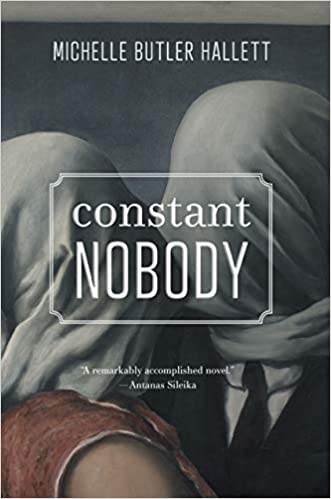
Constant Nobody, by Michelle Butler Hallett

Why this book: Recommended by my friend Chris in my literature reading group. Chris is a retired intel professional and said he found this novel powerful and recommended it for something different. So we agreed and selected it for our July discussion.  

Summary in 3 Sentences:  The book begins in the Basque region of Spain during the Spanish Civil War, with a male Russian undercover agent feeling an attraction to a female British undercover agent  – each representing their home country’s efforts to report on and influence the outcome of the civil war.  These two serendipitously run into each other again, but this time in Moscow in 1937 during Stalin’s purges, where our Russian is a mid-level executive with the NKVD carrying out the ugly work of the purges,  and our Brit is undercover as a language teacher trying to get insights for Britain about what is happening in Moscow. Through a series of painful episodes, they become involved with each other, their relationship and their lives are extremely strained and constrained and we get insight into the horrors of Stalin’s purges through their experiences and efforts to survive and protect each other. 

My Impressions:  A powerful book about a horrific time in Russia’s history. It was dark, and is not pleasant to read about and confront the horrors of Gestapo-like brutality and power in the hands of men who have become dulled to the pain and suffering of others.  But indeed it is a fascinating look at this very unpleasant side of humanity, and what it does to those carrying out murder on behalf of state.   

Kostya Nikto (“Nikto” is Russian for “nobody”) our male protagonist was an orphan on the streets of Odessa and owes his life to an older and senior member of Stalin’s NKVD, and therefore feels abiding loyalty to the state and his surrogate father.  As a human being, this loyalty erodes as he sees how thin the veneer of justice is on the horrors he is compelled to  commit and support on behalf of the state.    He struggles to come to terms with the legal executions he is compelled to commit as part of his “duty” – alcohol and drugs help dull his senses, and these are the refuges of many in his line of work.  In his world, he has to accept the willingness of his comrades to accuse and report on each other to gain personal advantage and promotion.  He is further confused by the feeling of love and sacrifice that he feels for the British woman Temerity – who goes by several different names in the book.

Temerity West (or Nadia, or Margaret, depending on the context) is a gifted, intelligent, ambitious agent for British intelligence MI6, and after her encounter with Kostya in Spain, volunteers for a tough assignment in Soviet Russia, and soon finds herself in over her head in the Moscow in 1937.  She is undercover as a language teacher, part of a group of COMINTERN volunteers who believed Soviet propaganda about the worker’s paradise that Stalin had created, and are living in a Moscow dormitory teaching different languages to the youth of Russia.   She, like the others, were constantly under surveillance and suspicion of being spies, or reactionaries, and were subject to the same arbitrary arrests, interrogations, and executions as Soviet citizens.   When she is picked up on the street as an attractive young woman out walking alone, and kidnapped to be part of a “dessert party” for senior NKVD officials, her situation become dire, and at the party, her erstwhile companion Kostya coincidentally at the party recognizes her, and at great risk to himself, is able to spirit her away. 

The remainder of the book is about their fraught relationship, their co-dependence in an environment where if either is compromised, they both die. 

Though it is very well written, it is not easy to look at the brutality that surrounds and threatens them in Moscow during Stalin’s purges.  That said, the ethical issues were palpable, and the discussion our reading group had of this book was among the more interesting we’ve had in a long time.   In this book,  we see what can happen when a regime or any government attains total power without checks and balances, and the whims and favors of the powerful (men in this case) cannot be challenged. 

Some of the interesting aspects of this book:

  • Beauty and ugliness. The incongruity of the horrors of random arrests and executions of citizens, and experimenting on human prisoners for medical purposes (very Nazi-Germany-like) contrasted with the beautiful music of Tschaikowski, Prokofiev and others played on the radio.
  • Personal power. When Kostya was issued his revolver, he felt a new sense of power and strength.   “A starving bezpriznorik (stray dog) held the life of a wealthy herring merchant. Was it so easy to obtain and exercise power, to solve problems, take revenge soothe humiliation and pain?  It felt better than a hit of vodka.” (p205)
  • Reality and Fantasy Throughout the book the two protagonists evoked and exchanged references to the images and characters from Russian children’s folk tales.
  • Special Cleaning Crews were always on hand to clean up the blood and carnage in the offices and other public and governmental spaces after a murder or a suicide.
  • Duty and Compulsion –  The concepts of “duty and compulsion”  were regularly discussed as two forces that drove the actions of the key players.  In fact the two concepts were conflated – one was seen compelled to do one’s duty. Temerity  argued for the concept of freedom and free will; Kostya responded that there is no such thing –  people are driven by externals -a combination of duty and compulsion, though there may be “theoretical choices.” “Where is the duty in choice?… True obedience hurts less in the end.” (p 279)
  • Intersections of power. Kostya’s surrogate father warned him to “find the intersections of power and adapt.” (p206)  A very Machiavellian perspective – even the lowly clerks have some power that intersects with the power of the senior bureaucrats.  The wise and nimble bureaucratic operator cultivates those intersections to his own advantage. 
  • Bureaucracy in the extreme. No one was trusted. Permission was necessary to take even the smallest step, and two or three person integrity and permission was required to take nearly every step, to approve nearly every decision.  There was always someone who could snitch on you to their own advantage.
  • Change and the shifting nature of power.  Kostya’s surrogate father repeatedly reminds him that “The steppe gives up in patches to forest, and forest gives up in patches to tundra, yet in places where you see no change, all the differences blend. Power works like that.”  
  • It’s not murder if it’s following the law.
  • Neither love nor duty drove her.  Purpose had fled. (p431)

In the midst of evil perpetrated by regular people, acting out of fear and duty as tools of a powerful state, we also saw acts of love and courage. In our group, we discussed the interesting ways in which we saw “love” manifested in this novel – differently than what one traditionally sees in literature, but there none the less.  It was interesting and reassuring to  see manifestations of love in the midst of the “banality of evil.”  The love story between Kostya and Temerity is also not a traditional love story – two damaged and yet courageous souls struggling to find a connection that has meaning and is deeper than the expedient and transactional relationships that had become the currency in a culture of fear and obligation.  

I and the others in our group had some issues with the style of the publishing.  Quotation marks were abandoned for the use of he dash (-), the new chapters and titles deserved  greater prominence, and we all found a number of typos and editing issues.  Goose Lane who published this interesting novel did not do it well.  That said, though it was not a pleasant read, I’ll agree with my friend Chris – it does certainly evoke an emotional response and poses thought provoking questions about how much evil would one do and be  accountable, under the authority of the state, and under the threat of torture and execution?  

Really glad I read it. Won’t soon forget it.  But I’ll be selective to whom I recommend it.  

Posted in Uncategorized | Leave a comment

The North West Passage Vols I & II, by Roald Amundsen

Why this book: I’m in a SEAL reading group and one of our sessions was a pick-your-own-book in the genre of explorations, discovery, survival.  I had read and been fascinated by Shackleton’s Endurance experience and of two failed American attempts to find the North Pole (Trial By Ice, and Kingdom of Ice) and so this one intrigued me  as well.  I was surprised when I bought it that the book is in two volumes. I bought the first volume, read it, then the read the second. 

Summary in 4 Sentences:  Roald Amundsen is best known for being the first man to the South Pole, but before that, he planned and completed the first transit by ship, from the Atlantic to the Pacific via the northern route – that is the Nortwest Passage vol 2famous “North West Passage.”  They began in Norway, with their crew of six on a Norwegian reinforced fishing boat, transited to Greenland and then north and west,  finding their route through the narrow passages well north of Hudson Bay and the Arctic Circle eventually around Point Barrow to Nome Alaska.  It took them 3 years and three winters in Canada, enabled by extensive interactions with and support from native Eskimos in the area. Their mission included extensive scientific studies and collection of data on everything from magnetic fields, weather patterns, plant and animal life, and of course,  Native American customs, language and culture. 
My impressions:  This book in two volumes is a fascinating and easy read. But it is not well published – it is a rebinding of what appears to be a photo copy of a long out-of-print original edition – to include notes and underlines and there are even sections with the pages out of order. On Amazon, the publishers claimed to have wanted to preserve the original flavor of Amundsen’s work, which sounded like an excuse to not tidy up and improve the layout – the lay reader needs help from the publisher to put together a quality experience.  That said, if one is interested in the heroes of the age of polar exploration, this is a good one to read  – as it is one of the most important experiences that prepared Amundsen to achieve his greatest and most famous success of being the first man to reach the South Pole. And it is written in a very conversational style – Amundsen’s personality,  feelings and perspectives shine through his narrative.

This book is Amundsen’s own account of the expedition, in his words and very much personalized. – clearly written based on diaries that included the immediacy of his feelings as the events happened, or shortly thereafter.  Volume 1 begins with a brief account of his childhood and the origins of his dreams of becoming an explorer, the steps he took to prepare himself, then the building of support, financial and otherwise, purchase of their fishing schooner Gjøa, outfitting it with what he thought they’d need, and assembling his team of six. Quickly the narrative gets into the trip across the North Atlantic, time spent and impressions of Greenland before he and his team crossed over to the North American continent and began their attempt to reach the Pacific via the up-to-then mythical North West Passage.

The book was clearly written not only for the lay person but also as a guide to future explorers and navigators.  Amundsen made extensive use of notes, charts and information he gleaned from the records of the multitude of unsuccessful attempts in the previous century to find the North West Passage, and he wanted to pay it forward to assist future explorers similarly, with maps, data, and lessons learned.  He gives details that were way more than I needed about shoal waters, landmarks, and descriptions of the various inlets and channels on their meandering through the confused, uncharted waters and passages as they found their way from East to West.  A great shortcoming of the books (both Vol 1 and 2) is the lack of maps to show where the various islands and waters were that he described.  I was regularly going to Wikipedia to find what I  could about places he named well north of Hudson Bay and well above the arctic circle where this story takes place.  Gjøahavn where they spent two winters is actually now a small town with a museum dedicated to Amundsen and his team.

I am not a sailor, nor do I have much background in Arctic sea travel.  The two years they wintered in Gjøahavn was to me the most interesting part of the book. Though they were all Norwegians familiar with cold weather, enduring the extremes of this area with no support from civilization were well beyond their experience.  As they were struggling to figure things out, they encountered and befriended the local Eskimos of various tribes, and during these two years, the Norwegians and Eskimos got to know each other quite well.  It is safe to say that Amundsen and his team may not have succeeded, may not even have survived without the help from and collaboration with the Eskimos. 

The Eskimos they encountered, while supportive, were very much interested in profiting from the relationship as well, and they did.  There was a brisk trade between explorers and Eskimos, the two cultures developing a truly symbiotic relationship.  Amundsen and his crew got food, information, guidance and expertise, clothing appropriate to the environment and manpower when they needed it, while the Eskimos attained much needed metal implements, weapons for hunting and other Western tools that helped them in their way of life.  Simple things that we take for granted, such as metal needles, matches, and nails were of enormous value to the Eskimos.  Both Norwegian and Eskimo were eager to learn from and about the other.  Amundsen and most of his crew learned the fundamentals of the Eskimo language, while the Eskimos learned a bit of English and Norwegian, and together they spoke a sort of mixed patois.  With good will and effort on both sides, it didn’t take long for them to be communicating quite well and enjoying each other’s company.  After nearly two years, when it was time for the Gjøa to head west, it was a sad parting for both sides. 

In his  writing, Amundsen clearly took great pleasure in sharing his fascination with the people and culture of those who were living not much differently than had their ancestors had for millennia. Both volumes provide a number of B&W photos, mostly of Eskimos, but also of the crew of the Gjøa and some of the environment.  The quality of photos published in photocopy is poor.  While Amundsen clearly respected Eskimo ingenuity and resilience, he wasn’t shy about sharing his Northern European prejudices against what he viewed as poor hygiene and lack of cleanliness and orderliness.  He noted how different tribes seemed to have different personalities and cultures, but he detected no violence between them in competition for hunting or fishing areas – there seemed to be plenty of land, and surviving the climate and weather was a full time job – leaving little energy or resources for fighting.  

One of the goals of the expedition was to obtain scientific data on this little explored part of the world, and whenever they were on land, they were measuring magnetic variations at various distances from the magnetic North Pole,  sending teams north to measure magnetic  variations as close to the pole as they could get. They were also measuring gravitational impact on magnetism, as well as weather, tides and currents, ice flows, animal migration patterns.  Underway they were mapping and recording their routes, depths, ice flow patterns, landmarks etc for future navigators.  

Volume 2 begins with the Gjøa leaving Gjøahavn in the summer of 1904 and heading west.   After months of fighting their way westward thru ice and narrow passages, it was a noteworthy day when they saw their first ship in the waters on or near the Beaufort sea north of Canada and Alaska – American whalers from the West Coast.  They had progressed far enough to the west to select a winter-over location not far from Hershel Island off the north coast of Canada, just east of the Alaskan border, where several whaling ships were wintering.  During the nine months that they were there entirely blocked in by ice, they were in regular contact with the whalers,  which gave them access to many more resources, as well as the insights experienced whalers could offer them about navigating those waters.  

During that third winter they continued to have interactions with local Eskimos but not to the extent that they had during their first two winters in Gjøahavn. The Eskimos in this region had already been in regular contact with whalers, and by this time, Amundsen and his team were pretty well adapted to living north of the Arctic circle.  Amundsen sadly noted that the happiness of an Eskimo tribe seemed to be in inverse proportion to the amount of contact they’d had with white westerners. 

After leaving their third winter during the very short summer of 1905, heading west to complete their transit to the Pacific along the North Coast of Canada and Alaska on the Arctic Sea, pack ice was their greatest obstacle and concern. They only had a couple of months – after early/mid October there was no more opportunity to sail. 

Within his narrative, Amundsen included (in Vol 1) a brief history of previous unsuccessful efforts to find the North West passage, which provided him with much information and background that helped him succeed.  One of those previous expeditions, the famous and ill-fated Franklin expedition disappeared and no one survived – and though Amundsen and other explorers found remnants and bones of some of those on the expedition, there is only speculation about their fate.   In Vol 2 he provides a brief history of American whaling in the waters off Alaska and Northern Canada as well. 

The degree that this team seemed to work together and support each other, living and working in very close quarters for 3 years was remarkable. Impressive leadership, different from Shackleton, but perhaps steadier.   Before they departed Gjøahavn heading west into unknown waters,  Amundsen wrote, “We all knew we were going to have a rough time of it, but the splendid relations which had always existed between us so strongly united us that although we were only seven, we were not easily discouraged.” p100 Vol 2 (Note – they had taken on an Eskimo to be part of their crew.) Or in another passage he noted that everyone had to be ready to help everyone else and step out of their lane if the expedition needed it. He said that, “In difficult situations we shared trouble and hardships in brotherly unity, and all rejoiced with one heart when difficulties were surmounted.”  p 275 Vol 2

There were two stories I found particularly interesting, having read several accounts (by Michener, Jack London, Robert Service) of travel with dogs over long distances in the Yukon territory during the Klondike gold rush.  There is a whole chapter in Volume 2 in which Amundsen describes his several hundred mile trip by dog sled accompanying a mail run from the whaling ships off Hershel Island south to Fort Yukon Alaska. At the end of Volume 2, there is a supplement written by 1st Lt Godfred Hansen, Amundsen’s 2nd in charge,  describing the nearly two month trip he and his partner made with dogs over snow and ice from Gjøahavn to explore farther north, to do scientific measurements and see what was there.  

There is much in these two volumes to fascinate people of many interests.  The story will capture history, adventure and exploration buffs like myself, while arctic sailors and polar explorers will revel in the detail of how Amundsen and his crew navigated Gjøa thru ice, wind, fog, shoals and currents.  Arctic and winter camping buffs will be fascinated with what Amundsen and his team learned from the Eskimos on building ice shelters and igloos, survival in the arctic, and details on expedition equipment. Hunters will enjoy hearing how they hunted reindeer, deer, polar bears, seals, arctic hares, lemmings – pretty much anything that moved and could live in that environment and could provide nourishment.  Dog lovers will be interested in how they managed and treated the dogs they brought and traded with the Eskimo – the dogs were a key to their success, and later to Amundsen’s success at the South Pole. 

All that said, these two volumes need to be republished for modern readers, with maps, better photos, and footnotes to better help us enjoy and learn from this experience. Amundsen’s writing is easy and enjoyable to read and it adds significantly to my appreciation of the era of arctic and antarctic exploration, a bit over a century ago.  


Posted in Uncategorized | Leave a comment

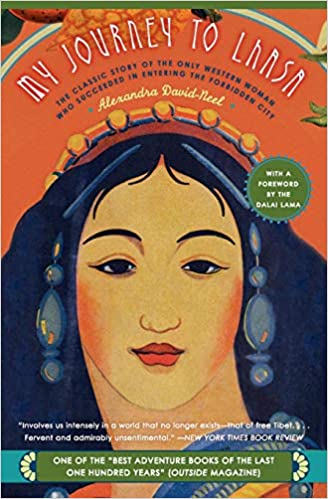
My Journey to Lhasa, by Alexandra David-Neel

Why this book: I heard first about Alexandra David-Neel in James Nestor’s  book Breath, in which he described how she kept herself warm while traveling in the Himalayas in Tibet by a special type of breathing.  I looked her up and she must be one of the most amazing women of the 20th century.

Summary in 4 Sentences: This is Alexandra David-Neel’s personal account of her trip on foot through the Himalayas to become the first western woman to visit Lhasa, the capital of Tibet. She had spent years living in Tibet, spoke the language fluently and had several times tried to visit Lhasa, but had been turned back each time because it was off limits to foreign women.  At age 55, in 1923, she decided to give it another bold attempt (in winter!), and this is her account of her several-months-long pilgrimage disguised as a peasant woman, with her adopted son, a Tibetan llama from a well respected sect, and their many close calls, struggles, hardships and adventures along the way to finally achieving her lifelong dream.

My impressions: This is an amazing story told in the first person by a most intrepid woman who, already very well versed in the history and culture of Tibet, chose to undertake a very risky and challenging trip through lawless and uncharted mountains of the Himalayas in  winter to fulfill her dream of visiting Lhasa.   Accompanying her was only her adopted son Yongden – a Tibetan llama with whom she’d already traveled through much of Tibet, India  and China.  I was amazed at her physical and mental hardiness and stamina as she and Yongden powered through a series of stunning trials and tribulations, challenges with snow, extreme weather, robbers, a very limited diet and sometimes days without any food between remote villages, with only what they carried on their backs, sleeping outside on the ground much of the time, eating very little, and having few creature comforts. 

They were both extremely cautious and scrupulous about not doing anything that would draw attention to themselves or appear to be anything other than what they  presented themselves to be – a penniless lama with his old peasant mother on a spiritual pilgrimage to Lhasa. This required her to eschew all western comforts, to quietly accept the humiliations of poverty, to humbly beg for food and shelter, and when that was not forthcoming, to do without, sometimes for days, as she and Yongden hiked through often trackless  and snow covered mountain passes and forests with no maps, no protection from wild animals or brigands, sometimes unable to find water, and often not sure where they were.  It took them several months, and they had quite a few adventures and close calls along the way.

Alexandra David-Neel was born in Belgium in the late 1860s, had had a fascination with Buddhism since she was young, and eventually found her way to the Far East where she studied Tibetan language, culture religion, mythology for decades and became well known to other literati well versed in these esoteric fields, including elite Tibetans themselves.  But as a westerner, and as  a woman, she was restricted in what she could do. With her force of personality and her intellect she broke through some of these barriers, but Lhasa was off limits.  This trip was her most ambitious ordeal and most audacious initiative. 

Her story is not simply about the challenges of her travel.  She enjoys telling stories of her interactions with the people she encountered along the way in the remote mountain villages of Tibet.  The farther she got into Tibet, the less likely she felt that people would suspect her of being a foreigner.   But she was always very careful.  She darkened her skin with dirt and soot, she blackened her hair with dye, and had a braid of black yak hair braided into her otherwise short hair – all to make her look like a common old peasant woman.  For shelter on their journey they sought old animal shelters, caves, or protected areas in the forest. In the villages they begged for and often got shelter from villagers, sometimes with the animals, sometimes sleeping with the family on the floor in the kitchen.  The living conditions in the remote villages in the Himalayas was quite  austere for those who lived there – it was especially austere for someone accustomed to Western comforts and hygiene begging for whatever these villagers were willing to give them    And often times they were turned away, sometimes had dogs sicked on them.  

She noted how western senses of privacy were unknown among the villagers she stayed with – there was very little of it, even for the most private matters of personal hygiene, to which she had to accommodate herself to appear accustomed to these living patterns.  Yongden was usually the star guest as he belonged to a Tibetan sect which was well known for having a sixth sense connecting him to the occult, magic and prophecies.  Wherever they went, he was asked to provide insights and answers to dilemmas, while Alexandra quietly sat and observed.  His talent and clever use of this skill got them out of many a tight situation, and allowed our narrator to sit quietly and inconspicuously in the shadows, and watch and listen .  

Throughout the book she instructs the reader through her own experiences about the culture of Tibet and of Tibetan Buddhism. We learn about how the poor villagers live, about various sects of Buddhism and how lamas are viewed.  She shares her perspectives on the faults and strengths of the culture and the people. She also regularly shared her inspiration from the beauty of the world through which she was travelling, describing breathtaking mountains and valleys that took her breath, and her fatigue away.

Eventually she and Yongden arrived in Lhasa, and her narrative changes tone. She spent two months there, still very concerned about being found out and evicted – so she continued to play the dumb, poor old peasant woman.   She and Yongden stayed in a ramshackle stable with some other poor pilgrims on the outskirts of Lhasa, and the stories she tells of the drunken quarreling of their stable-mates reminded me of Chaucer.  She loved what she found in Lhasa, having studied it for years, and her joy at being there for the new year in January, was palpable – she was able to participate with the other pilgrims in all the new years ceremonies, parades and festivities.  

After two months there, she headed back, a shorter route, and she didn’t have to be as concerned about being found out – if an official found out who she was, he couldn’t take her visit to Lhasa away from her. So she allowed herself a bit more comfort on the way out, and enjoyed sharing stories of Tibetan superstitions, myths and strange encounters she’d had with a variety of people in that remote part of the world, so different from the West.  

Two things would have made this book better and easier to follow – she uses a lot of Tibetan words that don’t have English equivalents, and though they are defined and explained in the footnotes, they are only explained once, but used again later.  It would have been useful to have had a glossary to refer to of all the words that were defined in footnotes – since a number of them appeared repeatedly, with the assumption that the reader remembered what they meant.  Also there is but one very indistinct and small map in the front of the book.  The book would have been greatly improved with maps of different portions of their journey,  with the various rivers, villages, monasteries and other place-names identified. 

I found the book and the woman fascinating.  I learned so much about a world and culture completely foreign to me –  the Tibet of a hundred years ago.  That world is certainly different now – the introduction to the book provides a painful litany of atrocities, and a description of the cultural genocide that China has inflicted on Tibet in the last 50 years to bring it under Communist Chinese control.  And it continues – I just read an article in the WSJ (July 2021) about current Chinese government efforts to undermine key Tibetan cultural practices in order to make Tibet culturally more Chinese.    But I was fascinated with Alexandra David Neel herself and how she describes this short snippet of her life.  I have ordered a biography of her life – I’m very interested in learning more about the rest of her story. 

Some quotes from the paper back book that will give you a sense for her style and her voice:

What a change from that ovenlike kitchen to the cold air of a frosty night, with a blizzard raging, at fifteen or sixteen thousand feet above sea level! It was not the first time that I had experienced this kind of hospitality. More than once villagers had invited us, treated us to a good supper, and then sent us on the roof or into the courtyard. Nobody apparently thought much of it in Tibet.   p115

For miles we proceeded under cover of gloomy, silent, and mysterious forests. Then, an unexpected clearing suddenly revealed, behind the dark line of tall fir trees, extraordinary landscapes of shining snow-clad mountains, towering high in the blue sky, frozen torrents and glittering waterfalls hanging like gigantic and immaculate curtains from the rugged rocks. We looked at them, speechless and enraptured, wondering if we had not reached the confines of the human world and were confronted with the abode of some genii.p198

We did not always spend the night in the forest.  On reaching hamlets, isolated farms, or monasteries, we often begged hospitality. Sometimes it happened that we were forbidden to enter. More than once we had to defend ourselves against dogs left loose to keep us away…p 198

In Tibet, amongst country folk, the farm always includes a number of rooms, but none of them has a really special purpose. Wool, grain, provisions, ploughs, and so on fill the different parts of the house, and for the most part, the family’s general living and sleeping room is the kitchen. p 213

Tibetans have lost much in parting with China . Their sham independence profits only a clique of court officials. Most of those who rebelled against the far-off and relaxed Chinese rule regret it nowadays, when taxes, statute labor, and the arrogant plundering of the national soldiery greatly exceed the extortion of their former masters. p262 (note: this was in 1923 only a few years after Tibet broke from China who had treated her as a remote colony, with benign neglect.)

The religious communities in Tibet form little states within the state, of which they are almost entirely independent. All are possessed of lands and cattle. As a rule, they carry on commerce of some kind.  p281

Life vows do not exist among Buddhists, who believe in the fundamental impermanence of all things, and these children may, therefore, return later on to the world and live as laymen without carrying the dis-esteem of their compatriots. Some of them do so, but many, not feeling sufficiently courageous to apprentice themselves to any other career, maintain the habit of the Order without respecting it as they should.  As a rule, these drones of lama-ism, somewhat lazy and gossiping, a trifle too gluttonous and especially too greedy of gain, are charitable and hospitable folks in spite of their faults. 282-3

(on leaving Lhasa) Under the blue luminous sky and the powerful sun of central Asia the intensified colors of the yellow and red procession, the variegated bright hues of the crowd’s dresses, the distant hills shining white, and Lhasa lying on the plain at the food of the huge Potala capped with glittering gold- all these seemed filled with light and ready to burst into flames. Unforgettable spectacle which alone repaid me for my every fatigue and the myriad dangers that I had faced to behold it! p303

Her story of practicing Thumo reskiang – the practice of creating body heat through a breathing practice is briefly described on p134.


Posted in Uncategorized | 1 Comment

Red Dress in Black and White, by Elliot Ackerman

Why this book:  This book had been repeatedly suggested by my friend Janar for our literature reading group. We had read Elliot Ackerman’s Waiting for Eden last year, and we were finally ready to select this book as well.  Glad we did.

Summary in 3 sentences: The story takes place in Istanbul in the last decade – between 2013 and 2016, and involves a female American expat married to a wealthy Turkish real estate developer, a male American photographer who has an affair with her, a female member of the US Consulate, and a Turkish avant garde art curator for museums.  The novel revolves around the relationships of these four very different people within the context of Turkish politics, American political influences on the Istanbul economy, and in the background but playing a significant role, the Gezi park demonstrations and riots that have had a profound effect on Turkish culture and politics – akin to Tiananmen square in China or George Floyd  in the US.  Character, values, principle vs expediency, Turkish and US cultural values in contrast – these all are key themes in this interesting novel set in a part of the world I know little about.

My Impressions: Very well done.  I wasn’t sure what to expect, and the book is full of surprises, and is very well written.  The characters are real, believable, and multi-dimensional, and I could relate to all of them.  Ackerman’s writing is simple and straightforward – his style has been called Hemingway-esque – and for each scene and setting he created a picture I could see and feel.  I listened to the book on audio and though it was well done, I wish that I had read it.   A good friend loaned me her copy after I’d finished listening to it, and after visually reading portions of it, I found reading it a more satisfying experience. 

The story takes place in Turkey in the 2nd decade of the 21st century, and the story is built around incidents related to a major anti-government protest in Gezi park in Istanbul by progressives protesting a wide variety of regressive and short-sighted government actions.  The police brutally repressed the demonstration, which led to a greater chasm between the progressives and Erdogan, and was truly a major incident in Turkey, the impact of which is still felt in Turkey today.  The story of the Gezi park demonstrations and their aftermath can be read about here.   There really was a lady in a red dress who became a symbol for the over-reaction of the police to the peaceful protests, which you can read about here.  The black and white in the title refers to a separate theme in the book – that people and events are influenced by being in tension with their opposites – in values, perspectives, life styles. We understand A best by seeing it in contrast with not-A.   The idea reminds me a bit of Hegel’s dialectic – a thesis in tension with an anti-thesis which results in a synthesis which becomes something new altogether – and becomes a new thesis, which generates its own antithesis. 

But the Gezi Park demonstration and riots are not what the story is about  – but it does provide the setting.  Red Dress in Black and White is about Peter an American photographer,  Catherine an American woman married to Murat a wealthy Turkish real estate magnate, Deniz, an avant-garde museum director, and Kristin a woman ostensibly serving as a Cultural Affairs liaison at the US Consulate, but clearly primarily working in an intelligence collection role, though “CIA” is not mentioned.  It is about how their lives become entangled and upended

Though for each of these characters their professional lives play a role, the story evolves as a character study of each of them, as they are confronted with challenges and dilemmas, usually of their own making, and all of it within the cultural landscape of modern Istanbul. 

There are many surprises in this novel – as it twists and turns, but most impressive to me in reading  it was Ackerman’s descriptions of the scenes and how he developed his characters with the dilemmas they faced and the sometimes reckless decisions they made.  This is no simple good-guys vs bad-guys novel; the characters are real, complex and each compelling in their own way.  I could relate to and had sympathy for each, though each also had their clear flaws and were in large part responsible for the dilemmas they found themselves negotiating.

Catherine is unhappy in her marriage with Murat and initiates an affair with Peter who allows it all to happen, and as it continues over time, it gets more complicated when Catherine decides she wants to leave Murat, return to the States with her and Murat’s adopted son – and she wants Peter to accompany her.  Catherine short sightedly believes this will solve all her problems – Peter isn’t enamored of the idea for a number of reasons.  Murat, Peter, and Catherine all find that their lives are connected through Kristin and Deniz in surprising ways. And in coming to understand these connections, we are introduced to some of the dirty underbelly of how the arts are promoted, how real estate deals are made, how the US influences events and people overseas, and how people react under pressure, in difficult situations of their own making.  It is a very well done character study of very different people making decisions that have impact well beyond themselves. 

Another key character in this book who, though in the background for much of the novel, is truly a lynchpin to all of what happens in the story:  Murat’s and Catherine’s adopted son William. He is a victim to the dysfunctional marriage of Murat and Catherine, as well as to Murat’s insecurity in his job leaving Murat little time or energy to give William the attention he deserves.  Questions of Willam’s biological parents take center stage later in the story as as Catherine seeks to escape with him to the US, and the parentage questions yield some surprises that involve and impact all the other characters in the book.  William himself evolves in the book from a nice but timid young boy into a promising young man.  One of the most creative and clever aspects of this novel is how Ackerman develops this theme from a side show to center stage in his story.

This is a story of people and their challenges and how they deal with the other characters.  In the background however, are the unstated sub-themes to the story: The Gezi park demonstrations, police corruption and brutality, progressives pushing for more justice, corruption and influence peddling in the real estate market, the US Embassy subtly injecting itself into various spheres of Istanbul life to maneuver events in ways that might benefit the United Staes, and the complexities of marriage and parental love. 

I enjoyed this book and recommend it to others and to other reading groups. Some in our group didn’t care for it – didn’t care for the characters, wanted more attention to culture and history of Istanbul. Others in our group loved it and gave it solid 9s on a scale of 1-10.  I enjoyed it, learned from it, found the discussion of it energizing and fascinating. I really liked the writing, it caused me to think and I gave it an 8.5.  

Posted in Uncategorized | Leave a comment

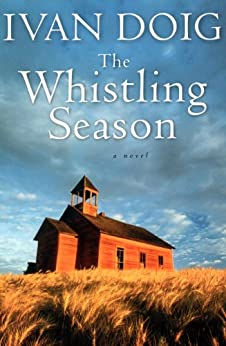
The Whistling Season, by Ivan Doig

Why this book: I had been reading primarily non-fiction and was looking for a novel to balance my reading. My friend Francine told me she’d just read this one. I had read 5 other books by Doig, one of the pre-eminent authors of the 20th Century American West, centered in Montana.  I really like his writing, have very much liked all I’ve read by him, so I bought it on audible and listened to it. Really glad I did.

Summary in 4 sentences: The story is told as a retrospective by the Superintendent of Schools in Montana in the mid-late 1950s, looking back on his youth about 50 years earlier in the early 1900s when his widower father was a homesteader in Marias Coolie, Montana and he and his brothers rode horse back to a one-room school house. The story begins with his father answering an add from a woman in Minnesota  offering to work as a housekeeper, since he needed help taking care of their home while the boys were in school and he was working the farm.  Responding to the add, an attractive woman arrives on the train from Minneapolis with her brother, and between the adjustments required in the family and the household, and the various day-to-day dramas at school, the story twists and turns as we get to know the world of small town Montana homesteaders. Our narrator goes back forth between his voice as a young teenager in Marias Coolie, to his voice as a middle aged man looking back on his youth while dealing with the challenges of running a school system in the age of Sputnik. 

My Impressions: A.wonderful story beautifully written, that allows the reader to experience the charm and frustrations of frontier life in the early 20th century, as the narrator tells his stories from his life growing up in a very small town in Montana.  There are a number of intermingled mini-dramas that take place throughout the story and Doig weaves them seamlessly into his narrative about the main character’s experiences coming of age in this world that once was, but is no more.   

The story begins with the changes wrought by bringing an energetic and charming woman into a household of all men and boys and how they have to adapt. That brings drama at school as the boys are ribbed at school and the constant gossip about an attractive single woman working for their widowed father.  We get to know the other kids in the one-room school house and a bit about their families, and there is the inevitable bad boy who bullies the other boys, who himself is bullied at home by his brutal father.   Boys get beat up, kids get in trouble, or fall in love, relatives die, the weather is always an issue for farmers, people come and go, and the town changes and evolves, as life happens and Doig fascinates the reader with his descriptions of people, places, events that deserve to be appreciated and savored, but are truly normal. 

Key characters in the book are the book’s narrator and protagonist, Paul Milliron,  unusually precocious and gifted student in the one-room school house, responsible and mature beyond his years, but rather timid, cautious and practical in his approach to most problems and life.   Paul’s younger brother Damon is bold, aggressive and adventurous, a sports nut, always willing to assume risk and take on a challenge.  Their youngest brother Toby is  affectionate, emotional,  innocent and extraverted.  And father Oliver,  who is hard working, intelligent, sensitive and practical – kind of a Ward Cleaver in overalls.

We also get to know Paul a bit as a 60 something middle aged man, telling the story as he looks back, but also as he confronts his challenge as Montana School’s Superintendent under pressure to close all one-room school houses. 

Into young Paul Milliron’s family comes Rose Llewelllyn,  practical, bold, hard-working and ambitious, but mysteriously, she arrives dressed in satins, but with no money. She brings a new, positive feminine energy into the household and all three boys are captivated by her, and Oliver keeps his practical  distance but remains the head of the household.  Rose’s brother Morrie escorts her from Minnesota and plans to stay – he too is another enigmatic and interesting character, extremely well educated, articulate in the way of a Harvard professor, who knows a little bit about everything, is wise in the ways of the civilized world,  but not in the practical skills of the frontier. 

The story evolves as various challenges arise in the school and community – for example, we get to know Aunt Eunice,  a caricature of a judgmental,  guardian-of-social-propriety aunt, Eddie Turley the school’s big, strong, dumb bully,  Ms Trent, the school house’s one teacher,  who elopes with a revivalist preacher,  leaving the school without a teacher, and more.  Throughout the book we are treated with different stories of the three brothers, of various dramas at school, stories of Rose and Morrie, and Oliver Milliron.  As the community deals with various mini-dramas, we get to know the all these characters and the community better  – all through the eyes of our precocious narrator, Paul Millirone. 

Eventually Rose and her brother move onto center stage as Rose takes initiatives that change not only life in the Milliron family but in the community. Her brother Morrie steps in to fill the teacher vacancy and he transforms the school house and the learning environment. Through Paul, his prize pupil, we get to know him as a fascinating character.  And eventually the mysterious backgrounds of Rose and Morrie are revealed to Paul – and this become something of a crisis and a fork in the road for the key players in this story. 

The magic of the book is in the writing and the language.  Doig injects the sophisticated language of the narrator, as well as the almost classically refined language of Rose’s brother Morrie, into the simple western world of homesteaders in Montana.  The juxtaposition is striking and entertaining.  The language itself is  a prism through which we see the contrast between two different worlds – but Doig’s style does not in any way belittle the hardworking homesteaders of Montana.

The New York Times reviewer Sven Birkerts wrote in his excellent review of this book, that:  “Doig’s writerly ambition is less in plotting than evoking, and it is his obvious pleasure to recreate from the ground up — or the sky down — a prior world, a prior way of being.”

I think that puts it pretty well.  I really enjoyed this book and was again, impressed with Ivan Doig, one of my favorite novelists.

Posted in Uncategorized | 2 Comments

By Water Beneath the Walls, by Ben Milligan

Why this book:  The author asked that I review this book before it was published. I declined, he politely persisted, I politely agreed to just take a look at it.  After I started reading it, I couldn’t put it down. I read a galley proof. It will be published and available to the public in July 2021. 

Summary in 4 Sentences: Ben Milligan’s intent was to explore how one of the nations and the world’s premier land commando units resides in the Navy, vice the Army, the Marine Corps or perhaps another government agency. He explores how the US military approached commando and commando-like (small unit raid operations) during WW2, Korea and ultimately Viet Nam, when the SEALs finally came into their own.  It is a story of individual champions in all the services arguing for a special capability, and repeatedly being shut down by leaders steeped in conventional thinking who could not imagine that  the value of such a force could be worth the costs. It is also a story of battles between staffs, as well as battles fought by intrepid early special operators, often under-trained, under-resourced, and poorly supported against our nations enemies in war. 

My Impressions: I wasn’t planning on reading this whole book -was planning to just read a chapter or two, skim the rest and give Ben Milligan an overall  impression.  But as I got started, I couldn’t put it down.  It is a great read – Ben Milligan has an engaging writing style that pivots back and forth between intense and serious, to humorous and even occasionally “snarky.”  Ben is a former SEAL with a BA in History and an MA in International relations and he successfully brings those worlds together in this book.  He is an outstanding researcher and a great story teller.  And though I had spent my career in the Navy SEALs and have read more military history than even most military officers, this book was full of new information and insights that give me a greater understanding of not only the history of the Navy SEALs but also of Special Operations.  His narrative extends from stories about leaders at the highest levels of power and authority in the military, those whose decisions shaped the direction of Special Operations,  down to the operators on the ground – their characters, experiences, decisions, frustrations and tragedies.

By Water Beneath the Walls is written in Five Parts:  Neglect, Opportunity, Relevance, Exigency, Culmination, and finishes with a Conclusion entitled:  Nature Abhors a Vacuum.  The chapters in the book have titles like:

  • Chapter 1: The Reluctant Creation and Violent Demise of the Navy’s First Commandos, the Marine Corps Raiders; 
  • Chapter 3: The Us Army’s First Commandos and the Raid That Wasn’t;
  • Chapter 6: The Contest for the Guerrilla War in China and the Organization That Had  “No Damn Business” fighting in IT: The US Navy’s Army of Sailors; 
  • Chapter 11: The First SEALs, Their Search for a Mission , and the Report That Found It for Them; 
  • Chapter 15: The Navy’s Skeleton Key to Inland Combat, and the Final Against-the-Current Achievements in the War’s Ebb Tide That Exposed the SEALs’ Preeminence as the US Military’s Go-Anywhere Commandos. 

The unusual title comes from a brief story on the fore-page about how in 705 AD, Justinian II “led a small group of fighters under the impregnable walls of Constantinople by way of an unguarded aqueduct and captured the city. It was a victory that never should have been, by water beneath the walls.”  The analogy is obvious: How unlikely it is that the SEALs should become one of the worlds most successful and famous commando forces, while being part of the Navy (and not the Army or USMC.)  Perhaps this too “never should have been.”    So, how did that happen?   That is the question Ben Milligan and this book seek to answer. Most  of the story takes place well before there were any SEALs.   Indeed, the SEAL Teams didn’t simply spring onto the scene. 

There is a fascinating back story, and By Water Beneath the Walls tells it.   In this book we learn about the rise and demise of William Darby’s Rangers in WW2, of the formation of the Naval Combat Demolition Units, Scouts and Raiders, and Underwater Demolition Teams, as well as Marine Raider units, and how they fared in North Africa, Normandy, and the Western Pacific.  We learn of the Navy-run insurgency operation and network behind the lines in Japanese-occupied China.  We learn of early attempts at using UDT’s as raiders in Korea, then of the ill-fated but bold efforts to create out of whole-cloth, a joint team of insurgents to run operations behind China’s lines in Korea. And we learn how repeatedly, after such units were created to meet an immediate need in war, at the conclusion of that war, the services either disbanded them altogether, or scaled them way back,  and reverted to what they knew best how to do – train and resource traditional general military forces. 

The final two sections of the book appropriately focus on Viet Nam, where the SEALs initially earned their credibility.  I came into the SEALs just after the Vietnam War, and all of the experienced SEALs I worked with and for had fought in that conflict.  Though I thought I had a pretty good idea of what that war was about, By Water Beneath the Walls gave me context to help me better understand and appreciate the stories of my mentors.  I knew many of the people he portrays in the operations he describes, which made this section that much more meaningful to me. 

The last part of the book spotlights a single SEAL platoon from SEAL Team TWO in Viet Nam, which provides an engaging picture of what SEALs did in that war.   Milligan highlights some of the colorful stories about the members of this platoon, some of the operations they conducted, and gives a detailed description of one particularly harrowing operation in which much went wrong, and only through amazing heroism on the part of the SEALs and their supporting helicopter pilots did the platoon survive, albeit with several SEALs severely wounded. 

The book concludes with CNO Adm Jimmy Holloway at the end of the Viet Nam war confiding to SEAL Medal of Honor recipient Mike Thornton,  that the Navy’s long term intention was to “dissolve the Teams.”  Was it deja vu all over again?  It seemed that the SEALs, “like the Raiders and Rangers before them, would be disbanded at the apex of their achievements.”  p502  The irony is that this was the same Adm Holloway who led the Holloway Commission investigating the failure of Operation Eagle Claw (Desert One) in 1980. The resulting Holloway report led directly to justifying the establishment of US Special Operations Command which all but ensured that the services would not be able to disband the SEALs, the Army SF, the Rangers or other Special Operations Forces. 

By Water Beneath the Walls is not a quick read for someone wanting a SEAL book for a junk-food-read on an airplane ride.  It is a multi-course banquet – 500 pages long, covers a lot of fascinating history, and Milligan builds his case with engaging and often edge-of-your-seat examples of brave men learning hard lessons that will make current operators wince. It is a fascinating read for anyone interested in the history of not just the SEALs, but of Special Operations, and it is an engaging read for anyone who enjoys great story telling by a wonderful writer.  I really enjoyed learning so much from this book.

——-

The many fascinating things I learned in this book, include: 

…that there has been a tug-of-war going back decades and probably longer between some of our most senior military leaders who advocated for elite specialized commando forces, and those who either did not support the idea, were adamantly opposed, or distrusted or even despised the idea of such forces.

…how and why conventional leaders in the Army and Marine Corps repeatedly smothered healthy efforts to create creditable raiding forces in their services, in WW2, Korea, and even Viet Nam.

…about the backgrounds, personalities, and military experiences of some of those who were huge in the history of Naval Special Operations.  Such heroes as Buck Halperin, Draper Kauffman, Rear Adm John Hall, Phil Bucklew, Milton Miles, NCDU Bill Freeman, PO1 Bob Wagner,  Lt Pete Peterson, and many more – even Ernie King, Arleigh Burke and Elmo Zumwalt.   

…how Draper Kauffman, considered the Father of UDT, had been an ambulance driver in France in the early years of WW2 (shades of Hemingway’s Farewell to Arms,) was captured and became a Nazi PoW, then served in the Royal Navy –  all before becoming a US Naval Officer and a key leader in forming and shaping the NCDUs and UDTs.  

…about extensive and controversial US operations that the Navy successfully ran behind Japanese lines in China.  And how Wm Donovan and the OSS lobbied hard to take them over, and in failing that, sought to undermined them.  

…that the Navy’s China operations played a key but subtle role in the Navy’s eventual support for creating SEAL Teams.  Phil Bucklew, one of the key founders of Naval Special Warfare had been a China operator.  Adm Arleigh Burke, CNO of the Navy in the late 50s and early 60s, always an advocate for bold action, had been a fan of the Navy’s China initiative.  He was a strong supporter of creating a Navy unconventional warfare raiding capability, and his influence mattered.

…that the unlikely (even incredible) mission that Anton Myrer gave Sam Damon in Once an Eagle to serve as an advisor/observer with communist insurgents in China in the 1930s had to have been based on Marine officer Evans Carlson who indeed was assigned to accompany Chinese Communist guerrillas fighting the Japanese in the late 1930s.

…about efforts to resurrect raiding units and a raiding capability in the often overlooked war in Korea.   I learned about the Navy’s efforts to use commandos to prep the battlefield for the landing at Inchon, the initial and fumbling steps of UDT to do small raids beyond the shoreline, and the bold, but poorly planned and executed efforts to insert US forces in the rear of China’s forces to generate Korean resistance. 

…about the mistakes made by the early pioneers in raiding operations, learning everything by trial and error, without the benefit of decades of experience and lessons learned that have been passed down to current special operators.  These were painful to read. 

…how Phil Bucklew and Dave Del Guidice with the help of a very enterprising SEAL E6 (Bob Wagner) “fought” to get SEALs any role at all in the Viet Nam War, a role which expanded as their successes and contributions were recognized and were clearly disproportionate to their size. 

…how the SEALs developed the idea of “snatch” missions designed to capture VC in Viet Nam in order to interrogate them and get intelligence. As obvious as this may seem, others weren’t doing it.  For others, it was all about body-count. 

Some of the great catchy expressions I enjoyed in By Water Beneath the Walls (page numbers are from the galley proof I read, and may not be reflected in the published version)

“Edson was a perfect Marine, and no perfect Marine has ever used his imagination unless ordered to do so.” p16

“Courage is always strongest when not allowed too much time for thought.”p 81

(Howlin’ Mad Smith’s) “mustache trimmed equidistant from nose and lip, and a jowly face that relaxed into a scowl (as every good Marine’s does)….p 145

“When they finally breasted the surf, many LVT drivers, slightly braver than smart – the best ratio in combat – drove onto the beach…” p146

“‘After that, there was the Jesus factor – the unpredictable.’  Though Luehrs and Acheson had not walked on water, they had been baptized in it, and they returned as apostles for a new method.” p 154

“Now Theiss was giving Kauffman a choice, a military euphemism for an order.” p166

(He was accompanied by) “at least eight other high-ranking officers –  a saluting , murmuring,  pyramid of authority, deferential to (Gen Mark) Clark and imperious to everyone else.”  P309

“Secretary of Defense Louis A. Johnson, a bald and bulky West Virginia Lawyer whose glad-handing past as Truman’s campaign director concealed a mind that never saw an arm without considering how to twist it.”  p 237

“Wide mouthed as a duck and so bowlegged that one observer declared that he (Roy Boehm) wore his “balls in parentheses,”…p414

Posted in Uncategorized | 3 Comments

Nine Years Among the Indians 1870-1879, by Herman Lehmann

Why this book: Herman Lehmann’s story is briefly told in Empire of the Summer Moon and I was intrigued and wanted to know more.  I was pleased to find that he had told his own story, in this book, first published in 1927.

Summary in 3 sentences: Herman Lehman was captured as an 11 year old and spent the next 4 years living among the Apaches, eventually becoming a trusted member of the tribe. He then got in trouble with the Apaches, escaped and was taken in by the Comanches where he felt more at home, and stayed with them, fighting for their survival against the US Army and Rangers who were driving the Comanches onto a reservation. Finally he also submits to the reservation, and eventually chooses to repatriate himself to his original family and to white culture, though for the rest of his life he proudly retained his status as a member of the Comanche tribe.

My impressions:  Fascinating read – especially if you’re interested in the West, and true life stories of Indians and settlers, and how it was to live in that time.  It is short (97 pages) and powerful, like sitting at the knee of the old man Hermann Lehman telling of his youth as a boy captured by raiding Apaches, living with them for about 4 years, before escaping to live with the Comanches, participating as an Indian in the battles with the US Army, the Texas Rangers and other whites.  This book is him telling his amazing stories of survival, brutal killings and torture that he observed and participated in, and his eventual repatriation to white culture.  It provides great insights into the different cultures of Apaches and the Comanches, as well as insights into the antipathy between them and anglo settlers. 

Herman and his brother were captured when Herman was 11 years old and they were not treated well. A fluke opportunity allowed his brother to escape, but Hermann himself made a point of adapting in order to not be further tortured, and though he unsuccessfully attempted a couple of escapes (for which he was tortured again), he eventually became a trusted member of the tribe, in part by aggressively participating in raids against white settlers. He also began to see and take pride in himself as an Apache warrior and adopted and internalized their values and lifestyle.

The introductory page of this book is written by Mr l. Marvin Hunter in 1927 who it appears served as Lehmann’s ghost writer, and Hunter he says in this book, he is writing down the stories as Lehmann told them, and which he says are vouched for by living whites, and Native Americans who knew him then.  The book is also based in part on a book Indianology, published in the 1890s form which he Hunter claimed to have taken considerable amount of information on Lehmann’s captivity and life. 

Nine Years Among the Indians is composed of short chapters, each a vignette from Lehmann’s life, and which can be read as short stories almost independent of each other.  Reading this book feels like going to visit the old man Herman Lehmann and getting a good story or two with each visit.  It was perfect for me to take in the field on a NOLS expedition and read a chapter at a time with my headlamp at night before going to sleep in my sleeping bag. The chapters have titles that describe a specific vignette, such as: “”Fight with the Rangers,” or “I Make a Saddle,” or “Cannibalism of the Tonkaways,” or “I get shot in the leg,” or “Soldiers kill our women.”

Lehmann was forced to escape from the Apaches after killing an apache medicine man in revenge for the medicine man having killed  his Apache “father” or mentor in an internal brawl among the Apaches after an alcohol fueled argument and fight on one of the reservations.  Those in the tribe who were allies of the medicine man swore to kill Lehman, and Lehman had to run for his life.  Apparently for months, he was surviving alone – “as a hermit” he writes – and was pursued by Apaches seeking revenge for killing the medicine man.  Eventually he finds a camp of Comanches and convinces them to take him in, after which he earns their trust and becomes a member of that tribe.

Lehmann’s time with the Apaches and Comanches was during the window described in Empire of the Summer Moon in the 1870s, when the Comanches were trying to maintain their way of life and survive while being aggressively pursued by the US Army and the Texas Rangers.  Lehmann fought the whites who he had learned to hate, and became a committed Comanche.  He eventually connected with Quanah Parker who he greatly admired, and who eventually convinced Lehman to surrender and come to live on the reservation.

At which point Lehmann was unwillingly returned to his original white family. That is a fascinating part of the story – his resistance to reintegrating with his white family and culture.  Eventually his original family’s tolerance for his Indian ways and idiosyncrasies, and the love they showed him slowly won him over, and he decided to integrate with white society.  

That said, he still retained his status as a member of the Comanche tribe, and for the rest of his life, he was both white man, and Comanche.  He married a white woman and had children and the story in Nine Years among the Indians of his later years is a bit more peaceful than the bio of him I subsequently read in Wikipedia, which indicates his family life may not have been as peaceful and happy as his book would have us believe, and hints that he may never have renounced some of his Comanche ways that were not in synch with well-healed Anglo culture.  As in Memoirs of a White Crow Indian (my review here), at the end of his life, he went back to his Indian tribe -where he felt most at home. 

Fascinating and fun read – with great insights into life in that turbulent time. 

Posted in Uncategorized | Leave a comment

The Weight of Ink, by Rachel Kadish

Why this book: Selected by my literature reading group after Patsy pushed for us to read it for at least a year. She hasn’t let us down yet with books she’s insisted that we read. This is a gem. I was going back and forth between the printed and the audible version, but ultimately chose to stick with the audible version; the reader Corrie James does a superb job of giving emotion and nuance to the characters. 

Summary in 4 sentences:  In a suburb of London, a history professor nearing the end of her career, is brought in with a graduate student to assess the value of some centuries old papers and letters found hidden in a locked compartment of a stately old mansion.   As they attempt to decipher the enigmatic letters and papers from an obscure rabbi and his household from the 2nd half of the 17th century, we are taken back to the world in which the letters and papers were written, and we get to know that world, and those we wrote the letters and papers.  There are two dramas occurring in The Weight of Ink, and they seem to be conversing with one another across the centuries and throughout the book – one drama taking place in the life of the rabbi’s scribe, a young precocious Jewish woman living in the harsh, bigoted world of restoration England and her challenges to support the rabbi while  struggling to create a role for herself, and to survive. The other drama is at the beginning of the 21st century as the historian and her intern work to understand what the papers might tell them about the lives and thoughts of those who wrote them, but they also struggle with their own personal issues, they struggle to connect with each other, and they struggle with the politics of the university’s history department, as they endeavor to bring the surprising insights they discover to light.  

My Impressions: For me, this was one of those powerful “Wow!” books that I’m fortunate enough to read every now and then.  I started saying “Wow!” about a quarter of the way into the book, and my “wow!” exclamations continued right through to the very last page.  Great writing, fascinating story, some powerful lessons on history and the human heart, three-dimensional and compelling characters – SO much richness in this wonderful book.  It may not be everyone’s cup of tea, because Rachel Kadish builds her characters slowly and deliberately,  and she paints a picture of her settings with detail and sensitivity.  She allows the drama to build slowly, all the way through to its rich and fulfilling conclusion, with many fascinating surprises along the way.  A great read. 

Each chapter begins with a date and a location telling us which part of the conversation we’ll be sitting in on in that chapter.  The papers from the 1600s include the Jewish date – for example November 12, 1657  6 Kislev, 5418 London – to tell you that this chapter is from that world, that period.  Then the next chapter may begin: November 4, 2000 London, and offering up that world, that perspective, that drama.    

There are three main characters in the book, of whom the most important is Ester, who lived in the earlier period.  The other two, who are seeking to understand Ester’s world and the letters she wrote, are Helen Watt, the stiff-upper-lip traditional British History professor,  whose health is failing as her academic career comes to an end, and Aaron Levy, a young American doctoral student floundering with his thesis who was sent to help Helen with evaluating and translating the papers.   Much of the richness of this book is in the relationships between these characters – the strained relationship between Helen and Aaron, and the evolving relationships between both Helen and Aaron and Ester as they conceive her, as they put together the pieces of the puzzle about who she was and unravel the mysteries in what she wrote. 

There are a number of important secondary characters who include the wise, elderly much-respected rabbi, who was blinded in the inquisition in Portugal; Rivka, the Polish Jewish housemaid who served and protected both Ester and the Rabbi;  Mary da Costa Mendes who Ester served as a companion; a couple of Ester’s suitors; Aaron’s girlfriend Marissa; Jonathan Martin, the smarmy chairman of Helen’s history department; and a  few other.   These and other characters play their role in The Weight of Ink, primarily to help us better understand our three primary protagonists. 

And much of the richness of this book is in the detail with which Rachel Kadish paints the world of London in the 1650s and 1660s.  We can feel the harshness of the bigotry toward Jews, as well as the caution and fear the Jews live with in that environment.  We get a sense of the city of London of the time, so different from what we are used to today.  And then came the plague, and the fear that gripped the city will feel familiar to us who are living through the COVID 19 pandemic – but back then, it was much worse, as the death toll was staggering, the city was essentially evacuated and no one understood what the plague was or how it was spread. And then most of the city burned. This section also recalled to me my recent reading of The Plague by Camus – another grim look at what pandemic panic can do to people.

Part of what I enjoyed about this book is how different all three of the main characters are from me. I was fascinated by their thought processes and decisions – all are very reserved in sharing their thoughts and feelings – yes even the cocky young American Aaron, an intellectually precocious young man, is secretly afraid of his own insecurities and lack of courage. Each of these characters, we eventually learn, is burdened by a different version of guilt or sense of regret for something they did, or didn’t do, or should have done – and this regret is a barrier to fully enjoying the good fortune they have. And each struggles in their own way to come to terms with it.

We see the ugliness of bigotry and prejudice, very much in the news in America today, expressed openly and much more viciously in 17th century Europe.  We learn of the horrors of the inquisition from the rabbi who barely survived it; we see how the Jews are treated in Portugal, Amsterdam and London by hateful Christians, and we see how the Sephardic Jews of Western Europe looked down their noses at Jews from Eastern Europe.  And we learn a lot about the restrictions women of that time faced – especially Jewish women, who were essentially either household workers or were the wards of their husband or a wealthy family.  There weren’t many other options available. Gifted and intelligent, Ester was told to marry, or else.  Or else what?  Rely on charity, or become a house servant,  or starve, or be forced into other unthinkable work to survive?

I realize also, that another thing that drew me to this book is that I so much enjoy the company of intelligent, thoughtful, independent, Stoic women, getting inside their heads and learning from how they think and perceive the world. Both Helen and Ester were these kind of women.   I really liked and  admired them, and enjoyed getting to know them.  The moment I realized the book had reached its conclusion,  I missed them.   Every day for nearly three weeks, I had really looked forward to spending time with them. 

Yes, I thoroughly enjoyed and will not soon forget this book.  I will look for another Rachel Kadish novel to read in the near future. 


Posted in Uncategorized | Leave a comment