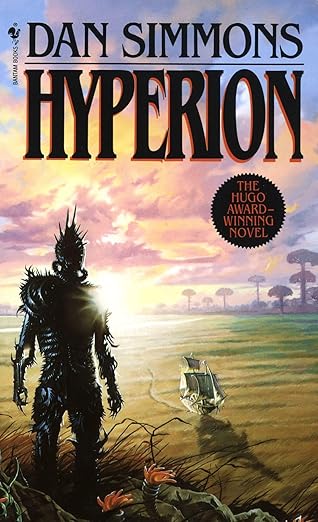
Hyperion, by Dan Simmons

Why this book: My Sci Fi reading group I’m in selected this book as part of our project to read some of the most highly regarded science fiction literature of the last decades.  Hyperion won the Hugo Award for best novel in 1989.

Summary in 5 Sentences:  The book begins when we meet 7 very different people with very  different backgrounds on a pilgrimage for which they have been selected to go to a renegade planet Hyperion, and confront and explore the the Church of the Shrike – a mysterious powerful and apparently malevolent entity based there. Part of this quest is in order to beat the Ousters, a competing entity in the universe that is in rebellion against the Hegemony,  in getting to and controlling the planet the Time Tombs, and the power of the Church of the Shrike.  Most of the book is the seven pilgrims each describing their life’s journey to explain why they were selected to be on this pilgrimage. Through these autobiographical tales, we come to understand the Universe of several hundred years into the future, and the issues that are behind their pilgrimage. 

My Impressions: A complicated story in a long multifaceted book, which takes some patience and perseverance to read. Those who stick with it, are rewarded with the auto-biographical stories of six of the seven pilgrims – each very different, each providing an important piece to the puzzle of the challenge and mission of the pilgrimage, and each story helping us better understand the universe Simmons is creating of several centuries into the future.  The autobiographies become the connecting thread between these 7 very different people and the challenge they will have working together to accomplish their mission.  There are internal tensions, and some differing agendas amongst the pilgrims, and indeed their mission from the Hegemony isn’t altogether clear -nor is it clear  how the Hegemony’s objectives for sponsoring the pilgrimage are consistent with the different, more personal agendas of each of the pilgrims. 

As i neared the end of the book with no clear conclusion in sight, I realized that Hyperion is the first in the author’s series Hyperion Cantos.   To find out what happens, I’ll need to read The Fall of Hyperion -(book 2 in the series) and perhaps Endymion (book 3)  the next book in Simmon’s Hyperion Cantos series.  

The book begins with our seven pilgrims meeting each other on a huge space ship (shaped like a tree!), as pilgrims being sent to Hyperion on a mission which isn’t entirely clear. Hyperion is a mysterious planet with mysterious forces and populations, apparently strongly influenced by the Church of the Shrike and outside the Hegemony’s control and governance.  The pilgrims  decide that each would tell their individual life stories to the others, so that they could better understand each other, their mission,  and better work together in fulfilling that mission.

Each pilgrim has been chosen by the Church of the Shrike and the Hegemony’s All Thing (see below) for this final pilgrimage. It seemed that they all understood that they were to somehow confront the Shrike and explore the mysterious Time Tombs which seemed to have a power that defied the laws of space and time in physics. More broadly, their journey is set against the backdrop of an impending Ouster invasion and the opening of the Time Tombs, on Hyperion which could have galaxy-wide consequences.

We initially get a superficial impression of each of the pilgrims and how they fit together, which sets up the more thorough background we get when each tells his/her own story about why they believe they were selected for this mission and what their own personal objectives are.  As they tell their own stories, we get to know the characters in considerable detail – they are very forthcoming and share experiences beyond what one might expect of a bunch of strangers to share with each other after meeting each other for the first time on a dangerous quest.   

The format of the pilgrims telling their individual stories is modeled after Chaucer’s Canterbury Tales.  The British poet John Keats is a constant presence in the novel – as a model of human insight and wisdom.  A city on Hyperion is named for him, his poetry and insights are regularly referenced, and the cybrid is a human-AI “designed” to be a reincarnation of Keats, who (in real life) died of tuberculosis at age 31.  There are other references to classical works and authors throughout the book – clearly Simmons was well read in the classics and brought that background into his writing of Hyperion.  

The pilgrims/ key characters in the book include:

  • Lenar Hoyt A Jesuit Priest who had been to Hyperion researching the disappearance of his mentor in the Catholic Church, and while there, was “infected” with a parasite which seemed to be controlled by the Shrike
  • Martin Silenus A poet,  who comes across as an articulate, but angry and cynical  reprobate  who had witnessed the killing of the former “king” of Hyperion; 
  • The Consul the former Consul of Hyperion, with extensive knowledge of the planet, but clearly a conflicted man whose perspective is most prominent in the book; 
  • Sol Weintraub a retired Jewish professor, accompanied by his baby daughter, who had regressed in age after being aflicted by “Merlin’s disease” ostensibly by the Shrike itself, when as an adult researcher, she was researching the Time Tombs;
  • Colonel Fedmahn Kassad A former miliary commander who had fought for the Hegemony against the Ousters in their battle to upend the Hegemony’s power, believing that Hyperion was key to that strategy. The strongest character in the book who in his battles became a convert to a Stoic version of Bushido;
  • Brawne Lamia -A woman private investigator, born on a planet where women have physical strength equal to or greater than men, whose lover had been killed while trying to connect with the church of the Shrike, and who she believed was a pawn in the battle between the Shrike, the Ousters, and the Hegemony
  • Het Masteen The seventh of this team was a Templar – a quasi religious group that puts trees and nature above considerations of technological progress.  We don’t get to know him, because before he can tell his story, he is apparently murdered by someone – his body is never found. A mystery probably to be resolved in book 2.

Reading the book I was often confused by the “structure” of the universe that Simmons  describes several centuries into the future, as well as some of the terms he used, which (I assume) we were to figure out by their context,  in the course of reading the book.  I am indebted to Super Summaries (an online book site) from which I quote liberally in the below definitions, which have helped me better understand the universe Simmons was describing in Hyperion. 

Understanding these definitions up front would have helped me better understand and appreciate the book while reading it.  

  • The Hegemony The governing body of all the planets in the universe that are populated
  • AI advisory council sentient artificial intelligences that have separated themselves from human control and form part of TechnoCore, 
  • The TechnoCore  – A powerful and pervasive presence of sentient artificial intelligences outside of the control of the Hegemony.
  • The All Thing  -a forum for Hegemony members that works through neural implants. 
  • The Church of the Shrike – a religious order which resembles the structure of religious orders on earth, dedicated to the belief that the Shrike – apparently a living force or being, very powerful and more evil than good,  is connected to God or an all powerful spiritual entity.  The Church of the Shrike and the All Thing have together and for their own (unknown) reasons, chosen these seven people to be the pilgrims on the final pilgrimage to Hyperion to thwart the Ouster’s efforts to control the Time Tombs. 
  • The Outback includes planets like Hyperion which are NOT part of the Hegemony system, kind of like un- or slightly governed territories in our world.
  • The Web or Data-sphere- a planet’s computers and information sharing system 
  • Time Debt  The difference in experienced time that results from traveling at relativistic (near light) speeds or using certain forms of space travel. When someone travels at these high speeds, time passes more slowly for them compared to people who remain stationary. This creates emotional and social distance between travelers and those who stay behind, as their lives move at different rates.  The traveler’s identity becomes fragmented, caught between the world they left and the one they return to, never fully belonging to either. This sense of being out-of-sync with the rest of humanity is a recurring theme for characters who travel between worlds in the novel.
  • The TechnoCore (the AI society) is obsessed with the Tombs because they are unpredictable and cannot be fully analyzed or predicted by AI, making them a threat to the Core’s plans and its Ultimate Intelligence Project.
  • Cybrid, a being where a human body and AI are fused. The woman private invstigator had had a relationship wiht a cybrid who was killed by, is pregnant with his childOne of 
  • The Hegira – when “Old Earth”  (the world we live in now) experienced a mass exodus to other planets and worlds as it was dying due unexplained environmental catastrophe – one may assume a nuclear accident or war. 
  • FORCE – the armed forces for the Hegemony of man
  • Hawking drives/effect Allow space ships to travel enormous distances faster than light
  • Farcaster portals – allow individuals to cover great distances in the galaxy in a flash ing
  • Poulson treatments  an undefined medical treatment that can extend life and health significantly.  
  • The Ousters:  a group of genetically modified humans who live outside the Hegemony’s Worldweb, often in deep space or on the fringes of human civilization. Unlike the Hegemony, which clings to the traditions and cultures of Old Earth, the Ousters have evolved and adapted to life in space, exploring new forms of art, ethics, and biology. They are often seen by the Hegemony as “interstellar barbarians” and are considered a major threat, especially as they prepare to invade Hyperion.

    The Ousters are not controlled by the TechnoCore (the AI society that influences the Hegemony) and represent a different path for humanity—one that is more dynamic and open to change. They are in conflict with the Hegemony, partly because the Hegemony seeks to eliminate any potential competitors, and the Ousters are the only significant human group not under its control.  The Ousters are not allies of the Shrike; rather, they are another faction trying to solve the mysteries of Hyperion and possibly use the Shrike to their advantage.

  • Time Tombs – six mysterious, ancient structures located on the planet Hyperion. They are surrounded by anti-entropic fields, which means time flows backward around them. This strange property makes them a scientific and mystical anomaly that no group fully understands.  Tombs are a focal point for conflict and curiosity because they represent power, mystery, and the unknown, drawing in all the major players in the universe of Hyperion. The Hegemony sees the Tombs as a potential source of power or danger. They want to control or at least understand them to maintain dominance and security. The Church of the Shrike views the Tombs as sacred, believing they are connected to the godlike Shrike and hold spiritual significance. Both the Hegemony and the Church of the Shrike want to prevent the Ousters from getting control of the Time Tombs.  

  • Anti-entropic fields around the Time Tombs cause time to flow backward in their vicinity. For nearby observers, this means that events around the Tombs appear to happen in reverse order, and the structures themselves seem to be moving backward through time. This reversal of time creates confusion and makes it difficult to study or predict what will happen at the Tombs, adding to their mystery and danger.

As I got into the book, and the auto-biographies of the characters, I slowly began to get an understanding of  some of these entities and concepts.  My reviewing Super Summaries afterward clarified a lot – which I have included in the above. 

Though the mission of the pilgrims is never quite clear to me, the book concludes with the six remaining pilgrims knowing and appreciating each other better, and with trepidation, approaching the Time Tombs and potentially confronting the Shrike.  

Posted in Uncategorized | Tagged , , , | Leave a comment

Remarkably Bright Creatures, by Shelby van Pelt

Why this book:  I listened to a preview of it on audible, in the voice of an octopus in a tank in an aquarium.  Since reading Soul of an Octopus and watching the movie My Octopus Teacher, I’ve been very intrigued by the creature. And two friends of mine had read it and said they really liked it. 

Summary in 3 Sentences:  The book does mini cameos of 4 main characters living on the coast of  Washington State in the recent times (the book was published in 2022) and the stories and characters are separate, but as the story unfolds, their lives and stories converge. Tova, a 70ish year old widow working as a cleaning lady in an aquarium,  who had lost her son in a mysterious accident many years ago;  Cameron, a 30 year old irresponsible ne’er-do-well, who’d grown up an orphan living with his aunt, and though immature not a bad kid, can’t hold down a job: Ethan, an old man who’d grown up in Scotland who ran the local grocery store in the small town of Sowell Bay in Washington State where the story takes place, and  Marcellus, a Great Pacific Octopus living in an aquarium tank, who observes people and has a sensibility and understanding of people and his environment much more than people suspect.  We get to know these characters and their lives and struggles as their life trajectories converge to bring them together.

My Impressions:  A fun, different and easy to read book – which i enjoyed listening to.  It starts out a bit slow as the author introduces us to the characters and the setting, but picks up pace as we start seeing the issues and drama unfold.  It’s an interesting and clever story and a “feel good” book.  I enjoyed getting to know the characters representing worlds I’m not terribly familiar with. It takes place in current time in the small town of Sowell Bay on the coast of  Washington State.  In addition to the story and the character descriptions, the book also gives insight into the insulated life in a small town on the Pacific Northwest – a town which is trying to bounce back after losing some of its luster from years ago.

In Tova the main protagonist, we get to know a kind, polite, lonely, compassionate but sad widow in her 70s, facing her old age alone, and worried that as she gets older, she has no family to take care of her. She is an extremely tidy and conscientious cleaning lady at the local aquarium, working not because she needs the money but because she needs some thing t0 do. She misses her husband of 47 years and continues to lament the mysterious loss of her son Erik some  30 years ago.   She has been for years a part of  a gossipy group of old hens who call themselves “the knit-wits,” good hearted older gals, who she respects but often finds annoying as they are always minding other people’s business. 

Cameron was frustrating to follow – a 30 year old modern-day Holden Caulfield, immature with poor judgment, irresponsible, resentful of those who are able to make their lives work, is convinced that he’s a victim of bad luck, because he never knew his father, and his mother abandoned him. His immaturity was clearly meant to frustrate the reader, which it certainly did me.  Cameron was always looking for the easy way out, and never seemed to be willing to take any responsibility for his so called bad luck.   But while I grimaced at his impulsive, poorly thought out decisions, it was clear that he was not “bad” – just very immature.  We are pleased to see him finally turn a corner.

Ethan the Scottish grocer is an eccentric and sympathetic character who inadvertently becomes a key person in the story by his tendency to share town gossip with the customers of his grocery store. He is a lonely old bachelor, smitten with Tova, always ready to help in the community, when and where he can.

Marcellus the Octopus is bored and lonely in his aquarium tank, amuses himself by observing the foolishness of the humans who observe him, and  is the wise observer of all that goes on around him,  Marcellus  is the only character in the book who speaks to us in the first person. He shares with us things about the Octopus genus, his life, unique biology, his abilities,  how he sees the world, what he eats and enjoys.   We learn that he is at the end of his lifespan, and that he knows he has little time left to live – and is feeling his age in diminished energy and abilities. His observations from an octopus’s perspective of the folly of the humans who visit the aquarium are interesting, fun and insightful.  I’m reminded of a quote from The Soul of an Octopus, (my review of it here) that says,  “I am certain of one thing as I sit in my pew: If I have a soul – and I think I do – an octopus has a soul, too.”

As the story unfolded, I knew that somehow these characters’ lives would converge and there were clues as to where it was going.  I did anticipate a satisfying and happy ending, which I was happy enough to get, though there were a couple of surprises.  Though some will complain that it may have been a bit formulaic, the portrayal of Tova and her perspective was particularly descriptive and realistic – she is a very sympathetic character.  In her compassion and loneliness, she develops a “relationship” of mutual respect and understanding with Marcellus, who she cares for in her capacity as cleaning woman for the aquarium.  They seem to communicate and understand each other telepathically.  She and Marcellus have in common the knowledge that they are each in the last phases of their lives and they are both trying to have an impact of some significance before they die.  The affection and mutual respect they have for each other become central to the book, and both of their lives.

I listened to Remarkably Bright Creatures,  and found the narration excellent – the reader did well at creating believable versions of the voices of the characters – a separate male reader was the voice of the octopus Marcellus.  By the way, while we may assume that the “remarkably bright creatures” are octopuses, that is a line that Marcellus uses to describe humans.

Several threads were left hanging at the end, which I believe screamed for some resolution, and I am surprised and a bit disappointed the author left them hanging.   What happened to Cameron’s mother?  Were there any more clues as to how Tova’s son Erik died?    Was there going to be any attempt to reconcile Cameron with his mother?  How and and under what circumstances was Erik secretly involved with her?  That the author left these questions unaddressed surprises me, and make me wonder if there is a sequel in the works.  

Posted in Uncategorized | Tagged , , , , | Leave a comment

Shadow Divers – Two Americans who risked everything to Solve a Mystery of WWII, by Robert Kurson

Why this book:  Proposed multiple times by several participants in my SEAL reading group, and finally selected, 

Summary in 2 Sentences:  Three men who were leaders of the elite wreck diving culture of New England discover a German Submarine in deep water off the coast of New Jersey,  and then endeavor through many dives and much research to determine what submarine it was and what was it doing there.  The mystery of the submarine is a lens through which the author takes us into the arcane culture of wreck diving, into the personalities, character and lives of the three main characters, and ultimately into the elite and tragic world and culture of the German submarine force in WWII.

My Impressions:  I listened to (rather than read) this book and loved it.  It started off a bit slow for me, as he explained SCUBA diving with which I’m pretty familiar – I assume this was to serve as an intro for audiences with little or no diving experience.  But then he got into the series of events that led to the discovery of a German U-Boot lying in 220 feet of water 60 miles off the coast of New Jersey.  There were no known U-Boots attacked or sunk in those waters, and so began the process of not only exploring the U Boot itself, but figuring out WHICH German U Boot it was and how it ended up sunk and lying unknown in this location for so long.

At this point the author takes a break from the story to describe the lives of the three main characters in his book  Bill Engle, John Chatterton, and Richie Kohler.  Each in his own way had become obsessed with the very demanding and dangerous hobby of diving on deep water shipwrecks, each for somewhat different reasons, which we learn as we get to know these men.  All working class men from New England, all consumed by their hobby which had become a passion. Diving on wrecks lying in deep water – more than 150 feet is no casual hobby – it requires a lot of training, discipline and is quite dangerous – much more so than recreational scuba diving.   Bill Engle one of the leading figures in New England wreck diving had become a hopeless alcoholic; John Chatterson rebelled against his wealthy father, joined the army and became a a successful ground combat medic in Vietnam and struggled with PTSD when he returned;  Richie Kohler grew up admiring his German heritage, had a broken home growing up, and eventually found community amid the deep water divers of New England.  I found these mini- bios fascinating – adding depth and flavor to the story.

Over 8 years and more than 20 dives they were unsuccessful finding anything that would identify which submarine they’d found.  When word leaked that they’d found a German U-boat, the best divers wanted to join them – it was a matter of prestige in that community to dive on difficult wrecks in challenging waters.  During those many diving trips, which included other experienced divers 3 men lost their lives – in each case due to the hazards to the body and mind of diving in water that deep.  Dives could only be scheduled during certain periods of hte year when weather was likely to permit such diving.  After multiple dive visits and more than a hundred hours of research in the Naval They researched National Archives, Naval History and Heritage Command, communicating with clubs and organizations in the US and Germany focused on German U-boat history and culture, they came up with a few theories, but nothing conclusive.  

Also in the story, Kurson takes us with the divers on their dives to 200+ feet – what it’s like to have nitrogen narcosis distort one’s thinking and judgment, to work in near zero visibility due to silt in the water,  inside a ship wreck filled with debris, collapsed walls and dangling wires,  in strong currents, having no more than 20 minutes of bottom time and over an hour of decompression time. 

This wreck was considered inordinately dangerous – not only because of the depth, but also because of the carnage inside the submarine – wires and broken pipes that could snag and hold a diver. In the case of this wreck, unlike other wrecks commonly visited by wreck divers off the coast of New England, this one contained the remains of the men who had manned the sub when it went down – the divers referred to it as a bone-yard, and they and the authorities insisted that it be treated as a maritime grave.   They had to be very creative in how they did their searches and while also being resolved to do their best to respect and not disturb the bones of the crew, even though the clothing that was still attached to some of them, potentially held the secret to the submarine’s demise. 

Kuson’s description of the dives,  what the men encountered during their dives, their close calls take the reader there.  We admire their fervid research into Naval archives to help find clues that might lead them to identify the U-boat. They searched out and interviewed those still living (this was the early 1990s ) who might have clues or insights that would help them identify the sub.  

Not to give it away, but eventually and through surprising effort and challenge, they were able to identify conclusively which submarine it was, and Richie Kohler made a point of visiting the living relatives of those who had been on the U-boot, whose remains he’d swum around inside the sub, looking for clues.  

A great, compelling and fully engaging read. I had difficulty stopping the audio when I had other things to do.  Additionally, it provides insights into the world of deep water wreck diving, the fascinating lives of the men who do it, and into the secret and heroic world of the German submarine force during WWII.  

Posted in Uncategorized | Tagged , , , , | Leave a comment

On Character – Choices that Define a Life, by General Stanley McChrystal

Why this book: Selected by the SEAL book club as our selection for summer of 2025. I and many of us had worked with Stan McChrystal in our careers. 

Summary in 3 Sentences:  A thoughtful meditation on values that help drive the decisions we make and how we live our lives – but McChrystal does it in the first person. It is very autobiographical – the wisdom he’s accrued over a full and fascinating lifetime of training and leading soldiers in combat.  But he doesn’t dwell on combat – he focuses on values he also brings in his experience coaching CEO’s in the civilian sector, as well as key life issues such as marriage, raising children, friendship, losing loved ones, accepting and  preparing for one’s eventual death. 

My impressions:  The title describes the book well – the choices Stan McChrystal has made in his life that define him and his life. It is indeed part memoir, part reflection on his decisions, part philosophy and wisdom accrued during a long, eventful and full life. It isn’t over – he is 72 years old with (presumably) many more years to live – I’d be interested in addendum in 10 or 15 years.

He is well known in military circles for having led a very successful campaign against Al Queda in Iraq and subsequently been given command of US forces fighting the Taliban and other terrorists in Afghanistan.  His book Team of Teams (my review here) provides a valuable  description of his groundbreaking initiatives to increase the success of our efforts to combat Al Queda in Iraq.  This book is more personal – how he has personally dealt with the challenges of not just leadership, but life in general – and he offers insights about leadership as well as character, how they are reflected in his decisions, both as a military leader and as a husband, father, and citizen,  and how they all overlap.

He begins with the impact of what led to his decision to resign from his position of leading US Forces fighting the Taliban in Afghanistan.  This was the first significant and dramatic failure in his life – and how he dealt with it.  He also offers other examples from his career where he felt he fell short and what he learned from those examples.  

His message can be muddy – intentionally so, since there is no easy formula for defining and developing good character.  As one of my philosophy mentors (Dr George Lucas) once told me, philosophers and thinkers have been arguing for millenia over three questions: What is good character?  Can it be developed? If so, how?   McChrystal doesn’t provide a pat formula for good character, admits that it’s messy, often can be situationally dependent, but he always emphasizes that it is important, that we need to think about our own character, and realize that any and every decision we make contributes to and says something about our character. This should be a consideration that should always be part of one’s decision making process. 

He points out that much that affects us in our lives is beyond our control.  But how we deal with circumstances and what our decisions say about our character are two very important factors that only we control.  Both the existential and stoic philosophies emphasize that “what is important is not what happens to us. What is important is how we deal with what happens t us.  Our character is not a function of what we say or believe – it is a function of what we do and how we behave.  He argues that our character defines the essence of who we are.  He notes that our reputation reflects what other people think of us; our character reflects who we really are – what the angels think of us.

He argues that it is important that we think and think deeply about our values and convictions. What do we most value? What are the things, behaviors values most important to us?.  But our true values are not what we think or say they are, rather they are reflected in how we behave and act, the decisions we make.  Creating and maintaining alignment between what we believe are our values and what we do and how we behave is a lifelong project, and all (or nearly all) of us fail sometimes.  It is part of being human.  Discipline and commitment are necessary, if  constantly improving our character is important to us, 

He offers us examples of when he believed his character fell short.  McChrystal is much more disciplined than the vast majority of people I know, but he humbly admits to having failed many times and how he still struggles sometimes with behaving in a way that is consistent with his values.  But he argues that is part of the point: If character is important to us,  we will always struggle to some extent with aligning our decisions and actions with the values we profess to believe in.  

A couple of chapter titles are clues to some of his more intriguing discussions:   “Opportunity or Opportunism,” “On Patriotism,”  “Anger and Frustration,” “Monuments.”  In each, he shares personal stories and perspectives, all of which are thoughtful, many are surprising.  

A couple of things I didn’t see in his book that I’d liked to have seen.  He didn’t address the Pat Tillman controversy in which the role he played remains somewhat controversial,  and which continues to bubble in the media.  I’d also have liked him to address the cultural dimension of character.  Stan McChrystal’s views on character and values have a uniquely American flavor – how much of his definition would fit in very different cultures like Asian or Middle Eastern?  In fact, even within the US – his vision and idea of character have a strong US Army Ranger flavor  – certainly understandable – that’s his background and frame of reference and is a bit more strict than works for me.   Does that ideal work for most of  Americans?  I suspect he would respond that his message is not that we follow his version of good character, but that we’ve thought about it, have identified our values and strive to do our best to live by them.  

Given the tough decisions he’s had to make, I would also have liked for him to have addressed the “Dirty Hands” challenge that political and military leaders (and perhaps all leaders) face when given a choice between multiple bad options, all with bad consequences, but having to pick one.  One cannot (or at least in my view,  should not) say simply, “too bad.  The ends justify the means,” and then feel ok. The wrong and bad results remain, and the leader is still accountable for them.  

His book succeeded in challenging me to reflect on my own values, behavior and character.  I liked his personal stories, his openness and humility,   and how he made this book a personal reflection vice an academic study. 

Posted in Uncategorized | Tagged , , , | 1 Comment

The Shipping News, by Annie Proulx

Why this book: Selected by my literature reading group – several had already read it and wanted to read it again.  It is one of a handful of novels that won the American Book Award and the Pulitzer Prize in the same year. the Pulitzer Prize.

Summary in 3 Sentences: It begins with a 36 year old man living in NY whose life is a mess – he is unfulfilled and unsuccessful at work, his wife with whom he is completely infatuated, disrespects him and is carousing with other men, and he has no prospects.  When his wife is killed in a car accident, he is devastated but his aunt insists he packs up his 2 children and accompany her to Newfoundland where their ancestors were from. In Newfoundland he slowly begins to make a life for himself, as he finds his footing and integrates with the eccentrics in the small town where they live.

My Impressions: Interesting, different, and the story a bit quirky.   The writing is idiosyncratic – interesting, not hard to follow, just creative and different. 

The “story” is about Quoyle – something of a ne’er do well – not a bad or evil guy, but someone who clearly has “issues,” his life is a mess, he lacks self confidence and one might say he is emotionally unstable.    And then he moves to Newfoundland Canada to try to start over.  His life after he arrives in Newfoundland is the heart of the story.

We meet Quoyle in NYC where he is in his mid 20s, and we learn that his father berated and belittled him as a child and his parents fulfilled a suicide pact.  No wonder he was screwed up! In his “nowhere man” life, he meets and falls madly in love with Petal,  apparently the first woman who has ever paid any attention to him. Petal turns out to be a very self-centered, narcissistic,  manipulative, unstable sex addict, and Quoyle is smitten by her attention and eroticism.  He asks her to marry him, which she does – clearly as a free meal ticket for herself with no intention of truly becoming “married.”   We get glimpses of their lives over the next few years – she has two daughters (we assume by Quoyle, but we don’t know,) , while she still aggressively plays the field with many lovers, bringing some home, which Quoyle knows and accepts – he doesn’t have the self confidence to confront or challenge her. 

She apparently pushes all the child rearing and housekeeping chores onto Quoyle, which he passively accepts as the cost of keeping her in his life.  We don’t get much of a glimpse into this very dysfunctional family until Petal is killed in a car accident while taking off with one of her lovers, after selling their children to a black market (probably sex-trafficking) adoption agency for $6K. That was the back drop for the rest of the story.

This is where the story of The Shipping News truly begins.  Quoyle is broken hearted and emotionally distraught when he learned of Petal’s death, (while I and other readers are thinking “good riddance!”) and now he doesn’t know what to do. In steps his Aunt, who suggests that he accompany her to Newfoundland and start over where their family had lived for generations before emigrating to America.  They travel to Newfoundland and it is the Aunt’s intent to move into and renovate the old Quoyle home that had been abandoned out on the coast for nearly 40 years.  Quoyle finds work in a dysfunctional local newspaper (the local rag) which highlights scandal, car wrecks, sexual assaults and other salacious news –  whatever will grab the attention of the local boreed, blue-collar audience.

Over the rest of the story, Quoyle slowly integrates himself into this backwater community, makes friends and finds a way to fit in, which he never had before. His Aunt pursues her own life, finding work upholstering yachts and ships, while the two daughters get into school.  In this process, Quoyle learns about the small community, some of its darker secrets and also some darker secrets of his own families past. He meets and befriends a  young woman who is a widow with a disabled child and the two seeming outcasts trying to raise children alone find common ground helping and supporting each other. Their friendship begins to blossom as Quoyle slowly finds some success in his efforts to integrate and create a life for himself.  Eventually he and his Aunt have to  confront some of the darker secrets of the Quoyle family history, which the older people in the community know, but he and his Aunt didn’t.  

What appealed to me in this book is that there are no heroes – regular people, living an isolated, rather unexciting life in a small remote town in Newfoundland.  We see how people can become rather eccentric – even unstable –  living in a small bubble like that.  Those living there accept as normal what might drive me crazy – but they learn to live together and take care of each other in their own way. And we see how alcohol becomes a primary source of entertainment and a social lubricant – often to the detriment of the community.

This was an interesting and good book – different –  but not a great book from my perspective.  It provides interesting insights into life today in a remote coastal village in Newfoundland, and perspectives on people who have ended up there, or chosen to live there.  

My wife and I watched the movie which we thought was an excellent adaptation of the book – staring Kevin Spacey as Quoyle, Judy Dench as the Aunt, and Julianne Moore as the woman freind and eventual love interest. I’d say the book and the movie complement each other – I recommend both together.   

Posted in Uncategorized | Tagged , , , | Leave a comment

Woman, Captain, Rebel – The Extraordinary True Story of a Daring Icelandic Sea Captain, by Margaret Willson

Why this book: I was planning to travel to Iceland for a hike and wanted to learn about the people and its history. This book was strongly  recommended by two women on the hike.

Summary in 4 Sentences:  The book is a biography of  Thurídur Einarsdóttir (1777-1863) who was born and lived in a remote rural fishing village on the southeast coast of Iceland.  She was intrepid and ambitious from a very young age, and wanted to join the boys and men in the fishing that was the lifeblood of her community, and so became a capable deckhand as a young teenager.  She evolved to become one of the most successful fishing captains in her region, but the book goes into her private life, how the men of power resented her and undermined her success.  The author takes us through her entire life until the end, and the reader is inspired by her resilience and character, and we learn not only about her life, but so much also about the culture of rural Iceland in the 18th and 19th centuries. 

My impressions:  This book was a very pleasant surprise – thoroughly enjoyed reading it and was fascinated by the world the author describes that provided the context for Thuridur’s life and successes. She was born in a remote fishing village in Iceland in  1777,  started going to sea with her father when she was 11 and was fully qualified to captain a fishing boat by the time she was 17. These fishing boats were open, powered by men pulling six, eight, or ten oars with no protection from rain or sea spray.  It was tough work.   She lived an amazing life, a successful fisherman for over 50 years, including in the winter, a career that was matched by few men and no women at that time. 

As a young girl, she recognized that fishing was the lifeblood of the small community where she lived and she wanted to be part of it – volunteering as a young teenage girl to work with her father on his fishing boat.   Clearly, she was a boldly independent woman from a young age – and chose against convention to wear trousers and men’s clothing, because it was more practical in the work she was doing.  As she grew older, her wearing of trousers indeed became a part of her identity and one of many things which set her apart.  But for her independence of spirit, she was not only admired, but also feared and resented by some men in her community, and she depended on a few powerful people to protect her from the wealthy community leaders who resented the respect and influence she had earned, and who deliberately sought to undermine her reputation and ability to work.

She was married three times but none of the marriages worked out.  Her husbands wanted  a more traditional subservient wife, a role that did not fit her character,  and because she refused to be the compliant, passive wife that her husbands demanded, her marriages did not last.   So for most of her life, she had to earn her own living.  She insisted on freedom and autonomy, and always defaulted to a path which, though not lucrative in financial or physical rewards, gave her the most freedom and the fewest restrictions.

 Though she had had great success as a fishing captain, she was never wealthy, and had to carefully manage her expenses, but spent much of what little she had taking care of others who had no guardian or sponsor – including her own mother when her married sister refused to take care of her, and her disabled niece when that same sister refused to take care of her own daughter.  There were many key inflection points in her life when she made decisions based on her compulsion to do right and protect the weak and vulnerable, even when it cost her.  Her independence, and refusal to be cowed into subservience annoyed the rich and powerful men in her community, and they succeeded in spreading rumors and lies about her that turned her community against her.  Eventually she chose to leave rather than live in that emotionally hostile environment.  

When she left her village of Stokkseyri, she was able to find work in Thorlakshofn a nearby town, and the only town on the south coast of Iceland with a natural harbor. Though a small town, it was (and is) much larger and more cosmopolitan than Stokkseyri.  There she fished and also worked for a young man she’d helped in Stokkseyrie many years before who’d moved to Thorlakshofn and managed a store.  She became well known and well respected in that town, and as she aged, though well into her 60s and beyond, she remained strong and fit, and earned extra money guiding visitors to into the back country or on overland routes to other towns along the coast. After several years living in Thorlakshofn,  she longed to return to the Stokkseyrie where the small-town controversies and envy that had forced her departure had subsided and many of her enemies had died or moved on.  When she returned to Stokkseyrie in her later years, she was welcomed and recognized as a significant figure in their community. 

By this time she had given up fishing and spent the last years of her life mentoring other independent young people, including those who marched to their own drummers, as she had. One such young man who she mentored was  outside the Stokkseyrie mainstream, who was what we today might consider a book geek, not a macho fisherman.   Thuridur took a liking to him and the feeling was mutual.  The young man spent much time with her and wrote down the stories she told him, which many years later he published as a book which contributed significantly to this book.  Eventually in her old age, she lived with relatives in Eyrarbakki, the next town over from Stokkseyrie, where she died at the age of 86 – a very ripe old age for that time and for having lived in those very tough conditions.

On my trip to Iceland I with several friends was able to visit Stokkseyrie, which it is an exaggeration to call a village – just a few homes, a convenience store and a community center.  Several decades ago, the community built a replica of the fishing huts that fishermen including Thuridur, lived in during the winter season, and they built it in triubute to Thuridor, on the site where she had her own hut toward the end of her life.  Below are pictures we took of that hut.

I loved learning about Thuridur, her life, and about the challenges and idiosyncrasies of life in a rural fishing village in the Iceland of two plus centuries ago.  I and my friends who read the book greatly admired her strength of character, her resourcefulness and resilience in the face of adversity.  Her self confidence, integrity and Stoic strength of character allowed her to survive and thrive under very challenging conditions.  She is the embodiment of the Icelandic term I learned (which they consider a national motto) “Petta Reddast” which means:   It will work out, things will be Ok. 

Also I was amazed at the detail that the author was able to find and share with us. How did she get so much detail?  Here’s a piece of an interview with the author that I found on line: 

…what we found— that just farmers wrote about their neighbors. When I first started doing this research, there was one book written by— started by a 16 year old boy who had no education, who started interviewing Þuríður when she was older—phenomenal! And he spent 50 years putting this together, and he did a series of newspaper articles in the late 1800s, which were put together in an edited book in 1945, about Þuríður, actually. It’s amazing. And I thought that’s all there was practically. Not so. Because she was such an amazing person, everybody wrote about her. There’s just tons, both in the archives as we going through these archives, page by page, we come across more and more and more and more about her, and in books in the library, old books, where people— they have these books like Saga of Stokkseyri or some town, that people talk about their own towns and record what people say or these occurrences. And so people recorded, they remembered and wrote down verbatim conversations. And they wrote about adulterous affairs. They wrote about children who were born that weren’t really supposed to be born to that person. They wrote about fights. They wrote about betrayals. They wrote about love. It’s phenomenal the detail with which they wrote. So you know, we were lucky.*

*https://scandinavian.washington.edu/crossing-north-23-woman-captain-rebel

Posted in Uncategorized | Tagged , , , | Leave a comment

How Iceland Changed the World – The Big History of a Small Island, by Egill Bjarnsason

Why this book:  I’m preparing to hike for a week in Iceland with NOLS,  and this book comes strongly recommended by a friend who has done that hike. I listened to the book which served me well. 

Summary in 4 Sentences: The author begins  back in the days of the Norse Vikings, the original human inhabitants of Iceland back around the 10th century CE, and includes how those original Norse inhabitants spread out to Greenland and the North American continent during their first centuries on the island.  The history continues through the middle ages and beyond the era of Viking dominance of Northern Europe into becoming a Christianized colony of Denmark. Iceland remained relatively isolated until the 20th century when it became a strategic location in the allies’ fight against the Nazis.  After WWII the book covers Iceland’s emergence onto the world stage, its relationship to the US and eventually becoming a leader in the feminist movement of equal rights for women. 

My Impressions: A fun and fascinating way to learn history.  The author clearly is enjoying telling the story of Iceland and it was enjoyable to hear him tell it. I listened to it, which has the advantage of the author’s easily comprehensible Icelandic accent but we also hear him pronounce Icelandic words and names authentically – very guttural and which convinced me not to try to learn much Icelandic in the two weeks I’ll be there.

I like most Americans grew up learning European history mostly about Germany, France, Spain and Italy.  This book makes clear that there was a separate Scandinavian history surrounding the Baltic Sea and which included Iceland – which was founded by Norse in the Viking era, and was ruled for centuries by Denmark. 

Iceland’s “known” history began when Eric the Red’s father was exiled with his family from Norway to the remote island of Iceland for having committed manslaughter, and he took his young son Erik with him.  Apparently there were already some Norse settlers there and Iceland must have served as a kind of Alcatraz.  Later, as an adult in Iceland, Erik got involved with a feud in Iceland which resulted in a number of people killed by Erik and his comrades, so Erik with some of these comrades was exiled for 3 years to the remote island of Greenland. There Erik and his small brood began the process of establishing a colony, and he is therefore regarded as the father of Greenland.   He later returned to Iceland and convinced others to join him in Greenland.  He is credited also with naming it “Greenland” as a sort of marketing ploy to get people to move there – though most of the land was covered in ice, except for around some of the fjords in the south.   

Erik’s son Leif Erikson is believed to have been born in Iceland, ultimately became a great explorer and is credited with having discovered and founded colonies in North America. Erik’s daughter apparently was also an intrepid explorer. The Norsemen from Iceland and Greenland are believed to have stumbled upon northern Canada after being blown off course on their way to Greenland, and then explored the coastline of Northern Canada. They ultimately founded   several small settlements to include the famous Vinland believed to have been on the north cape of Newfoundland.  For some  years there was traffic between those settlements and Greenland and Iceland but those settlements eventually disappeared and it isn’t clear why.  Likewise after about 500 years the Greenland settlements disappeared – uncertainty but some conjecture as to why.  All of this is outlined in Bjarnsason’s book with details from the various Norse sagas from that era, which are the primary source of his information.

There wasn’t a lot going on in the middle ages, though Iceland’s conversion to Christianity was a key cultural event, as that included them under the umbrella of the Catholic Church. Iceland was a pawn in some of the various dramas and competition for power between the Scandinavian countries of Norway, Sweden and Denmark – eventually becoming a colony of the Danish kings.  As Bjarnsasone moves into the 20th century, Iceland becomes more important strategically in the international community.  Though it remained neutral with Denmark during WW1, when the Germans invaded and annexed Denmark in WW2, the British “invaded” Iceland and held it for the allies, and when the US entered the war, the Americans established a large presence  in Keflavik near Reykjavik,  to help control the North Atlantic sea and air space, where the Nazi Navy was very active.  Also during that window, in June 1944 Iceland became a republic independent of Denmark following a national referendum.

After WW2, the US continued to retain a large military presence in Iceland as they sought to  prevent the Soviet Union from controlling the so-called G-I-UK gap (Greenland – Iceland – UK) in the North Atlantic. The relatively large military American presence, with military and DoD personnel, their money and American cultural traditions had an influence on the relatively provincial Icelanders, which resulted in some controversy, some resentment and cultural tensions between the strong American presence, and those intent on retaining a uniquely Icelandic culture. 

In the later 20th century two key events brought Iceland to the attention of the world: The chess match between Bobby Fisher and Boris Spassky in 1972 for the world Chess championship was publicized all over the world; and the summit between Ronald Reagan and Mikhail Gorbachev that took place in Iceland was key to ending the cold war.  Also surprising  to me was  the role that Iceland played as a so-called neutral arbiter in establishing the nation of Israel after WW2,  and that Iceland became in the 1980s and 1990s (and remains) a leader in the world feminist movement by electing women to key leadership positions in government. 

In sum, this short book covers a lot of history in an entertaining and engaging way.  A thoroughly fascinating and enjoyable way to learn about this fascinating Island and nation.  

Posted in Uncategorized | Tagged , , , | Leave a comment

The Japanese Lover, by Isabel Allende

Why this book:  Selected by my literature book club.

Summary in 3 sentences:  There are two  key protagonists in this novel, beginning with a young woman Irina who is working in a retirement home in the early 21st century in the San Francisco bay area,  an older woman Alma,  living in the independent living section of that retirement home.  Irina eventually becomes a trusted assistant to Alma, who is independently wealthy, eccentric and aloof, but who slowly begins to trust Irina to manage many of her affairs.   Irina assists Alma with sorting out her papers, paying bills  and gathering her documents, and Irina, together with Alma’s  grandson Seth begins to uncover evidence of Alma’s  mysterious past, to include a secret love affair she’d had been having for decades with a Japanese man whom she’d befriended when they were children. 

My Impressions: This is perhaps the fifth or sixth Isabel Allende book that I’ve read, and all have been engaging, interesting and a joy to read.  The time frame in The Japanese Lover jumps back and forth from the early 21st century (modern times) to the 1930s and 1940’s as we get to know a number of the characters in their youth and then later in their lives.  Over the course of telling the personal stories of her characters,  Allende gives us insights into the pre and post WWII San Francisco Jewish community, the San Francisco Japanese community, the Nisei and how they were treated in California after Japan attacked Pearl Harbor, and what life was like in the internment camps during the war. 

We briefly get to know the title character – the “Japanese lover” Ichimei Fukuda early in the book as the son of a Japanese Gardener working for Alma’s wealthy uncle  We get to know Alma – whose Jewish family had sent her to live with her well-to-do uncle in San Francisco in the 1930s when it became apparent that the Nazis would probably invade Poland.  As Alma’s uncle Isaac’s gardener worked his estate, his young son Ichimei assisted him, and in that process became a playmate and friend of the young Alma – just a young girl living at the estate. In this digression we learn of Alma’s past, her life with her wealthy Uncle Isaac and his family and how she became friends with Ichimei.  Then comes WWII and the Fukuda family is whisked off with most other Nisei to Japanese internment camps and we learn of their life in those very trying circumstances.  

Meanwhile Alma grows up, goes East to college and develops her own career and become a young adult. We learn sporadic events of her life – and she and Ichimei go separate ways. When the story returns to early 2000s, Irina is working for Alma and she and Seth are piecing together the puzzle of her life from bits and pieces of what they discover  – Alma is very private and won’t reveal much.  But we the readers know that she still loves Ichimei even during her  good marriage, with children and after she had established herself as an important personage in the San Francisco Jewish Community.  

We also get to know Irina’s past – a sexually abused orphan from Moldova who is adapting to life as an adult in San Francisco while hiding and sublimating her shame from her abused past.  Seth – her co-conspirator in learning about Alma’s past, is in love with her but she will not let him get close to her – and is unwilling to reveal the source of her reluctance.

At the end of the book, Alma’s health is failing, Seth and Irina are trying to find a way to connect, and Ichimei and Alma remain connected, but in secret.  Alma has a serious automobile accident and Irina and Seth work together to take care of her, and Ichimei mysteriously appears.  

I loved the story, the characters and the way Allende tells it. There is a magic here in Alma’s life and her relationships to the people she loves and grows up with, and likewise in the resilient and powerful character Irina.  And Ichimei is an iconic Japanese buddhist – who reminded me in so many ways to the Japanese gardener and protagonist in the book I’d just read, The Garden of Evening Mists. 

Posted in Uncategorized | Tagged , , , , , | Leave a comment

The Tiger – A True Story of Vengeance and Survival, by John Vaillant

Why this book: Highly recommended by Ryan Holliday.  Selected by my “literature” reading group and was a near select by my SEAL reading group.

Summary in 3 Sentences: This is the author’s account of his research into how the Russian government and the local communities in the Russian Far East (SE Siberia, bordering China, Manchuria, and near North Korea)  responded to a huge male Siberiian tiger killing and consuming two local hunters.  The book describes the rather primitive and poor communities and cultures that live on basically a subsistance economy in this remote, and poorly served part of Russia, and includes  the role of the police and wildlife protection services.  We also learn a lot about the history, habits, and the role of this species of tigers in this part of the world  – they are perhaps the largest, most  powerful and intelligent of the mammalian carnivorous predators

My Impressions: I enjoyed this book – because I was keen to learn about the culture of far eastern Russian villages, people living a subsistence life in a remote part of Russia – and the author’s study of the Siberian tiger (also referred to and known as Amur tigers) and its relationship to human communities over the years. He provides this as context for understanding this rare occurrence of a tiger attacking and consuming not just one, but two humans in the same region.  Well written and thoroughly researched by the author who spent a considerable amount of time in the region with  those affected by, and investigating the incidents. 

A number of those in our reading group didn’t care for the story – too much anthropology, history and culture – not enough page-turning action.  Women played a very minor role in the book – the wife of one of the victims and the mother of the other are referred to and mentioned, but the majority of the author’s research and interviews were with the men who were associated with the victims, and those involved in investigating what happened and why, and then hunting the man-killer down.

The book is also a tribute to these carnivores, at the top of the food chain – except for humans – and how the encroaching civilization has impacted them, with the worst impact coming from poachers who are very well paid for skins, and other parts of the tigers. The Russian government has wildlife protection and forestry services trying to manage, catch and arrest the poachers, but they are grossly underfunded and under manned for the extensive territory that they are responsible for. A good percentage of their resources come from Western wildlife preservation groups.

We also learn in this book a bit about the history of this region –  white Russians from the west moved into this territory during the 20th century that had been for millennia the home of local natives.  Native communities still live in the region, and they have retained much of the traditional wisdom from their forefathers who had lived there and co-existed with the tiger for generations.  These native hunters had previously had a symbiotic live-and=let-live relationship with the tigers who hunted in the same forests they did – and in fact, the indigenous communities  revered the tigers as gods.  But with the influx of westerners with new high powered weapons and technology, the balance in the relationship of the natives to the animals and the forest in the region shifted. The protagonists in this book, Yuri Trush was the head of the tiger preservation team in the region – and Vaillant clearly admired him as a man, and the work he was doing.

The final episode of the book is the tracking down and hunting of this specific tiger, who they realized was starving, injured and desperate.   That section and the aftermath was indeed a page-turner. He concludes the book with a look at the Siberian tiger’s prospects as an endangered species – only about 500 remaining in the wild, when it was believed that a century ago there were close to 25 thousand.  Western conservation groups are helping to fund and support the meager efforts of the Russian government to protect these tigers.

I was also surprised to learn that for the poor people in this region, peristroika has been a disaster. Under communism, there was at least an infrastructure that was responsible for providing jobs (however meaningless) and minimal income to the residents, and was responsible for taking care of the people in remote areas.  With peristroika and the advent of the free market, the government infrrastructure collapsed and with it the local economy.  As a result, there are very few opportunities for people to work, which forced many to hunt and poach just to feed their families. 

Very good book for a perspective on this remote area of Russia and to learn about the predator-prey relationship between the apex predators (man and tiger0 in that part of the world.

Posted in Uncategorized | Tagged , , , | Leave a comment

Beyond the Trident, by Tom Murphy

Why this book:  I had briefly met Tom Murphy during my career in the Navy, and I recall that he had a reputation as an unusually intelligent and gifted SEAL Officer.  I was very interested in his perspective on the role of spirituality in his career.

Summary in 3 Sentences: This is Tom Murphy’s personal story about his spiritual journey and development, beginning with experiences in his childhood, his early years in the SEAL teams, to include being a victim of an ambush in Vietnam, and then on to his post-Vietnam Navy Career.  His focus in the book is sharing lessons he’s learned from his experiences in the Navy and life in general, about how we might better develop the spiritual leg of what he refers to as the three legged stool of a good healthy life: Mind, Body, Spirit.  He refers to but doesn’t dwell on his lessons about life from his SEAL career, but he shares a lot about what he’s learned exploring the different manifestations of a much broader perspective than what most of us perceive as reality, and the implications of those rather esoteric experiences, including his own, as to how one might consider one’s spiritual place in the universe.

My Impressions: If you’re looking for a book about SEALs doing SEAL commando stuff, you’ll probably be disappointed in this one. Tom only gives us a few SEAL stories from his very full career and life. Most particularly, his two tours in Vietnam, the killing he experienced and paricipated in had a profound impact on him, which he spent the next few decades coming to terms with. He does include a number of other stories from his Navy career where he wasn’t working with the SEALs – but only in so far as they help the reader understand his perspective on his own spiritual development and the primacy of spiritual development in a good life.  This book is about his spiritual journey and the SEAL anecdotes are provided as key part of his life’s journey, but are discussed only in so far as they contribute to understanding him and his spiritual journey.

He begins with a SEAL operation in Vietnam in which he and his platoon were ambushed and several of his men were injured. And he talks about the impact of that on him over time – how he suppressed the trauma for years, in order to focus on his job and doing it as well as he could. And he noted how repressing that trauma impacted him later in his life and career. Only later did he realize that the effects of his wartime missions in Vietnam, and other brutality he witnessed and experienced and perhaps even in part participated in, were still with him and negatively impacting his life.

There is a whole section in the book about dealing with Trauma and PTSD – his own experience as well as what he’d learned from others.  But he notes that dealing with PTSD is only part of what one should be paying attention to, if one is trying to live a full life. Early on he gives us his metaphor of the good life being a solid and well balanced three legged stool.  In this metaphor, each of the legs represents one fundamental component of a good and well balanced life, and if any one of these legs is shortened, weak, or ignored, one’s life, just like a three legged stool, is unbalanced and much less than it could be. He makes the point that dealing with trauma effectively, should not be done in isolation or separate from one’s spiritual growth.

The three legs of a well balanced life represent 1. The physical ; 2. the mental;  and 3. the spiritual.  He notes that the physical and the mental aspects are well recognized and get plenty of attention in Western culture. The spiritual aspect however, often gets short shrift or is ignored altogether, much to the detriment of individuals and society.  The three legged stool is therefore out of balance. It is this spiritual leg of the three legged stool that Murphy spends most of this book addressing, and he seeks to  open the readers’ minds to many aspects of spirituality about which most people are either unaware, or choose to ignore. He makes a point of not pushing any single option – but encouraging his readers to explore and find a spiritual path that works for each individual. He emphasizes that there are many good paths – but one should seek and find what works for oneself.

He talks about the Out of Body Experience – which in the audible version is refered to as an “OB”.  Tom has had many such experiences over his life, and notes how such phenomena indicate that our purely physical understanding of the world is incomplete. He notes that OB experiences which are and have been well documented all over the world over time, indicate that we are not “merely” tissue, bones and living cells – that the OB indicates that consciousness and awareness must have a separate or different dimension of existence if they can leave the body behind.  He gives not only his own but the well documented examples of others, especially in Near Death Experiences.*

He also shares his extensive research on channels or mediums who receive knowledge and wisdom from outside their own bodies and experience. 

I found the book interesting and enlightening, and it has inspried me to look into some of the channels he describes. I’d heard of Seth, but was unfamiliar with most of the others, and would like to explore them. Many years ago, I had read and been inspired by many books on/about Edgar Cayce, whose incredible capabilities Murphy gives attention to in a portion of his book, and he refers to Edgar Cayce several times. Cayce lived in Virginia Beach, and the Association for Research and Enlightement (which I have visited) is still there dedicated to the study of Cayce’s readings and to continuing his legacy.

What disappointed me a bit about the book are a couple of things he didn’t address, which I believe deserved some attention, given his theme. He may have chosen not to address these for his own reasons, or they simply didn’t occur to him, or he considered them unimportant or irrelevant.

1. He didn’t include in his discussion remote viewing, an incredible phenomenon which supports his thesis that our rational understanding of reality is incomplete, and that time and distance and consciousness are not what they seem to most of us in the Western tradition.

2. He didn’t discuss “the problem of evil” – does it exist as a separate force, or is it “merely” the absence of good, like cold is the absence of heat? We read or hear regularly of humans torturing and doing horrific things and causing great harm to other humans and other living creatures, for pleasure or to fulfill personal agendas. Understanding, and learning to live with, if not accept that reality I believe should be part of any book offering spiritual guidance.

3. And finally, I would have liked him to have elaborated more on how the spiritual perspective and practice he advocates can help us deal with great disappointment and sadness in life, when we lose or have to give up things that are very important to us, such as loss of a child, or close friend or loved one, a life altering disease or accident, or having one’s career derailed by nefarious actors.

After reading the book, I listened to Jocko Willink’s podcast interview with Tom (Jocko podcast 455) which added a lot to my appreciation of this book and Tom Murphy. He did note that he didn’t address psychedelic therapies for dealing with trauma, which have been shown to be very effective for some, and are being widely used by retired SEALS. He said he didn’t address this because he hasn’t had any personal experience with these drugs or therapies and didn’t feel qualified to address them.

* Note: Sebastian Junger – an avowed atheist – recently published a book entitled In My Time of Dying in which he describes a powerful OB experience he had when he nearly died. He describes his book as “part medical drama, part searing autobiography, and part rational inquiry into the ultimate unknowable mystery.”

Posted in Uncategorized | Tagged , , , , | Leave a comment